KitGuru KitGuru.net – Tech News | Hardware News | Hardware Reviews | IOS | Mobile | Gaming | Graphics Cards


2023 has been a good year so far for FSP – the last PSU I reviewed from them (FSP Hydro Ti Pro 1000W) was one of the best I have tested in recent years. Based on a lot of emails we received, if FSP could get around their long term supply issues, many of our readers would already have that unit in their systems. Today I take a look at another power supply from the company, the Platinum-rated Hydro PTM X Pro.
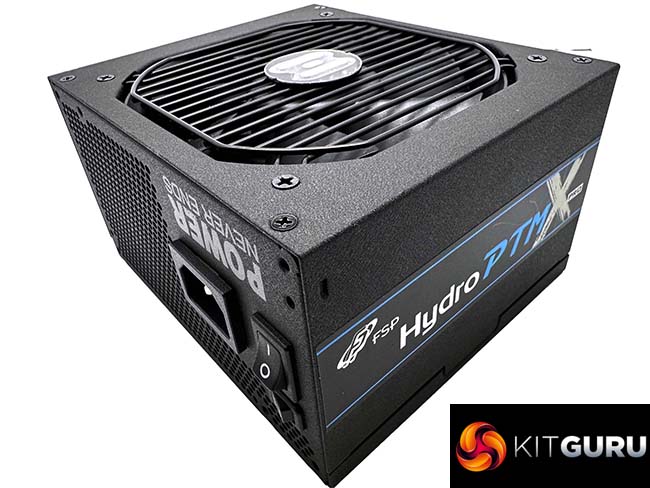
This new unit from FSP is ATX 3.0 compliant. It is a fully modular unit, rated at Platinum efficiency levels. FSP claim the unit incorporates 105C-rated Japanese capacitors for longevity and reliability and it is a modern day half bridge LLC topology circuit design. Furthermore, unlike other units with this kind of power output, FSP are trying to keep the footprint compact (130mm), for better support in a wide variety of chassis design. This is always welcome to see.
Features:
- High power density inside 130mm chassis
- LLC Half Bridge Topology
- 450V, 105c Rated Japanese bulk capacitors
- Quiet and durable FDB fan
- 100,000 hours MTBF
- Fully modular design.
- +12V single rail design
- Complies with ATX 12V V3.0 and EPS 12V V2.92
- Eco Semi fanless control switch
- Black Flat cables
- Complete protection: OCP/OVP/OPP/SCP/OTP
- 10 Year Warranty
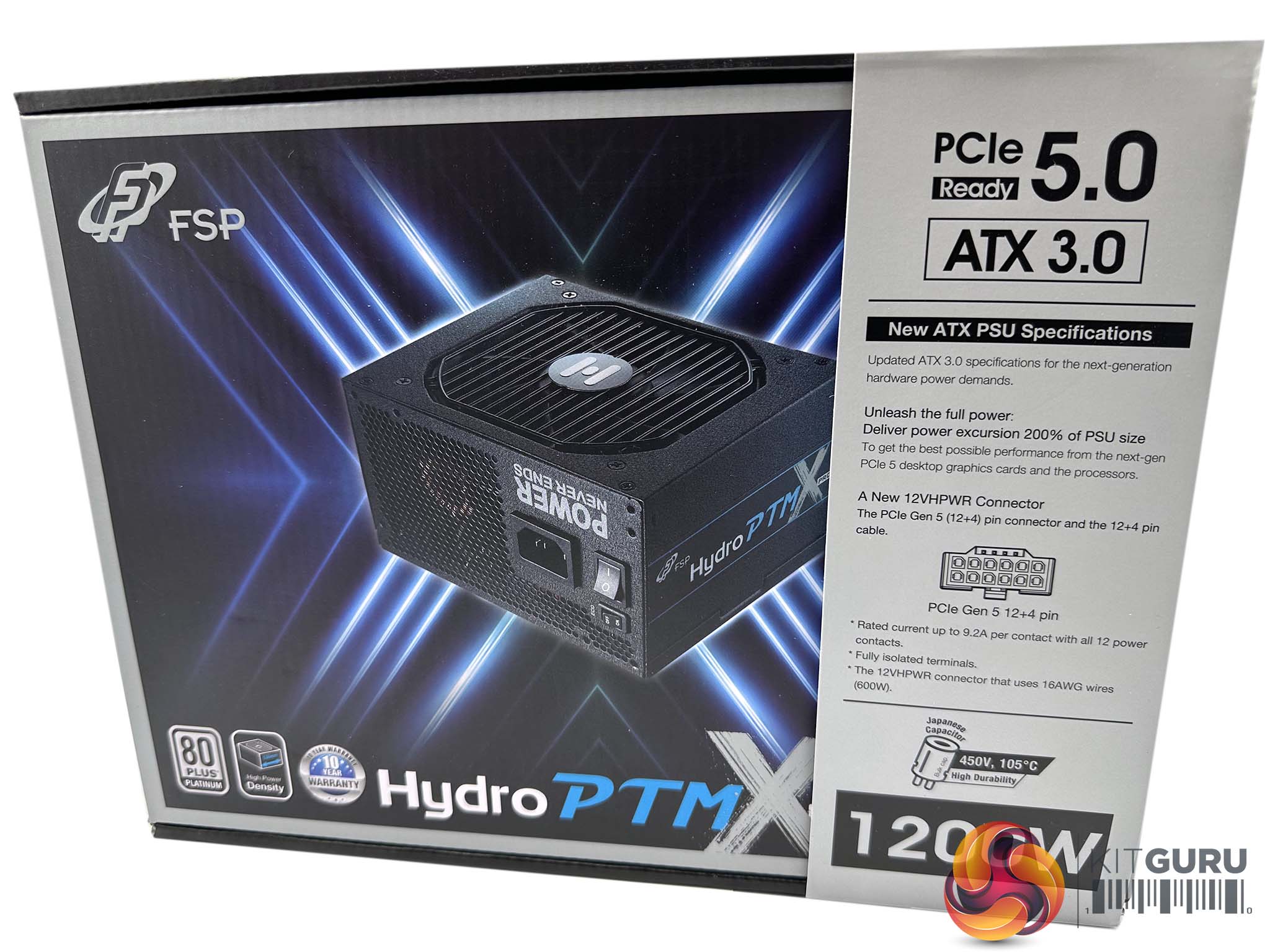
The power supply ships in a large box with a lot of information down the right side and a high resolution photograph of the power supply on the left.
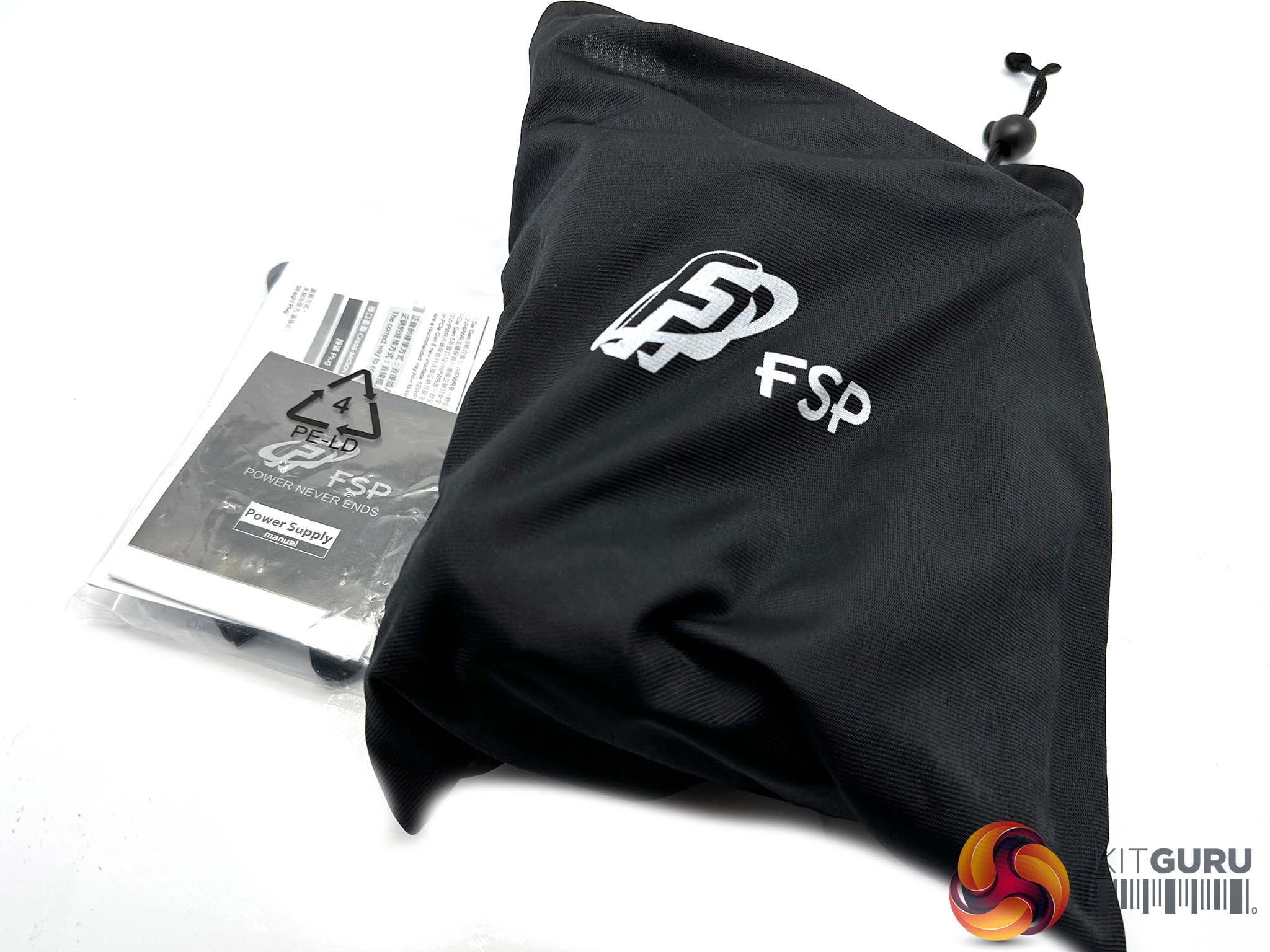
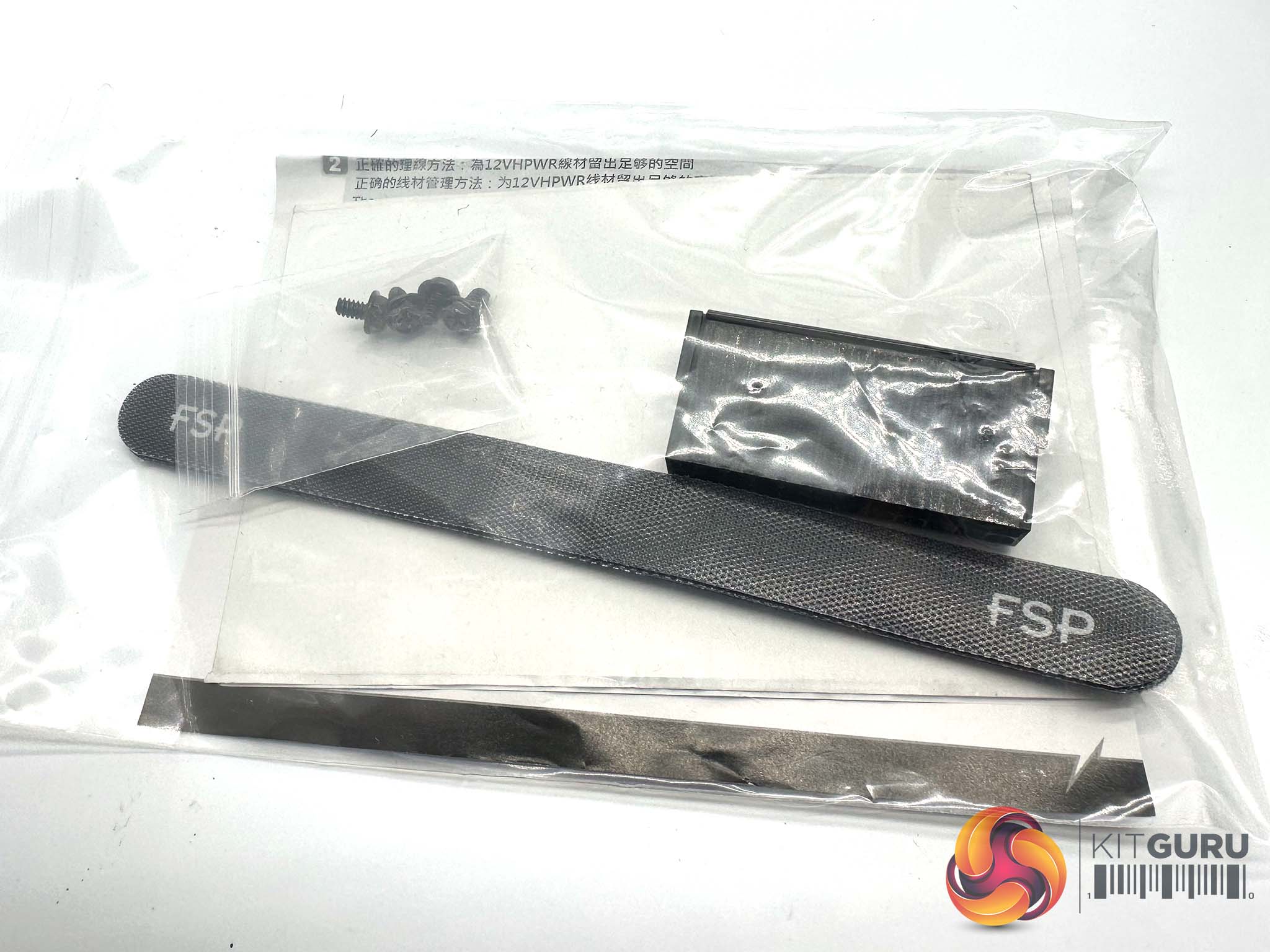
Inside the box is a bag with all the cables inside and some literature on the product. FSP include some cable ties, a tester and mounting screws for the case.
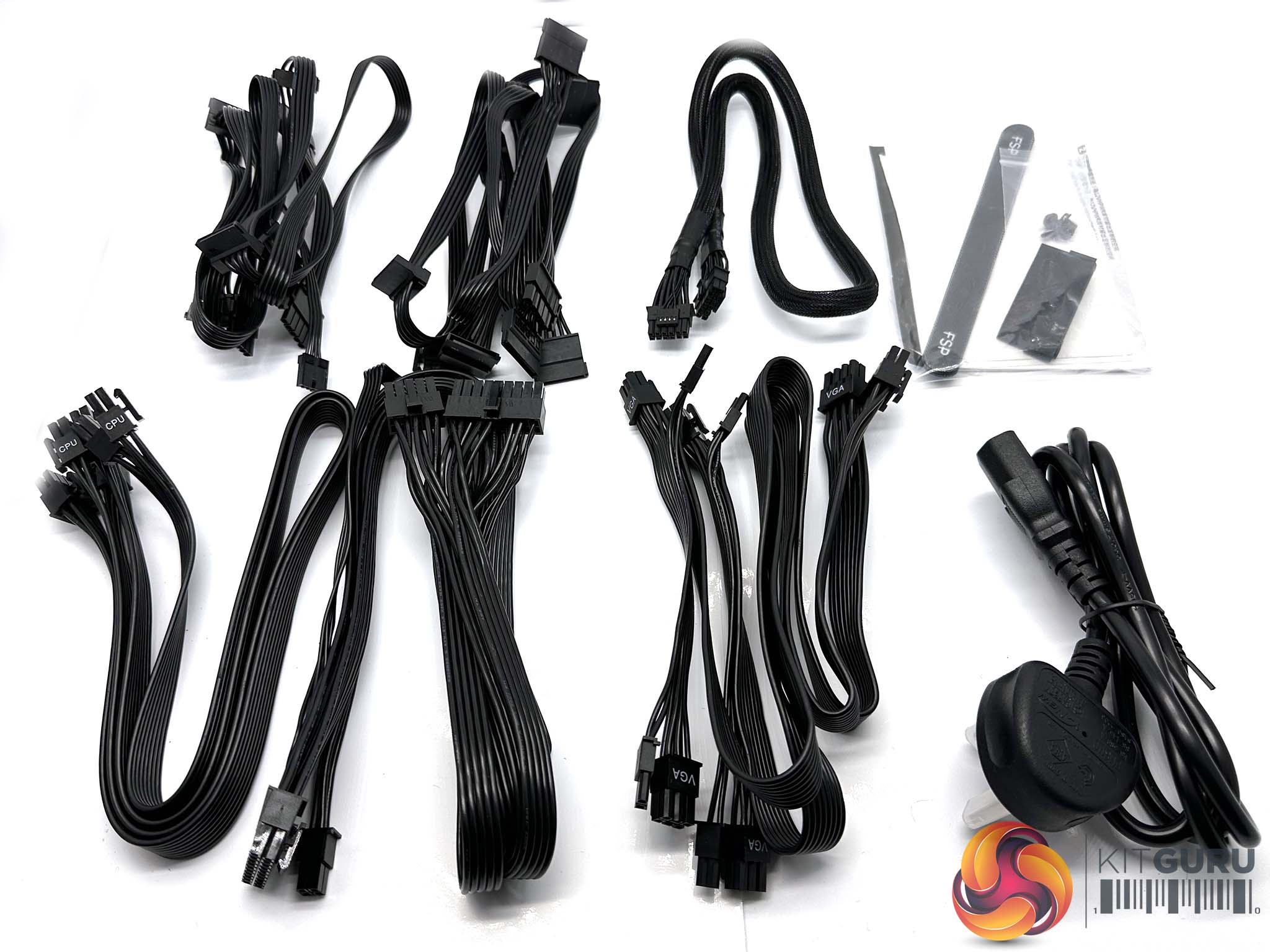
FSP are highlighting their adoption of black flat ‘ribbon style' cables throughout to help create a ‘neat and tidy look'. The only exception is the PCIe 5.0 12WHPWR, which is a traditional sleeved cable. This uses 16AWG wires.
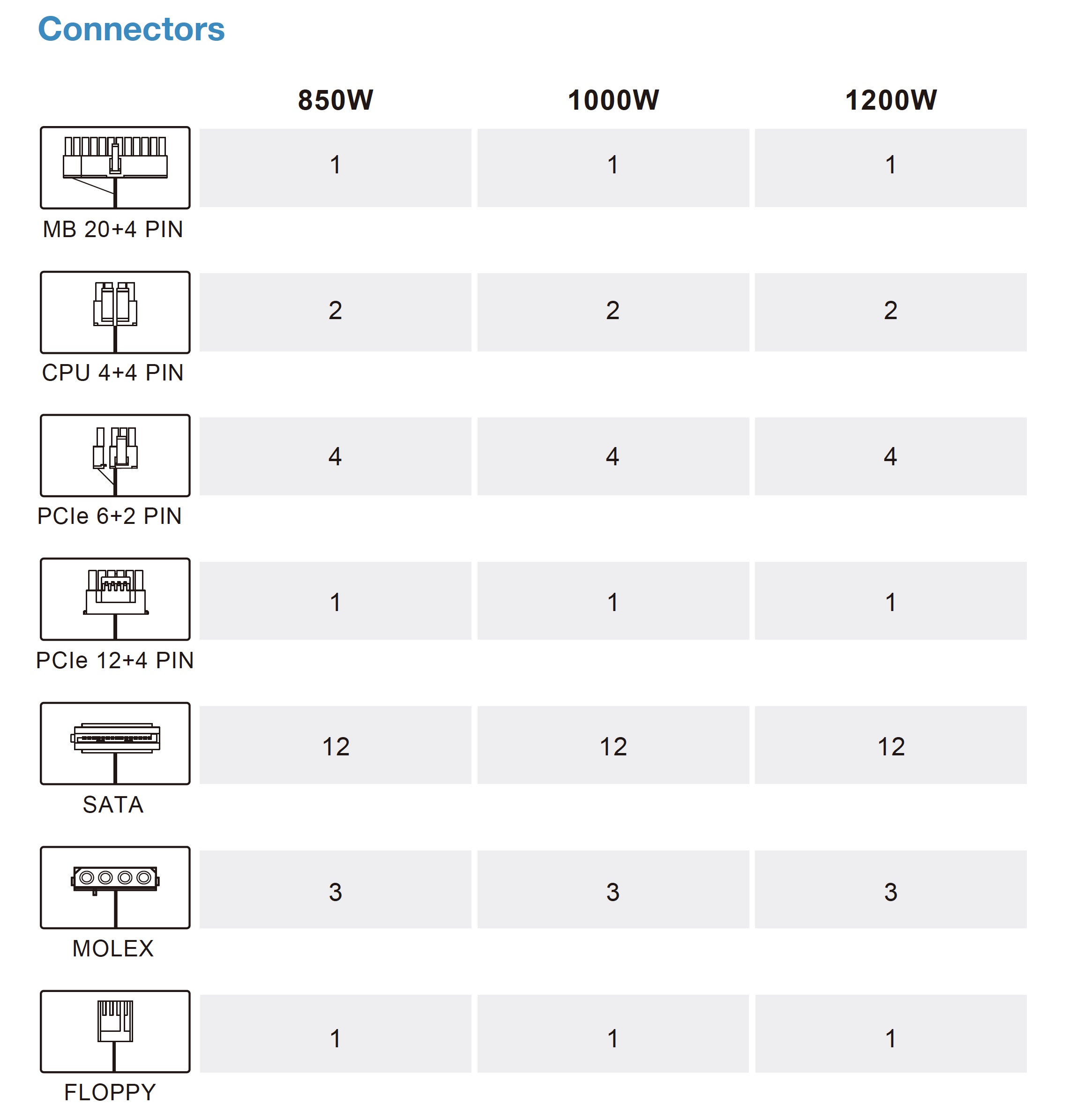
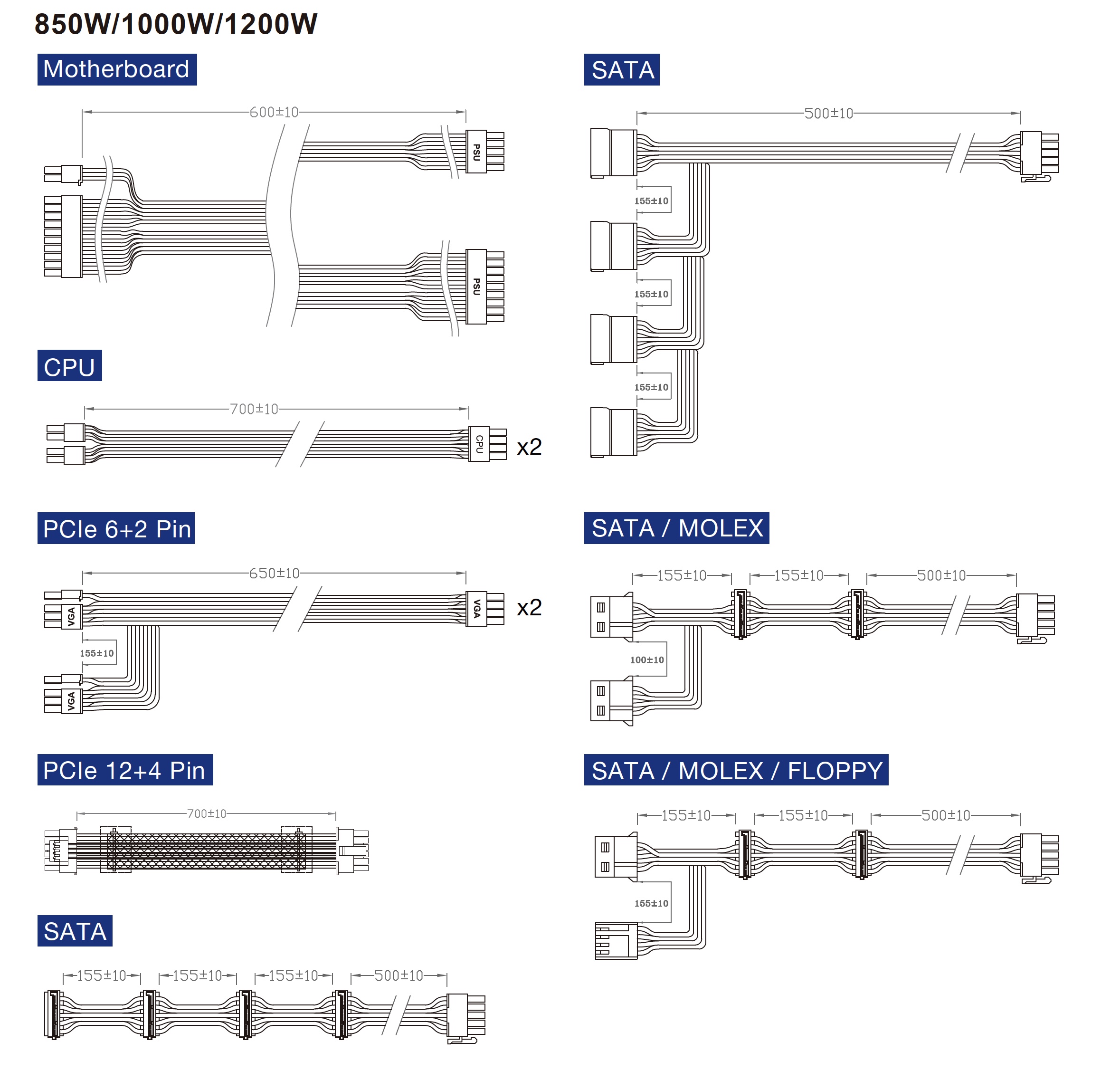
The 850W, 1000W and 1200W units all ship with the same amount of cables – which in reality should be plenty for any high end enthusiast system on the market today.

This is one of the smallest 1200W power supplies we have seen. Measuring 150mm x 130 mm x 86 mm this is actually slightly smaller than the ATX standard 140mm length. It is common to see power supplies in this category measuring 190mm in length. If you don't like the blue stickers on the sides you can replace them with red or green stickers that FSP include in the box. Sadly if you remove any of the stickers they will be destroyed as they bond with the metal.
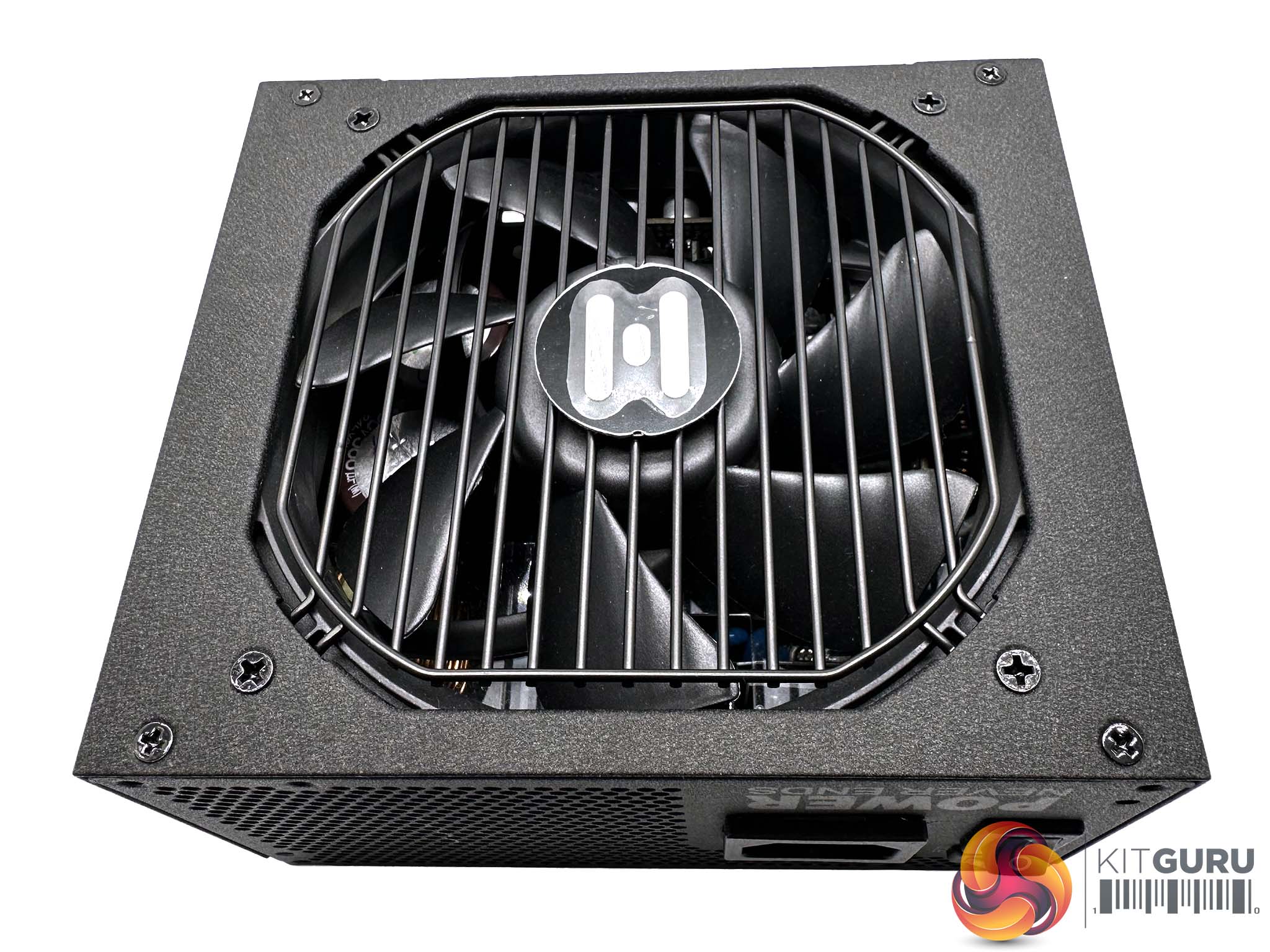
The large fan is highlighted behind a protection grille. We will take a close look at this fan when we open the unit shortly. FPS say the unit adopts a ‘off-wet, off-dust and off-stain' conformal coating which protects the chassis from dust, moisture and staining. if we move past all the marketing speak, the finish of the unit really is excellent, uniformly coated and resistant to finger prints and light scratching.
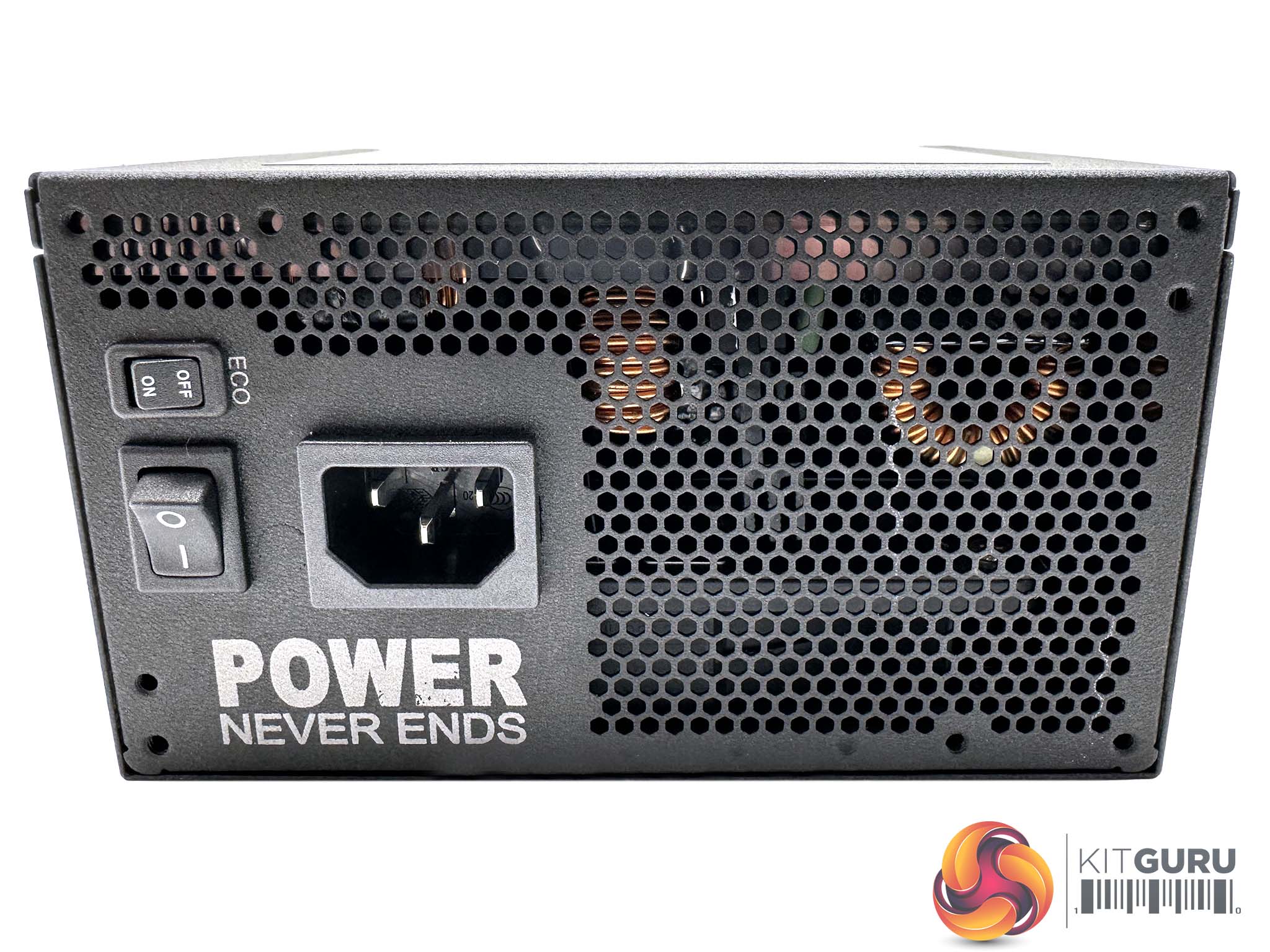
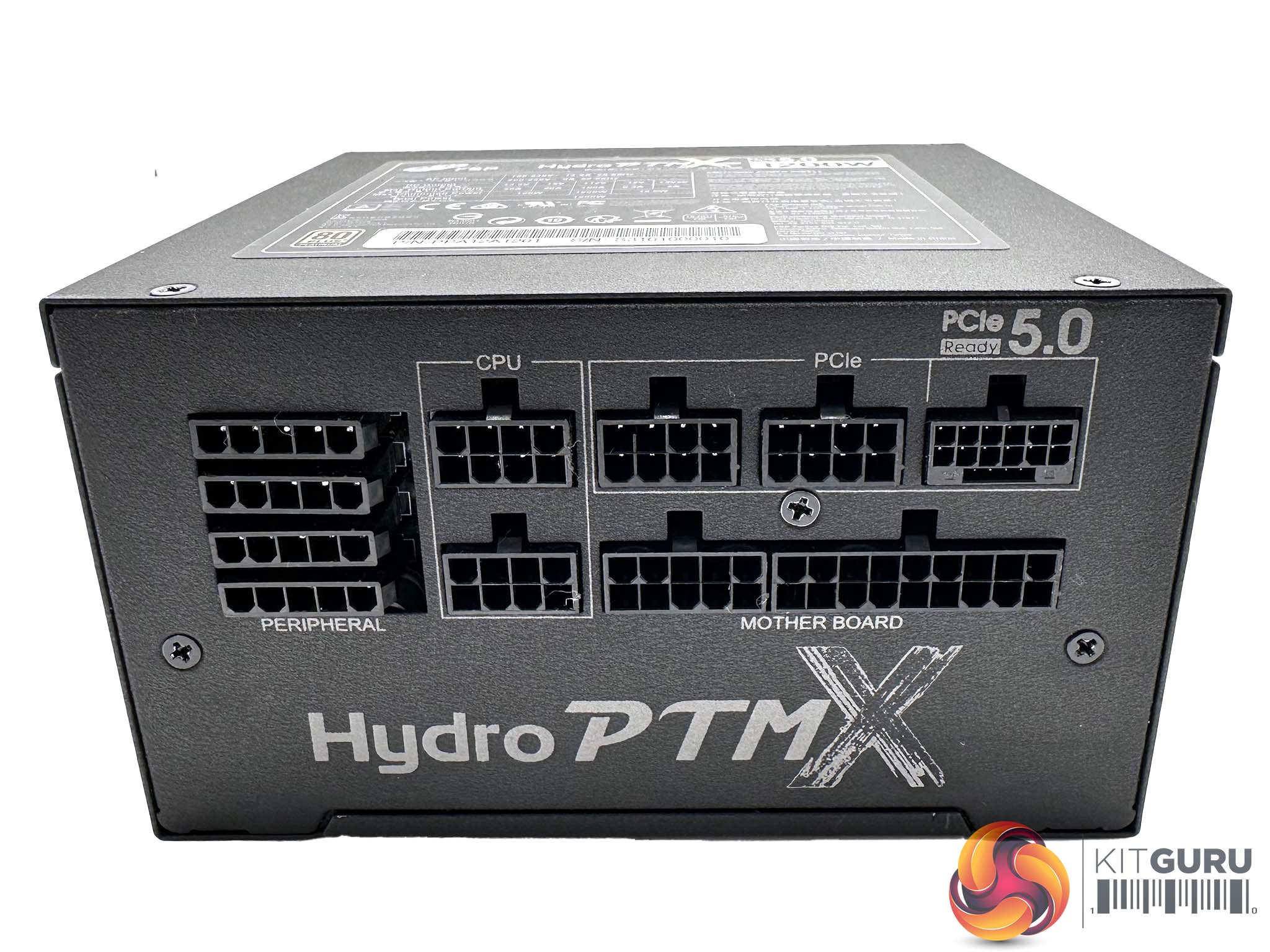
One side of the power supply is home to the power connector, switch and vented panel to help aid airflow. The other side is home to the modular bay which is clearly laid out and labelled for ease of install. It is pretty common in 2023 to see a ECO mode mode button – which will shut off the fan when the unit is at lower power demands of around 300 watts or less. If you always prefer to leave the fan running (if you live in a warm or humid climate for instance) then you can disable this.
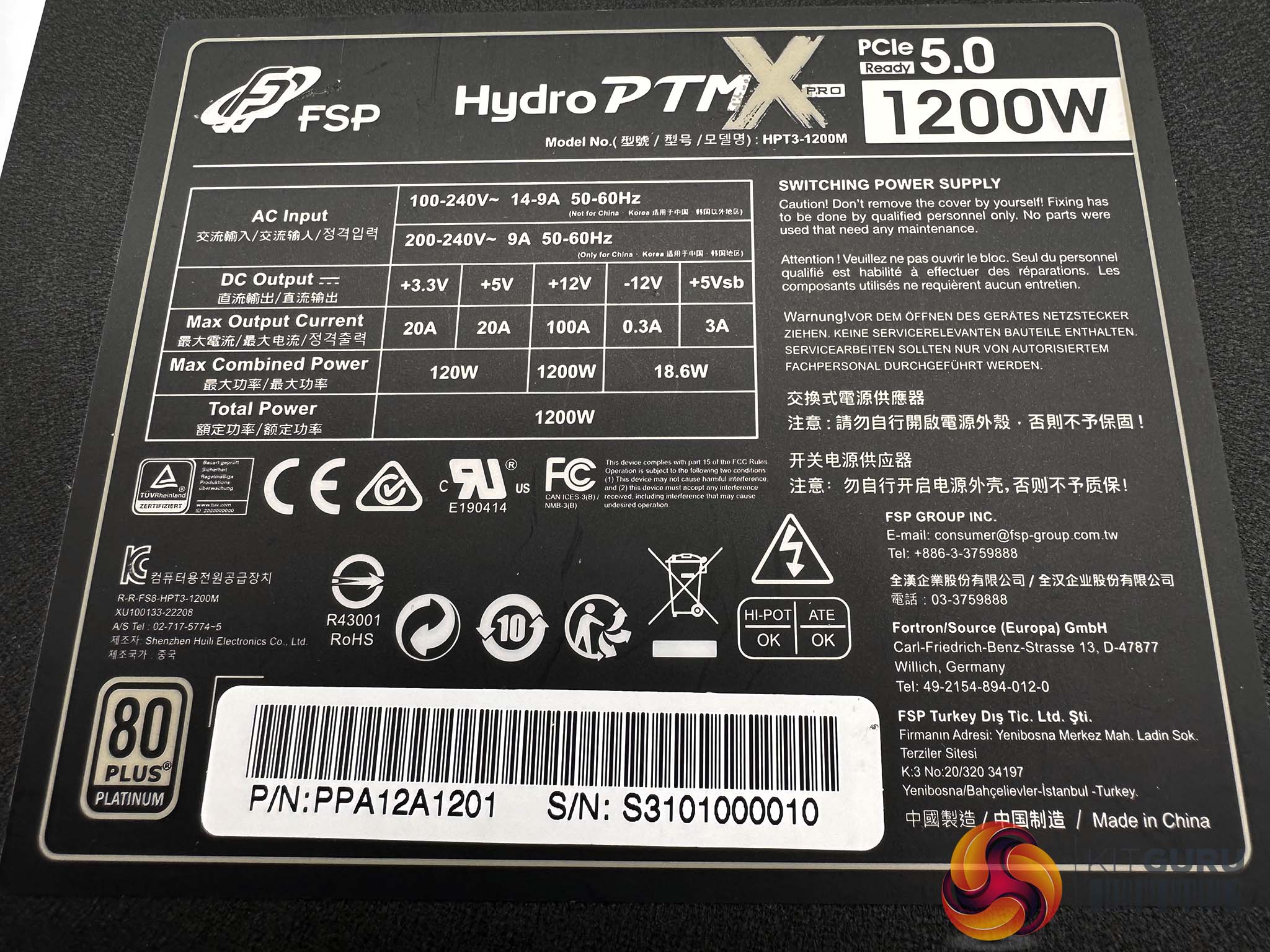

The single rail power supply design is able to deliver 1000A across the +12V rail and 20A to both secondary +3.3V and +5V rails.
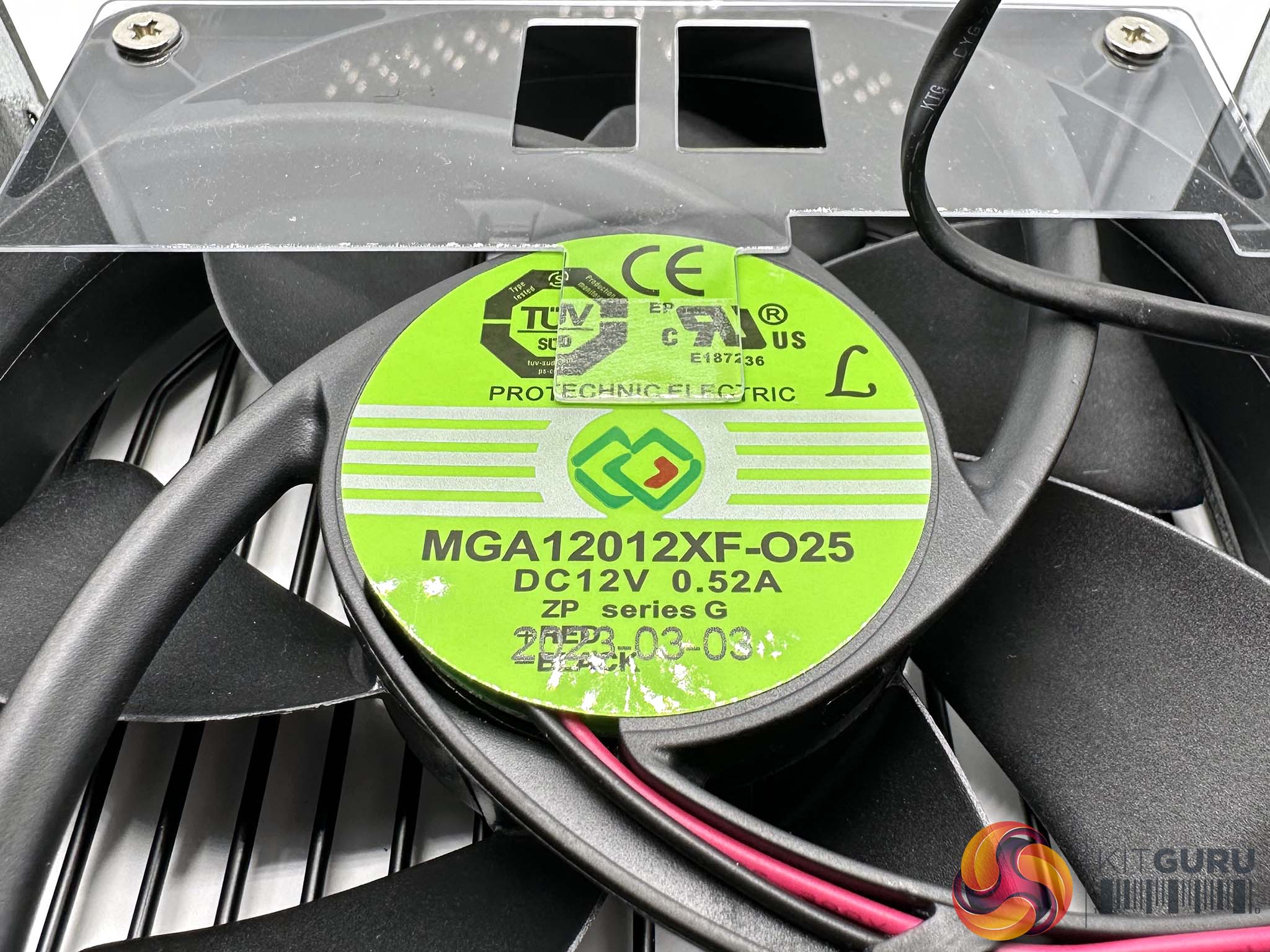
FSP are using a 120mm Protechnic Electric Fluid Dynamic Bearing fan – MGA12012XF-025. This is a fan that FSP have favoured for years – we saw the same fan back in our 2019 review of the Hydro G Pro 850W unit (HERE). This fan is rated 12V 0.52A output. It has proved to be a reliable, well made fan over the years. If needed it can also spin to a maximum high rotational speed of 2,700 rpm under use.
Usually we would see a slightly larger fan inside a unit of this power output, but FSP have made the chassis so small (150mm x 130 mm x 86 mm), it is impossible for them to adopt a larger fan.
Below - a High Resolution Gallery of the internal layout of the Power supply.
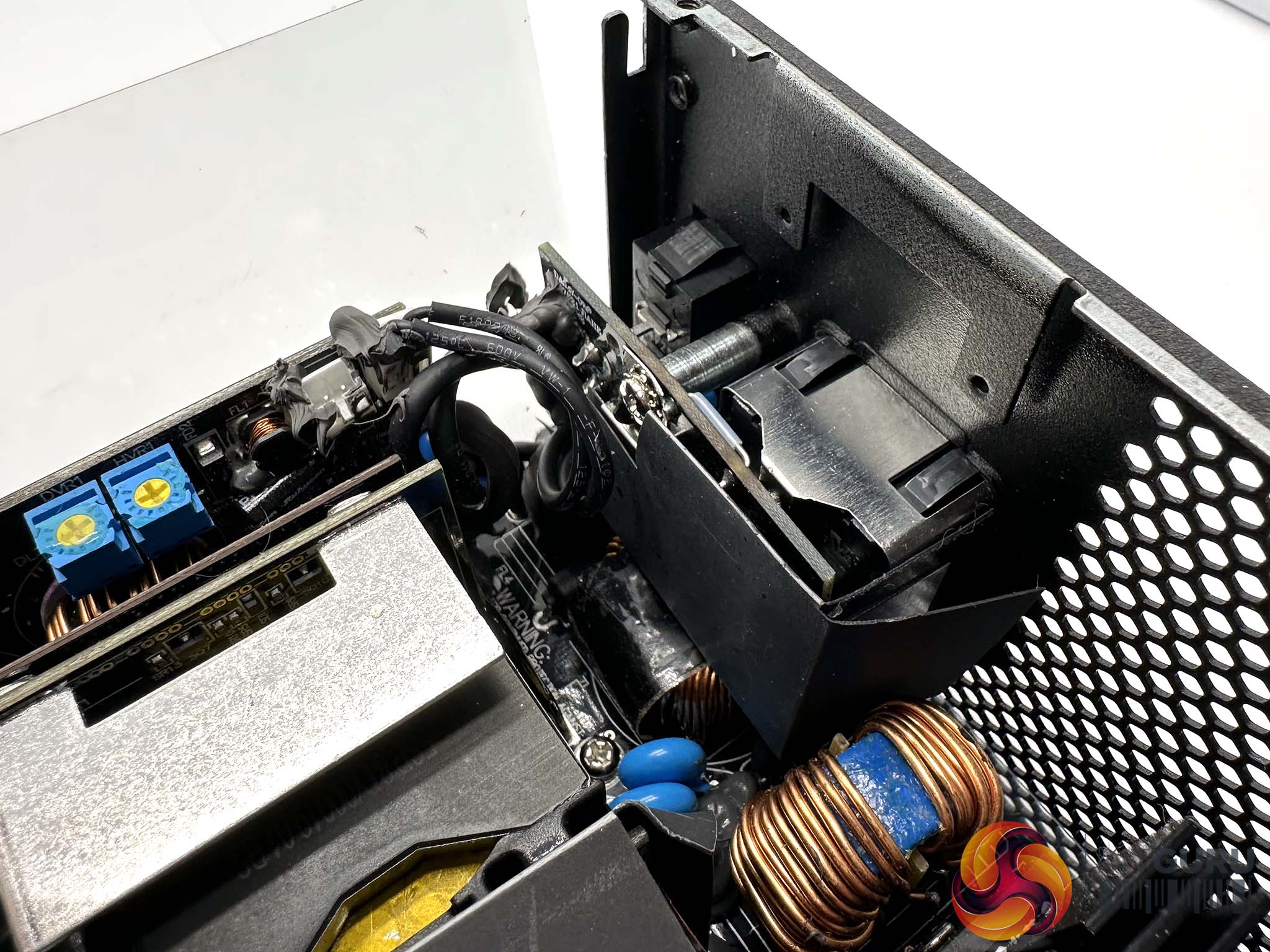
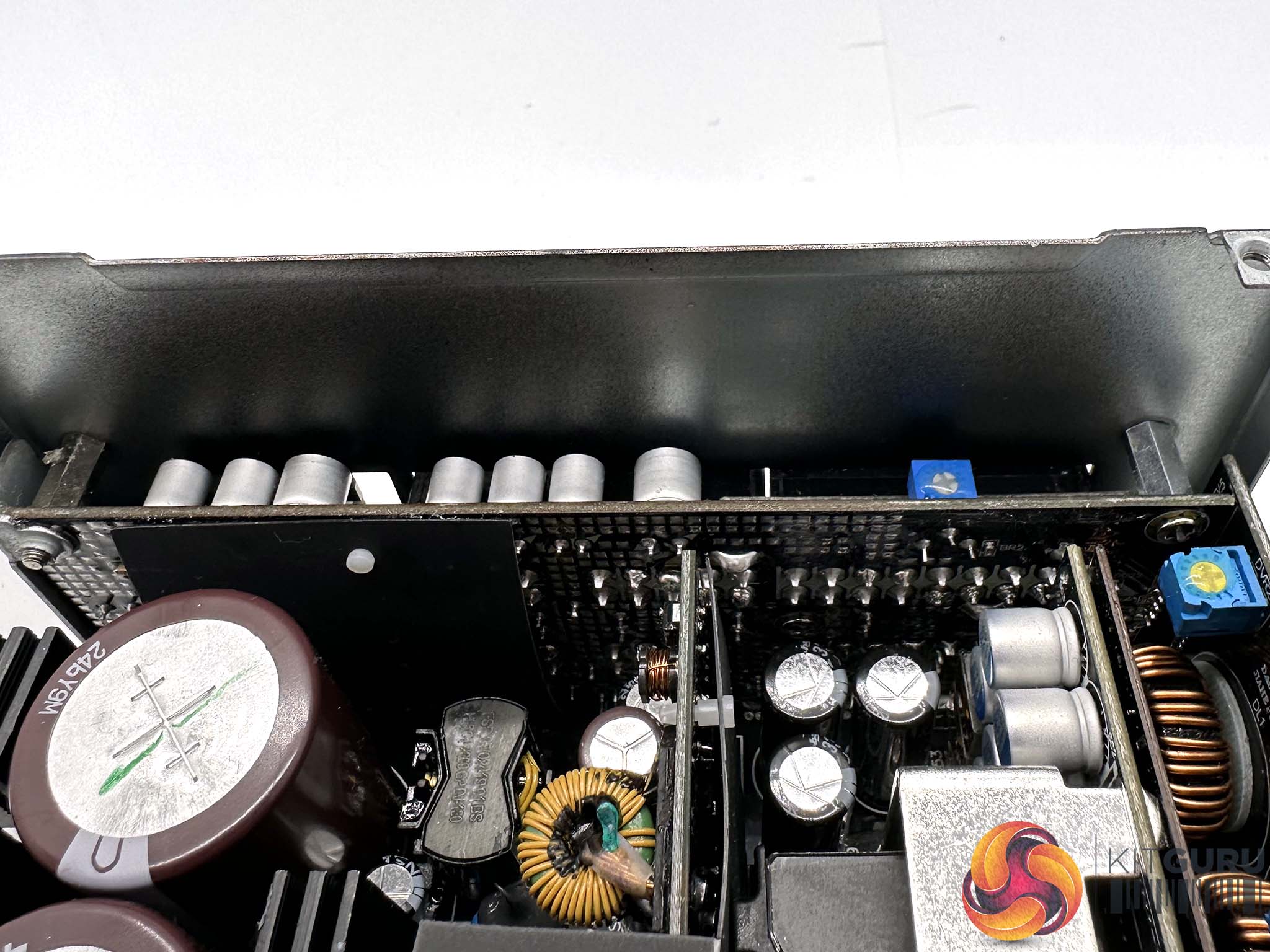
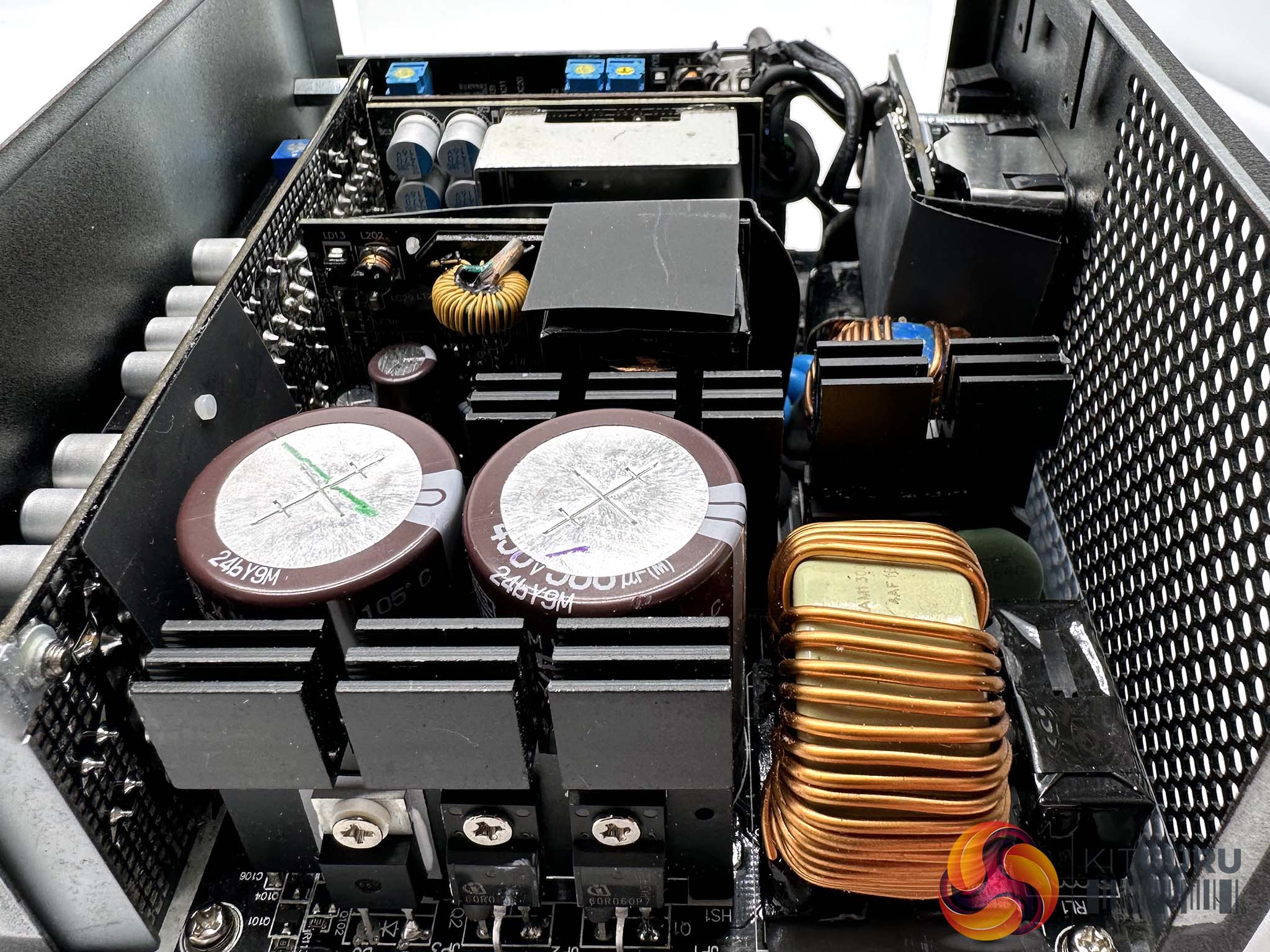
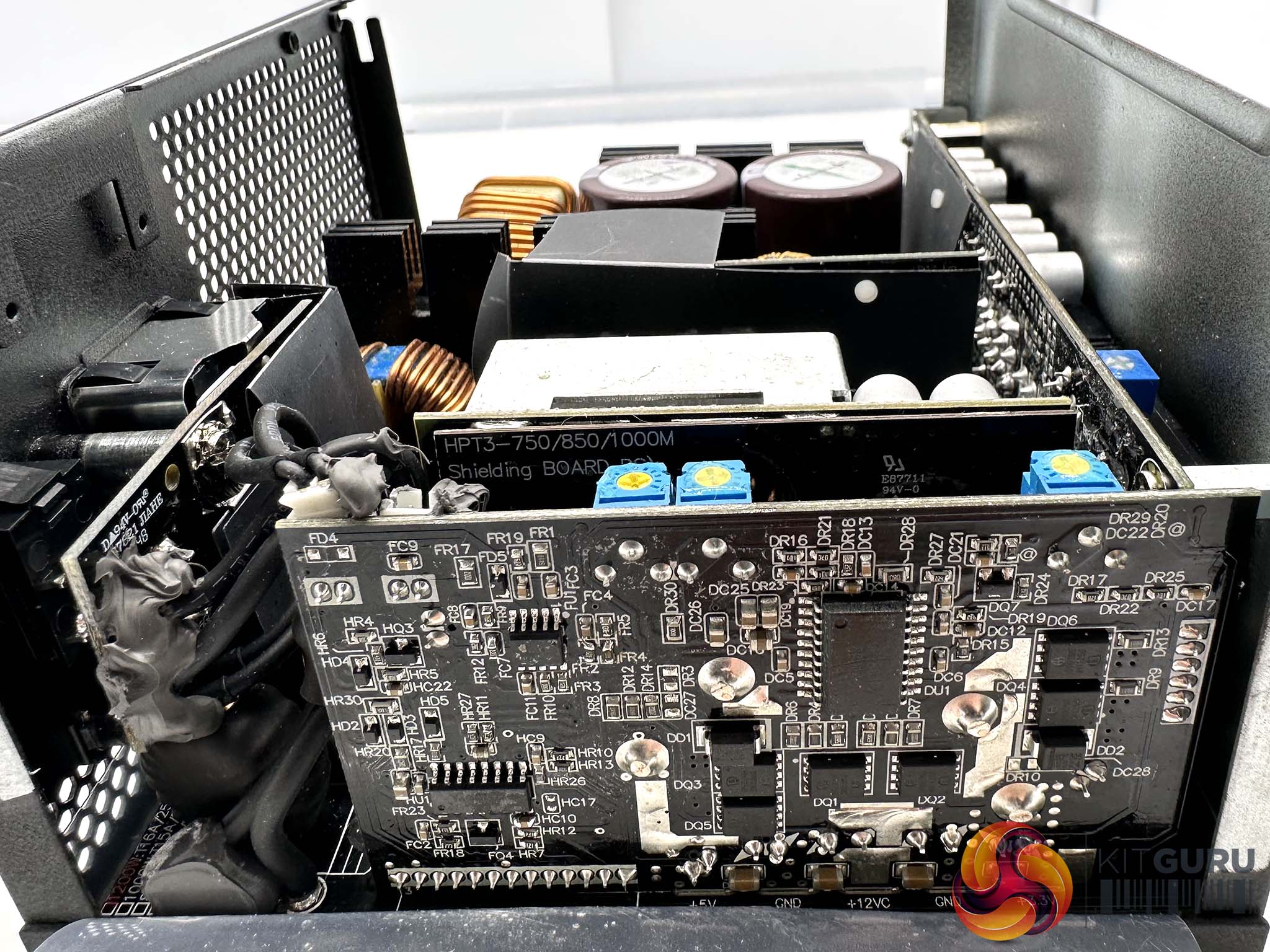
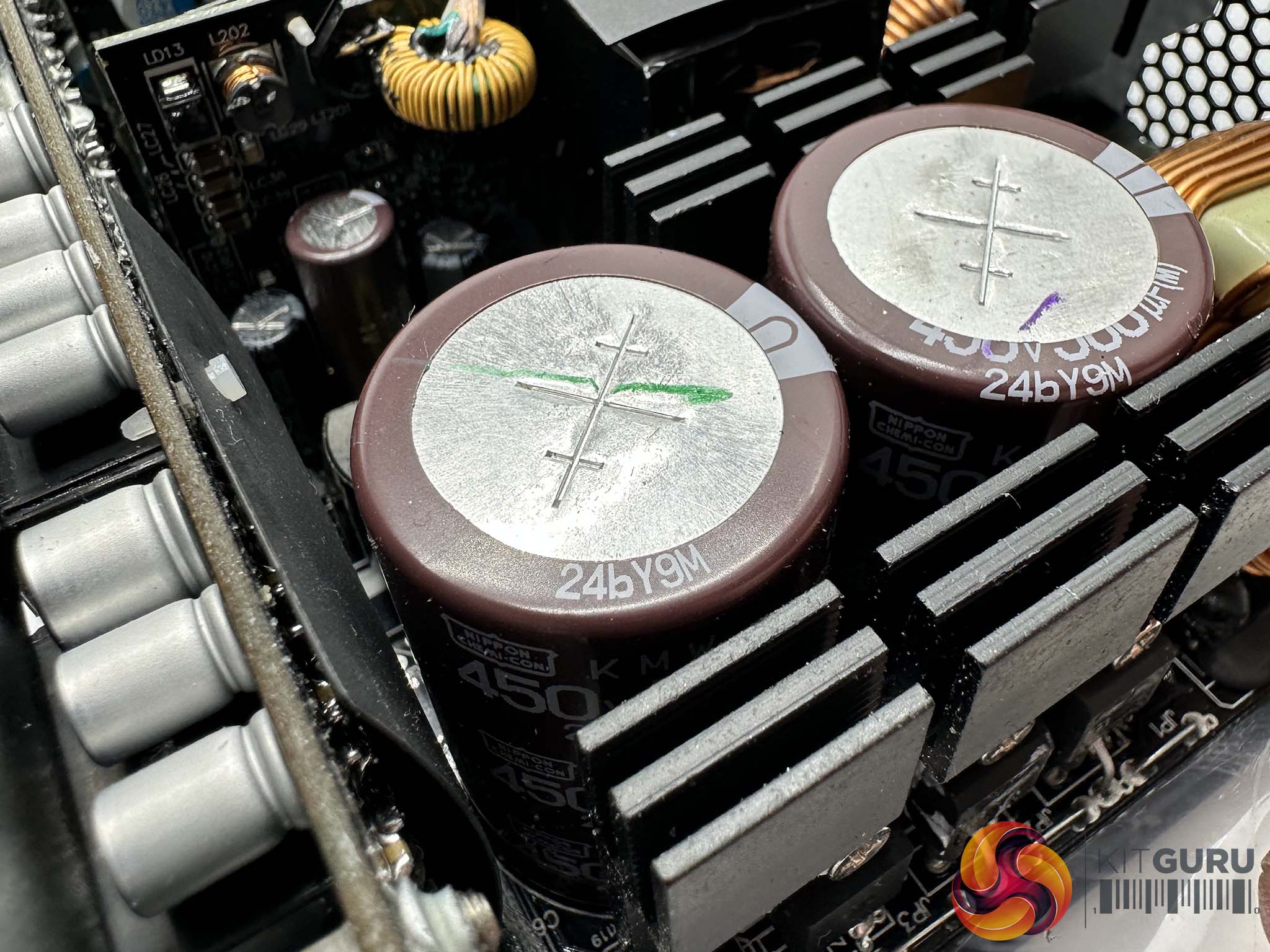
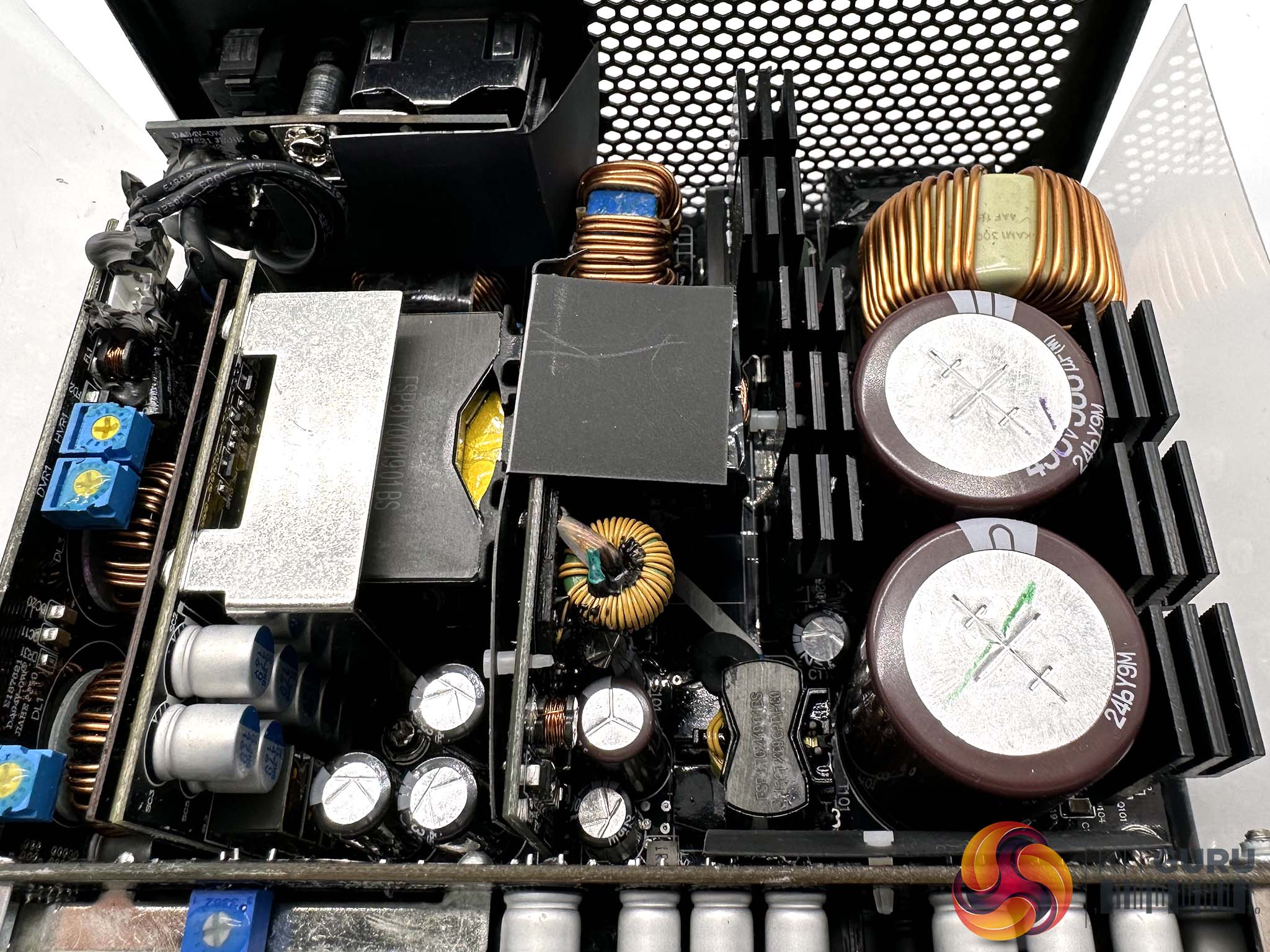
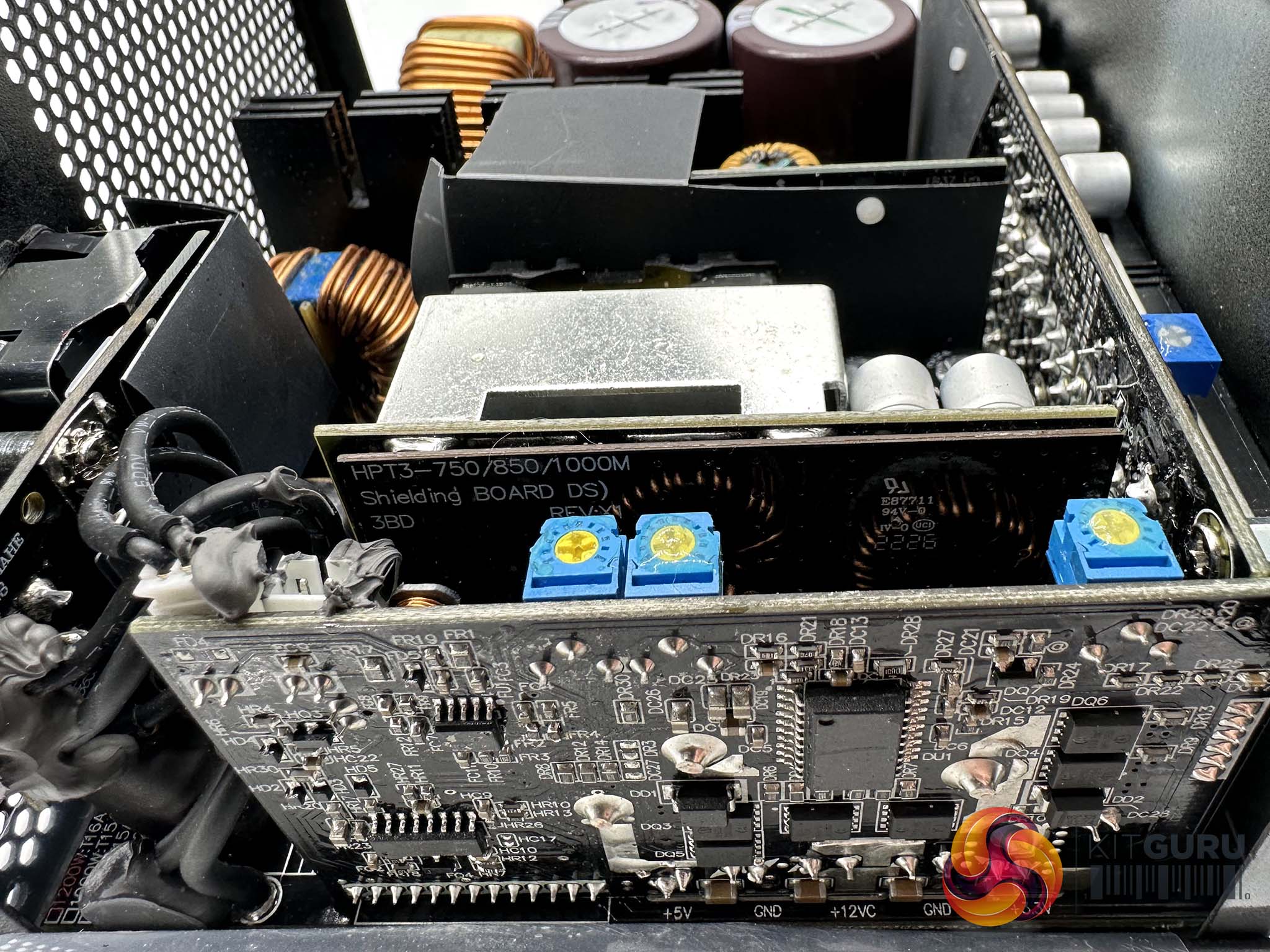
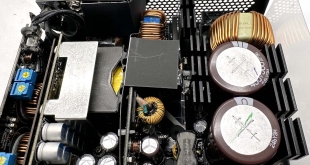
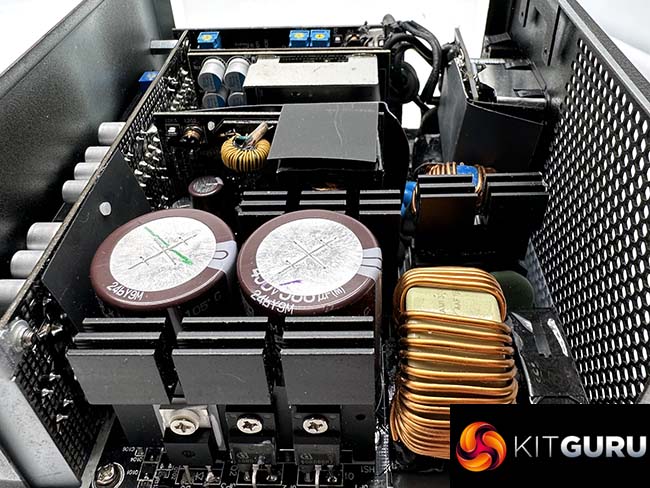
Unlike many other companies who adopt an OEM partner, FSP create their own power supplies from start to finish. This unit is very well put together and it is a very clean layout with high standards of soldering quality. Filtering begins on the rear of the AC receptacle with four Y capacitors, two X capacitors and two more filtering inductors – a dual input rectifying bridge configuration. The two rectifying bridges have a heatsink between them to aid with reducing temperatures. Additional filtering capacitors are on the PCB which hold the cable connectors.
This unit is a half bridge design adopting only two transistors at the primary side of the transformer. Many manufacturers would adopt a full bridge design for such a highly rated efficiency level as it can often give a little extra efficiency to the overall design.
We are happy to see FSP aren't cutting corners and the primary stage is home to two high capacity 450/500uF 105C-rated Japanese capacitors by Nippon Chemi Con. A large heatsink along the edge of the PCB is home to active APFC components.
The secondary stage of the design is mounted on vertical PCBs. The two boards house the LLC resonant circuitry and the secondary rectification stage which includes the transformer. FPS are using very high grade Toshiba efficiency switchers to help achieve the rating. 3.3V and 5V lines are produced by DC-to-DC conversion – a standard practice for a design such as this.
Correctly testing power supplies is a complex procedure and KitGuru have configured a test bench which can deliver up to a 2,000 Watt DC load.
We test ambient temperatures at 35C in our environment to greater reflect warmer internal chassis conditions.
We use combinations of the following hardware:
• SunMoon SM-268
• CSI3710A Programmable DC load (+3.3V and +5V outputs)
• CSI3711A Programmable DC load (+12V1, +12V2, +12V3, and +12V4)
• Extech Power Analyzer
• Extech MultiMaster MM570 digital multimeter
• Extech digital sound level meter
• Digital oscilloscope (20M S/s with 12 Bit ADC)
• Variable Autotransformer, 1.4 KVA
|
DC Output Load Regulation
|
||||||||||
|
Combined DC Load |
+3.3V
|
+5V
|
+12V
|
+5VSB
|
-12V | |||||
|
A
|
V
|
A
|
V
|
A
|
V
|
A
|
V
|
A | V | |
|
120W
|
0.90
|
3.33
|
0.93
|
5.02
|
8.95
|
12.04
|
0.50
|
5.00
|
0.20
|
-12.02
|
|
240W
|
1.62
|
3.33
|
1.63
|
5.02
|
18.45
|
12.04
|
1.00
|
5.01
|
0.20
|
-12.02
|
| 600W |
3.00
|
3.33
|
3.11
|
5.02
|
46.78
|
12.02
|
1.50
|
5.01
|
0.30
|
-12.01
|
| 900W |
4.01
|
3.33
|
4.05
|
5.02
|
70.86
|
12.00
|
2.00
|
5.01
|
0.30
|
-12.01
|
|
1200W
|
5.02
|
3.33
|
5.20
|
5.02
|
94.57
|
11.98
|
2.50
|
5.01
|
0.30
|
-12.01
|
Load regulation is really in the top tier, holding within 1%.
| FSP Hydro PTM X Pro 1200W | Maximum Load |
| 1387 Watts |
We managed to get another 187 Watts from the power supply before the protection circuitry kicked in. The supply was fine and it was ready to fire up again when we dropped the load to a more realistic level.
Next we want to try Cross Loading. This basically means loads which are not balanced. If a PC for instance needs 500W on the +12V outputs but something like 30W via the combined 3.3V and +5V outputs then the voltage regulation can fluctuate badly.
| Cross Load Testing | +3.3V | +5V | +12V | -12V | +5VSB | |||||
| A | V | A | V | A | V | A | V | A | V | |
| 1190W | 4.0 | 3.33 | 3.0 | 5.02 | 88.0 | 11.99 | 0.2 | -12.01 | 0.50 | 5.00 |
| 240W | 19.0 | 3.33 | 22.0 | 5.02 | 2.5 | 12.04 | 0.2 | -12.00 | 0.50 | 5.01 |
The FSP Hydro PTM X Pro 1200W handled our cross load tests without any issues. When hit with 88A, the +12V rail held at 11.99.
We then used an oscilloscope to measure AC ripple and noise present on the DC outputs. We set the oscilloscope time base to check for AC ripple at both high and low ends of the spectrum. ATX12V V2.2 specification for DC output ripple and noise is defined in the ATX 12V power supply design guide.
|
ATX12V Ver 2.2 Noise/Ripple Tolerance
|
|
|
Output
|
Ripple (mV p-p)
|
|
+3.3V
|
50
|
|
+5V
|
50
|
|
+12V1
|
120
|
|
+12V2
|
120
|
|
-12V
|
120
|
|
+5VSB
|
50
|
Obviously when measuring AC noise and ripple on the DC outputs the cleaner (less recorded) means we have a better end result. We measured this AC signal amplitude to see how closely the unit complied with the ATX standard.
| AC Ripple (mV p-p) | ||||
| DC Load | +3.3V | +5V | +12V | 5VSB |
| 100W | 5 | 5 | 10 | 5 |
| 200W | 5 | 5 | 10 | 5 |
| 400W | 5 | 5 | 10 | 5 |
| 600W | 10 | 10 | 15 | 10 |
| 800W | 15 | 10 | 20 | 10 |
| 1000W | 15 | 10 | 20 | 15 |
| 1200W | 15 | 10 | 25 | 15 |
Ripple Suppression is superb, hitting 25mV at full load on the +12V rail. Other rails fall well within industry rated parameters.
|
Efficiency (%)
|
|
|
100W
|
89.3
|
|
200W
|
91.5
|
|
400W
|
92.4
|
|
600W
|
94.7
|
|
800W
|
94.2
|
| 1000W | 93.4 |
| 1200W | 92.1 |
The overall efficiency results are excellent, peaking at close to 95% between 40-60% load, and dropping to 92.1% at full load.
We take the issue of noise very seriously at KitGuru and this is why we have built a special home brew system as a reference point when we test noise levels of various components. Why do this? Well this means we can eliminate secondary noise pollution in the test room and concentrate on components we are testing. It also brings us slightly closer to industry standards, such as DIN 45635.
Today to test the power supply we have taken it into our acoustics room environment and have set our SkyTronic DSL 2 Digital Sound Level Meter (6-130dBa) one meter away from the unit. We have no other fans running so we can effectively measure just the noise from the unit itself.
As this can be a little confusing for people, here are various dBa ratings in with real world situations to help describe the various levels.
KitGuru noise guide
10dBA – Normal Breathing/Rustling Leaves
20-25dBA – Whisper
30dBA – High Quality Computer fan
40dBA – A Bubbling Brook, or a Refrigerator
50dBA – Normal Conversation
60dBA – Laughter
70dBA – Vacuum Cleaner or Hairdryer
80dBA – City Traffic or a Garbage Disposal
90dBA – Motorcycle or Lawnmower
100dBA – MP3 Player at maximum output
110dBA – Orchestra
120dBA – Front row rock concert/Jet Engine
130dBA – Threshold of Pain
140dBA – Military Jet takeoff/Gunshot (close range)
160dBA – Instant Perforation of eardrum
|
Noise (dBA)
|
|
|
100W
|
<28.0
|
|
200W
|
<28.0
|
|
400W
|
<28.0
|
|
600W
|
29.7
|
| 800W | 31.7 |
| 1000W | 32.9 |
| 1200W | 35.3 |
The fan does not make any noise until around 450-500 watts load, when it spins up a little to deal with rising temperatures and losses. The fan profile is not very aggressive, however with efficiency levels as high as this, it doesn't need to be.
At full load, the fan did not need to run at close to the maximum 2,700 rpm rotational figures. FSP could have optimised the fan a little better for even lower noise levels, but we feel a little higher speed is a safe course of action – especially as the fan never causes any audible discomfort. All round, great results for this unit.
|
Temperature (c)
|
||
|
Intake
|
Exhaust
|
|
|
100W
|
35
|
37
|
|
200W
|
36
|
41
|
|
400W
|
38
|
44
|
|
650W
|
43
|
50
|
|
800W
|
45
|
54
|
| 1000W | 47 | 57 |
| 1200W | 50 | 61 |
Temperatures are well maintained throughout the load range thanks to the overall efficiency of the design and the good airflow from the large FDB fan.
|
Maximum load
|
Efficiency (%)
|
|
1387W
|
91.5
|
Pushing the power supply above its rated limits generates an efficiency level of around 91.5%. Not a realistic situation to be running but interesting nonetheless.
The FSP Hydro PTM X Pro 1200W Platinum is a fantastic power supply which exhibited strong electrical performance across the board. The adoption of quality components throughout both primary and secondary stages, and a well cooled layout ensure maximum reliability and performance. FSP have not cut corners with this design and are using 105C-rated Japanese capacitors from one of the market leaders – Nippon Chemi Con.
The unit achieved Platinum efficiency ratings without any problem, topping out around 95% in our testing and holding over 92% even at full load. Ripple suppression rates as excellent, falling well within industry parameters – peaking at only 25mV at full load on the +12V rail.
Noise levels at modest ambient temperatures are very good, with the fan remaining almost silent at loads up to 500 watts in our test environment (35C forced ambient). FSP could have tuned the fan profile to be slightly less aggressive, but I feel they met a decent balance, ensuring adequate air flow in a warmer, more humid climate when necessary. The fan never proved too intrusive during our testing even when delivering higher loads well in excess of 1000 watts.
Overall I have been very impressed with this relatively new 1200 watt supply from FSP – the two designs we have tested in 2023 have proven that FSP are firmly on the right track when offering high quality power solutions for the discerning enthusiast user.
My only real concern with FSP is that it is often difficult to buy their power supplies in some countries – a point many readers remind me about after every FSP review we publish. I have raised this with FSP and they have assured me they are trying their best to improve distribution globally. I asked about availability for this unit we are testing today and FSP sent me the following information (KitGuru does NOT get a percentage from any sales generated from these links – they are only included to help you find retailers).
Poland will have stockists in August. Spain and Italy will have stockists in September. UK has nothing confirmed yet. However if you click the Amazon link above from a UK account, Amazon will deliver for around £232.66 (at time of publication there was even a £23.27 discount option on Amazon's page).
Pros:
- 10 year warranty.
- Adoption of 105c high rated Japanese capacitors throughout.
- Fully modular.
- Quality fluid dynamic bearing fan.
- High quality finish.
- Stable power delivery across the range.
- Load regulation with 1%, class leading.
- Ripple suppression is tight.
- Tiny 130mm length which is remarkable for such a high capacity unit.
Cons:
- FSP (sadly) seem to struggle with availability in many countries.
KitGuru says: The FSP Hydro PTM X Pro 1200W Platinum delivers stable, high quality power across the full range of delivery. Highly recommended if you want to upgrade your current supply or build a new high end system for 2023.