 KitGuru KitGuru.net – Tech News | Hardware News | Hardware Reviews | IOS | Mobile | Gaming | Graphics Cards


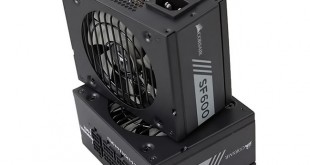
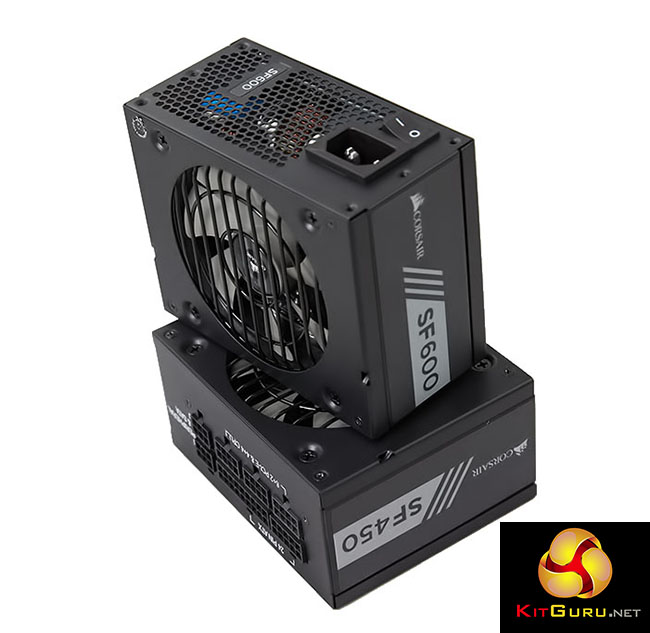
Today Corsair release two new SFX power supplies – the aptly named SF450 and SF600, in 450 watt and 600 watt capacities respectively. One of the talking points with these power supplies is the adoption of large 92mm fans, breaking the SFX trend of 80mm or smaller ‘noisemakers'. This should help reduce noise levels, while maintaining a high level of airflow. Both supplies are pure modular designs and are 80 Plus Gold Certified.
To help facilitate low noise conditions, Corsair have adopted a Zero RPM fan mode at low to moderate loads. Corsair claim the fan should be inactive at up to 30% of the PSU's maximum load.
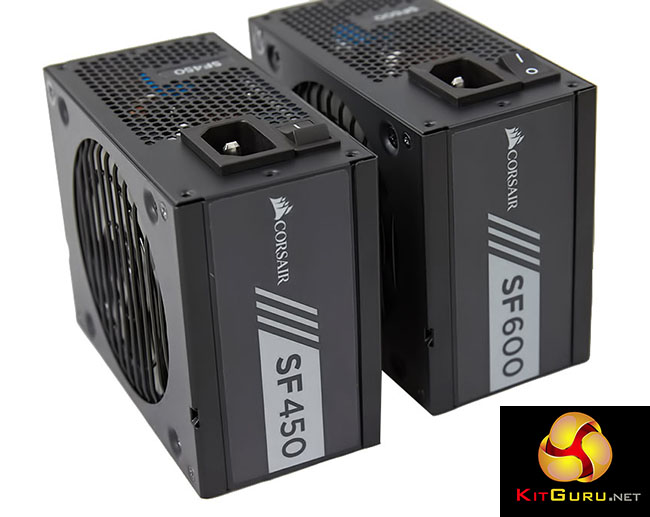
Corsair say they are accepting no compromises in the design of these units, they have adopted 105c Japanese capacitors throughout to deliver clean, stable power. The all modular design helps ensure that neat, fast system builds are possible – Corsair have opted for flat ribbon style cables, for ease of routing.
SF450 and SF600 overview:
- Low Noise SF Series 92mm fan.
- Easy to Route Modular Cables.
- 105c Japanese Capacitors.
- careful selection of components to reduce coil whine.
- 80 Plus Gold Certified.
- 5 year warranty.
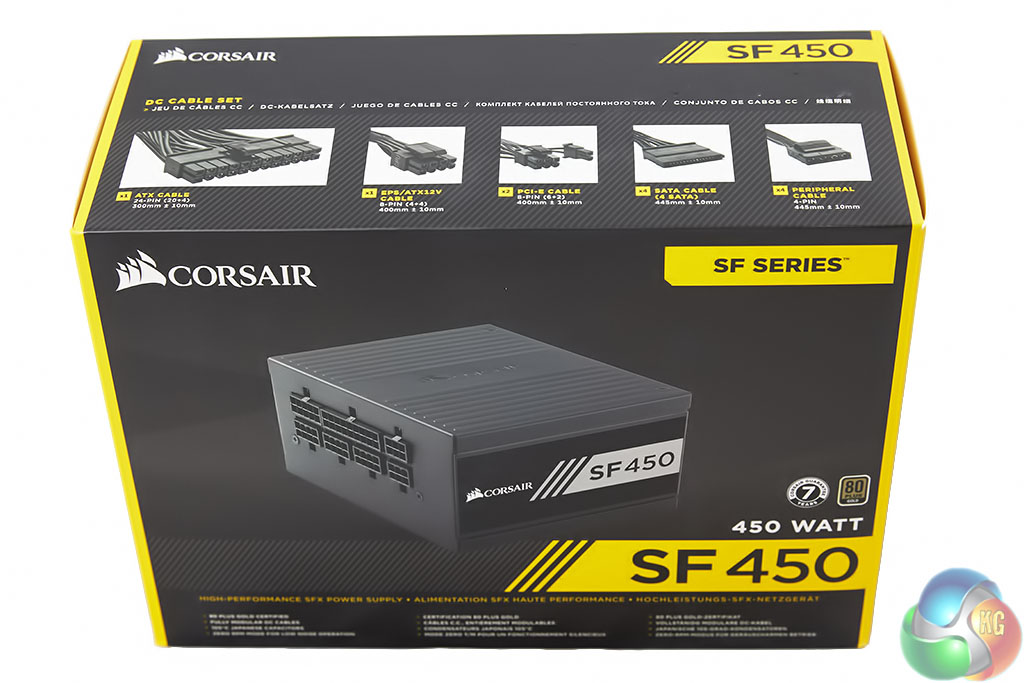
The Corsair box artwork is effective and highlights the SF450 on the front, with yellow accenting. Various specifications are shown around the box.
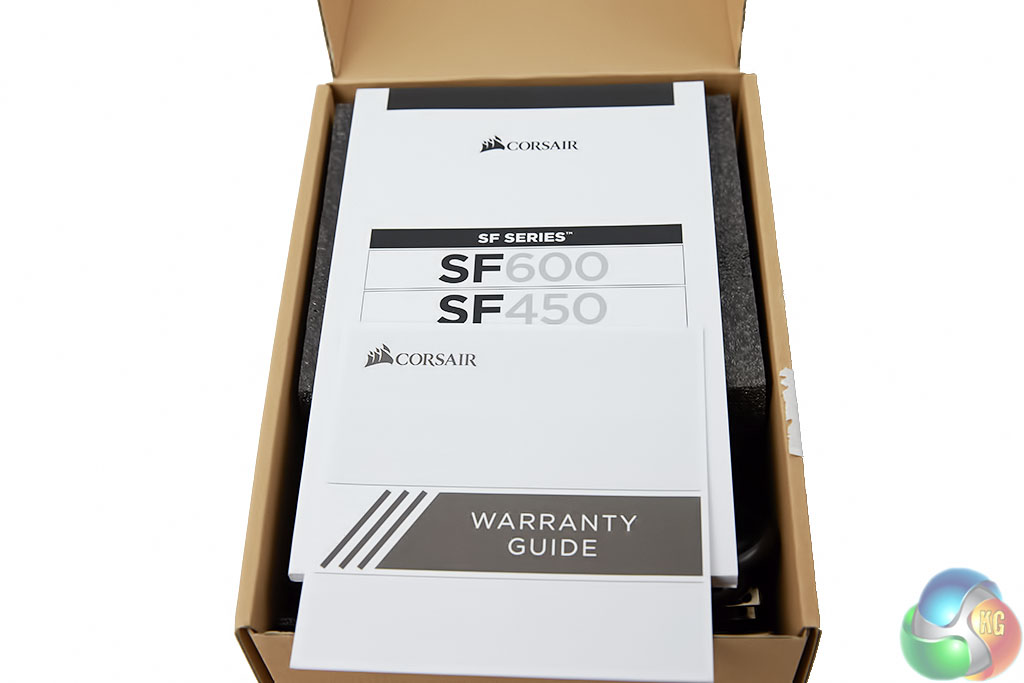
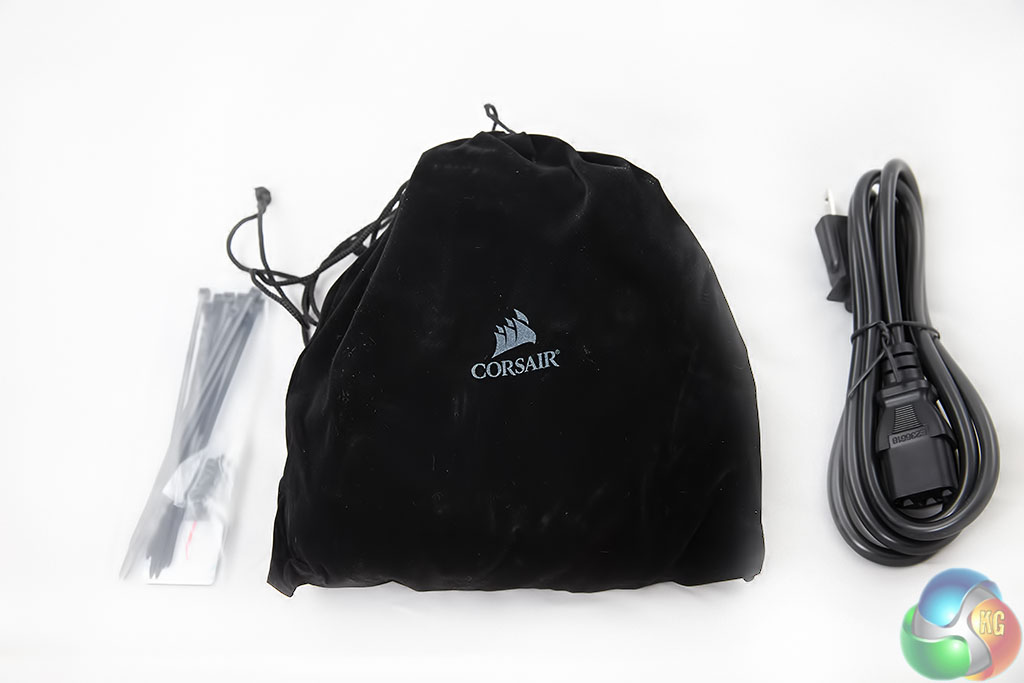
The power supply is encased in thick foam for added protection during shipping. On top is warranty information and a user manual. Alongside is a felt pouch containing the modular cables, cable ties, and a regional specific power cable.

The Corsair SF 450 ships protected inside a felt bag, which is a nice touch.
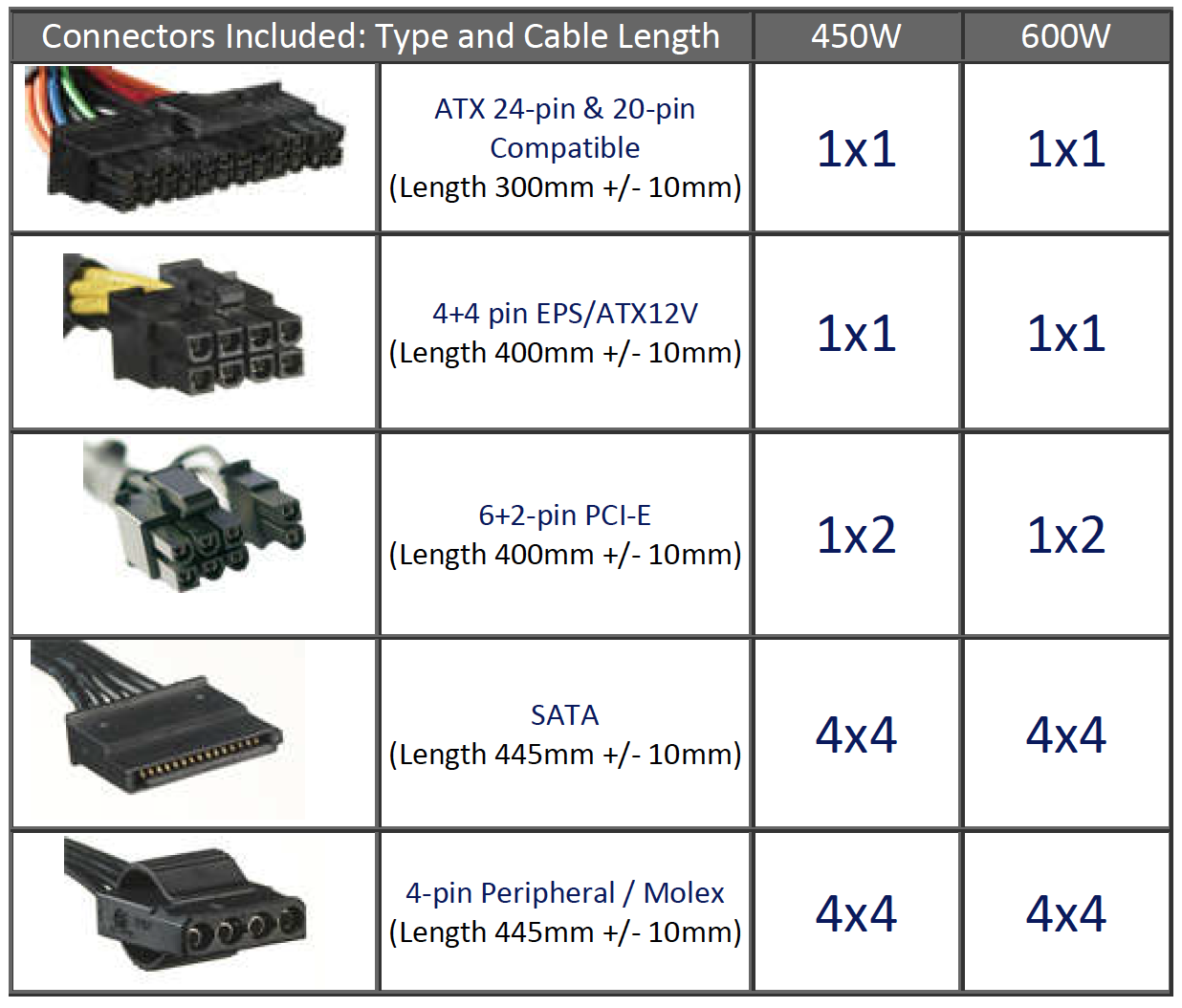

The power supply itself has no hardwired cables, so all the cables are flat and modular, as shown above. These are easy to route to build a neat system. Critical if you are building a space restricted SFX system. There are two 6+2 PCI e Cables to cater for a high end graphic card, or two lower specified models in Crossfire, or SLi configurations.
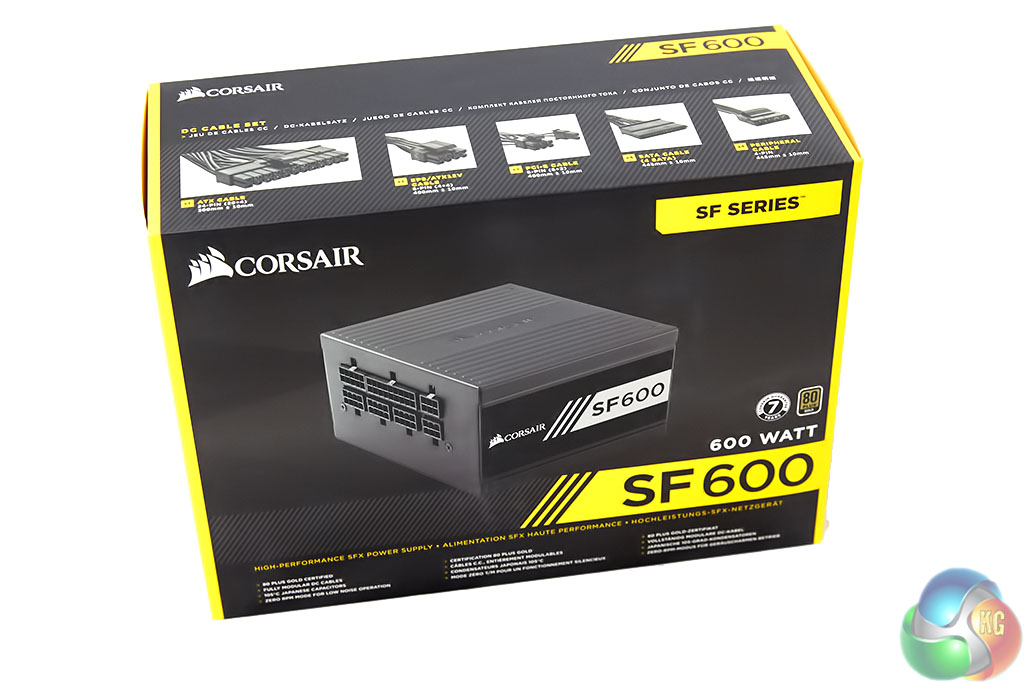
The Corsair box artwork is attractive – there is a high resolution image of the SF600 on the front of the box, and details for the power supply are shown on all sides.
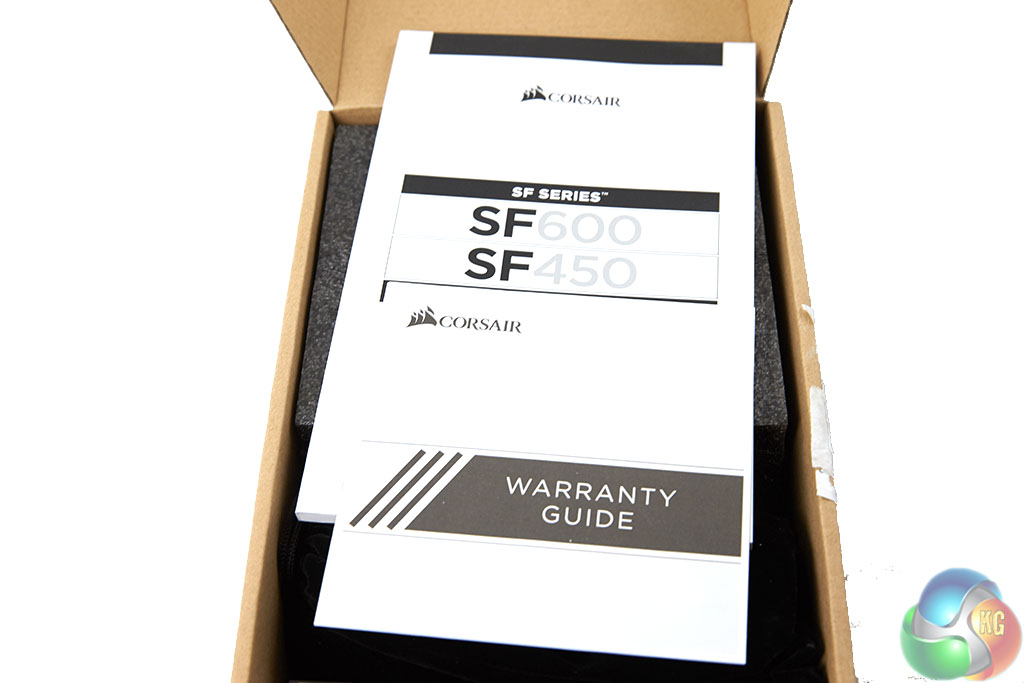
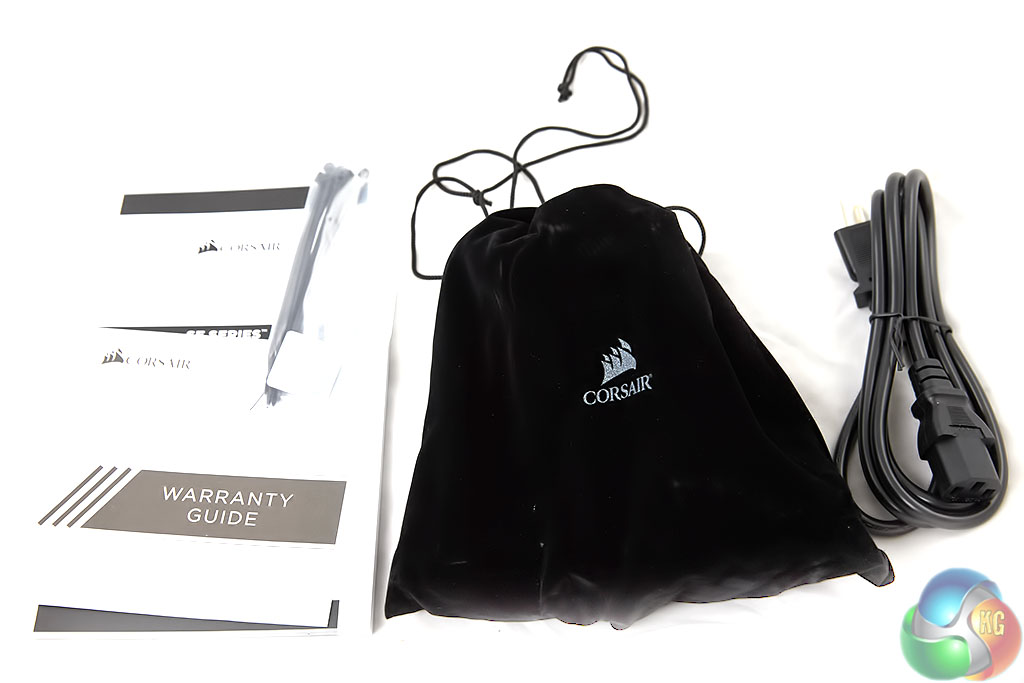
The power supply is securely packed and protected inside thick foam panels. Warranty information and the user manual are placed on top. At the side is a felt bag with the modular cables, cable ties and a regional specific power cable.

The Corsair SF 600 ships protected inside a felt bag, which is a nice touch.
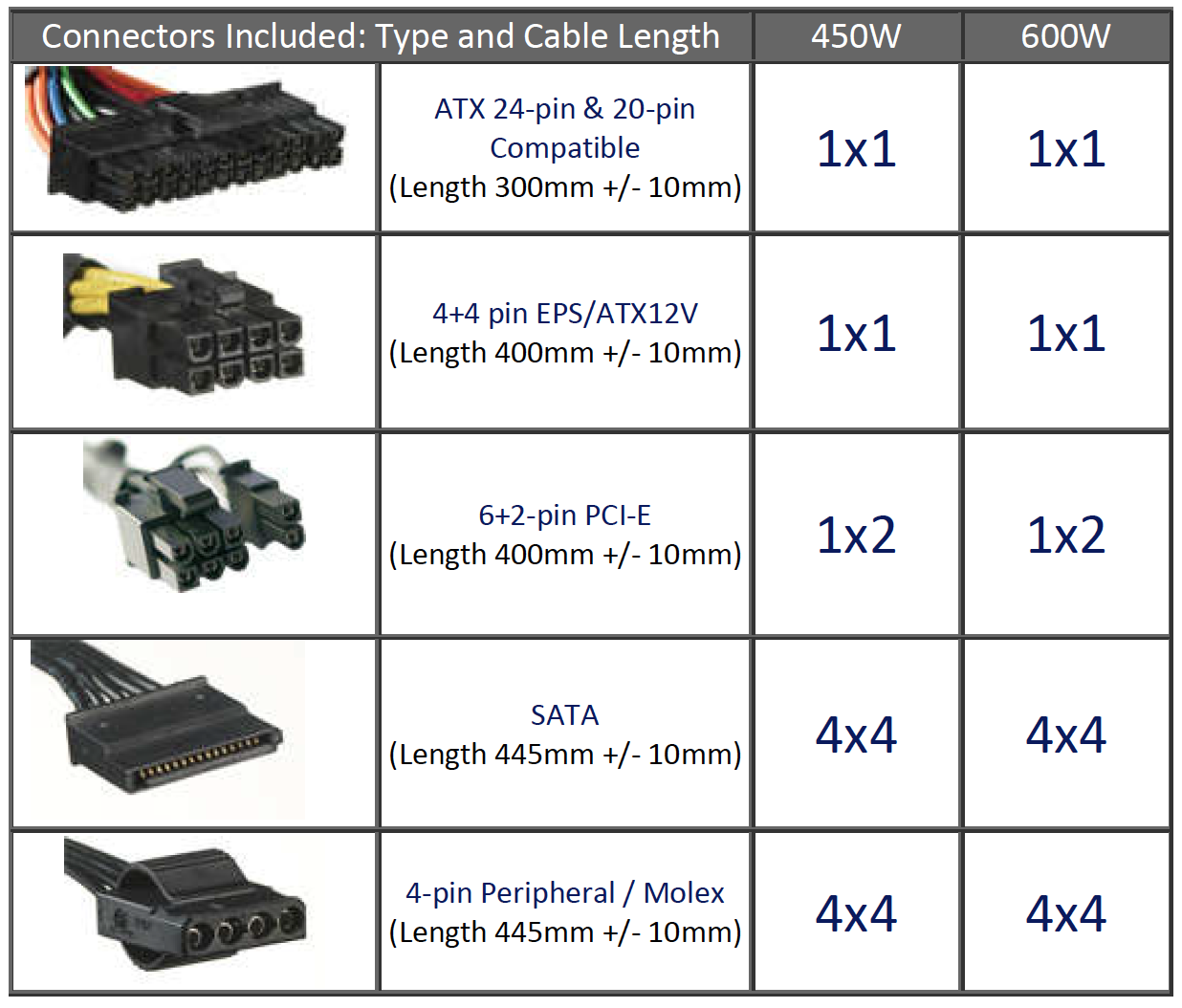
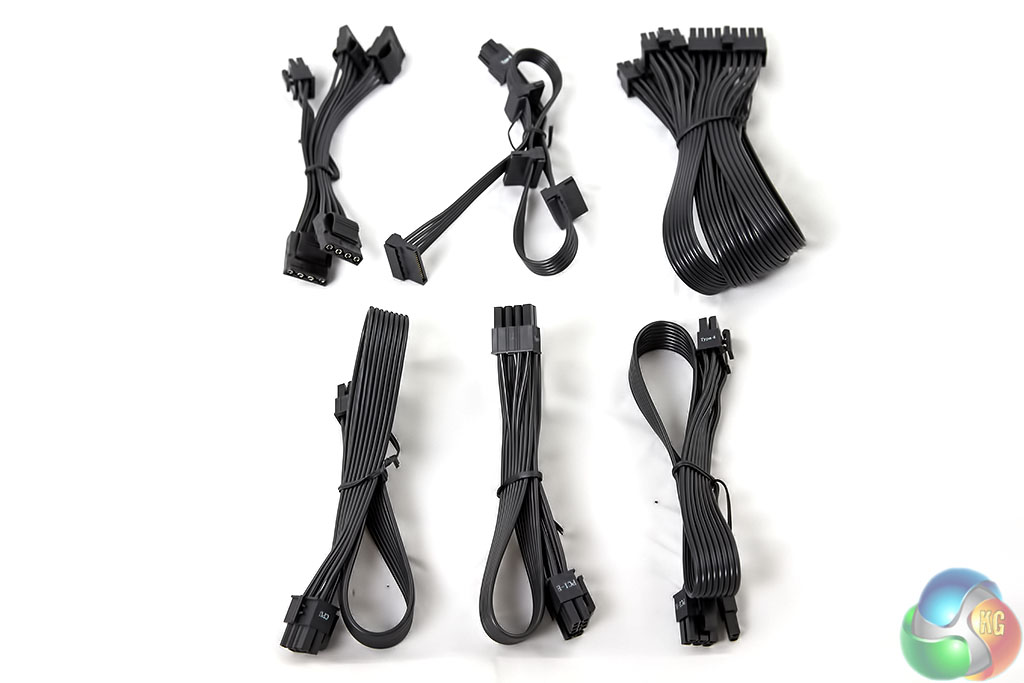
The power supply itself has no hardwired cables, so all the cables are flat and modular, as shown above. These are easy to route to build a neat system. Critical if you are building a space restricted SFX system. There are two 6+2 PCI e Cables to cater for a high end graphic card, or two lower specified models in Crossfire, or SLi configurations.
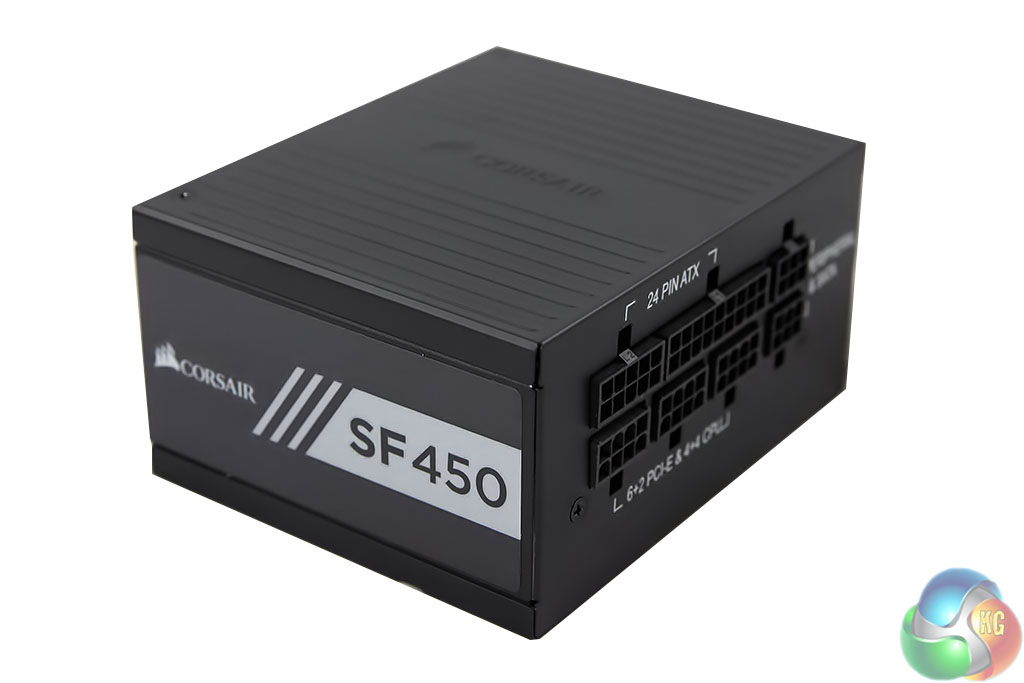
The Corsair SF450 is a tiny little power supply with no fancy external stickers or lights. The unit is finished in matt black with the name shown on one side.
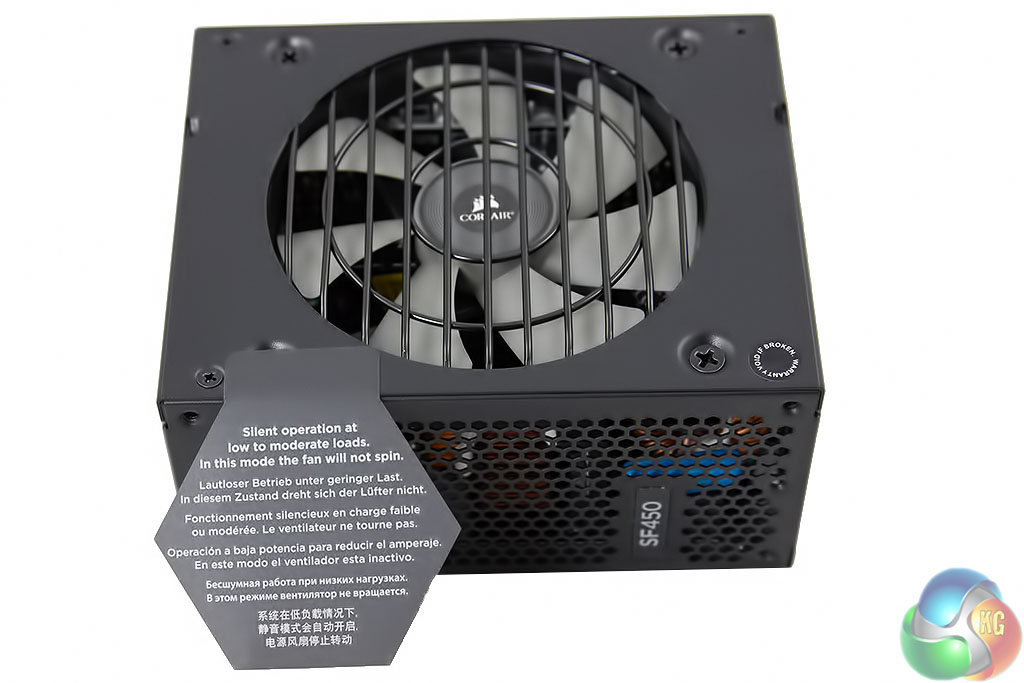
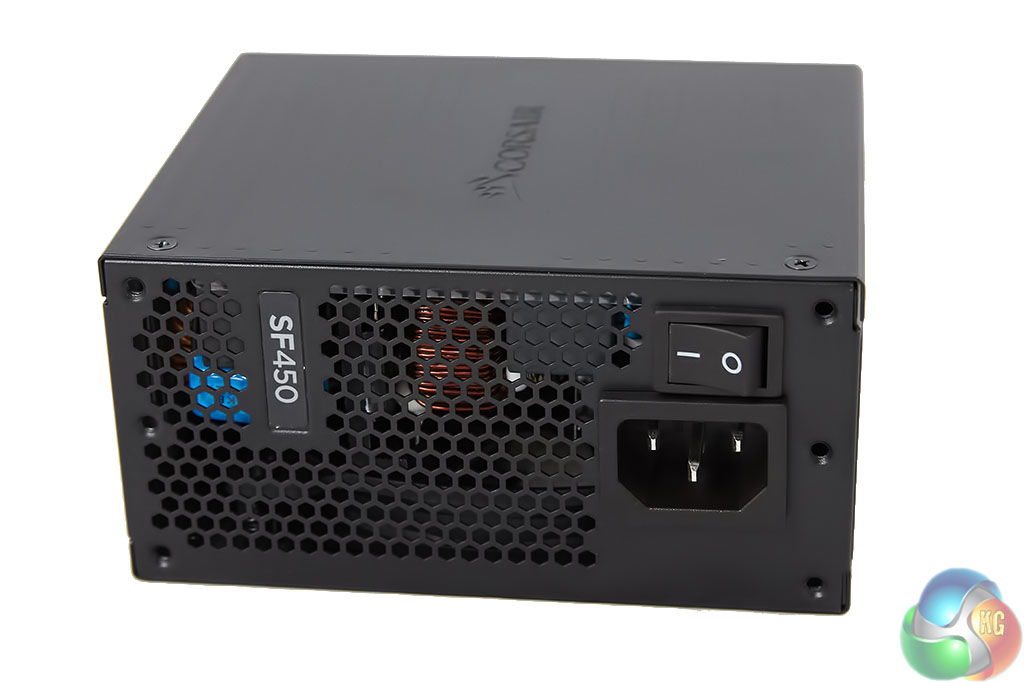
First thing, remove the sticker with information on the ZERO RPM mode. There is a power switch and cable connector close by.
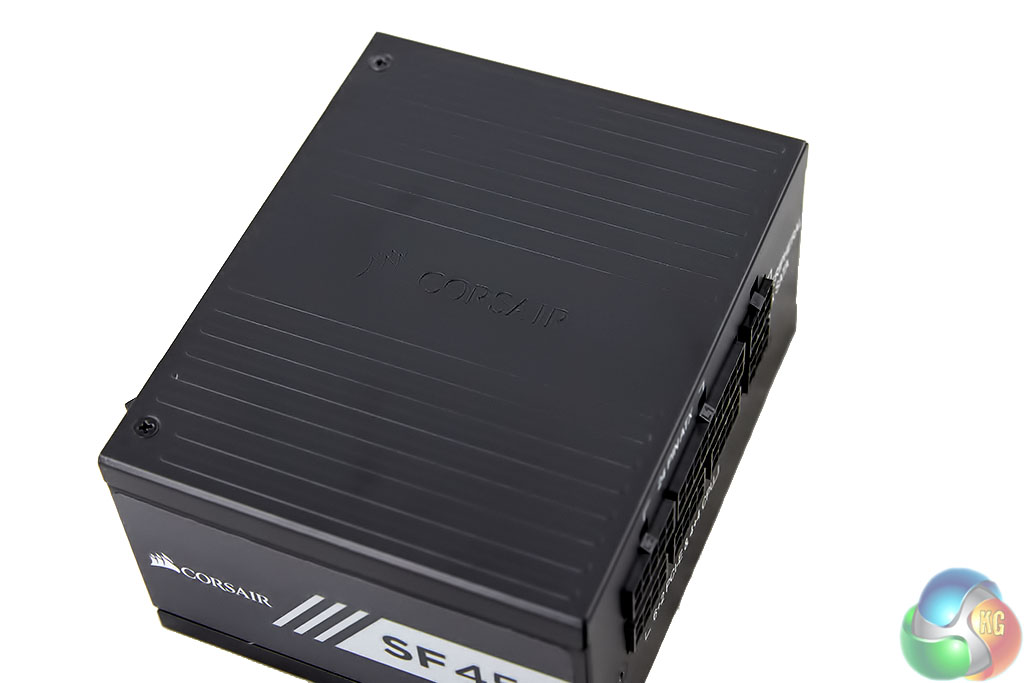
We like the little touches, such as the engraved ‘Corsair' into the top of the chassis.
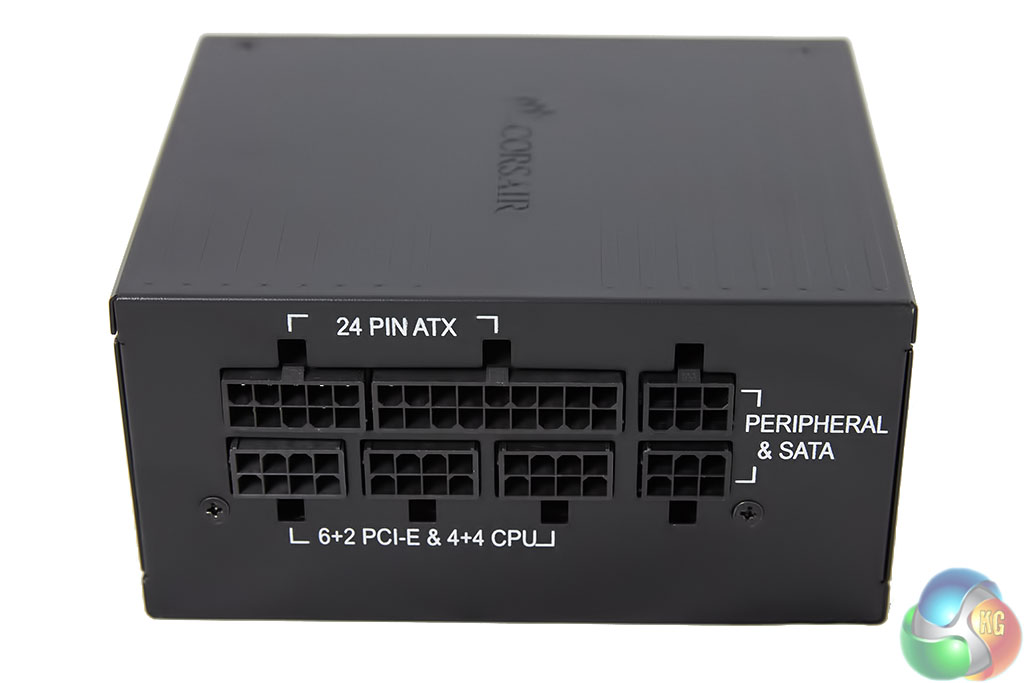
The modular side of the power supply is neatly laid out and easy to follow – with the cable connectors all labeled.
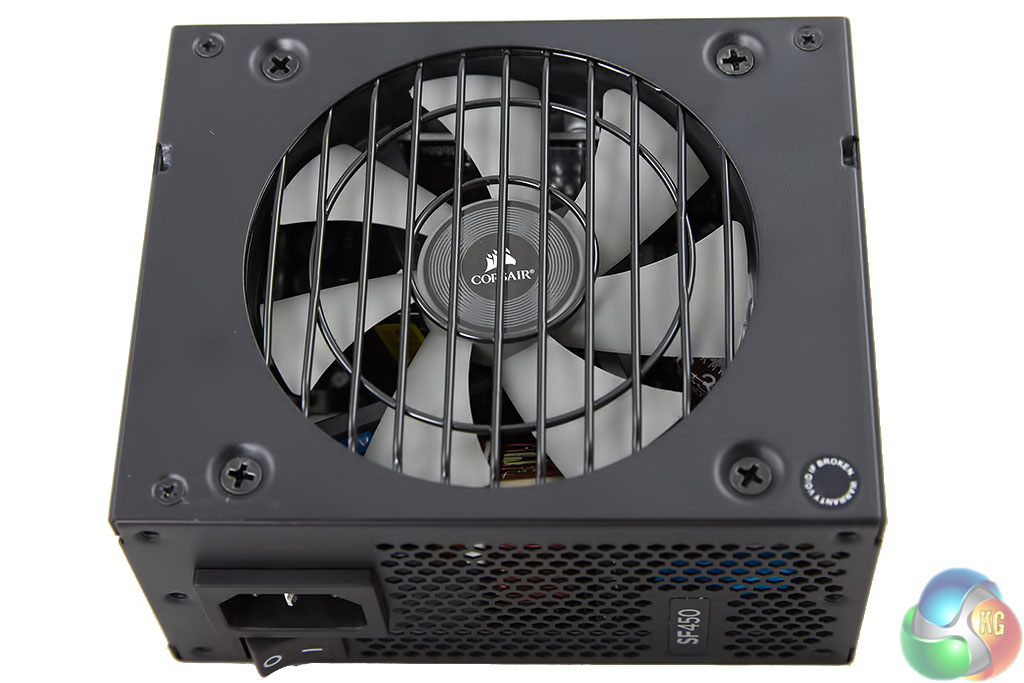
The large grey/white 92mm fan is clearly seen behind the black metal grill, above.
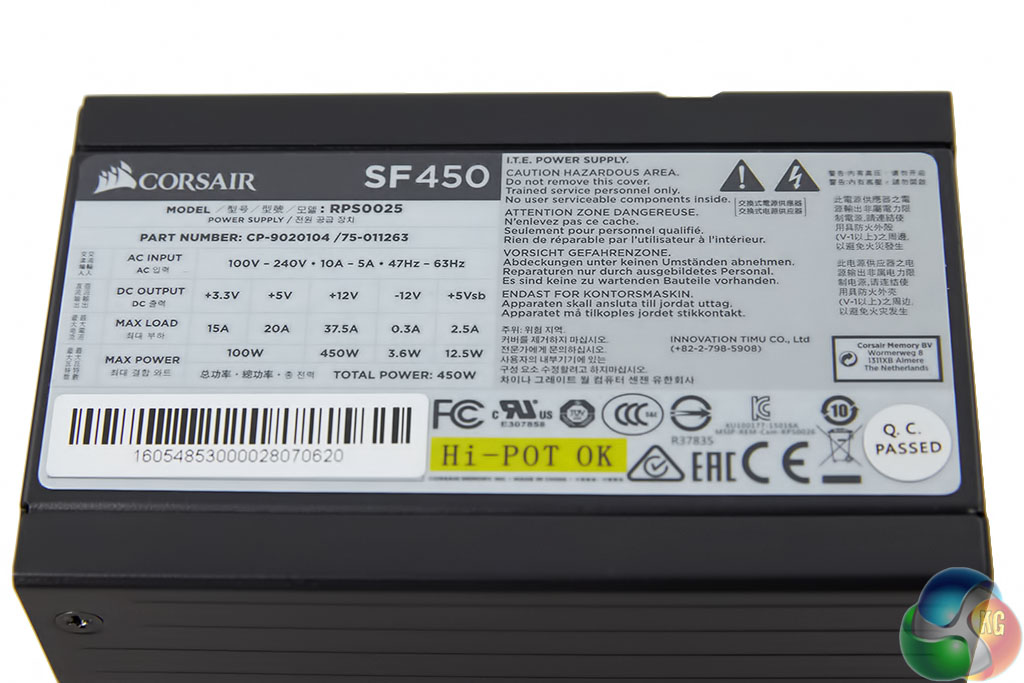
| Corsair SF 450 Power Supply | |||||
|
DC Output
|
+3.3V
|
+5V
|
+12V |
-12V
|
+5Vsb
|
|
Max Output
|
15A
|
20A
|
37.5A |
0.3A
|
2.5A
|
| Total Power | 100W | 450W | 3.6W | 12.5W | |
| 450W | |||||
The Corsair SF 450 can deliver 37.5A from the +12V rail.
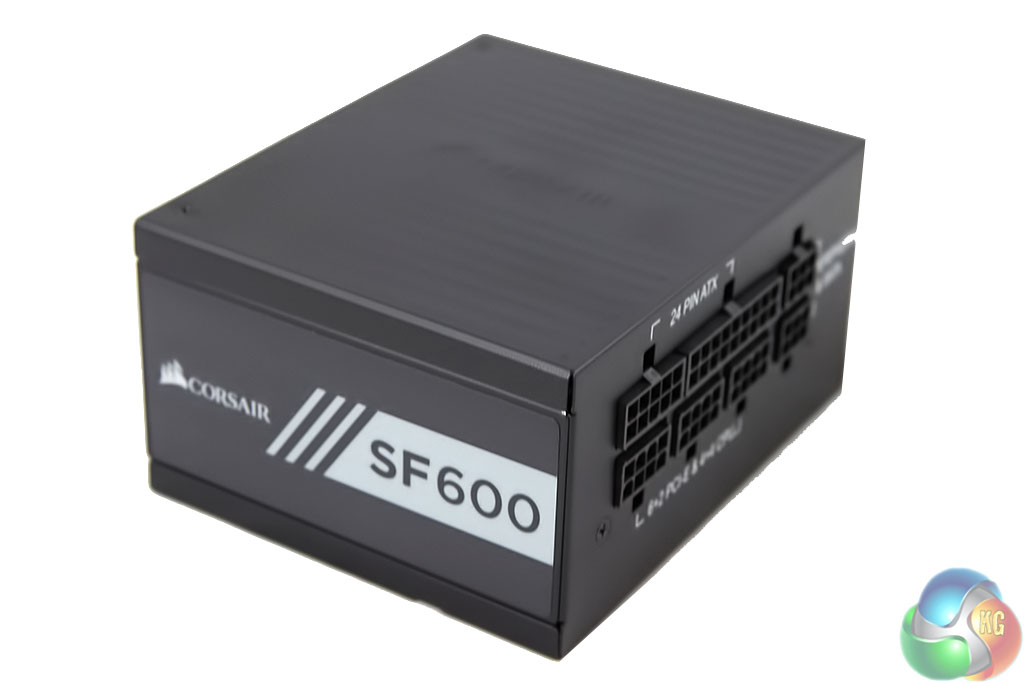
The Corsair SF600, like the SF450 is a tiny little power supply with no fancy external stickers or lights. The unit is finished in matt black with the name shown on one side.
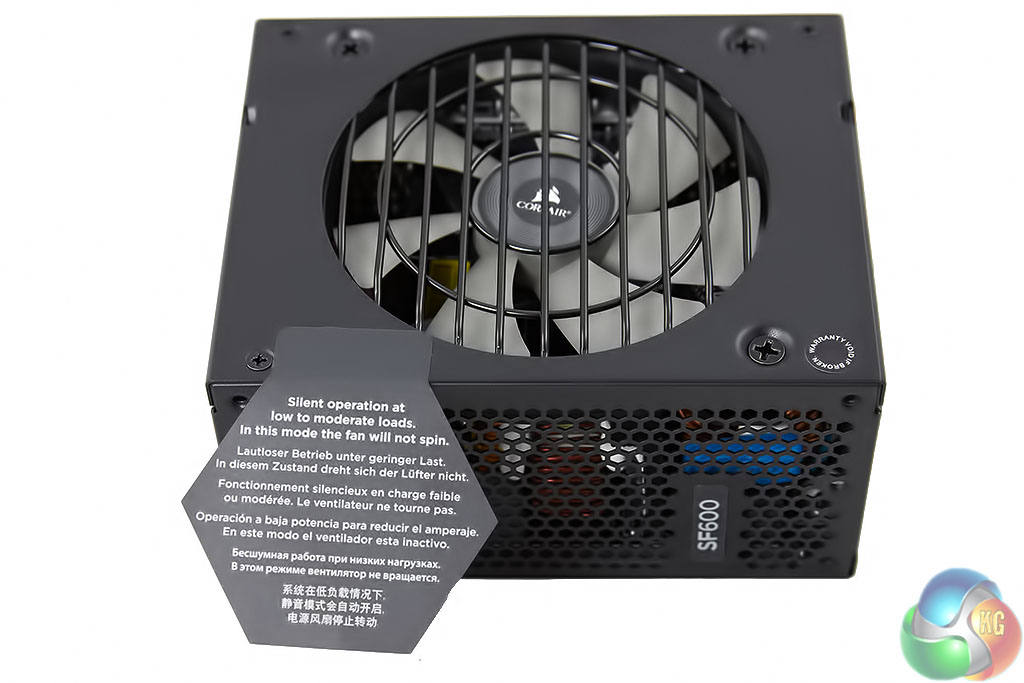
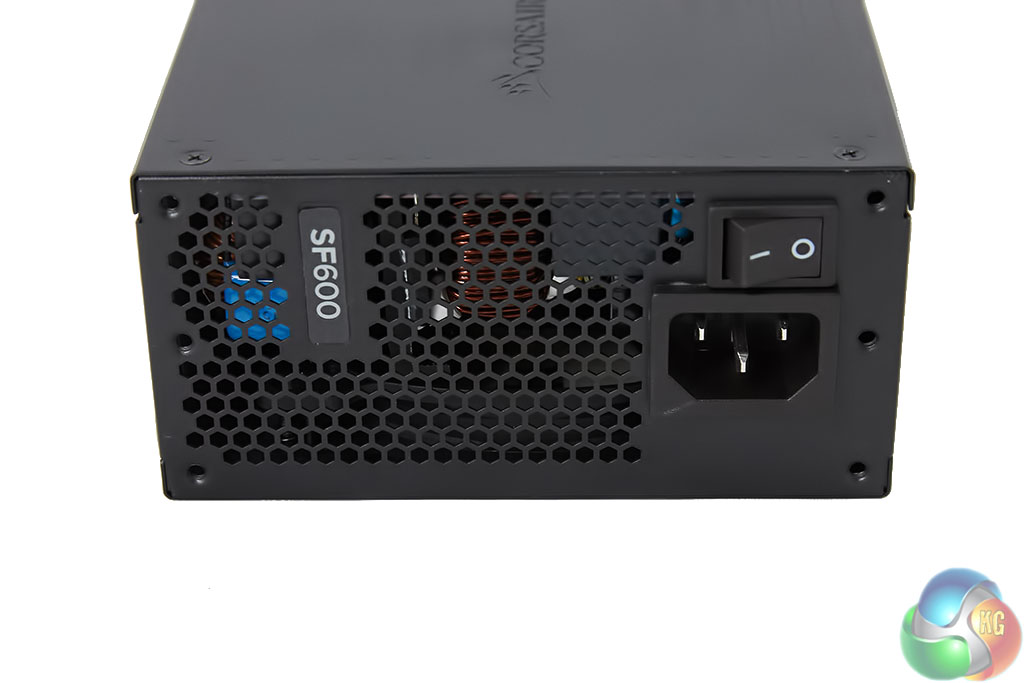
First thing, remove the sticker with information on the ZERO RPM mode. There is a power switch and cable connector close by.
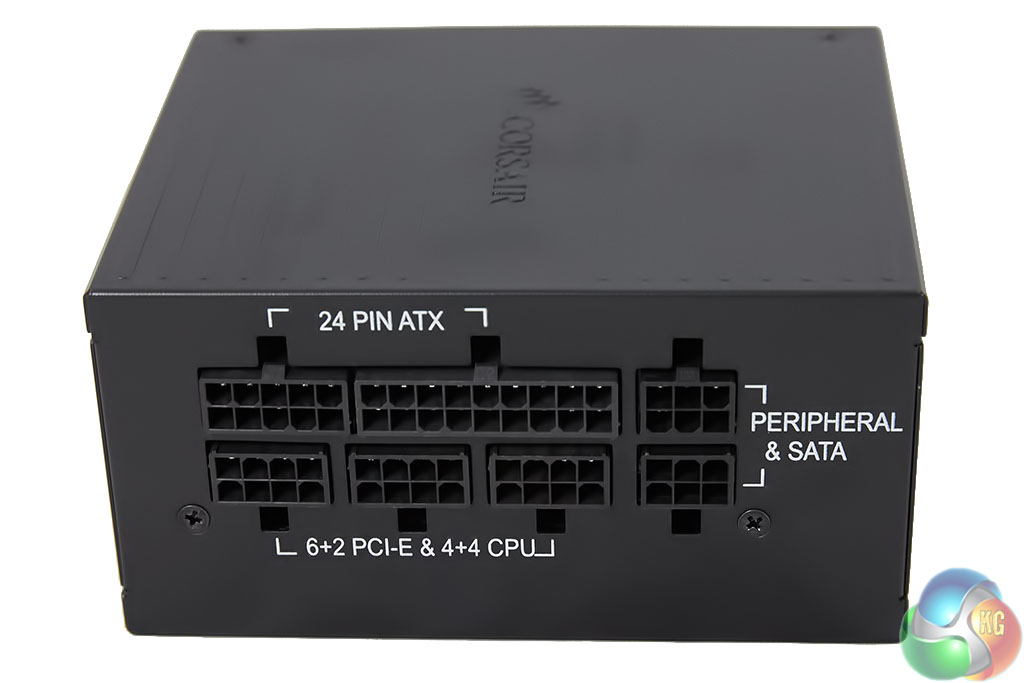
The modular side of the power supply is neatly laid out and easy to follow – with the cable connectors all labeled.
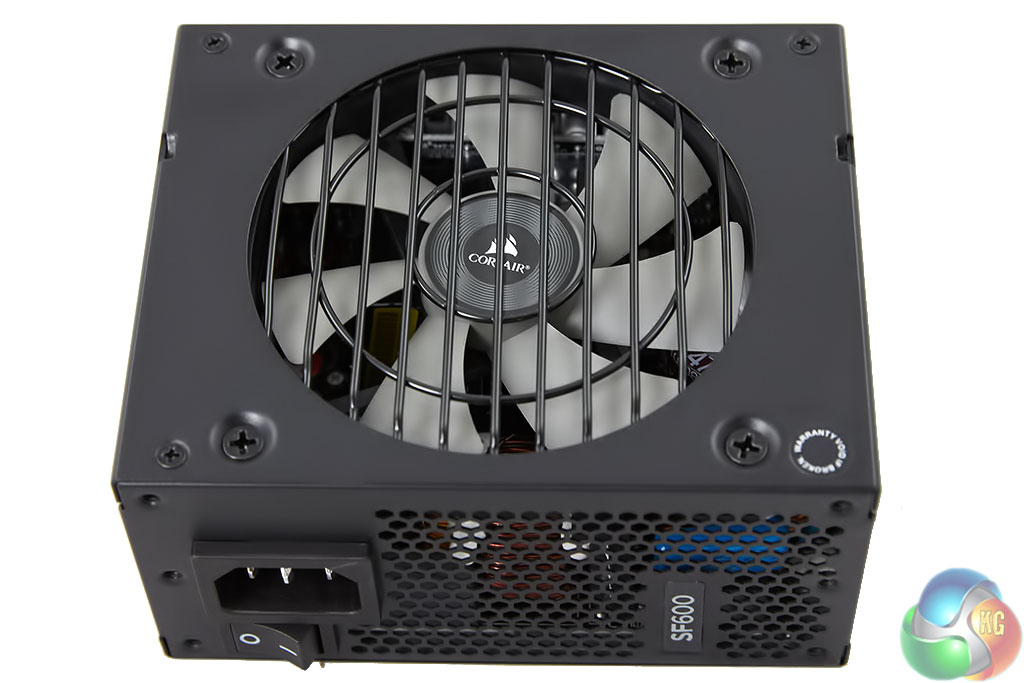
The large grey/white 92mm fan is clearly seen behind the black metal grill, above.
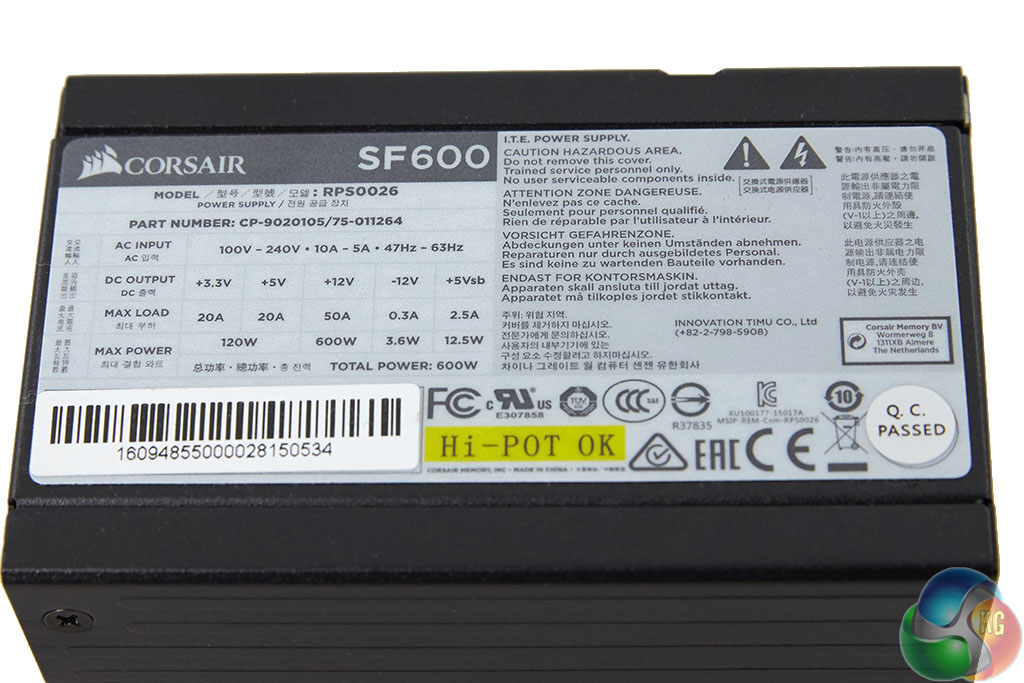
| Corsair SF 600 Power Supply | |||||
|
DC Output
|
+3.3V
|
+5V
|
+12V |
-12V
|
+5Vsb
|
|
Max Output
|
20A
|
20A
|
50A |
0.3A
|
2.5A
|
| Total Power | 120W | 600W | 3.6W | 12.5W | |
| 600W | |||||
The Corsair SF 450 can deliver 50A from the +12V rail.
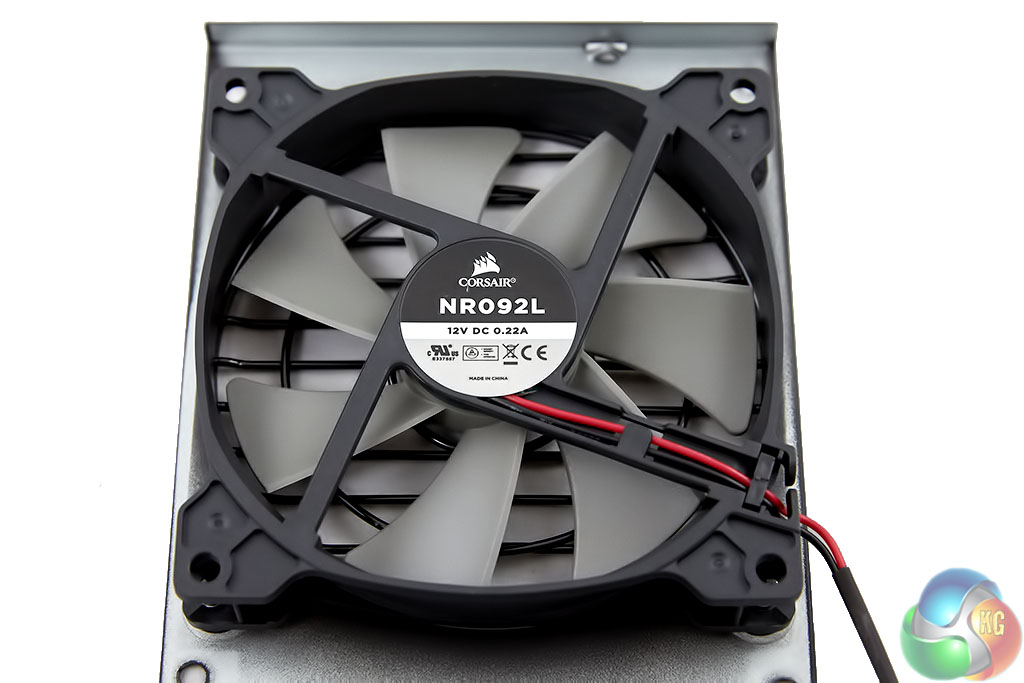
Corsair have adopted a NR092L fan inside the SF 450. This is rated 12V, 0.22A. There is very little, if any information on this fan online.
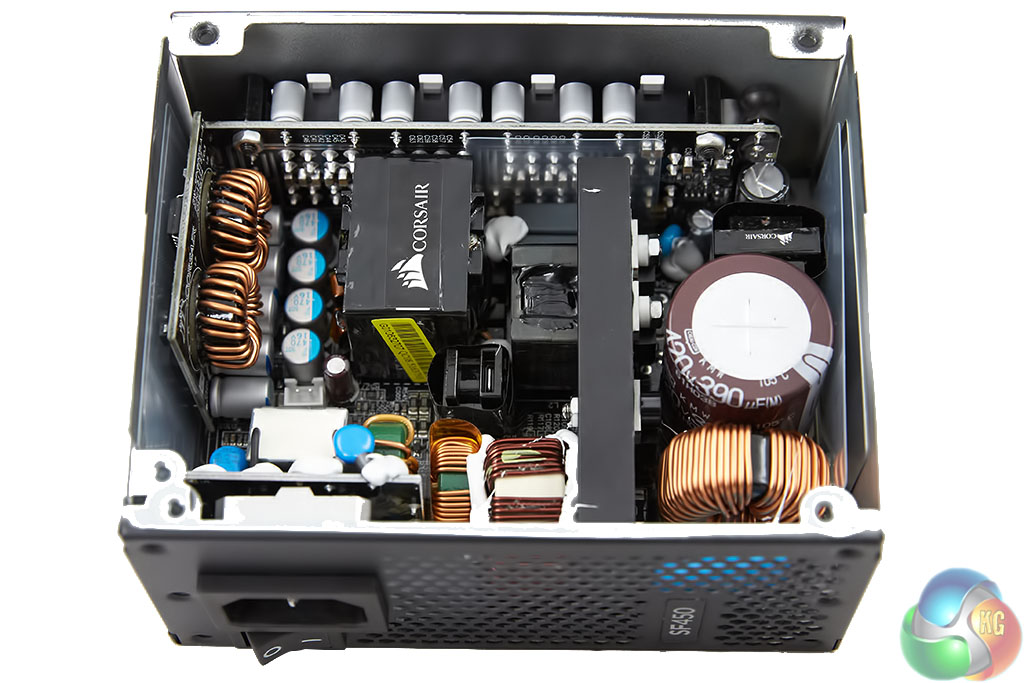
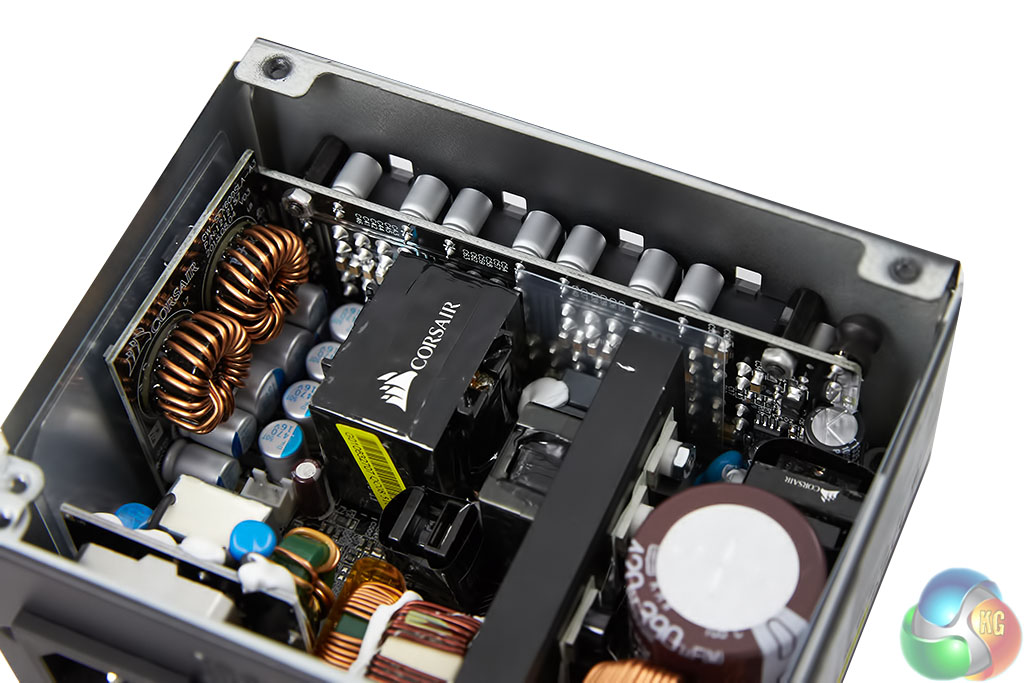
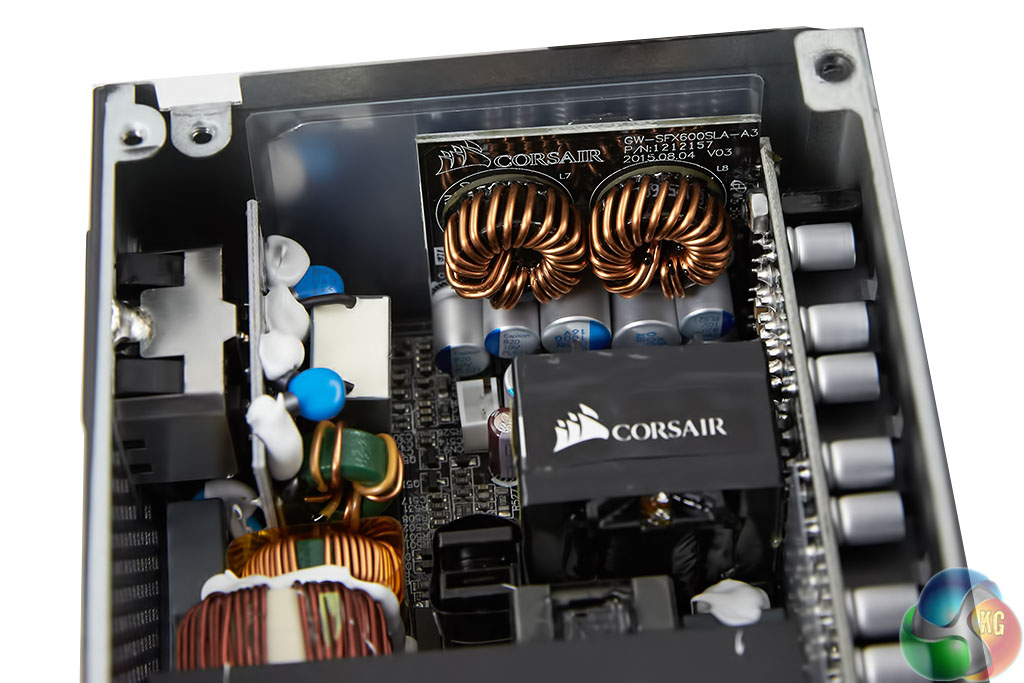
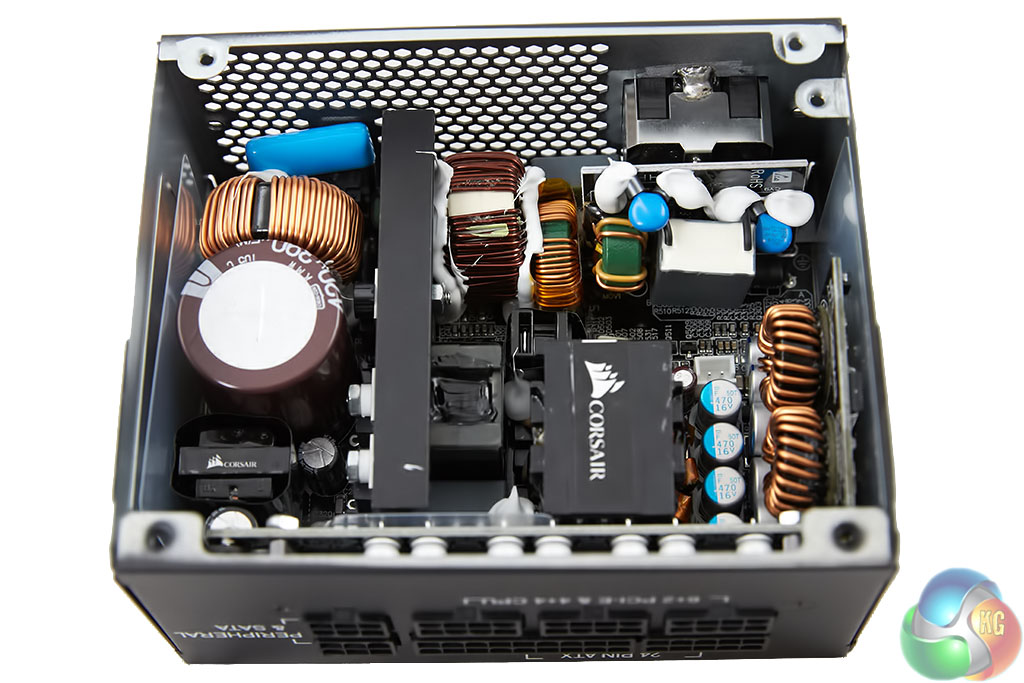
Corsair are using Great Wall as the OEM partner for these supplies. Soldering quality is good throughout and the layout is clean. This is critical as there is not a lot of room in such a small chassis.
The modular connector board is installed in one side of the unit. Close by we can see there is a Diode bridge for AC/DC rectification of the incoming AC voltage. We can see the +3.3V and +5V voltage is generated from the +12V.
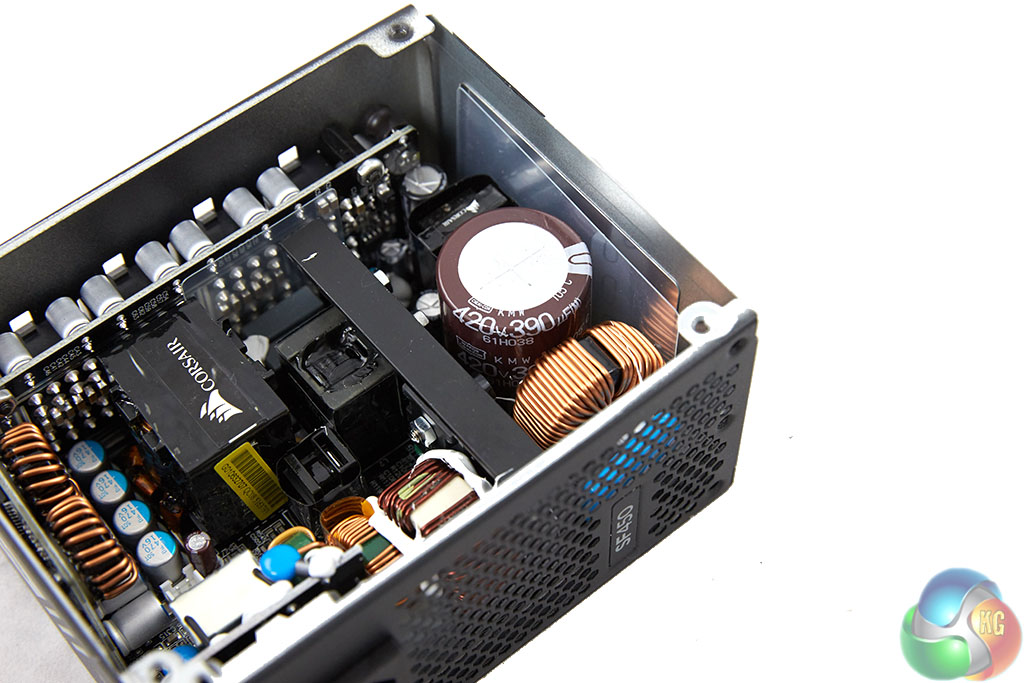
Corsair are using a 105C Japanese grade capacitor from Nippon Chemi Con in the primary stage, rated 420V 390uF. This capacitor is from their KMW series. There is full support for OCP, OVP, UVP, SCP, OTP and OPP.
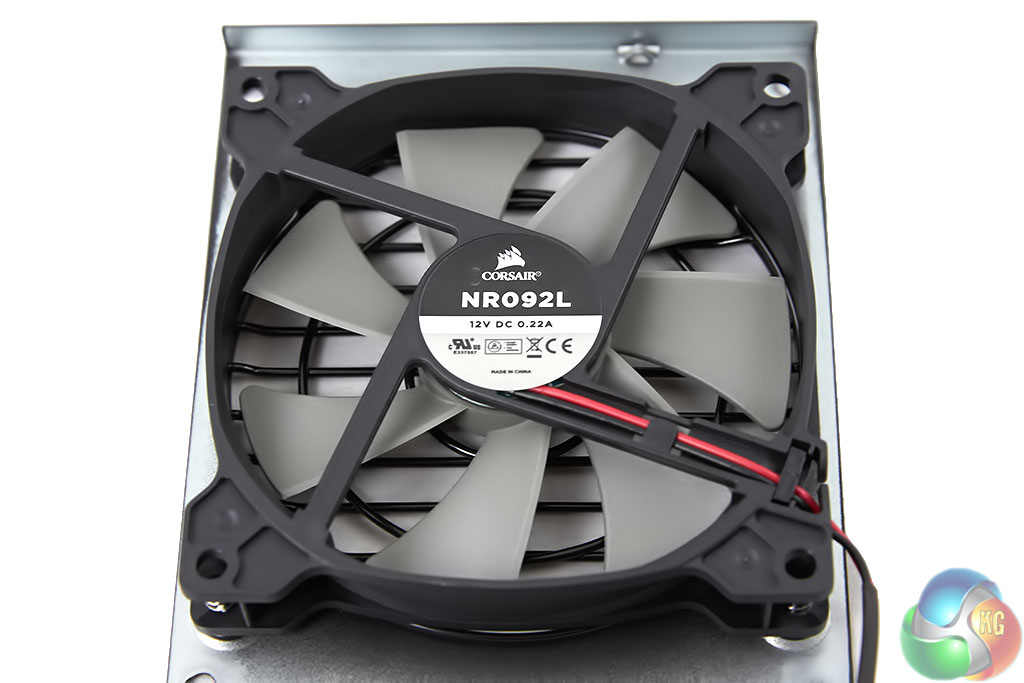
Corsair have adopted a NR092L fan inside the SF 600 – the exact same fan installed in the SF 450. This is rated 12V, 0.22A. There is very little, if any information on this fan online.
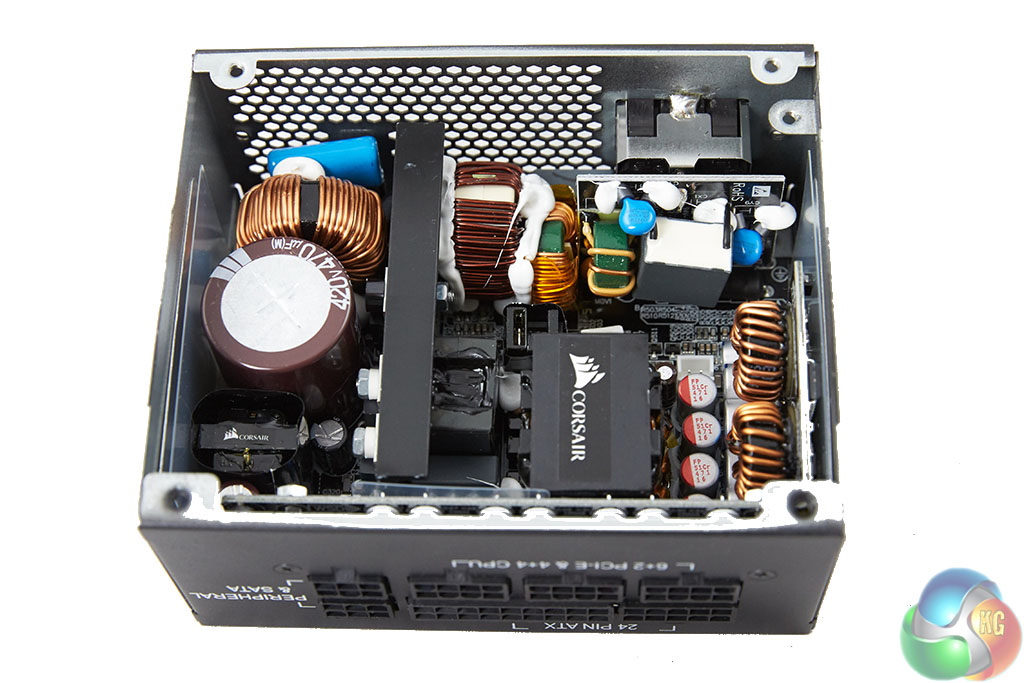
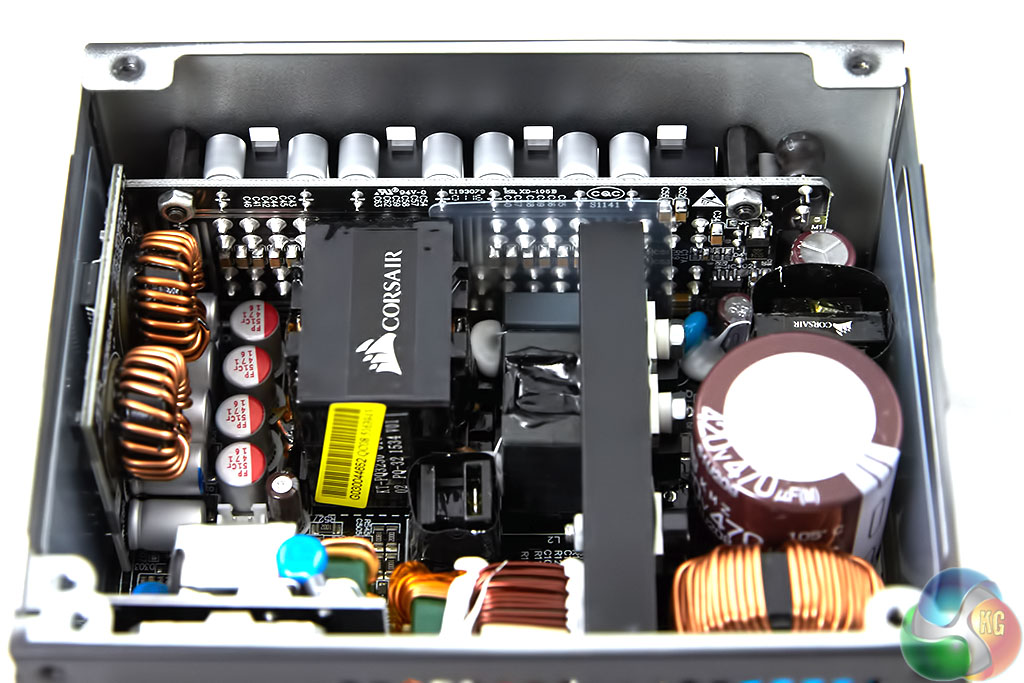
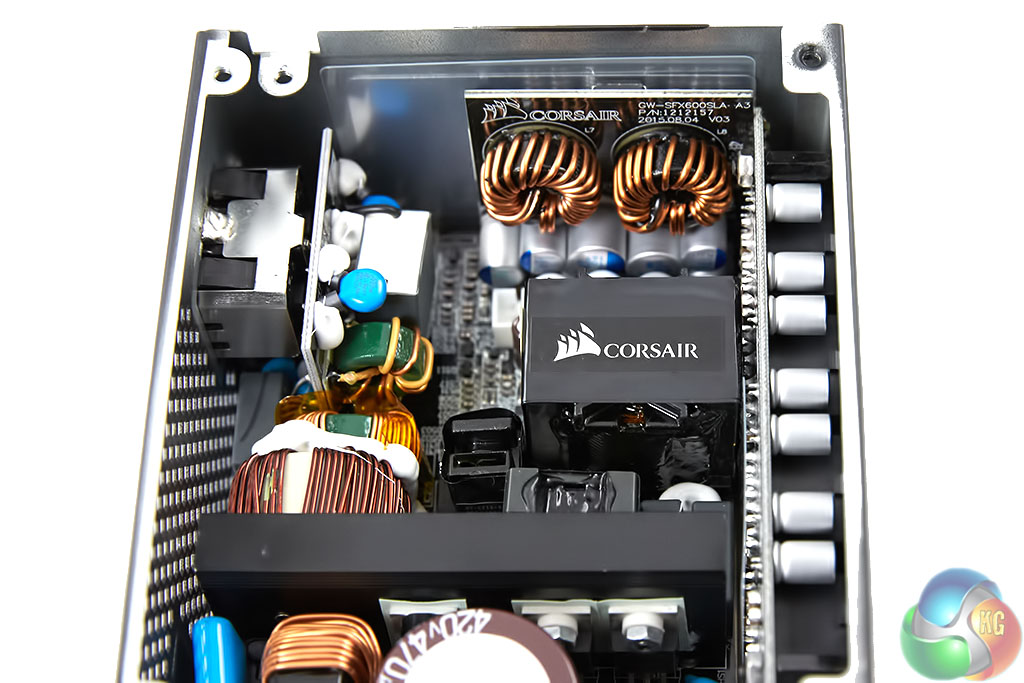
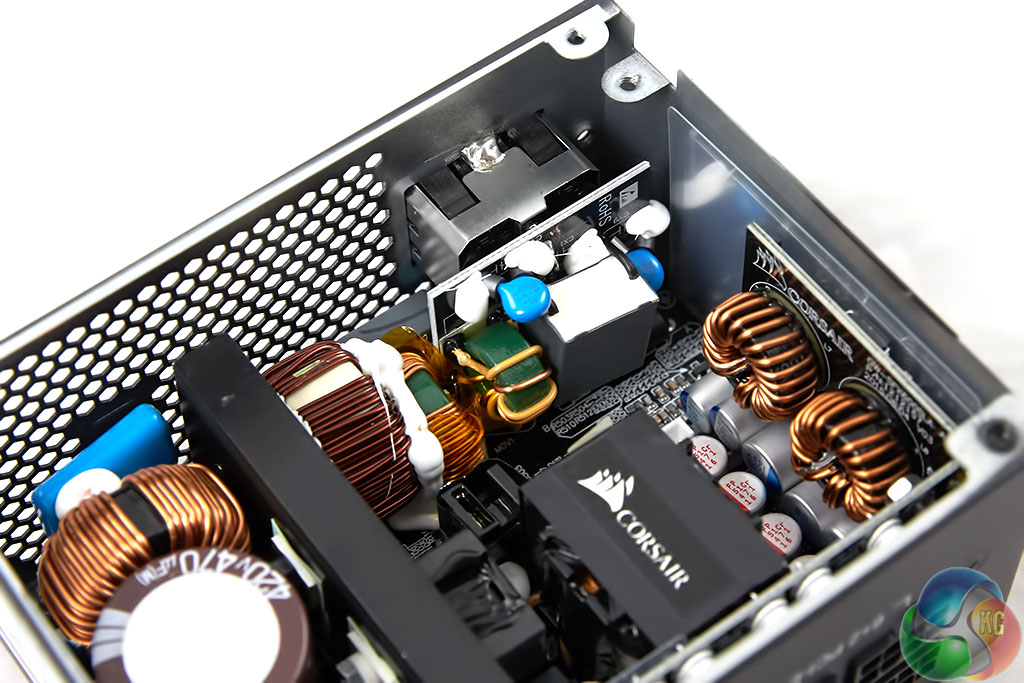
Corsair are using Great Wall as the OEM partner for these supplies. Soldering quality is good throughout and the layout is clean. This is critical as there is not a lot of room in such a small chassis.
The modular connector board is installed in one side of the unit. Close by we can see there is a Diode bridge for AC/DC rectification of the incoming AC voltage. We can see the +3.3V and +5V voltage is generated from the +12V.
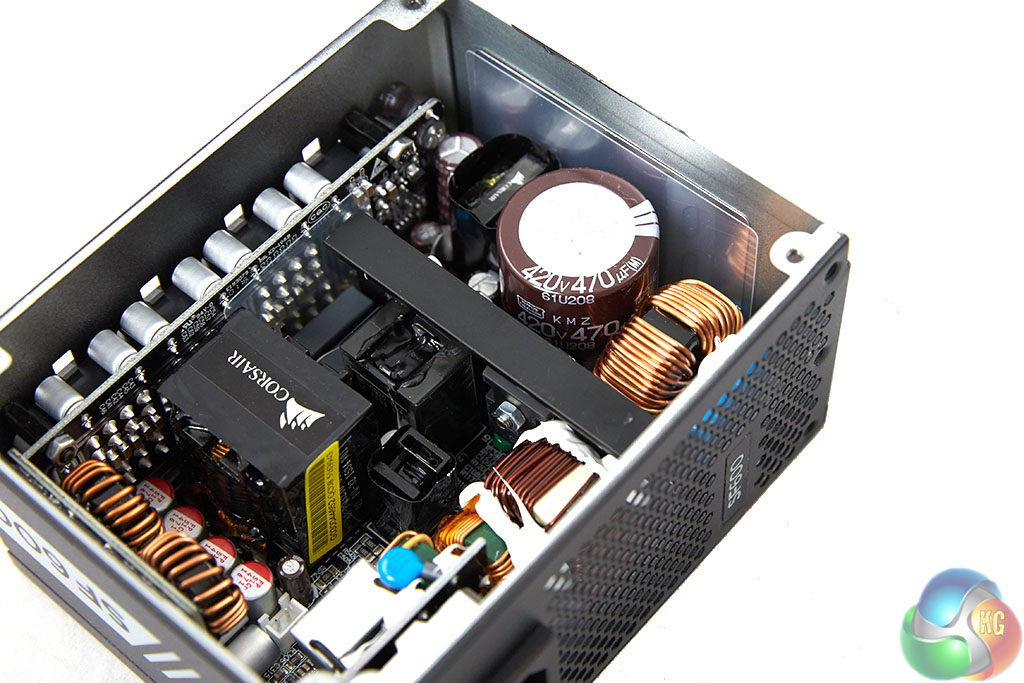
Corsair are using a 105C Japanese grade capacitor from Nippon Chemi Con in the primary stage, rated 420V 470uF. This capacitor is from their KMZ series. There is full support for OCP, OVP, UVP, SCP, OTP and OPP.
Additional technical assistance: Peter McFarland and Jeremy Price.
Correctly testing power supplies is a complex procedure and KitGuru have configured a test bench which can deliver up to a 2,000 watt DC load. Due to public requests we have changed our temperature settings recently – previously we rated with ambient temperatures at 25C, we have increased ambient temperatures by 10c (to 35c) in our environment to greater reflect warmer internal chassis conditions.
We use combinations of the following hardware:
• SunMoon SM-268
• CSI3710A Programmable DC load (+3.3V and +5V outputs)
• CSI3711A Programmable DC load (+12V1, +12V2, +12V3, and +12V4)
• Extech Power Analyzer
• Extech MultiMaster MM570 digital multimeter
• SkyTronic DSL 2 Digital Sound Level Meter (6-130dBa)
• Digital oscilloscope (20M S/s with 12 Bit ADC)
• Variable Autotransformer, 1.4 KVA
|
DC Output Load Regulation
|
||||||||
|
Combined DC Load |
+3.3V
|
+5V
|
+12V
|
+5VSB
|
||||
|
A
|
V
|
A
|
V
|
A
|
V
|
A
|
V
|
|
|
75W
|
1.02
|
3.35
|
1.45
|
5.05
|
4.88
|
12.07
|
0.50
|
5.02
|
|
150W
|
2.43
|
3.34
|
3.15
|
5.05
|
9.72
|
12.05
|
1.00
|
5.02
|
|
250W
|
3.64
|
3.34
|
5.18
|
5.04
|
16.53
|
12.04
|
1.50
|
5.02
|
| 350W |
4.93
|
3.34
|
7.08
|
5.04
|
23.51
|
12.03
|
2.00
|
5.02 |
|
450W
|
6.77
|
3.34
|
9.16
|
5.03
|
32.76
|
12.02
|
2.50
|
5.01
|
Load regulation is excellent and all output maintain close to reference results.
| Corsair SF 450 | Maximum Load |
| 519 watts |
We managed to push the supply to 519 watts before it would shut down safely.
Next we want to try Cross Loading. This basically means loads which are not balanced. If a PC for instance needs 500W on the +12V outputs but something like 30W via the combined 3.3V and +5V outputs then the voltage regulation can fluctuate badly.
| Cross Load Testing | +3.3V | +5V | +12V | -12V | +5VSB | |||||
| A | V | A | V | A | V | A | V | A | V | |
| 386W | 2.0 | 3.35 | 2.0 | 5.05 | 30.0 | 12.01 | 0.2 | -12.03 | 0.50 | 5.02 |
| 171W | 18.0 | 3.33 | 12.0 | 5.02 | 4.0 | 12.06 | 0.2 | -12.04 | 0.50 | 5.01 |
Our first test placed a heavy load (30a) on the +12 V output with a light load on the remaining voltages. The power supply had no problems dealing with the load changes.
We then used an oscilloscope to measure AC ripple and noise present on the DC outputs. We set the oscilloscope time base to check for AC ripple at both high and low ends of the spectrum.
ATX12V V2.2 specification for DC output ripple and noise is defined in the ATX 12V power supply design guide.
|
ATX12V Ver 2.2 Noise/Ripple Tolerance
|
|
|
Output
|
Ripple (mV p-p)
|
|
+3.3V
|
50
|
|
+5V
|
50
|
|
+12V1
|
120
|
|
+12V2
|
120
|
|
-12V
|
120
|
|
+5VSB
|
50
|
Obviously when measuring AC noise and ripple on the DC outputs the cleaner (less recorded) means we have a better end result. We measured this AC signal amplitude to see how closely the unit complied with the ATX standard.
| AC Ripple (mV p-p) | ||||
| DC Load | +3.3V | +5V | +12V | 5VSB |
| 75W | 10 | 10 | 15 | 5 |
| 150W | 10 | 10 | 20 | 5 |
| 250W | 15 | 10 | 25 | 5 |
| 350W | 15 | 15 | 30 | 10 |
| 450W | 15 | 15 | 30 | 10 |
Ripple suppression is stellar, with both +3.3V and +5V peaking at 15mV. The +12V rail hit a maximum of 30mV at full load.
|
Efficiency (%)
|
|
|
75W
|
86.75
|
|
150W
|
88.33
|
|
250W
|
92.04
|
|
350W
|
90.34
|
|
450W
|
88.85
|
The Corsair SF450 is a very efficient unit, peaking at around 92% at 50% load. This drops to around 89% at full load.
We take the issue of noise very seriously at KitGuru and this is why we have built a special home brew system as a reference point when we test noise levels of various components. Why do this? Well this means we can eliminate secondary noise pollution in the test room and concentrate on components we are testing. It also brings us slightly closer to industry standards, such as DIN 45635.
Today to test the Power Supply we have taken it into our acoustics room environment and have set our SkyTronic DSL 2 Digital Sound Level Meter (6-130dBa) one meter away from the unit. We have no other fans running so we can effectively measure just the noise from the unit itself.
As this can be a little confusing for people, here are various dBa ratings in with real world situations to help describe the various levels.
KitGuru noise guide
10dBA – Normal Breathing/Rustling Leaves
20-25dBA – Whisper
30dBA – High Quality Computer fan
40dBA – A Bubbling Brook, or a Refridgerator
50dBA – Normal Conversation
60dBA – Laughter
70dBA – Vacuum Cleaner or Hairdryer
80dBA – City Traffic or a Garbage Disposal
90dBA – Motorcycle or Lawnmower
100dBA – MP3 Player at maximum output
110dBA – Orchestra
120dBA – Front row rock concert/Jet Engine
130dBA – Threshold of Pain
140dBA – Military Jet takeoff/Gunshot (close range)
160dBA – Instant Perforation of eardrum
|
Noise (dBA)
|
|
|
75W
|
<28.0
|
|
150W
|
<28.0
|
|
250W
|
31.4
|
|
350W
|
32.2
|
| 450W | 33.3 |
The 92mm fan spins slowly under 200 watts load, spinning up at around 300W and greater. At full load you can barely hear the fan.
|
Temperature (c)
|
||
|
Intake
|
Exhaust
|
|
|
75W
|
35
|
38
|
|
150W
|
36
|
44
|
|
250W
|
39
|
48
|
|
350W
|
42
|
58
|
|
450W
|
45
|
60
|
The supply holds a good temperature variable – rising to a 15c peak at full load.
|
Maximum load
|
Efficiency
|
|
519W
|
88.33
|
Pushing the power supply above its rated limits generates an efficiency level of around 88%. This is not a viable ‘real world’ situation, but its interesting nonetheless.Additional technical assistance: Peter McFarland and Jeremy Price.
Correctly testing power supplies is a complex procedure and KitGuru have configured a test bench which can deliver up to a 2,000 watt DC load. Due to public requests we have changed our temperature settings recently – previously we rated with ambient temperatures at 25C, we have increased ambient temperatures by 10c (to 35c) in our environment to greater reflect warmer internal chassis conditions.
We use combinations of the following hardware:
• SunMoon SM-268
• CSI3710A Programmable DC load (+3.3V and +5V outputs)
• CSI3711A Programmable DC load (+12V1, +12V2, +12V3, and +12V4)
• Extech Power Analyzer
• Extech MultiMaster MM570 digital multimeter
• SkyTronic DSL 2 Digital Sound Level Meter (6-130dBa)
• Digital oscilloscope (20M S/s with 12 Bit ADC)
• Variable Autotransformer, 1.4 KVA
12V output is combined for our testing.
|
DC Output Load Regulation
|
||||||||||
|
Combined DC Load |
+3.3V
|
+5V
|
+12V
|
+5VSB
|
-12V | |||||
|
A
|
V
|
A
|
V
|
A
|
V
|
A
|
V
|
A | V | |
|
75W
|
1.09
|
3.35
|
1.47
|
5.04
|
4.92
|
12.05
|
0.50
|
5.03
|
0.20
|
-12.03
|
|
150W
|
2.09
|
3.35
|
2.97
|
5.04
|
10.02
|
12.03
|
0.50
|
5.02
|
0.30
|
-12.03
|
|
300W
|
4.30
|
3.34
|
6.00
|
5.03
|
20.58
|
12.02
|
1.00
|
5.02
|
0.30
|
-12.04
|
| 450W |
6.57
|
3.33
|
8.48
|
5.01
|
31.79
|
12.00
|
1.50
|
5.02 |
0.30
|
-12.05
|
|
600W
|
9.94
|
3.33
|
12.20
|
5.00
|
41.78
|
11.98
|
2.50
|
5.01
|
0.30
|
-12.06
|
The Corsair SF600 delivers very good load regulation results.
| Corsair SF 600 watt | Maximum Load |
| 653W |
We managed to get 653W out of the Corsair SF600 before it shut down gracefully.
Next we want to try Cross Loading. This basically means loads which are not balanced. If a PC for instance needs 500W on the +12V outputs but something like 30W via the combined 3.3V and +5V outputs then the voltage regulation can fluctuate badly.
| Cross Load Testing | +3.3V | +5V | +12V | -12V | +5VSB | |||||
| A | V | A | V | A | V | A | V | A | V | |
| 590W | 1.0 | 3.35 | 1.0 | 5.03 | 46.0 | 11.97 | 0.2 | -12.04 | 0.50 | 5.02 |
| 145W | 12.0 | 3.33 | 15.0 | 5.00 | 2.0 | 12.05 | 0.2 | -12.02 | 0.50 | 5.03 |
The supply handled the cross loading tests with flying colours, with minor fluctuation on the +12V rail.
We then used an oscilloscope to measure AC ripple and noise present on the DC outputs. We set the oscilloscope time base to check for AC ripple at both high and low ends of the spectrum. ATX12V V2.2 specification for DC output ripple and noise is defined in the ATX 12V power supply design guide.
|
ATX12V Ver 2.2 Noise/Ripple Tolerance
|
|
|
Output
|
Ripple (mV p-p)
|
|
+3.3V
|
50
|
|
+5V
|
50
|
|
+12V1
|
120
|
|
+12V2
|
120
|
|
-12V
|
120
|
|
+5VSB
|
50
|
Obviously when measuring AC noise and ripple on the DC outputs the cleaner (less recorded) means we have a better end result. We measured this AC signal amplitude to see how closely the unit complied with the ATX standard.
| AC Ripple (mV p-p) | ||||
| DC Load | +3.3V | +5V | +12V | 5VSB |
| 75W | 10 | 10 | 15 | 5 |
| 150W | 10 | 10 | 20 | 5 |
| 300W | 10 | 10 | 25 | 10 |
| 450W | 15 | 15 | 30 | 10 |
| 600W | 15 | 15 | 30 | 10 |
Noise suppression rates as very good, with both +3.3V and +5V rails peaking at 15mV at full load. The +12V rail peaks at 30mV at full load. All well within rated industry parameters.
|
Efficiency (%)
|
|
|
75W
|
86.32
|
|
150W
|
88.45
|
|
300W
|
92.21
|
|
450W
|
90.67
|
|
600W
|
88.91
|
Efficiency peaks at 92.2% percent at 50% load, dropping to around 89% at full load.
We take the issue of noise very seriously at KitGuru and this is why we have built a special home brew system as a reference point when we test noise levels of various components. Why do this? Well this means we can eliminate secondary noise pollution in the test room and concentrate on components we are testing. It also brings us slightly closer to industry standards, such as DIN 45635.
Today to test the Power Supply we have taken it into our acoustics room environment and have set our SkyTronic DSL 2 Digital Sound Level Meter (6-130dBa) one meter away from the unit. We have no other fans running so we can effectively measure just the noise from the unit itself.
As this can be a little confusing for people, here are various dBa ratings in with real world situations to help describe the various levels.
KitGuru noise guide
10dBA – Normal Breathing/Rustling Leaves
20-25dBA – Whisper
30dBA – High Quality Computer fan
40dBA – A Bubbling Brook, or a Refridgerator
50dBA – Normal Conversation
60dBA – Laughter
70dBA – Vacuum Cleaner or Hairdryer
80dBA – City Traffic or a Garbage Disposal
90dBA – Motorcycle or Lawnmower
100dBA – MP3 Player at maximum output
110dBA – Orchestra
120dBA – Front row rock concert/Jet Engine
130dBA – Threshold of Pain
140dBA – Military Jet takeoff/Gunshot (close range)
160dBA – Instant Perforation of eardrum
|
Noise (dBA)
|
|
|
75W
|
<28.0
|
|
150W
|
<28.0
|
|
300W
|
<28.0
|
|
450W
|
33.8
|
| 600W | 36.2 |
The same fan is used in both SF450 and SF600 power supplies however it has to work harder in the SF600 unit as temperatures rise further above 500 watts load. As such, noise levels are higher, as shown above.
|
Temperature (c)
|
||
|
Intake
|
Exhaust
|
|
|
75W
|
35
|
39
|
|
150W
|
35
|
45
|
|
300W
|
37
|
52
|
|
450W
|
41
|
58
|
|
600W
|
44
|
64
|
The large fan manages to hold a good thermal curve rising to +20c above ambient at full load.
|
Maximum load
|
Efficiency
|
|
653W
|
88.2
|
At 653W the supply drops to 88.2% efficiency. This is not a viable ‘real world’ situation, but its interesting nonetheless.
The Corsair SF450 and SF600 are power supplies designed for specific small form factor, space restricted environments and we have no hestitation in giving them both a very high recommendation.
Cosmetically, we love the understated design and paintwork, including the pure modular implementation which will prove popular with the enthusiast audience. The modular cables are high grade, flat ribbon style, suited to the audience who want to achieve the best looking build with good air flow around hot running components.
Many small SFX power supplies are hampered with sub 80mm fans spinning at extreme speeds however Corsair's adoption of a larger 92mm fan in both units has proven very practical indeed.
Noise levels are low for a power supply of this diminuitive stature as the large blades are able to shift a lot of air to guarantee stable operation. The fan only has to work hard when the larger 600 watt unit is close to the limit, so most times noise levels will be very low.
Technically the design is solid. Load regulation from both supplies is stellar, and ripple suppression rates very highly indeed peaking at 15mV via both +3.3V and +5V rails. The +12V rails both peak at 30mV at full load, which is well within industry rated tolerance safety levels. Both units hit very high levels of efficiency, peaking at just over 92% around 50% load.
Unlike some of their competitors, Corsair have incorporated 105c Japanese Capacitors throughout these SF supplies, which earns them bonus points. It is always reassuring to find a company spending a little extra on Nippon Chemi Con or Rubycon capacitors – long term it makes sense.
The Corsair SF400 and SF600 will be available this week online for £64.99 and £94.99 inc vat respectively. Due to their niche nature SFX power supplies are expensive but we are confident that these Corsair models are some of the best on the market. We powered a liquid cooled overclocked Core 6700k system with Titan X graphics card, 32GB of memory, and multiple hard drives from the SF600 and it was completely stable over the course of a weeks intensive stress testing.
Discuss on our Facebook page, over HERE.
Pros:
- lovely understated appearance.
- 105C Japanese capacitors.
- 92mm low noise fans.
- can deliver over their rated power before shut off.
- ripple suppression.
- load regulation.
- High levels of efficiency.
- 5 year warranty
Cons:
- SFX power supplies are expensive.
Kitguru says: Both Corsair SF450 and SF600 power supplies are technically solid designs and will be ideal for many small form factor system builds. The adoption of an effective, large 92mm fan and 105c Japanese capacitors ensure they will deliver quality power for a long time.


It would have been nice to have a direct comparison with the Silverstone versions. I have a SX600-G myself and sometimes I think I can hear the fan getting a bit noisier than I would like. It’s in a small case (Case: Fractal Design Core 500), so it’s not always easy to hear what is causing the noise. I also have a weird chirping echo after about 15 minutes from cold boot. I still haven’t figured out what that is. I can hear a slight squeaking noise that gets slightly louder (still all very quiet) and then it does the echoing noise. After that it stops making the sound. But I still haven’t figured out what is causing it. It doesn’t seem to cause any problems, so I’m not too fussed as it’s too much effort to keep taking it apart.
Were these tested at 115VAC input or 230VAC input? I noticed you listed a Variac in your list of test equipment so you can better sync with Ecova’s test results, but it doesn’t hurt to ask. 😉
it said 7 years warranty on the corsair web
The site SWEclockers seem to have gotten a better model, measuring only 23 mV max ripple on the 12 Volt rail.. I guess that could be manufacturing variance or a different approach to taking measurements. :p
Either way, I’m glad I found this PSU. There’s some PSU test site that tests in far more detail than Kitguru, but I couldn’t remember the site’s name. That’s not to say Kitguru’s test was insufficient – they make a lot more effort than most other sites that “test” PSU’s.
My Sharkoon 600W SFX-L wasn’t bad, but it ran hotter and its modular connectors were pushing hard against the back of the GPU in my NCase M1. A little too close for NCase’s claim that SFX-L PSUs will “fit”.
I never bought anything from Corsair before, but I might check out their coolers, since my Noctua cooler refused to fit into my case as well…
Silverstone has some brilliant engineering for case layout and airflow. But the company has a bad habit of building things as cheaply as possible. Granted, I’m used to Lian Li, which is at about the opposite end of the quality spectrum, but Lian Li too often bumbles space optimization and cooling concepts instead. Its anyone’s guess what’s worse in the end.
But after having built in some of Silverstone’s cases, I stopped well short of wanting to gamble on one of their PSUs, especially because I couldn’t find any thorough test at the time. Too many sites call something “test” and then just paraphrase the corporate press release for the product.
At any rate, if your PC is running and never has random crashes, your’s must be good enough. The only way to reduce the noise from your SX600G would be to put in a better and/or larger fan, voiding the warranty in the process.
If I was you and the noise got on my nerves, I’d buy the Corsair PSU and ebay the other one, while its still a current model.