KitGuru KitGuru.net – Tech News | Hardware News | Hardware Reviews | IOS | Mobile | Gaming | Graphics Cards


Today marks AMD's first GPU launch for five months, with the company unleashing its new RX 6600 XT. Designed to offer the ultimate 1080p gaming experience, AMD claims the RX 6600 XT has the beating of Nvidia's RTX 3060, and accordingly has set pricing higher at $379 MSRP. We put this card through its paces and compare it to a wide range of both current and former-generation GPUs.
The first three RDNA 2-based GPUs – the RX 6900 XT, RX 6800 XT and RX 6800 – all used Navi 21 silicon, while the RX 6700 XT made use of Navi 22. Now, with the new RX 6600 XT, AMD has introduced Navi 23, its smallest RDNA 2-based GPU yet, measuring just 237 mm². While this reduces the number of Compute Units, stream processors, ray accelerators and so on, it's also interesting to see AMD opt for a 128-bit memory interface.
That allows the company to comfortably pair the GPU with 8GB of memory – avoiding the situation as seen with the RTX 3060, where Nvidia's mid-range GPU has more VRAM than even the RTX 3080. It is, however, a relatively narrow bus for a GPU of this price class, and while AMD has its Infinity Cache to fall back on, there's only 32MB of it here, compared to 96MB on the RX 6700 XT.
That may be why AMD chose to focus the 6600 XT solely on 1080p gaming, a resolution where the GPU is less likely to be constrained by memory bandwidth than at 1440p. We will, however, be testing this GPU across 1080p, 1440p and even 4K resolutions throughout this review.
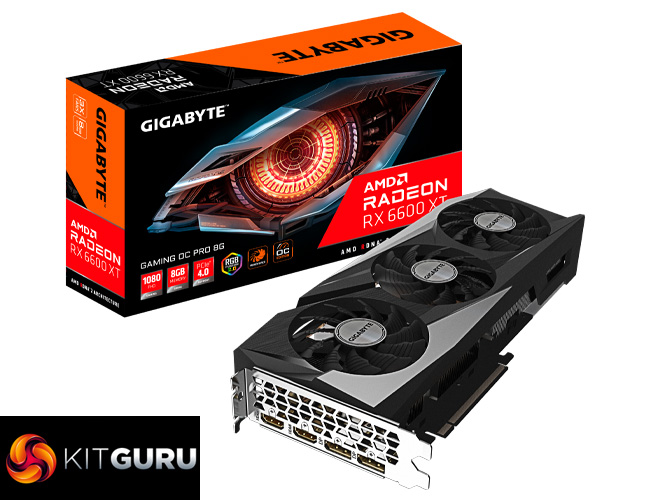
It is also worth making clear that the RX 6600 XT is an ‘AIB-only' launch, meaning there's no AMD reference card. For this review, AMD sampled us directly with a Gigabyte RX 6600 XT Gaming OC Pro 8G, Gigabyte's flagship 6600 XT offering.
| RX 6900 XT | RX 6800 XT | RX 6800 | RX 6700 XT | RX 6600 XT | |
| Architecture | RDNA 2 | RDNA 2 | RDNA 2 | RDNA 2 | RDNA 2 |
| Manufacturing Process | 7nm | 7nm | 7nm | 7nm | 7nm |
| Transistor Count | 26.8 billion | 26.8 billion | 26.8 billion | 17.2 billion | 11.1 billion |
| Die Size | 519 mm² | 519 mm² | 519 mm² | 336 mm² | 237 mm² |
| Ray Accelerators | 80 | 72 | 60 | 40 | 32 |
| Compute Units | 80 | 72 | 60 | 40 | 32 |
| Stream Processors | 5120 | 4608 | 3840 | 2560 | 2048 |
| Game GPU Clock | Up to 2015MHz | Up to 2015MHz | Up to 1815MHz | Up to 2424MHz | Up to 2359MHz |
| Boost GPU Clock | Up to 2250MHz | Up to 2250MHz | Up to 2105MHz | Up to 2581MHz | Up to 2589MHz |
| Peak SP Performance | Up to 23.04 TFLOPS | Up to 20.74 TFLOPS | Up to 16.17 TFLOPS | Up to 13.21 TFLOPS | Up to 10.6 TFLOPS |
| Peak Half Precision Performance | Up to 46.08 TFLOPS | Up to 41.47 TFLOPS | Up to 32.33 TFLOPS | Up to 26.43 TFLOPS | Up to 21.21 TFLOPS |
| Peak Texture Fill-Rate | Up to 720 GT/s | Up to 648.0 GT/s | Up to 505.2 GT/s | Up to 413.0 GT/s | Up to 331.4 GT/s |
| ROPs | 128 | 128 | 96 | 64 | 64 |
| Peak Pixel Fill-Rate | Up to 288.0 GP/s | Up to 288.0 GP/s | Up to 202.1 GP/s | Up to 165.2 GP/s | Up to 165.7 GP/s |
| AMD Infinity Cache | 128MB | 128MB | 128MB | 96MB | 32MB |
| Memory | 16GB GDDR6 | 16GB GDDR6 | 16GB GDDR6 | 12GB GDDR6 | 8GB GDDR6 |
| Memory Bandwidth | 512 GB/s | 512 GB/s | 512 GB/s | 384 GB/s | 256 GB/s |
| Memory Interface | 256-bit | 256-bit | 256-bit | 192-bit | 128-bit |
| Board Power | 300W | 300W | 250W | 230W | 160W |
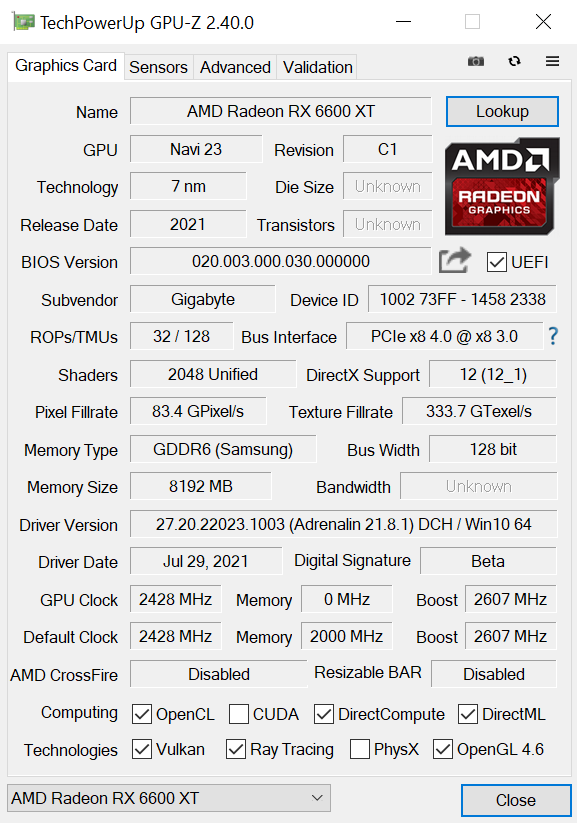
As a spec recap, RX 6600 XT is built using the new Navi 23 GPU, a physically small die, measuring just 237 mm². It houses 32 Compute Units (CUs), with 64 stream processors per CU, giving a total of 2048. RX 6600 XT features a fully populated Navi 23 GPU, but we can expect a cut-down version to appear with the rumoured RX 6600.
RDNA 2 houses one ray accelerator per CU, so there’s a total of 32 with the RX 6600 XT. Four texture units per CU gives a total of 128, while there’s also 64 ROPs. Clock speed remains at the lofty heights that we saw from the RX 6700 XT, as the 6600 XT's rated game clock of 2589MHz is 8MHz above that of the RX 6700 XT.
As for the memory configuration, AMD has opted to use a 128-bit memory interface paired with 8GB of GDDR6 memory. Using 16Gbps modules, total memory bandwidth hits 256 GB/s, lower than even the last-generation RX 5600 XT . RDNA 2 GPUs, however, have the benefit of AMD’s Infinity Cache, but even that is reduced, with just a 32MB cache used here.
Lastly, total board power (TBP) is rated at 160W, a reduction of 70W, or almost 30%, compared to the RX 6700 XT. We are using our new GPU power testing methodology in this review, so read on for our most detailed power and efficiency testing yet.
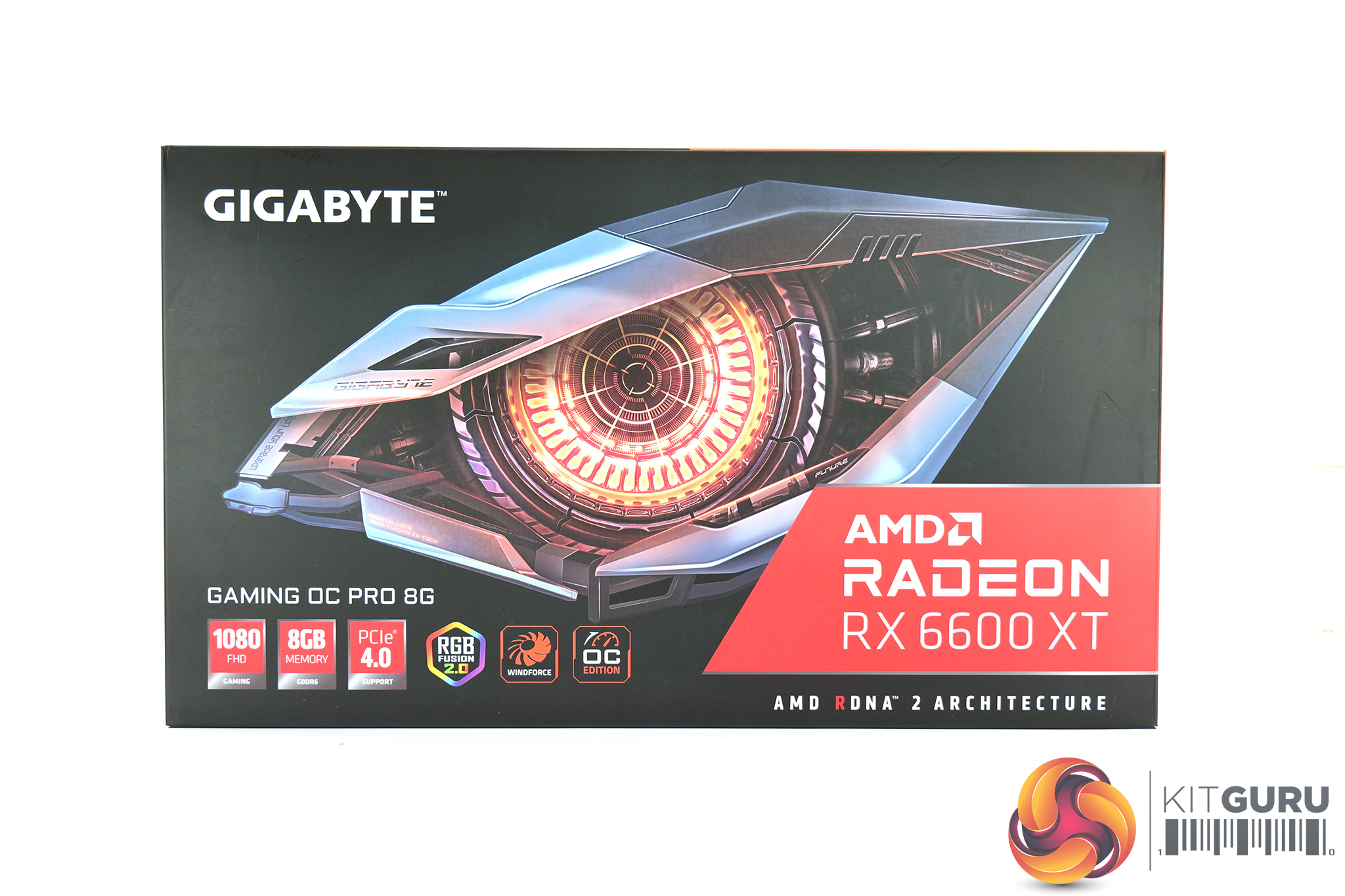
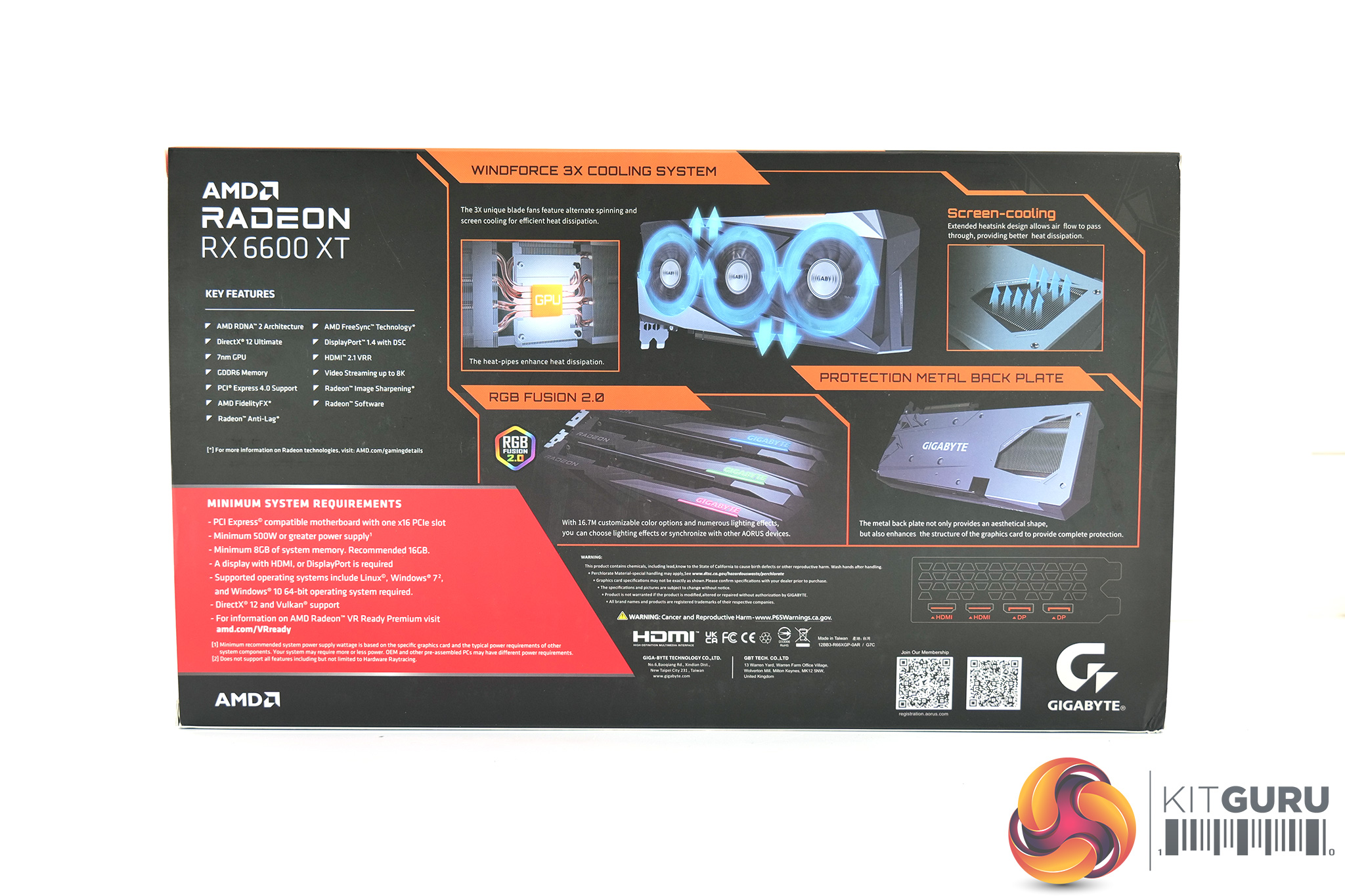
The Gigabyte RX 6600 XT Gaming OC Pro 8G ships in a familiar-looking box, with Gigabyte's robotic eye logo dominating the front. On the back, the company highlights a few key features, including the fan layout, direct heatpipe contact and ‘Screen Cooling.'
Inside, we find a single piece of documentation – a quick start guide.
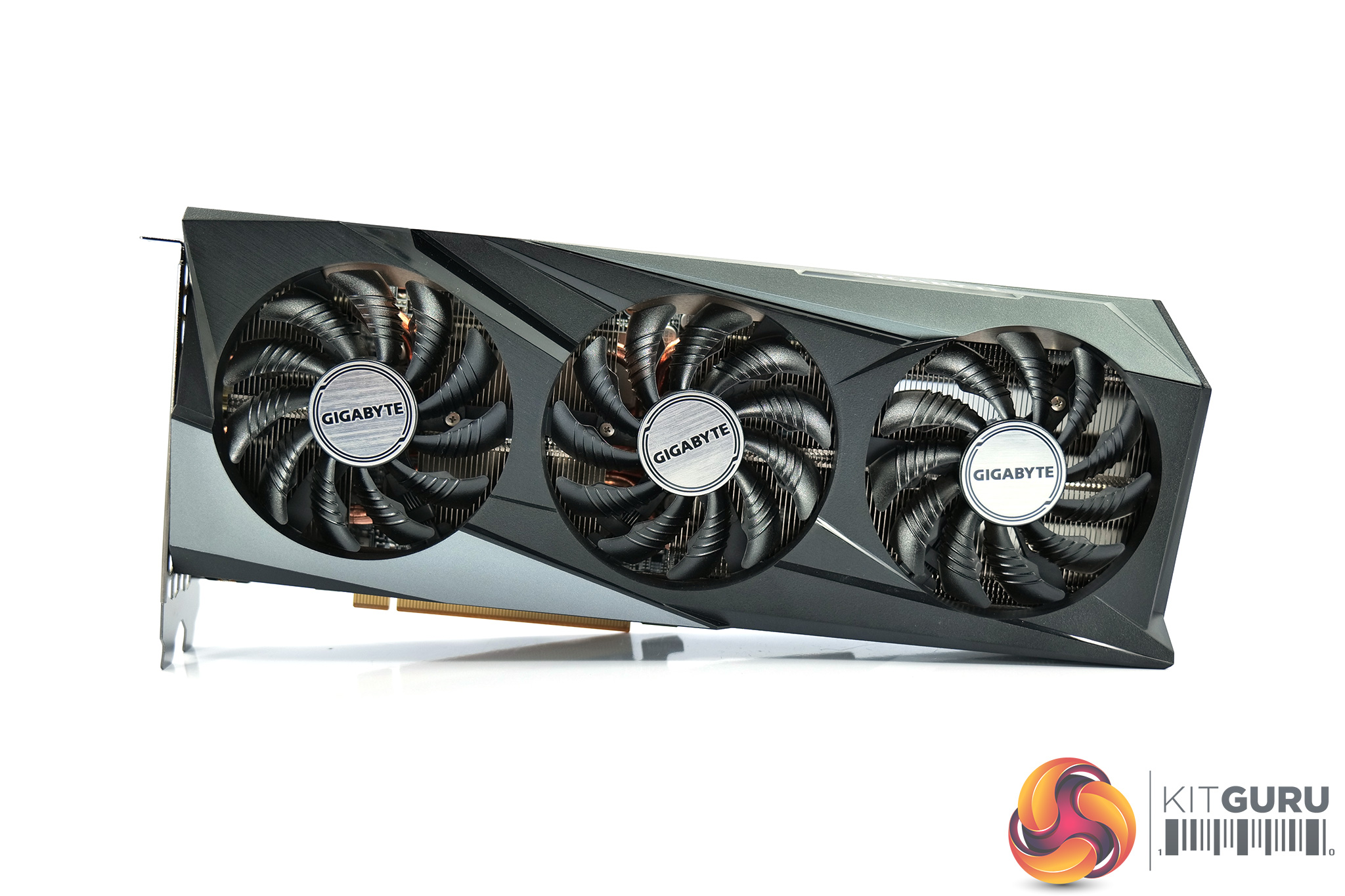
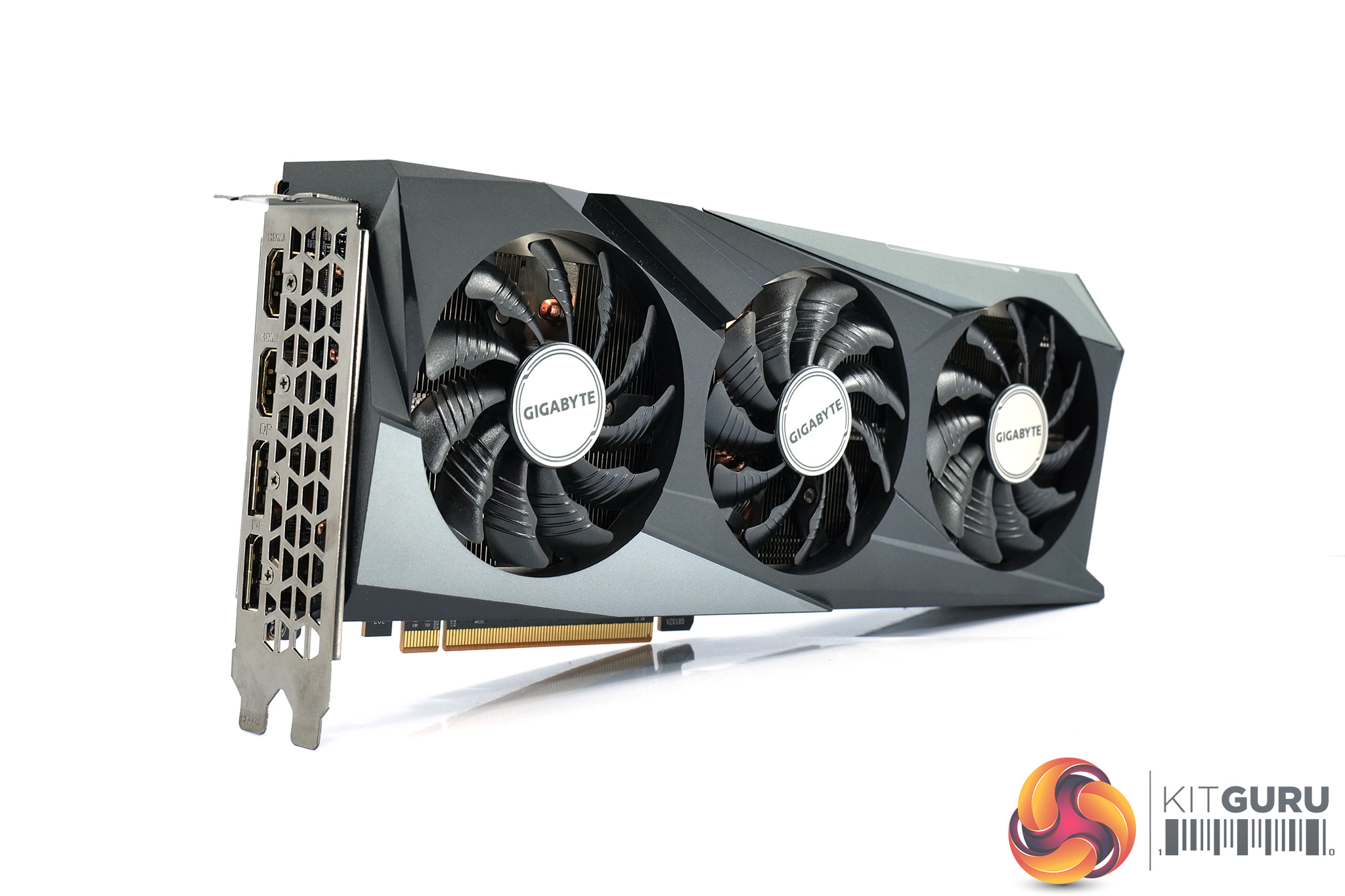
As for the card itself, we've reviewed plenty of Gaming OC cards from Gigabyte this GPU generation, and the 6600 XT Gaming OC Pro is very much part of the family. That means Gigabyte is using its tried-and-trusted black and grey plastic shroud, with a total of three 80mm fans. As always, the central fan spins in reverse, relative to the outer two, which Gigabyte claims helps to reduce overall turbulence, and thus increase airflow pressure down onto the heatsink itself.
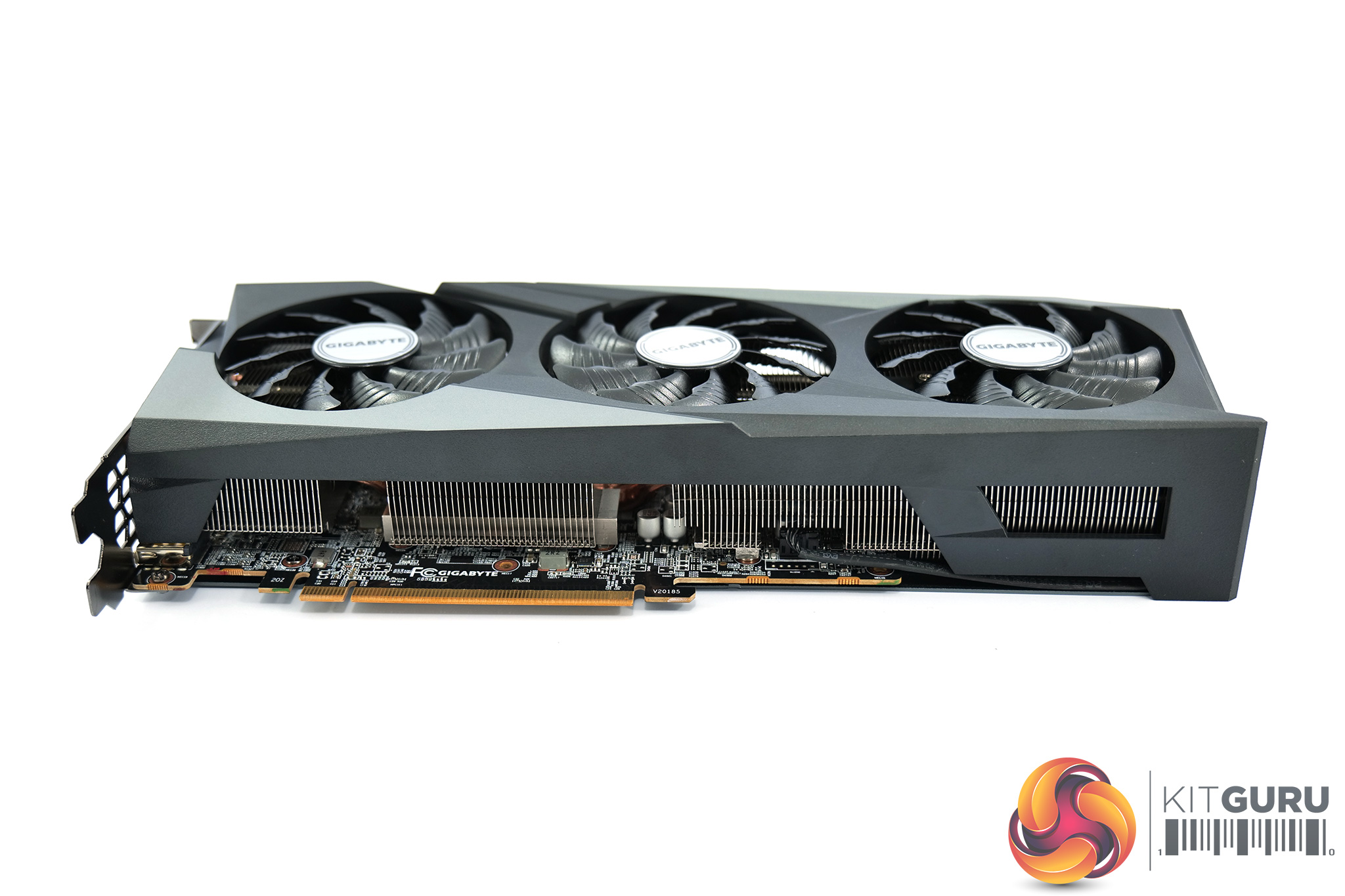
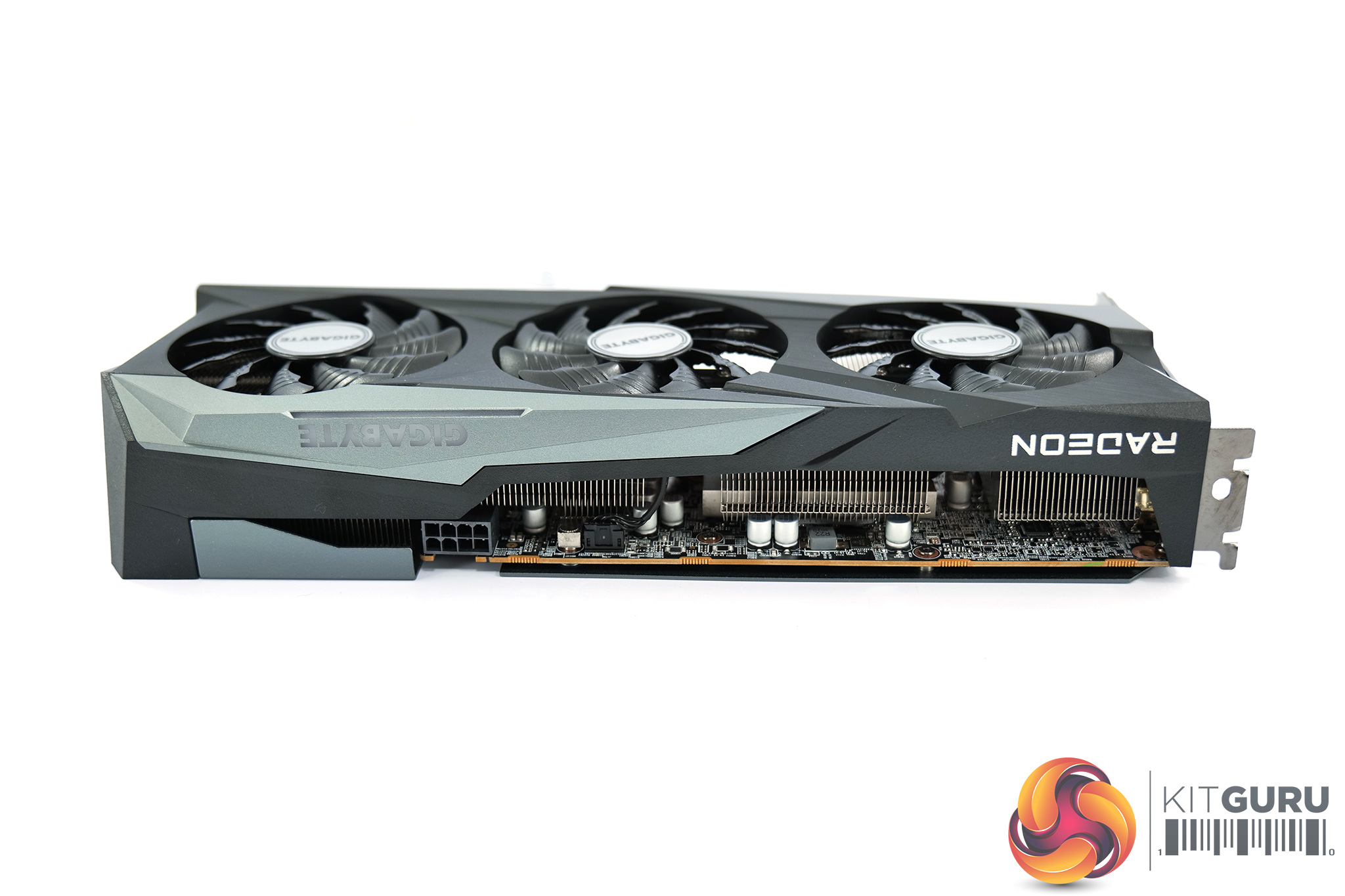
For a 6600 XT, we'd expect this card to be one of the bigger models considering the fairly low 160W total board power (TBP) rating – the Gaming OC Pro measures 282 x 115 x 50mm. It should still fit in most cases on the market, but it's not exactly a dinky single-fan, dual-slot solution.
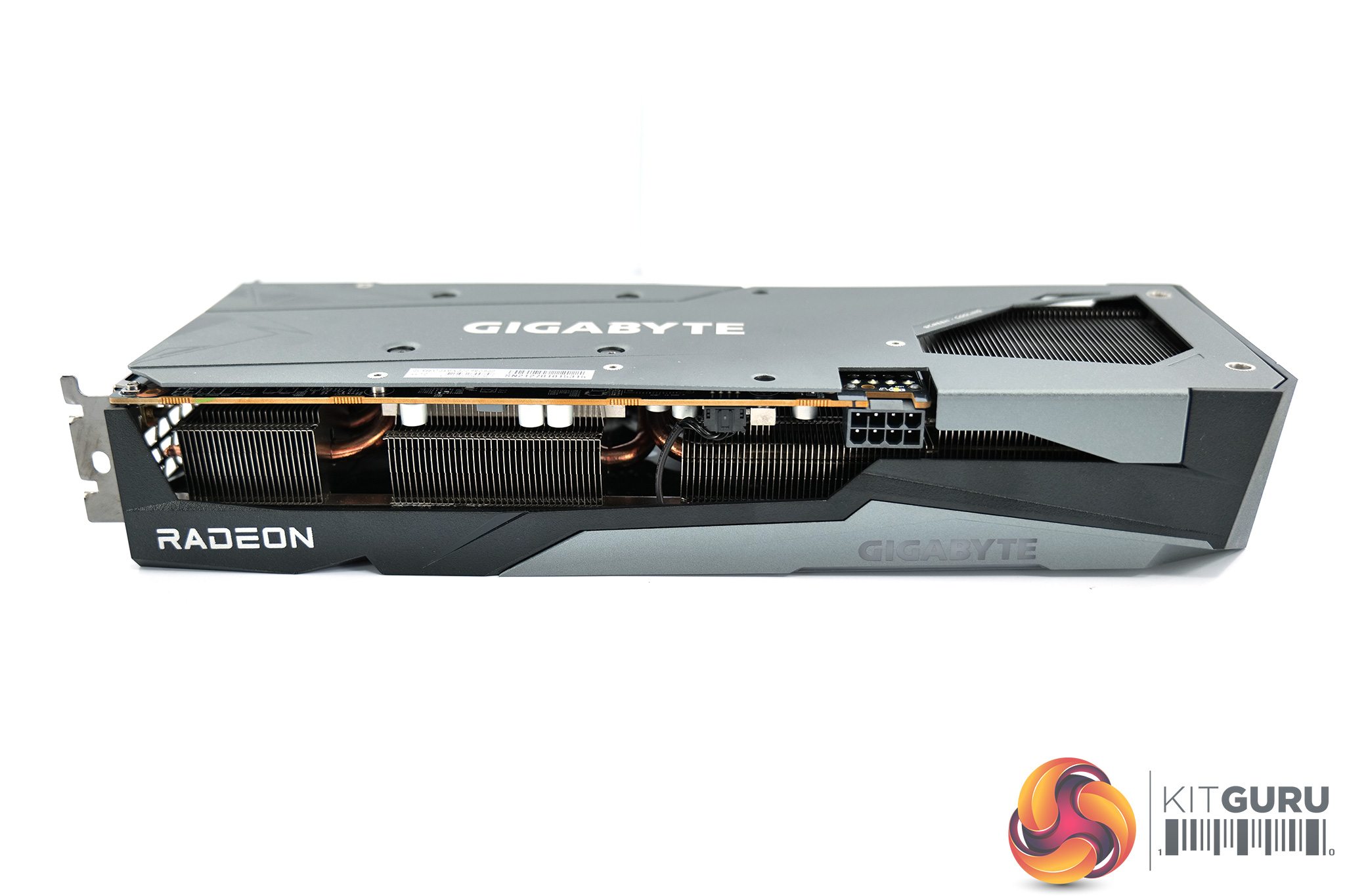
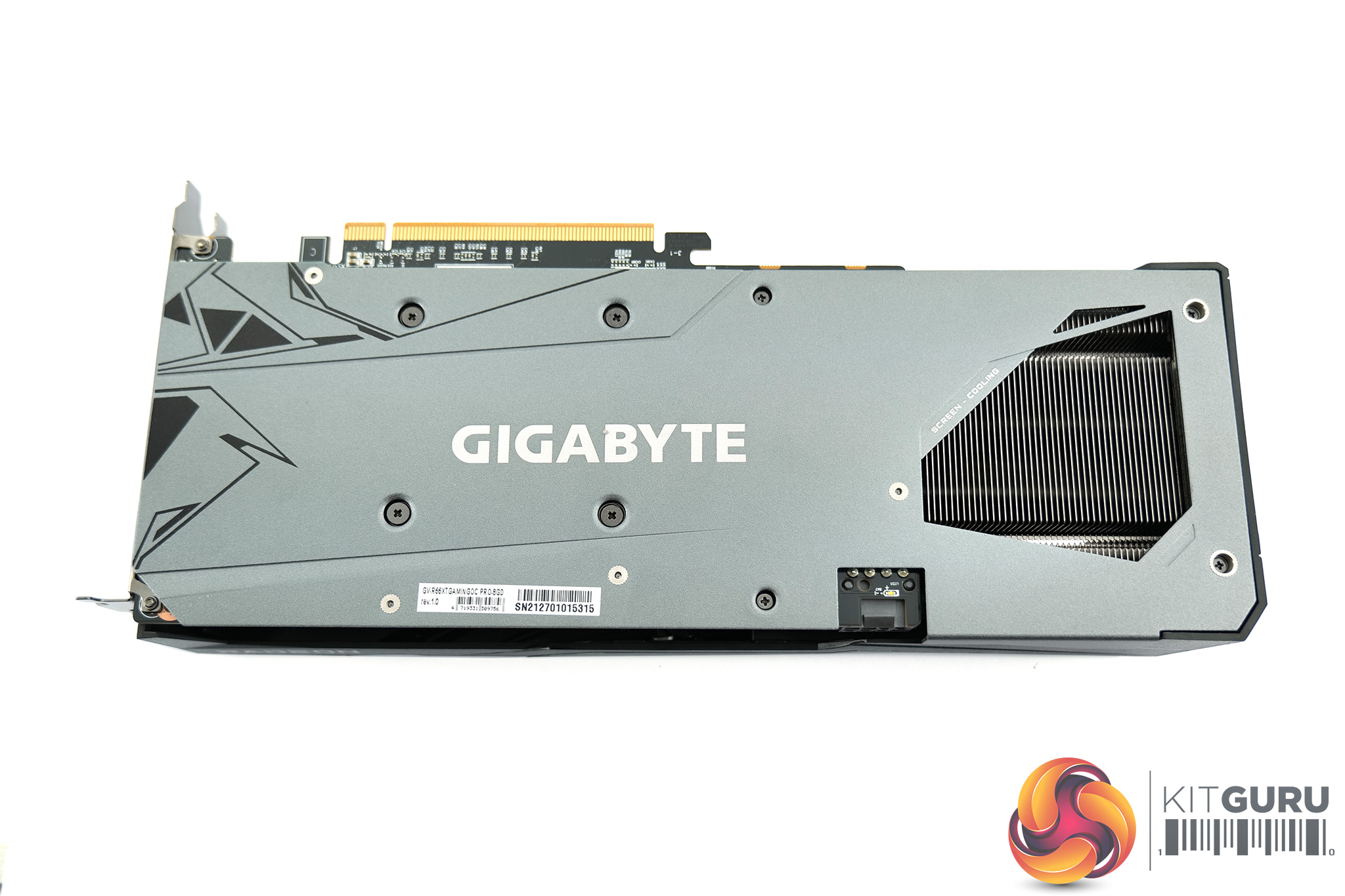
Gigabyte has also stuck with a plain metal backplate, though it does feature a large cut-out which the company calls ‘Screen Cooling.' It's simply a way to getting air coming in from the fans, directly though the heatsink, and out of the back of the card.
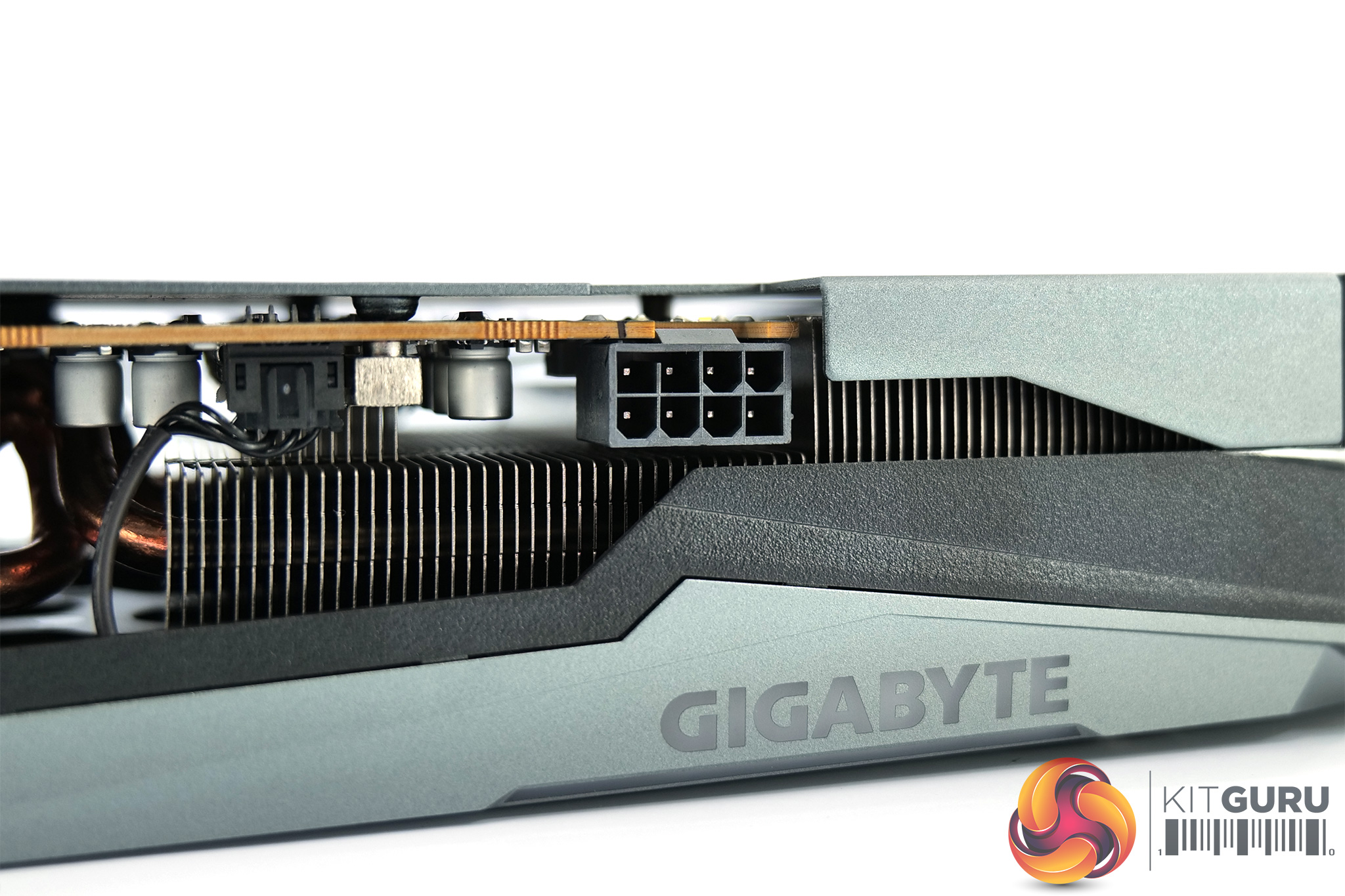
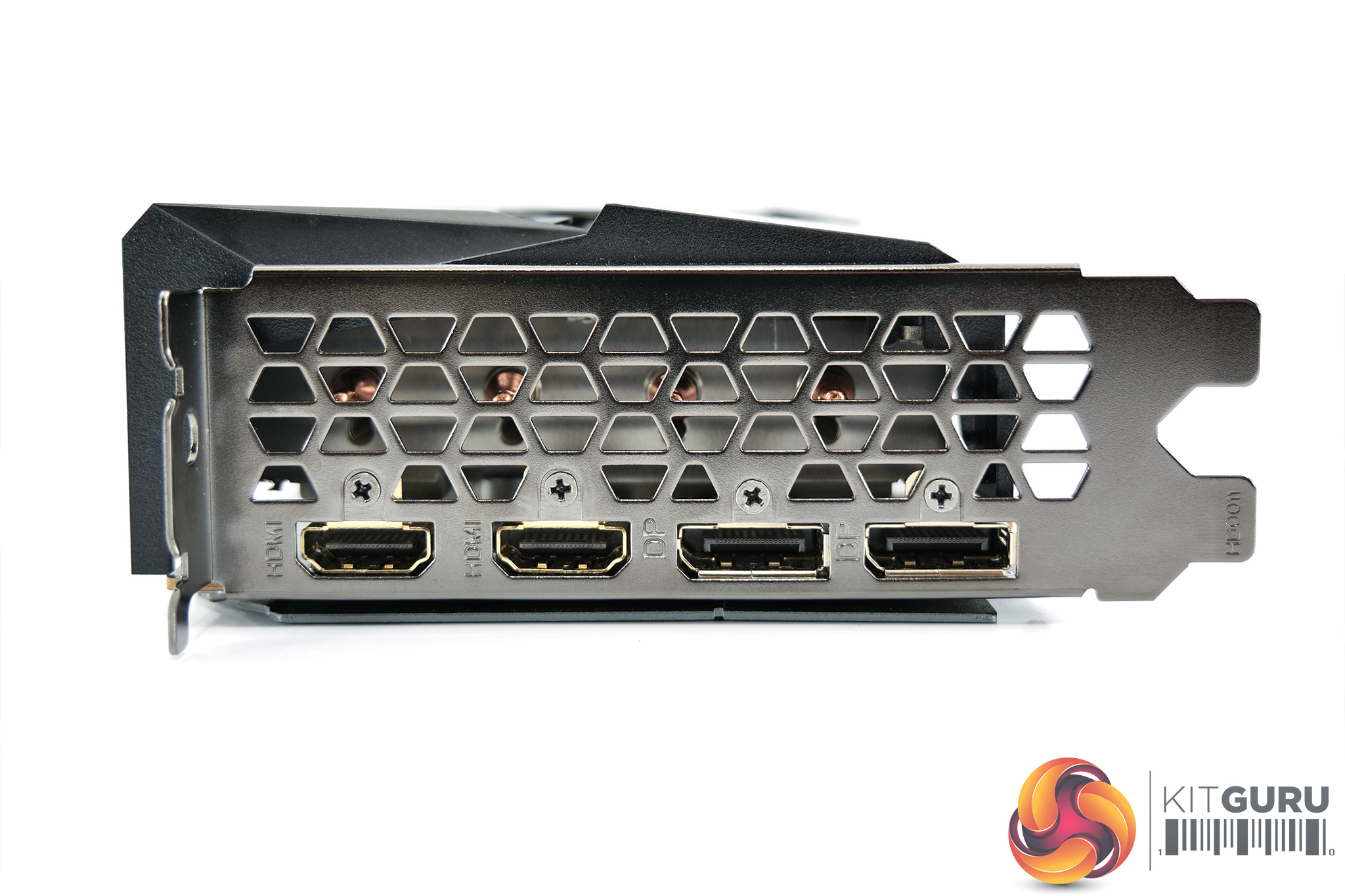
We'd expect most RX 6600 XTs to require a single 8-pin connector, and that is exactly what we have here with the Gaming OC Pro. Display outputs consist of 2x HDMI 2.1 and 2x DisplayPort 1.4.
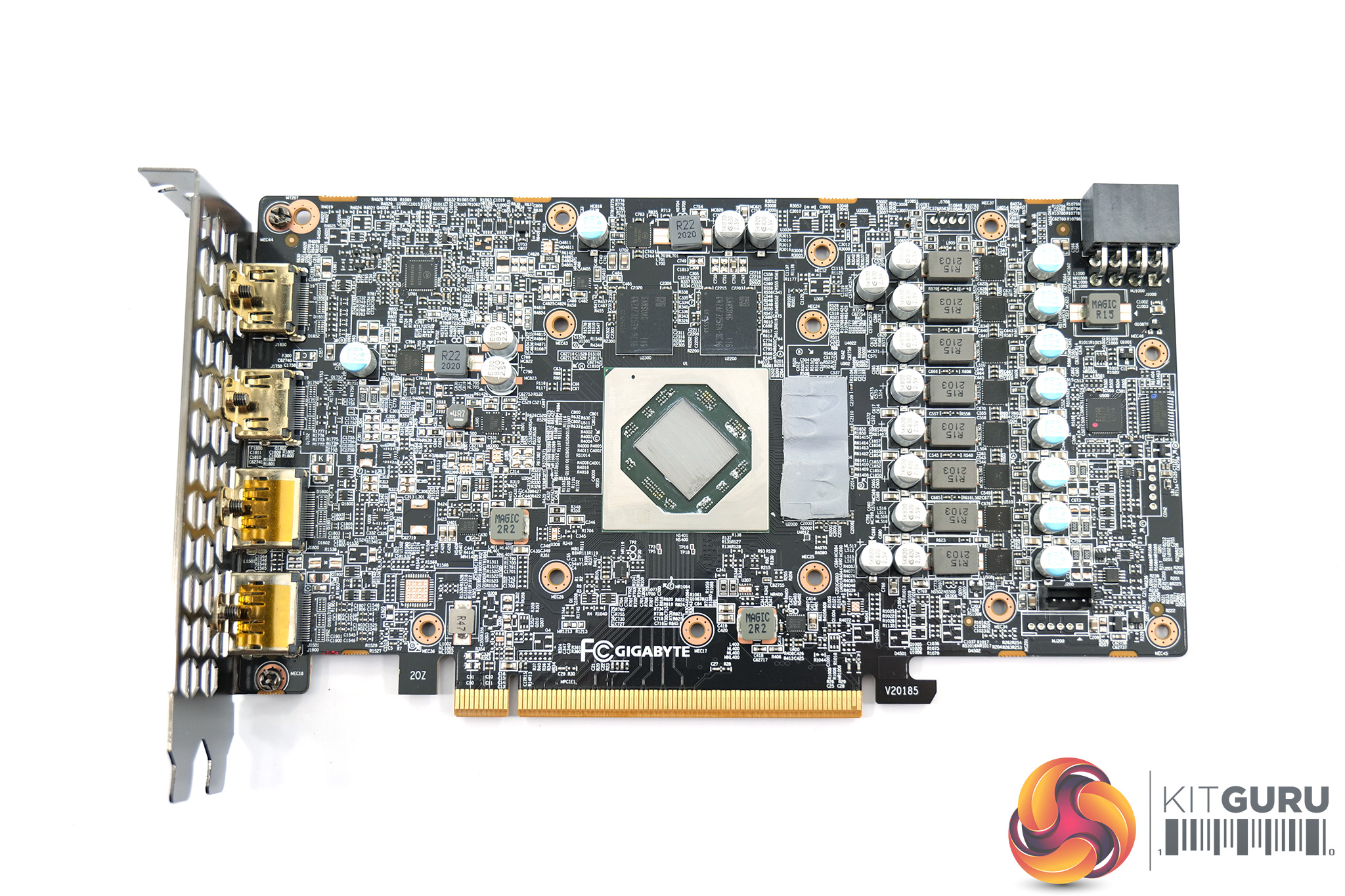
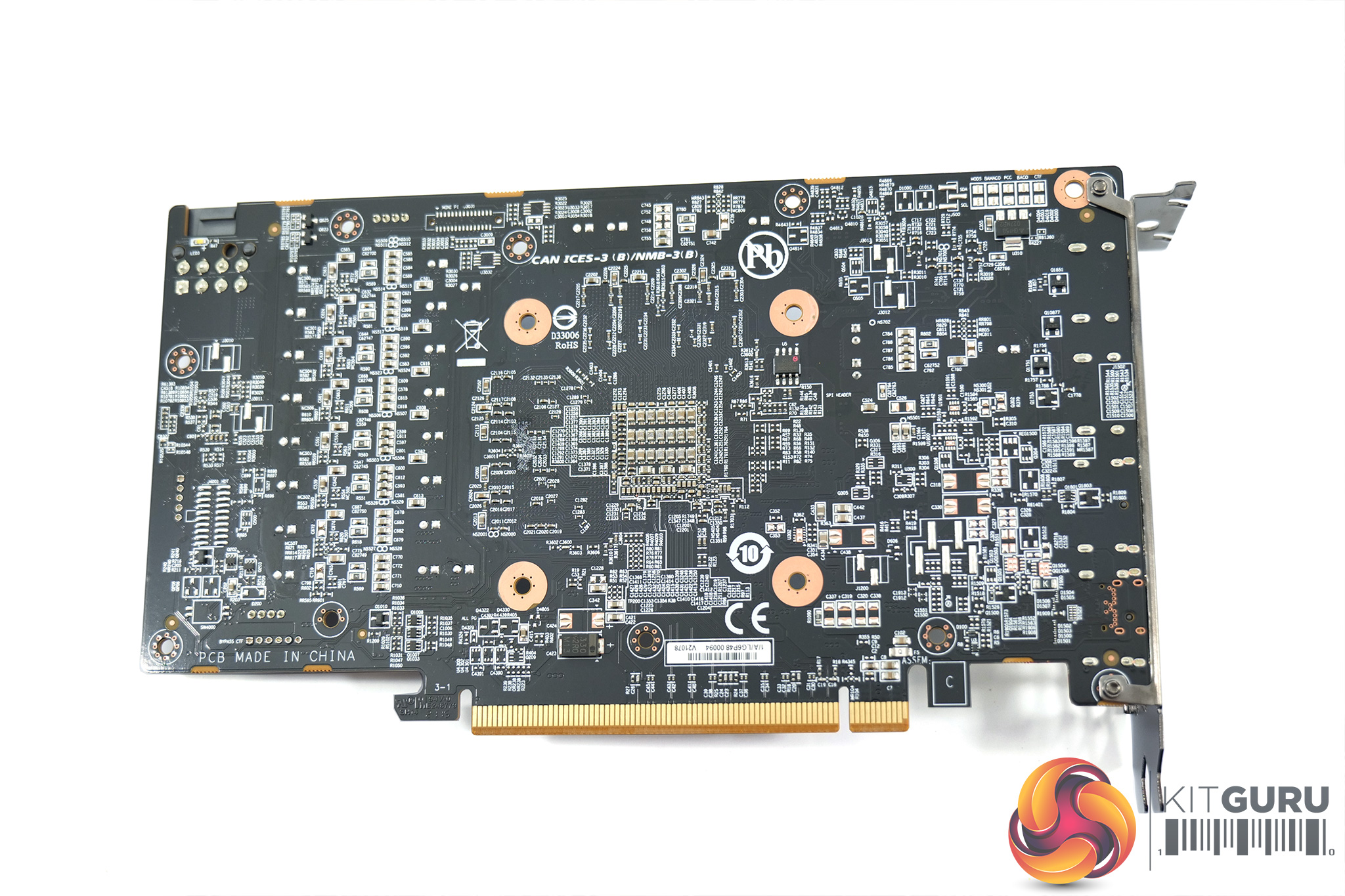
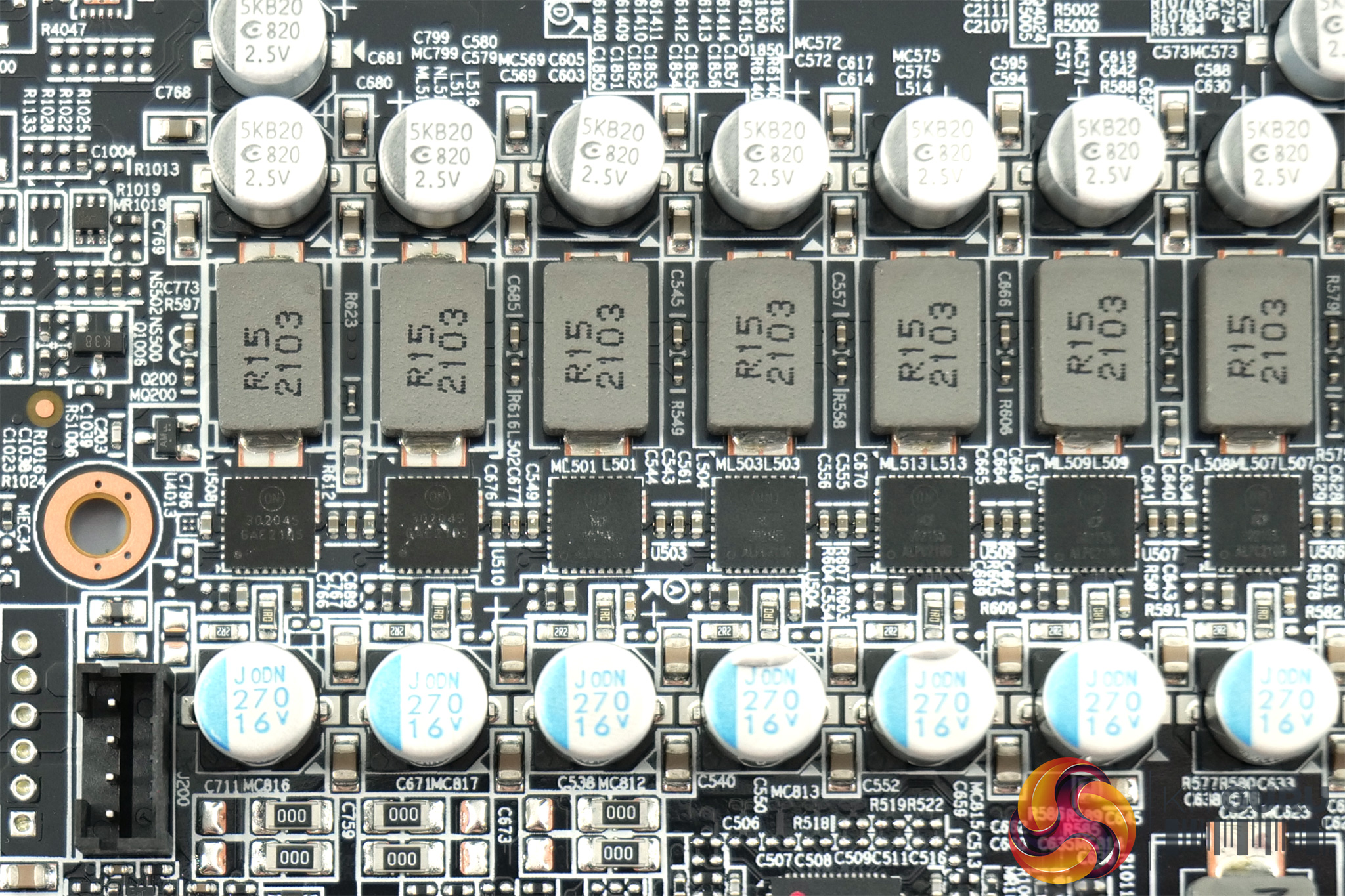
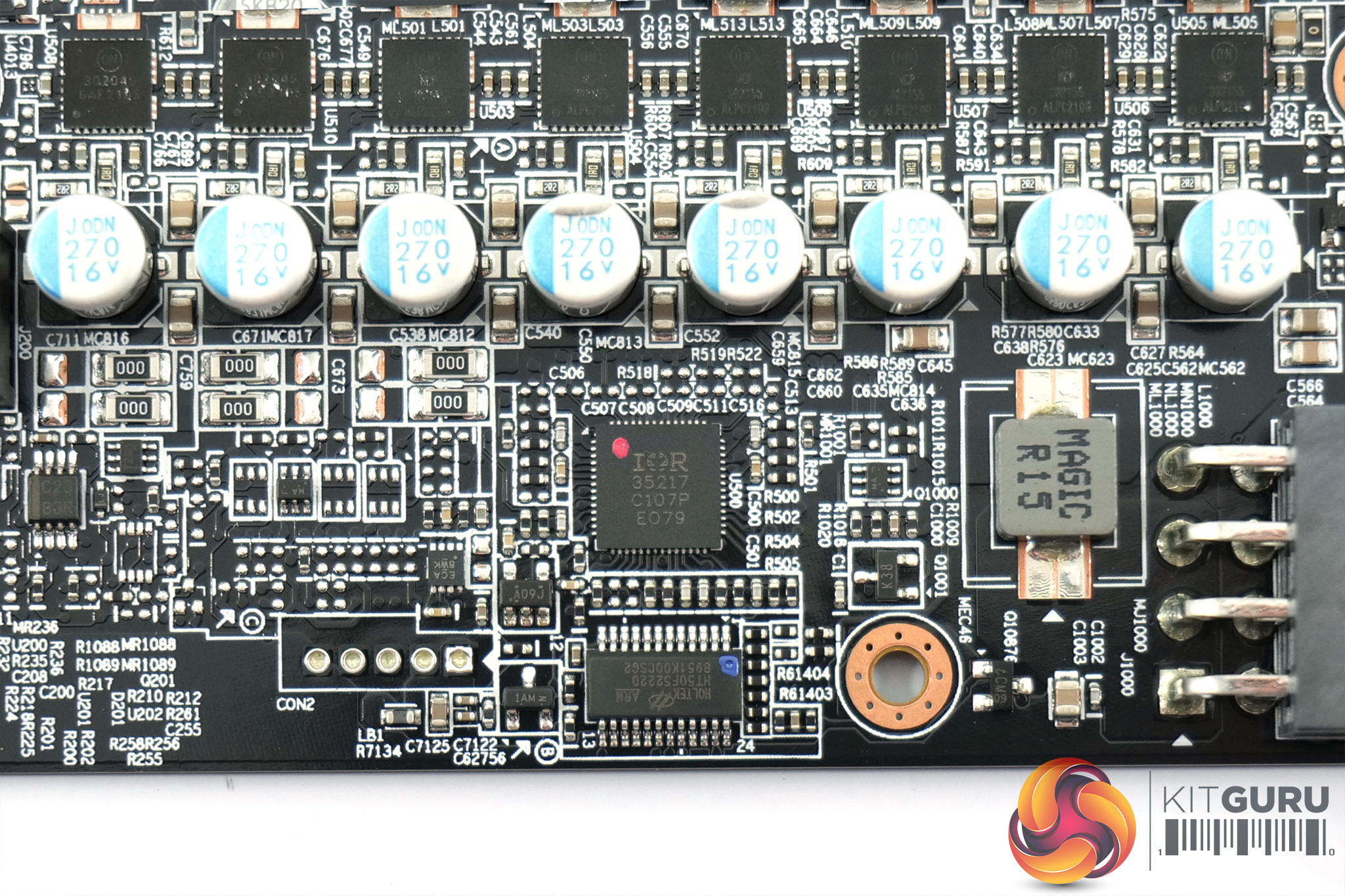
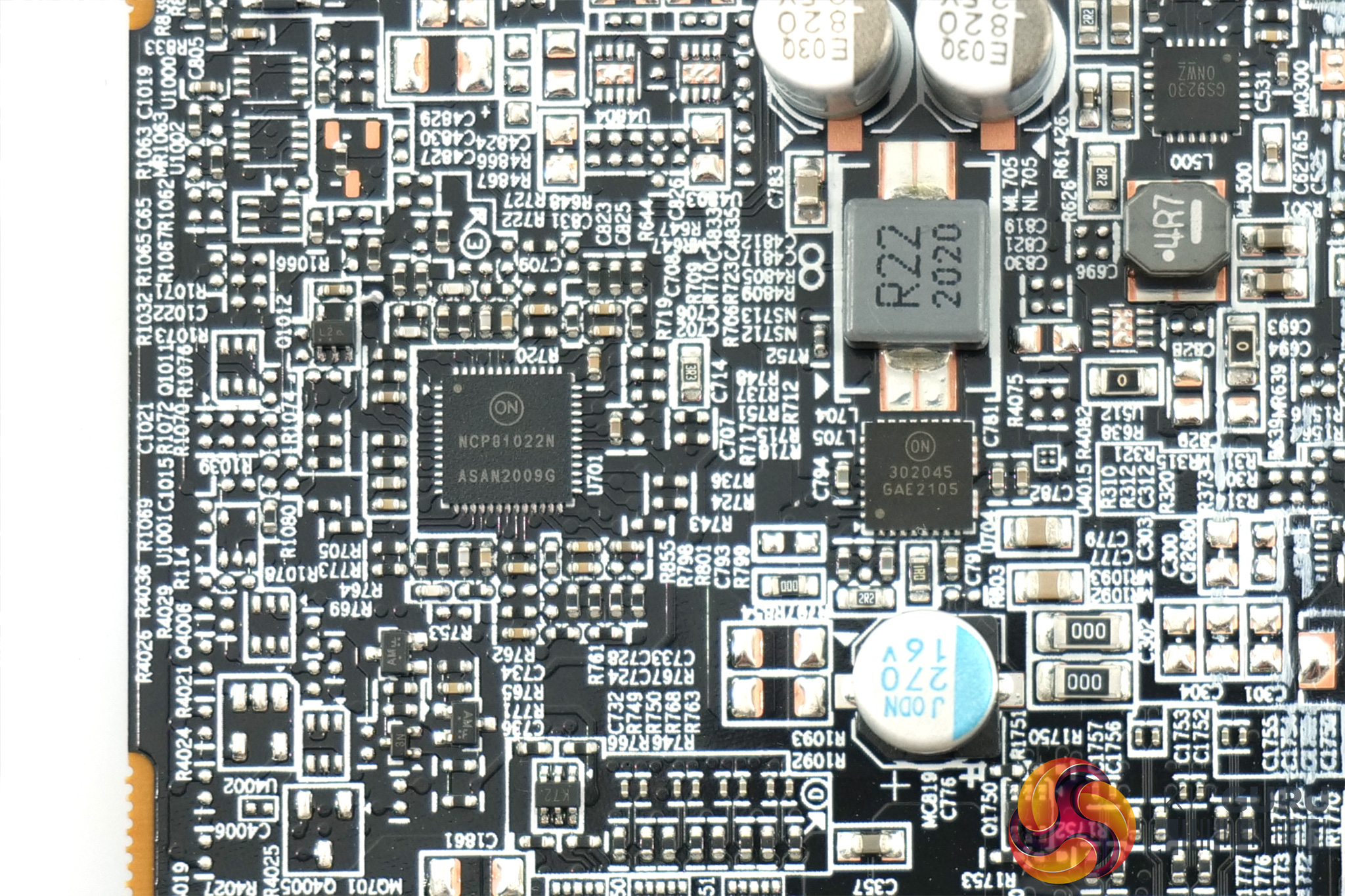
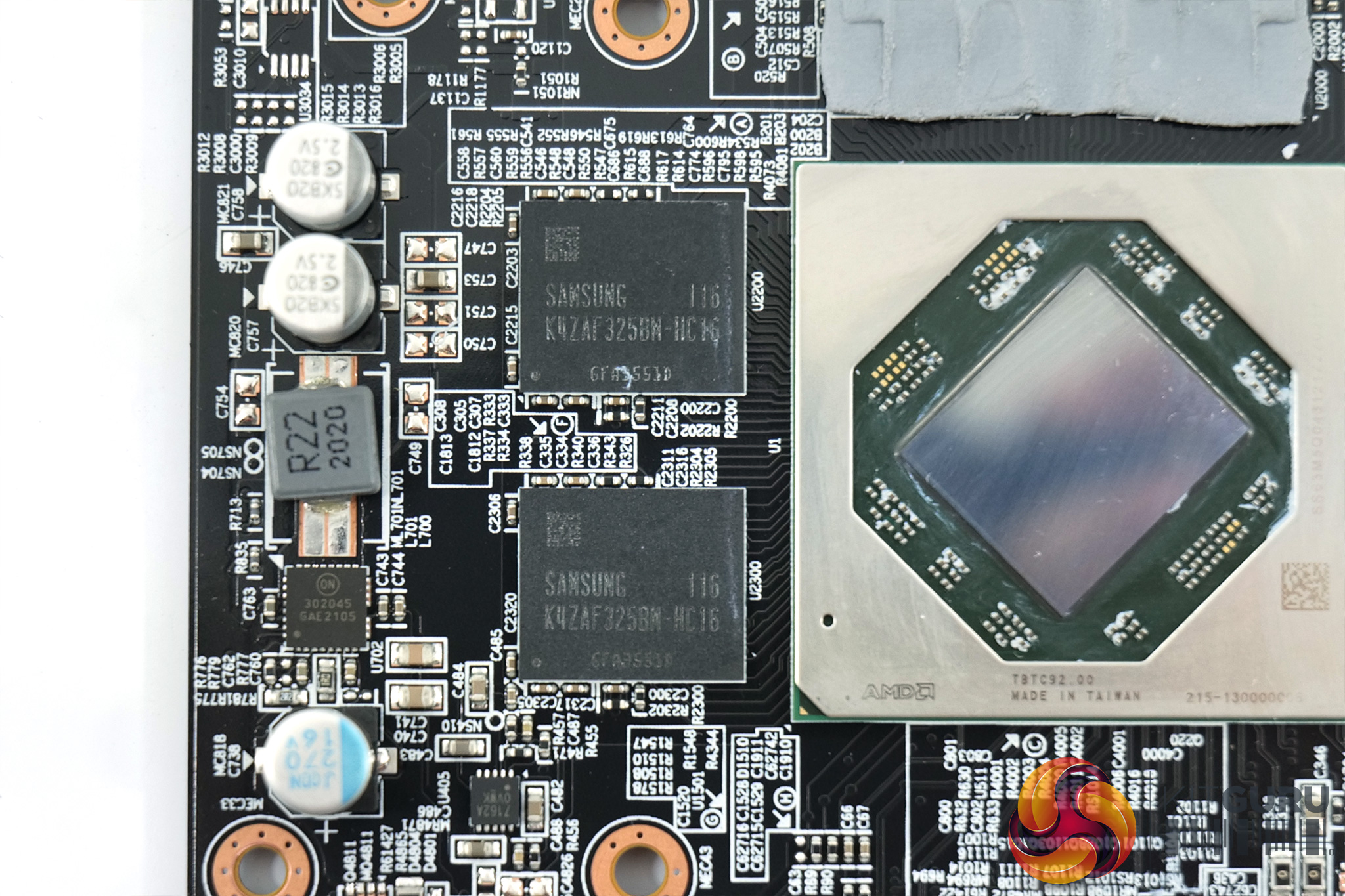
Looking now at the card's PCB, this is the only RX 6600 XT card we have looked at for launch so it's hard to say exactly how ‘custom' this PCB is, or will be, compared to the other boards which hit the market.
Still, we can identify the core layout, with an 8-phase VRM for the GPU and a 2-phase solution for the memory. The GPU VRM makes use of OnSemi's 302045 and 302051 MOSFETs, with 302045 MOSFETs used for the memory. The GPU VRM is controlled by International Rectifier's IR35217, while the memory VRM uses OnSemi's NCP81022N controller.
As for the VRAM itself, there are only four modules on the PCB – Samsung's K4ZAF325BM-HC16. We can also note the very small Navi 23 die, measuring just 237 mm².
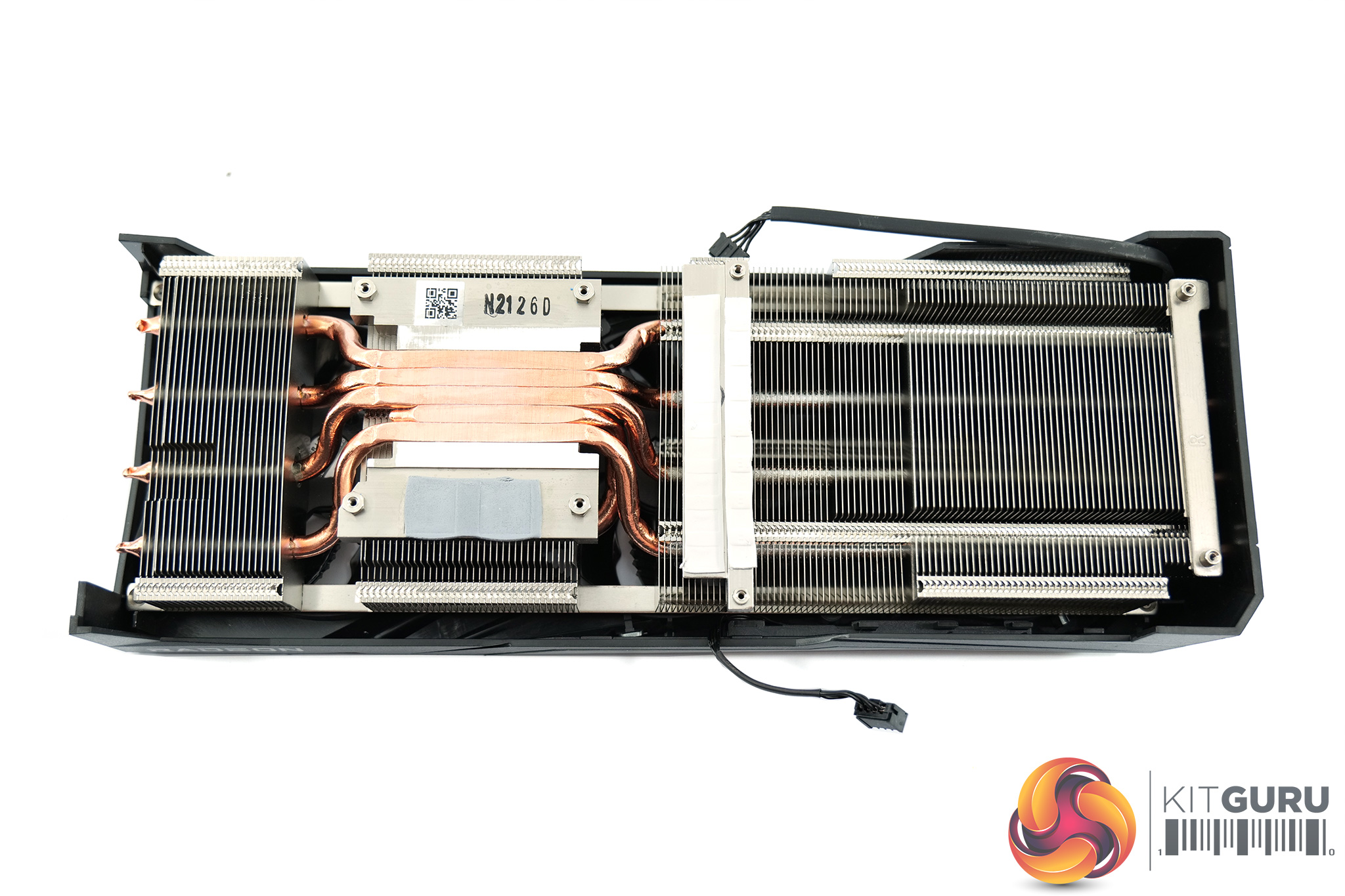
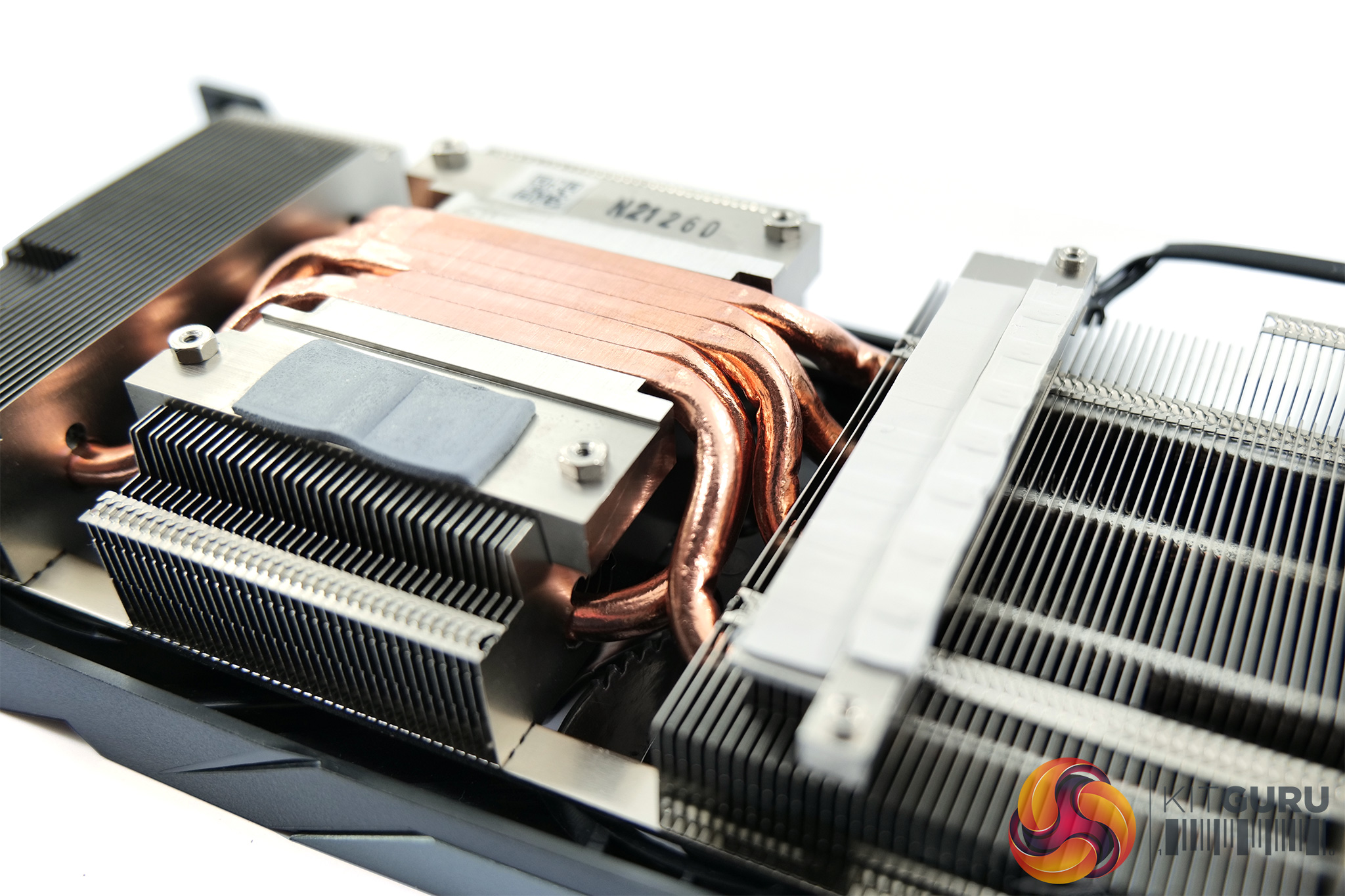
The cooler, meanwhile, looks rather sophisticated for a GPU with just a 160W power rating – Gigabyte is using three finstacks connected by a total of 5x6mm heatpipes. The heatpipes make direct contact with the GPU die, as do two of the memory modules (via a thermal pad), while the other two modules contact with a separate plate. We can also note another aluminium plate used to contact the VRM.
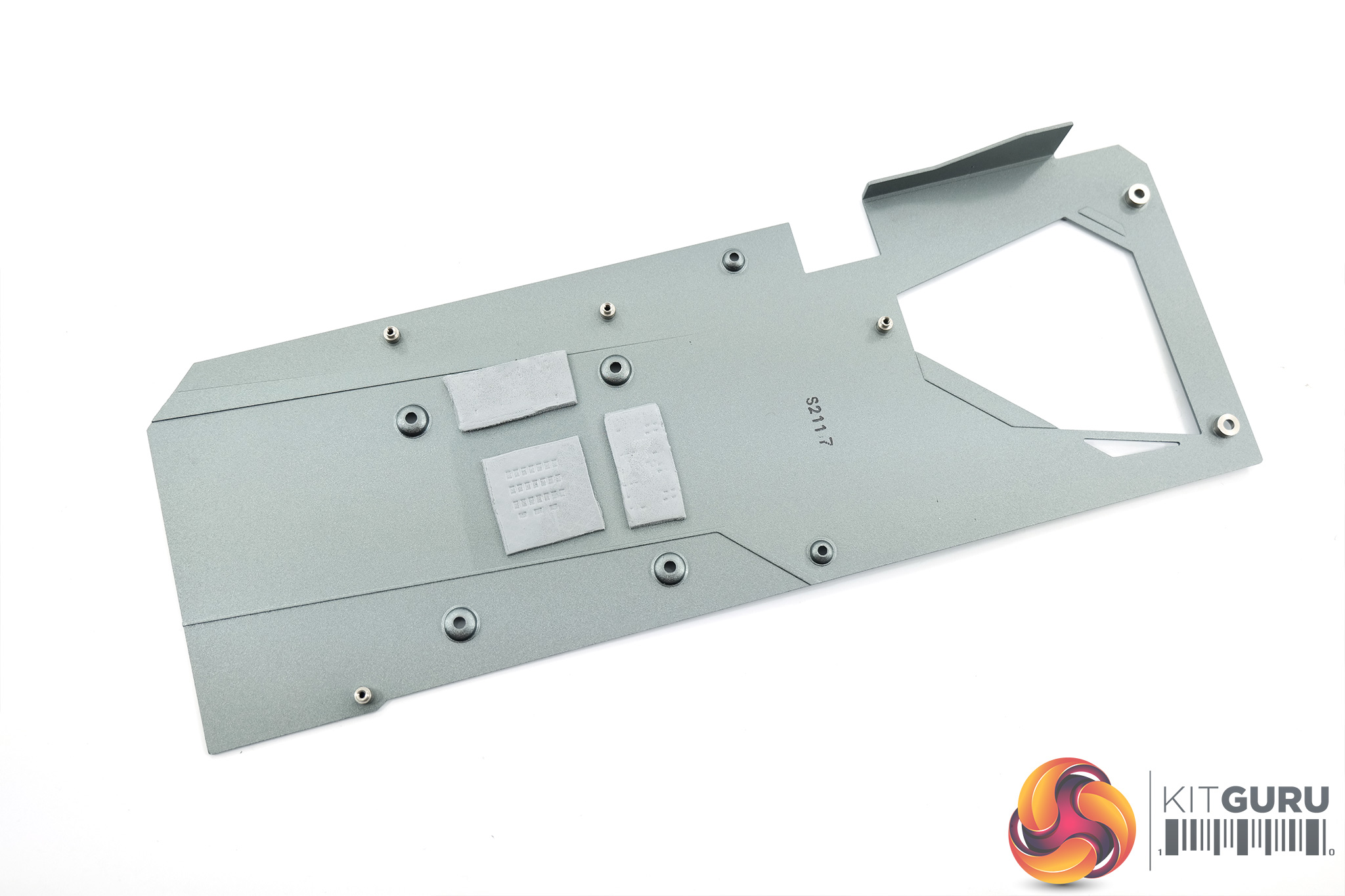
Lastly, it's good to see Gigabyte using three thermal pads on the underside of the backplate to contact the back of the PCB. This doesn't make a massive difference, but it will help draw at least some heat from the PCB and spread it over the metal backplate.
Driver Notes
- All Nvidia GPUs were benchmarked with the 471.41 driver.
- All AMD GPUs (except RX 6600 XT) were benchmarked with the Adrenalin 21.7.2 driver.
- RX 6600 XT was benchmarked with the Adrenalin 21.8.1 driver supplied to press.
Test System
We test using the a custom built system from PCSpecialist, based on Intel's Comet Lake-S platform. You can read more about it over HERE, and configure your own system from PCSpecialist HERE.
| CPU |
Intel Core i9-10900K
Overclocked to 5.1GHz on all cores |
| Motherboard |
ASUS ROG Maximus XII Hero Wi-Fi
|
| Memory |
Corsair Vengeance DDR4 3600MHz (4 X 8GB)
CL 18-22-22-42
|
| Graphics Card |
Varies
|
| System Drive |
500GB Samsung 970 Evo Plus M.2
|
| Games Drive | 2TB Samsung 860 QVO 2.5″ SSD |
| Chassis | Fractal Meshify S2 Blackout Tempered Glass |
| CPU Cooler |
Corsair H115i RGB Platinum Hydro Series
|
| Power Supply |
Corsair 1200W HX Series Modular 80 Plus Platinum
|
| Operating System |
Windows 10 2004
|
Comparison Graphics Cards List
- Nvidia RTX 3060 Ti FE 8GB
- Palit RTX 3060 StormX 12GB
- Nvidia RTX 2070 Super FE 8GB
- Nvidia RTX 2060 Super FE 8GB
- Nvidia RTX 2060 FE 7GB
- AMD RX 6700 XT 12GB
- AMD RX 5700 XT 8GB
- AMD RX 5700 8GB
- Sapphire RX 5600 XT Pulse 6GB
- AMD RX Vega 64 8GB
Software and Games List
- 3DMark Fire Strike & Fire Strike Ultra (DX11 Synthetic)
- 3DMark Time Spy (DX12 Synthetic)
- 3DMark Raytracing Feature Test (DXR Synthetic)
- Assassin's Creed Valhalla (DX12)
- Control (DX12)
- Cyberpunk 2077 (DX12)
- Days Gone (DX11)
- F1 2021 (DX12)
- Gears 5 (DX12)
- Hitman 3 (DX12)
- Horizon Zero Dawn (DX12)
- Metro Exodus Enhanced Edition (DXR)
- Red Dead Redemption 2 (Vulkan)
- Resident Evil Village (DX12)
- Total War Saga: Troy (DX11)
- Watch Dogs: Legion (DX12)
We run each benchmark/game three times, and present mean averages in our graphs. We use FrameView to measure average frame rates as well as 1% low values across our three runs.
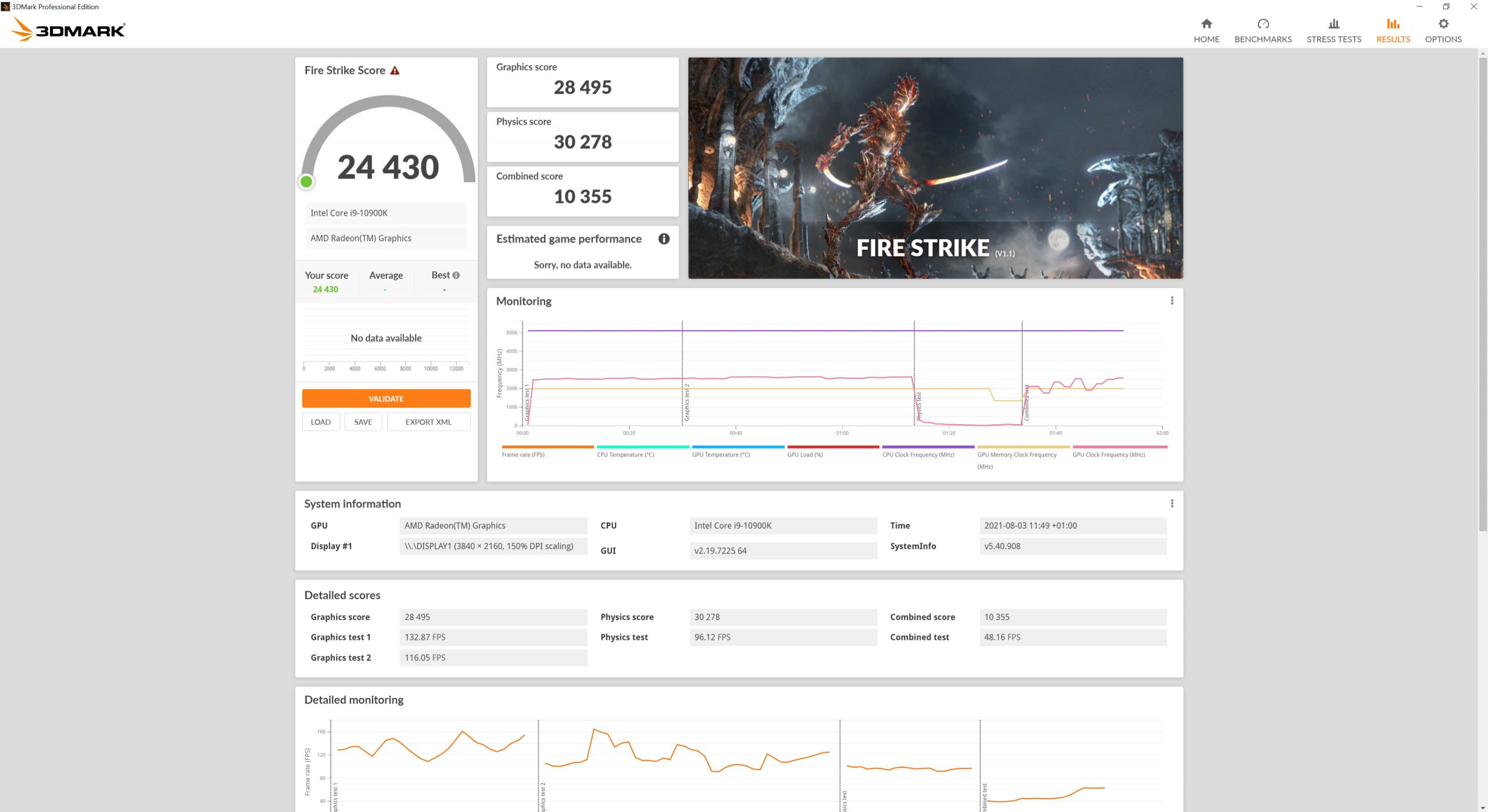
Fire Strike is a showcase DirectX 11 benchmark for modern gaming PCs. Its ambitious real-time graphics are rendered with detail and complexity far beyond other DirectX 11 benchmarks and games. Fire Strike includes two graphics tests, a physics test and a combined test that stresses the CPU and GPU. (UL).
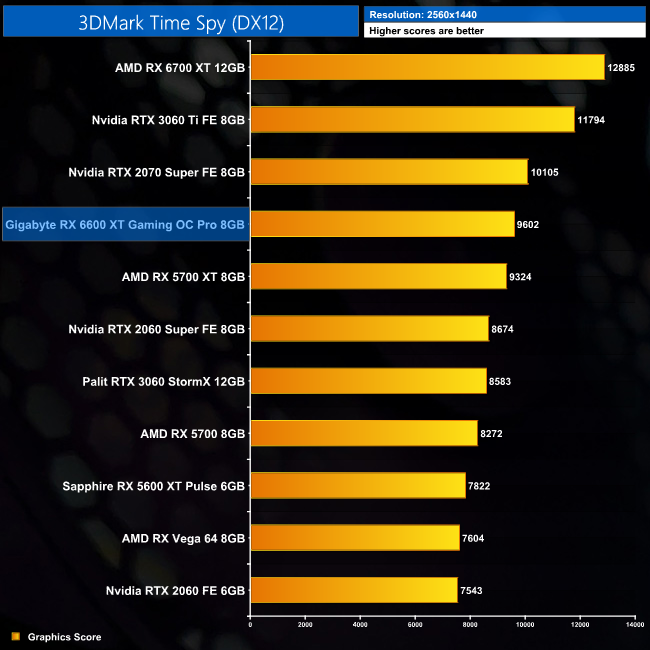
3DMark Time Spy is a DirectX 12 benchmark test for Windows 10 gaming PCs. Time Spy is one of the first DirectX 12 apps to be built the right way from the ground up to fully realize the performance gains that the new API offers. With its pure DirectX 12 engine, which supports new API features like asynchronous compute, explicit multi-adapter, and multi-threading, Time Spy is the ideal test for benchmarking the latest graphics cards. (UL).
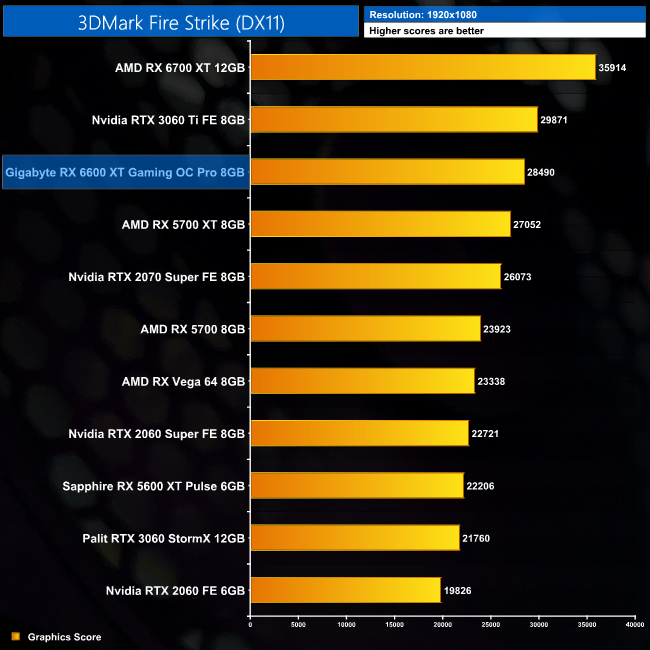
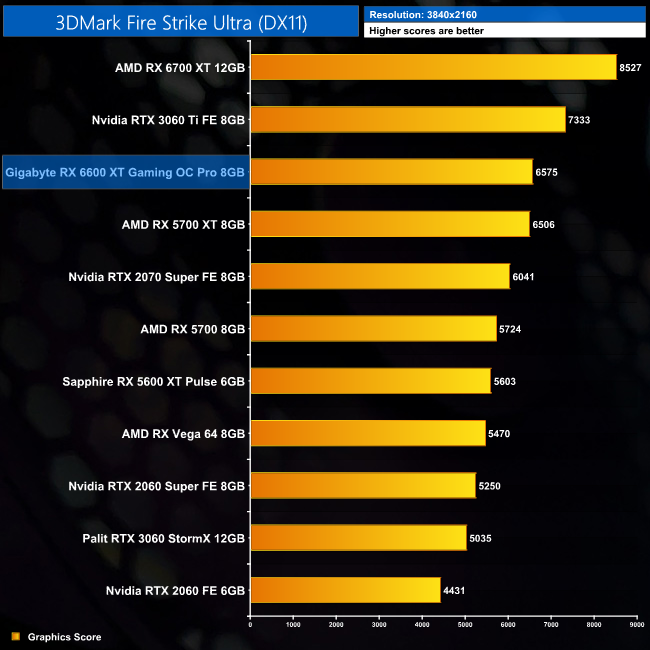
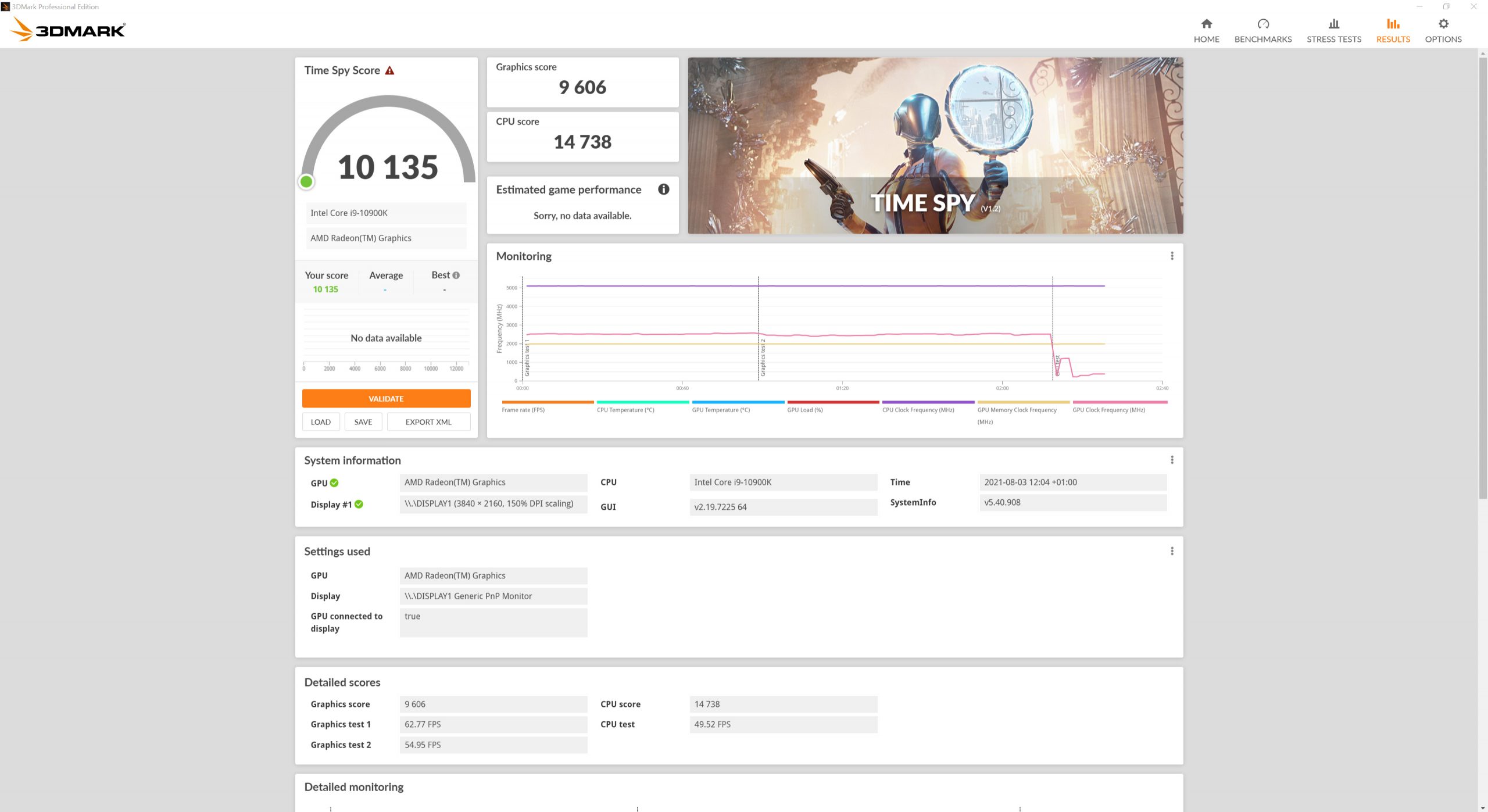
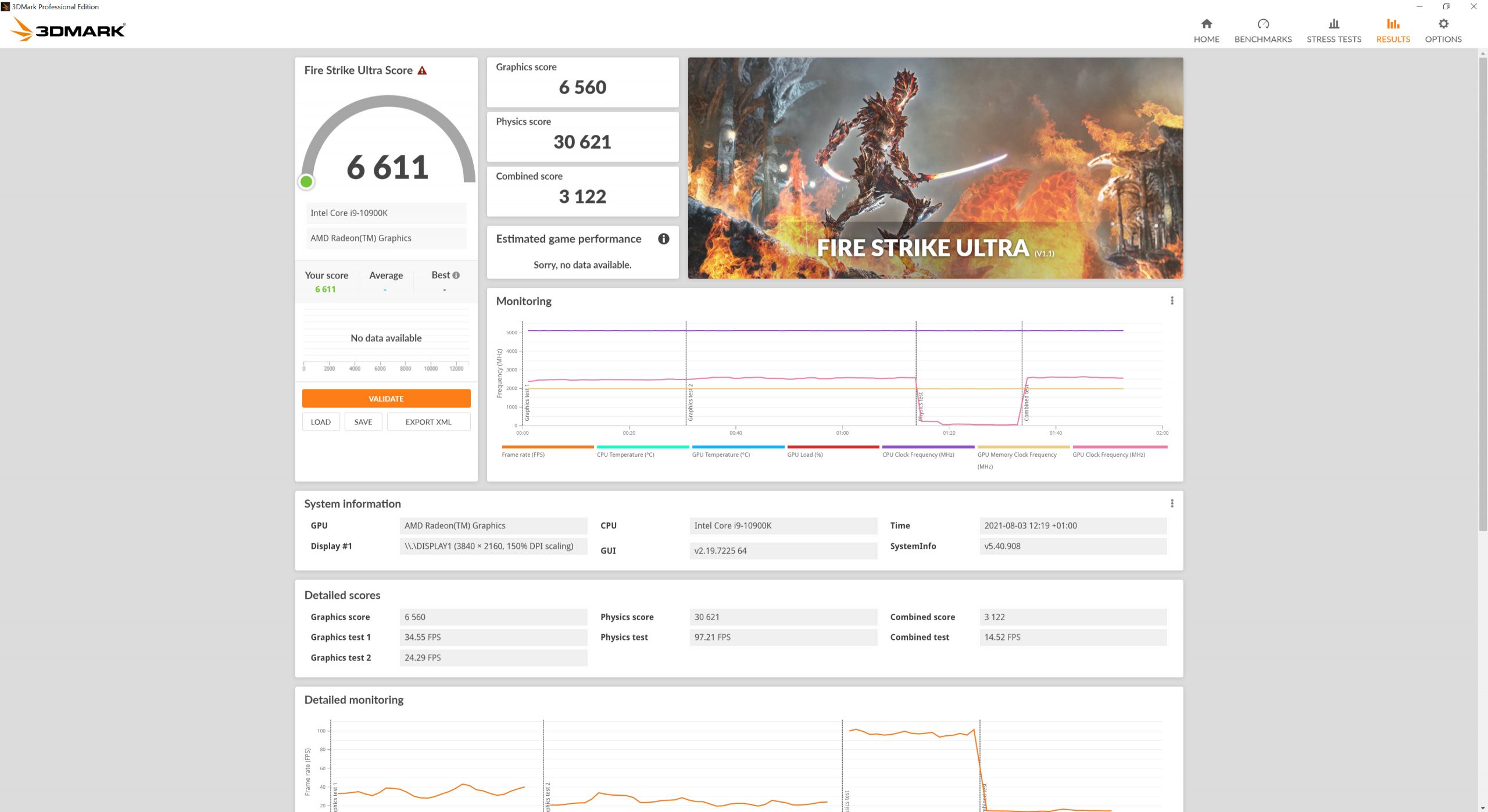
Kicking off with our 3DMark benchmarks, the RX 6600 XT gets a strong start in Fire Strike, where it is snapping at the heels of the RTX 3060 Ti and beats the RTX 3060 by a whopping 31% margin.
Things do get closer in the DX12 Time Spy, but the 6600 XT is still 12% faster than the RTX 3060, while Fire Strike Ultra shows more of what we saw from Fire Strike. It's a good start for AMD.
Real-time ray tracing is incredibly demanding. The latest graphics cards have dedicated hardware that’s optimized for ray-tracing. The 3DMark DirectX Raytracing feature test measures the performance of this dedicated hardware. Instead of using traditional rendering techniques, the whole scene is ray-traced and drawn in one pass. The result of the test depends entirely on ray-tracing performance. (UL).
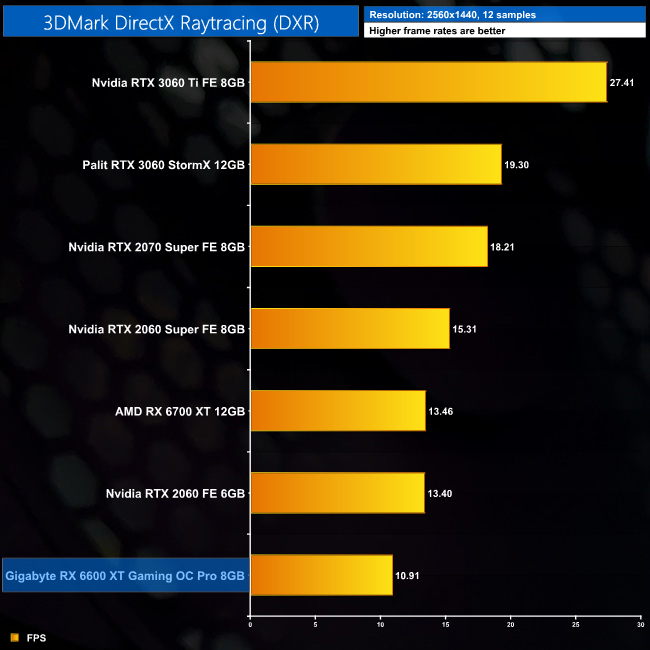
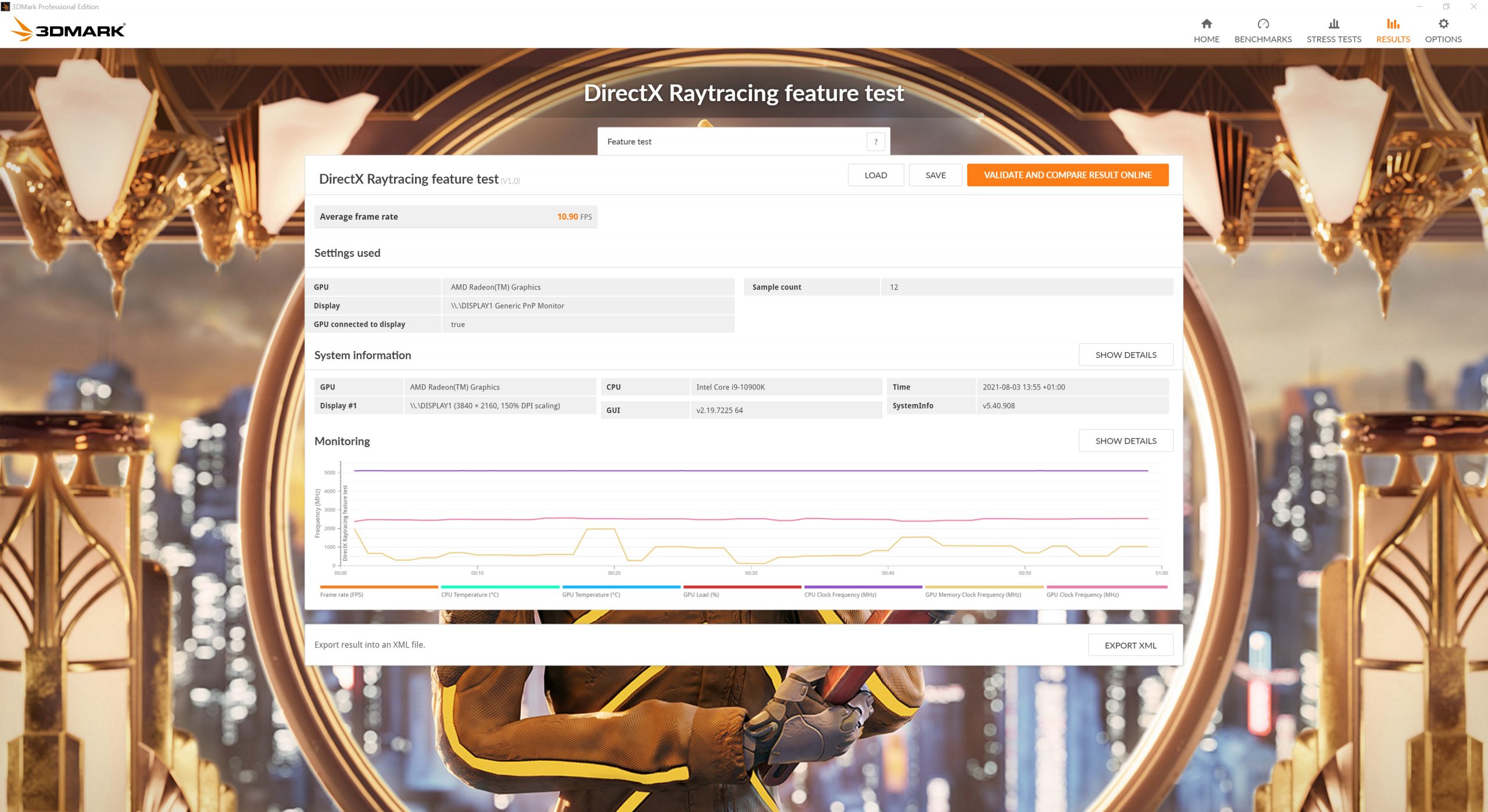
We know AMD isn't as strong when it comes to ray tracing, and using the 3DMark DXR Featuretest – which is entirely ray traced – we can see the RX 6600 XT is slower than even the RTX 2060 which launched over 2 years ago. Put it another way – the RTX 3060 Ti isn't far off being three times as fast.
Assassin's Creed Valhalla is an action role-playing video game developed by Ubisoft Montreal and published by Ubisoft. It is the twelfth major installment and the twenty-second release in the Assassin's Creed series, and a successor to the 2018's Assassin's Creed Odyssey. The game was released on November 10, 2020, for Microsoft Windows, PlayStation 4, Xbox One, Xbox Series X and Series S, and Stadia, while the PlayStation 5 version was released on November 12. (Wikipedia.)
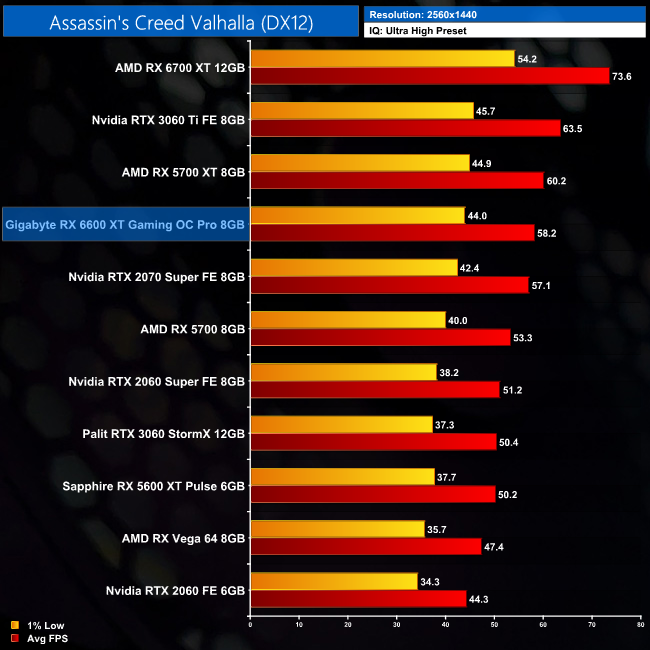
Engine: AnvilNext 2.0. We test using the Ultra High preset, DX12 API.
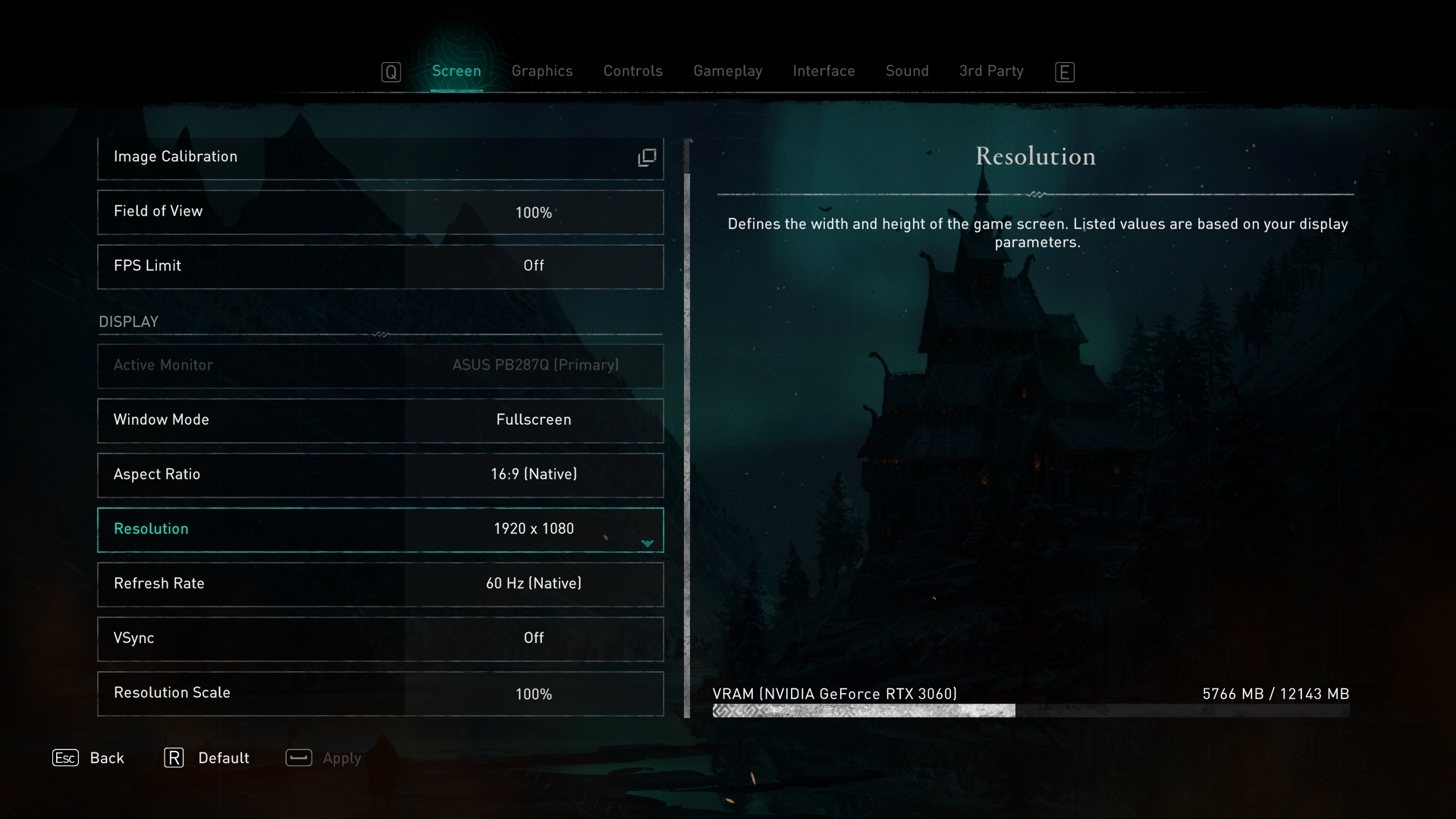
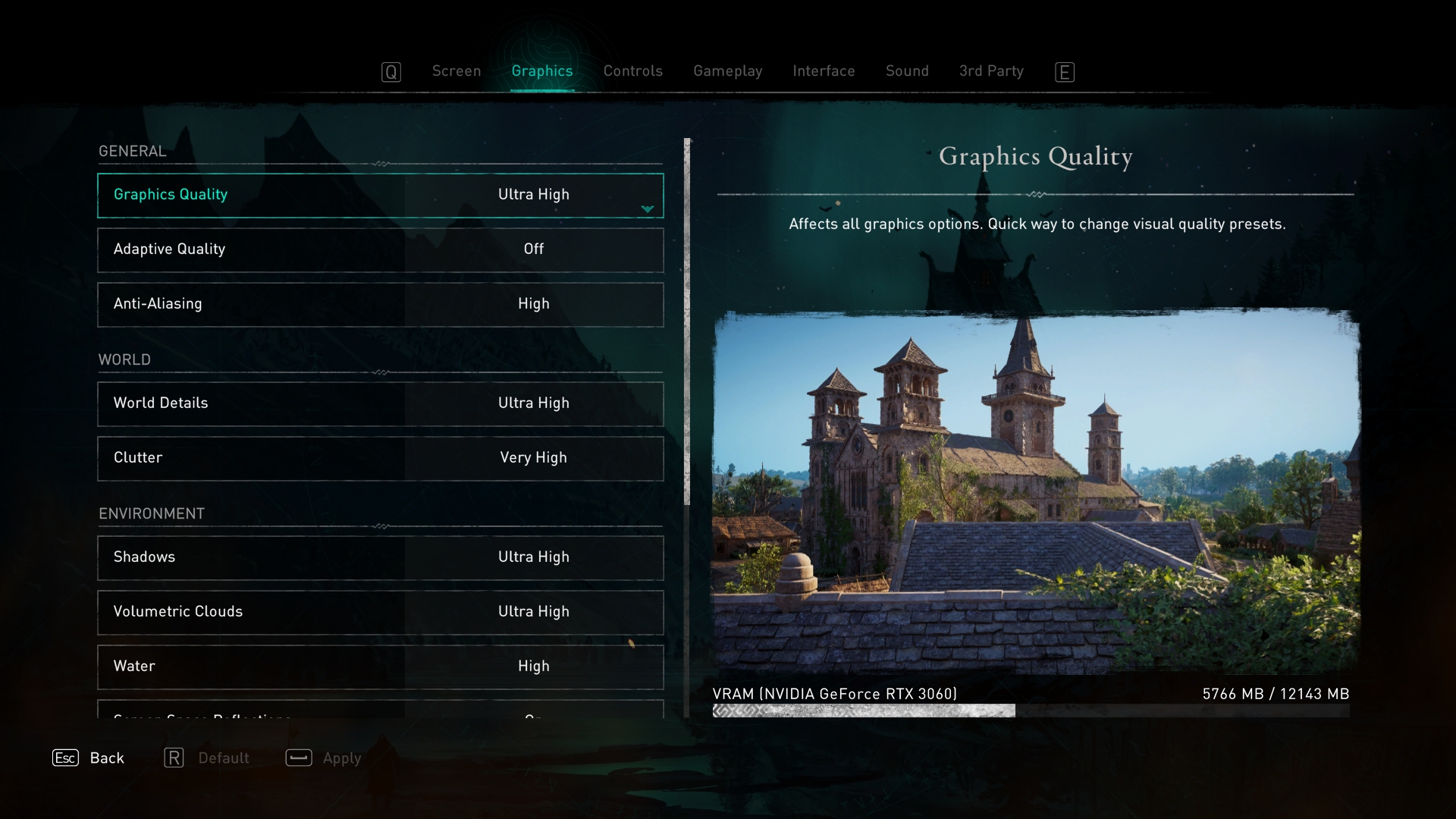
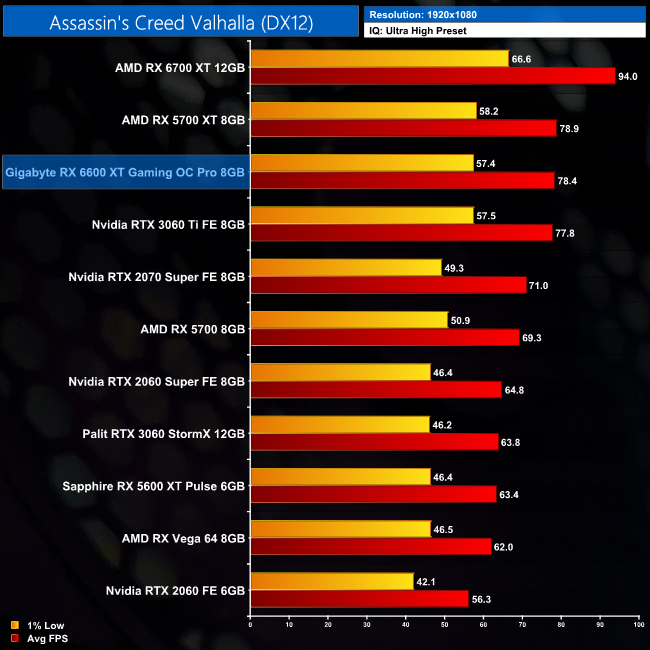
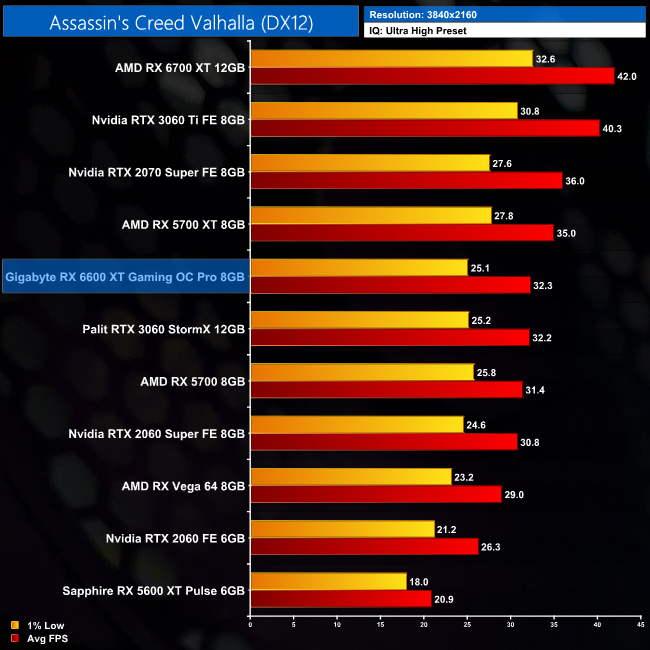
Our first game of the day is Assassin's Creed Valhalla, where at 1080p the RX 6600 XT delivers an average of 78FPS. As you might expect considering this is an AMD-sponsored title, that frame rate blows the RTX 3060 out of the water, as AMD's GPU is 23% faster. It's also just about level with both the RTX 3060 Ti and RX 5700 XT, which all deliver pretty much identical performance.
At 1440p though, the 6600 XT's lead is cut to 16% over the RTX 3060, which is still very strong, but it is closer than at 1080p. We can also see the RTX 3060 Ti averaging 5FPS more than the 6600 XT, making AMD's GPU about 8% slower here.
Control is an action-adventure video game developed by Remedy Entertainment and published by 505 Games. Control was released on 27 August 2019 for Microsoft Windows, PlayStation 4, and Xbox One. (Wikipedia).
Engine: Northlight Engine. We test using the High preset, with 4x MSAA, DX12 API.
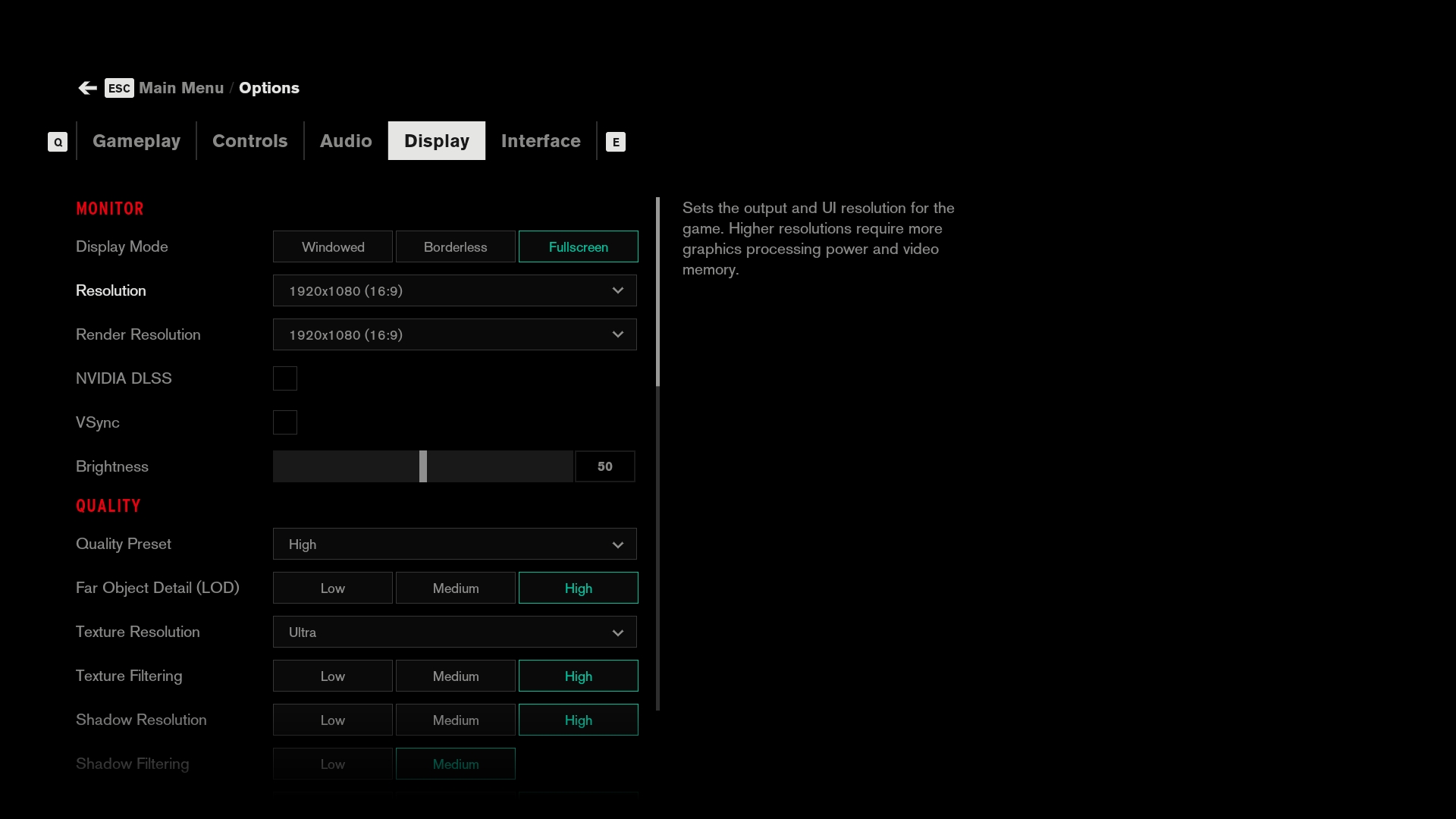
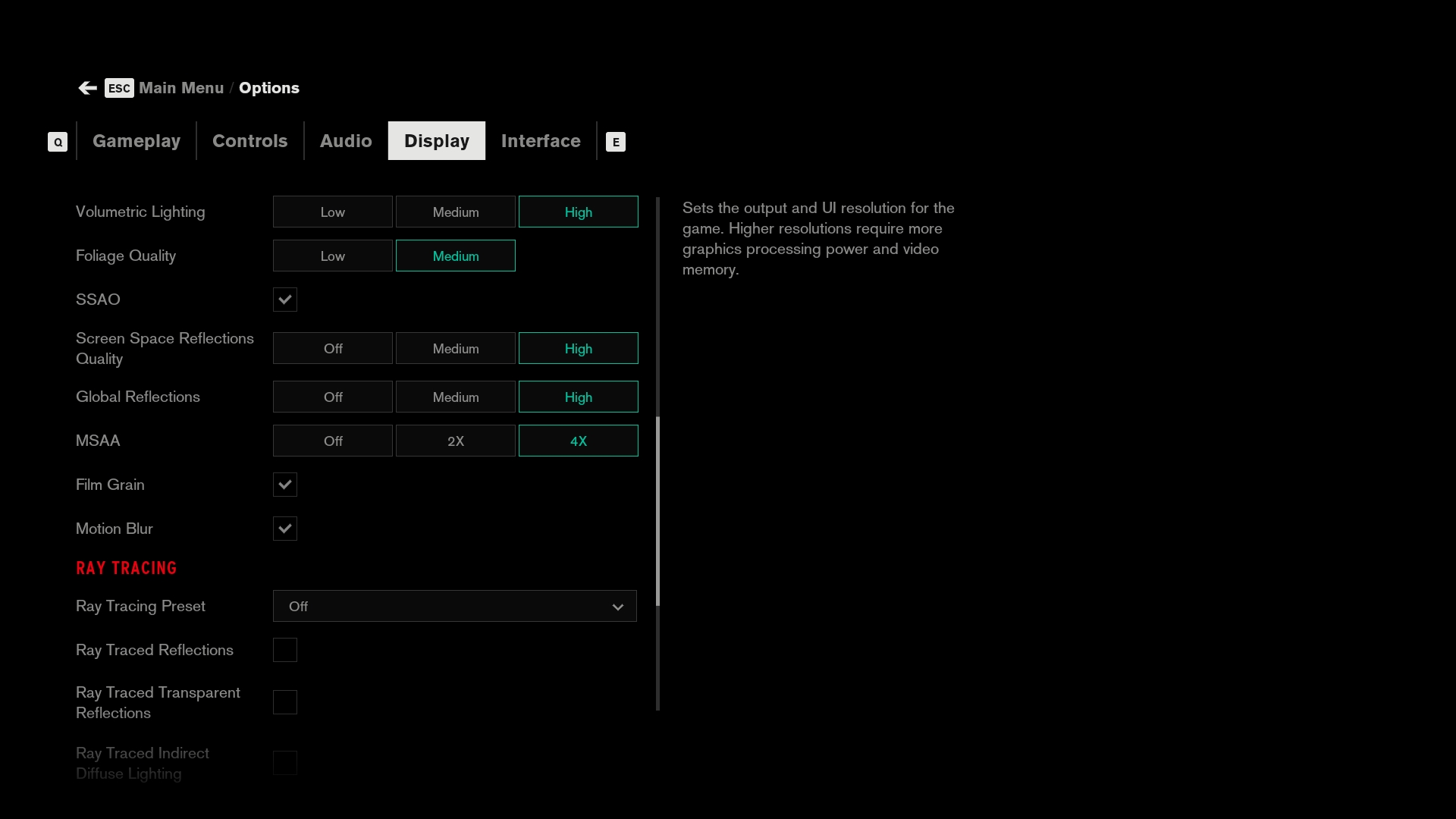
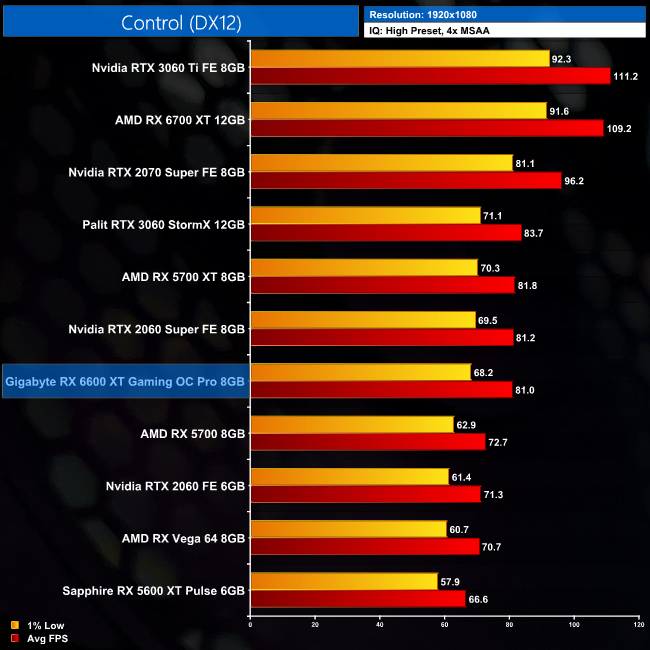
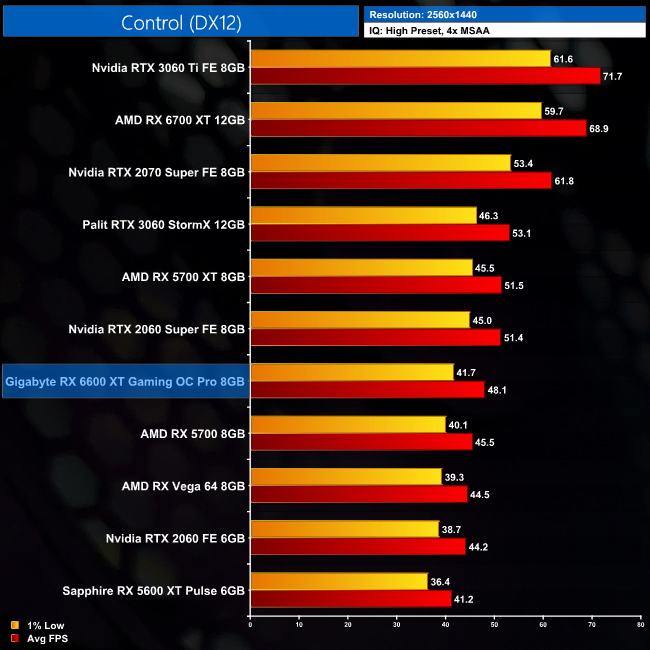
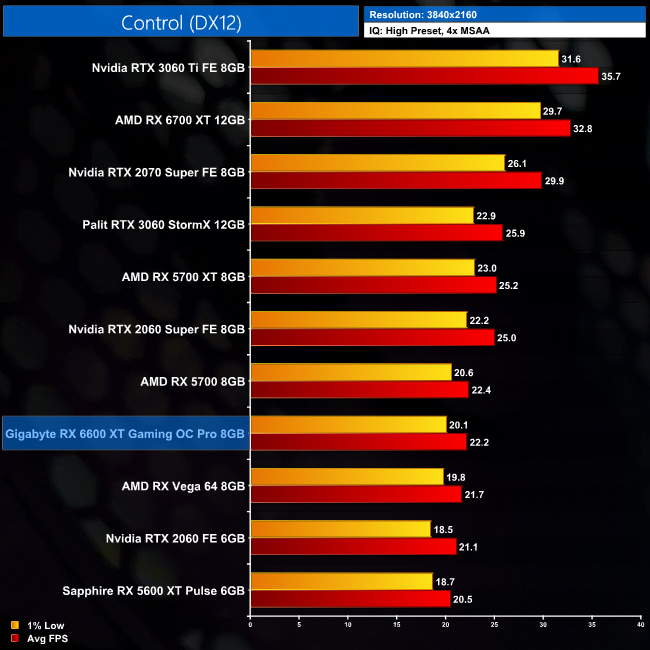
Moving from one AMD-sponsored title to one sponsored by Nvidia, and the RX 6600 XT delivers an average of 81FPS in Control, at 1080p. That does make it fractionally slower than the RTX 3060 here, but realistically there's no difference between either of those GPUs, or the RX 5700 XT and 2060 Super, as they're all within a couple of frames of each other.
Up at 1440p though, the 6600 XT does fall away from the RTX 3060 slightly, where it is now 7% slower. It's not a massive difference by any means, but the RX 6600 XT doesn't look as strong as it did at 1080p.
Cyberpunk 2077 is a 2020 action role-playing video game developed and published by CD Projekt. The story takes place in Night City, an open world set in the Cyberpunk universe. Players assume the first-person perspective of a customisable mercenary known as V, who can acquire skills in hacking and machinery with options for melee and ranged combat. Cyberpunk 2077 was released for Microsoft Windows, PlayStation 4, Stadia, and Xbox One on 10 December 2020. (Wikipedia).
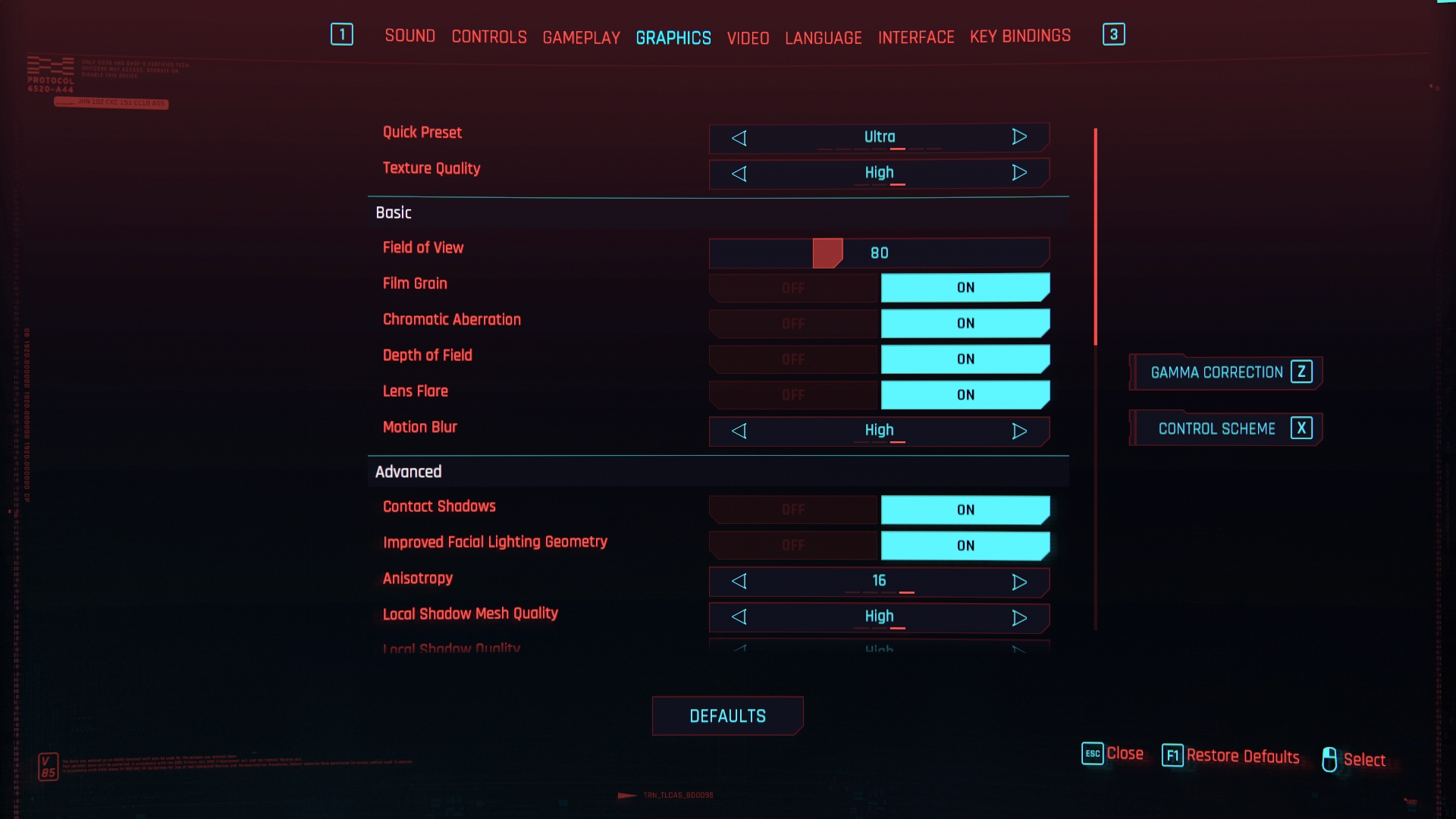
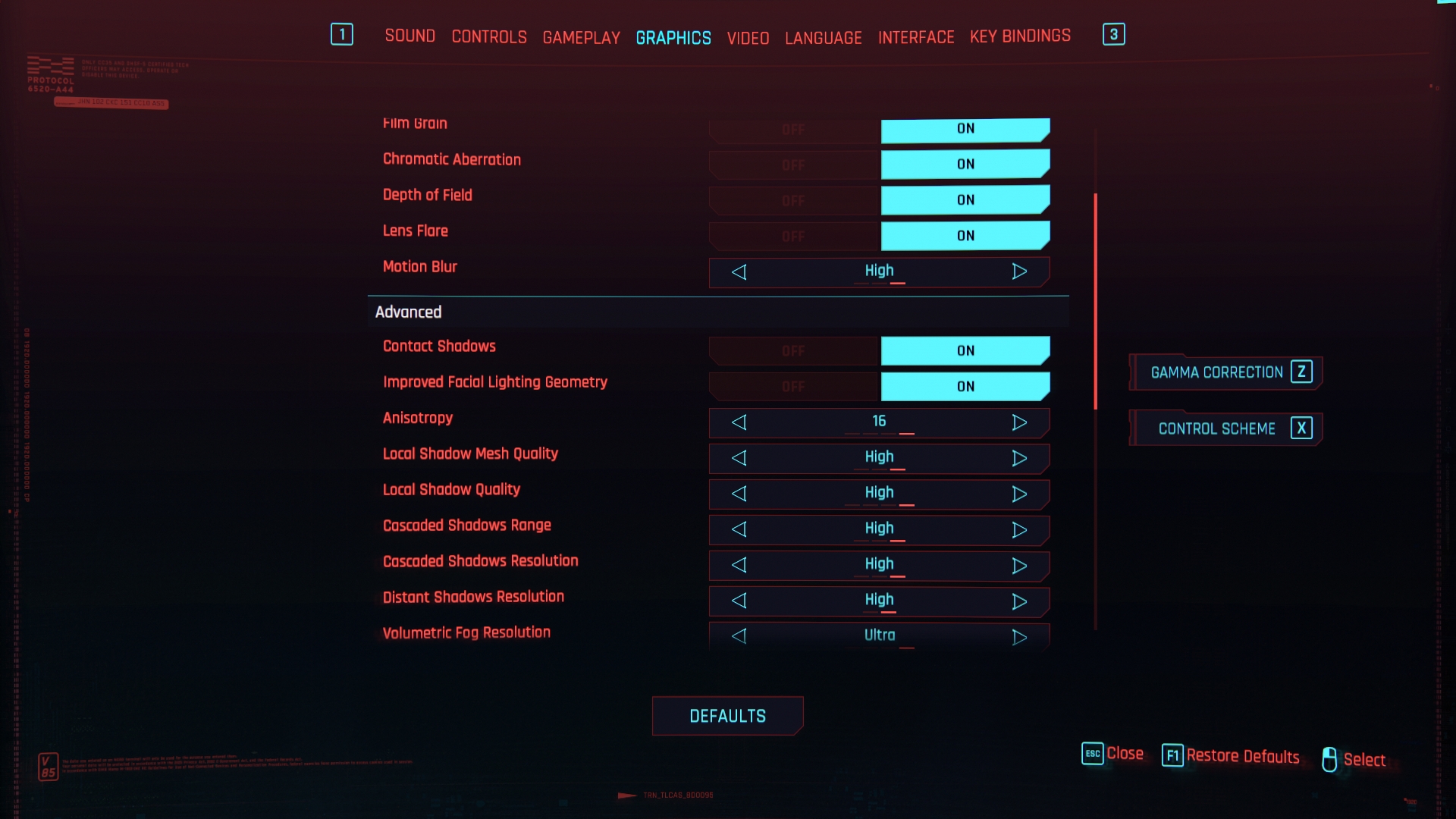
Engine: REDengine 4. We test using the Ultra preset, DX12 API.
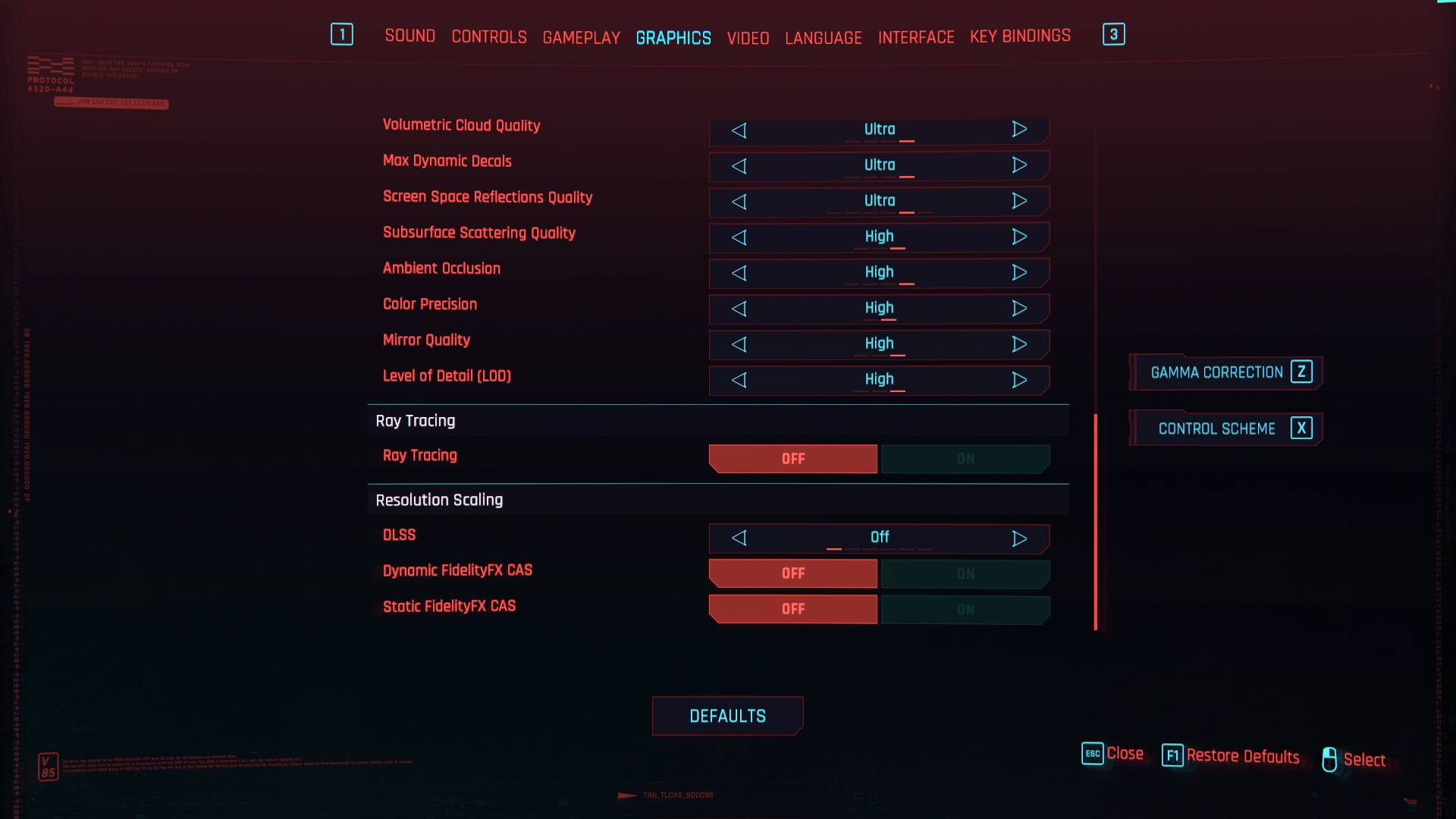
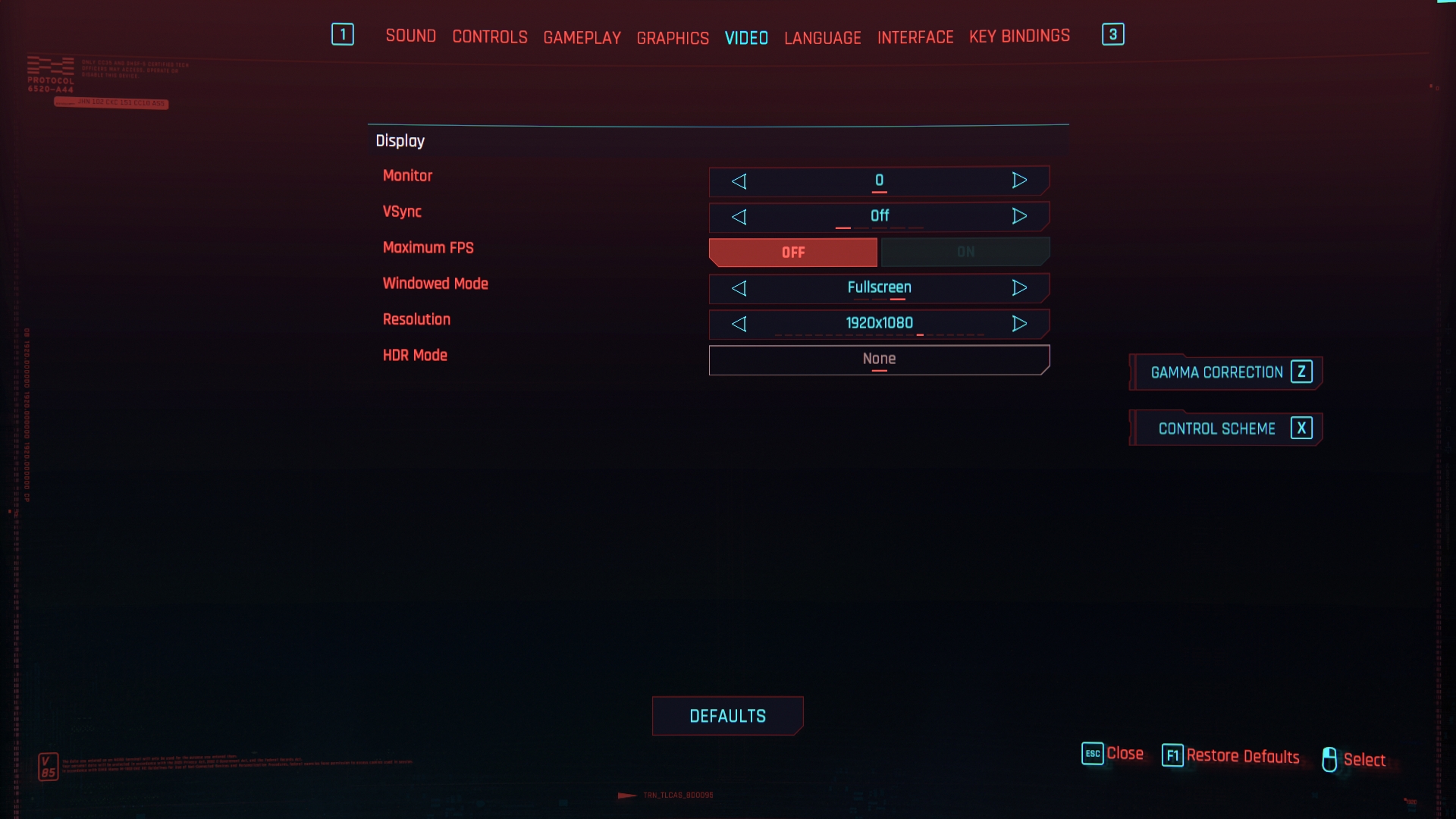
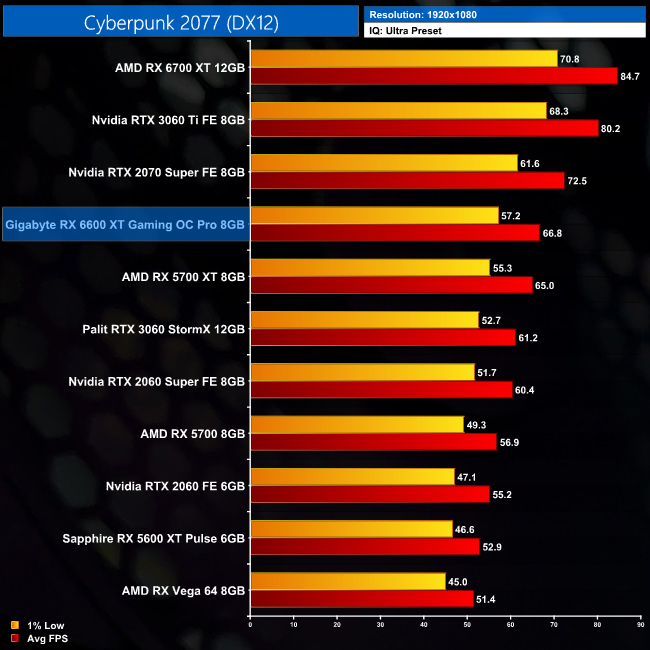
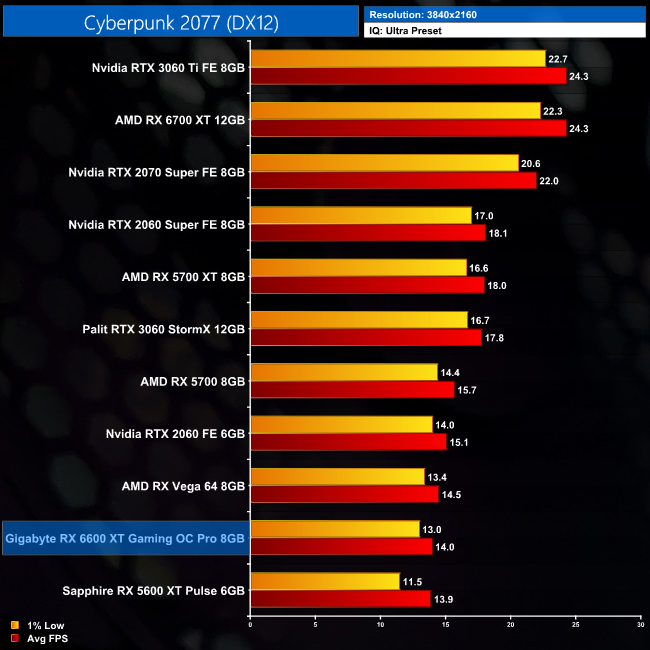
Next up is Cyberpunk 2077, where the RX 6600 XT manages 67FPS at 1080p. That's enough to give it a 9% lead over the RTX 3060, but it is well behind the RTX 3060 Ti, despite just a $20 difference in the cards' MSRPs. We're also looking at just a 2FPS uplift over the RX 5700 XT, a GPU which also launched for just 20USD more over two years ago.
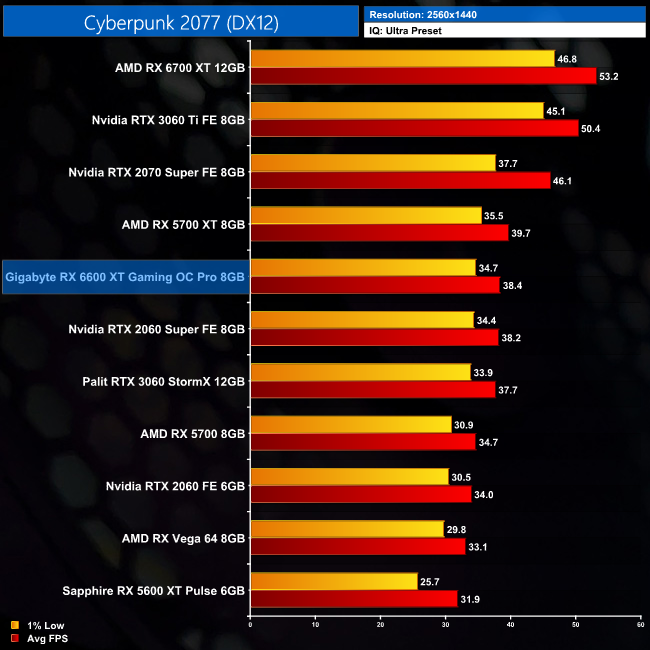
At 1440p, the 6600 XT even falls slightly behind the RX 5700 XT, not by a lot but we are getting the picture that this GPU is strongest at 1080p. It's also now less than a single frame faster than the RTX 3060, so that is definitely a tie between those GPUs.
Days Gone is a 2019 action-adventure survival horror video game developed by Bend Studio and published by Sony Interactive Entertainment for the PlayStation 4 and Microsoft Windows. As part of Sony's efforts to bring more of its first-party content to Microsoft Windows following Horizon Zero Dawn, Days Gone released on Windows on May 18, 2021. (Wikipedia).
Engine: Unreal Engine 4. We test using the Very High preset, DX11 API.
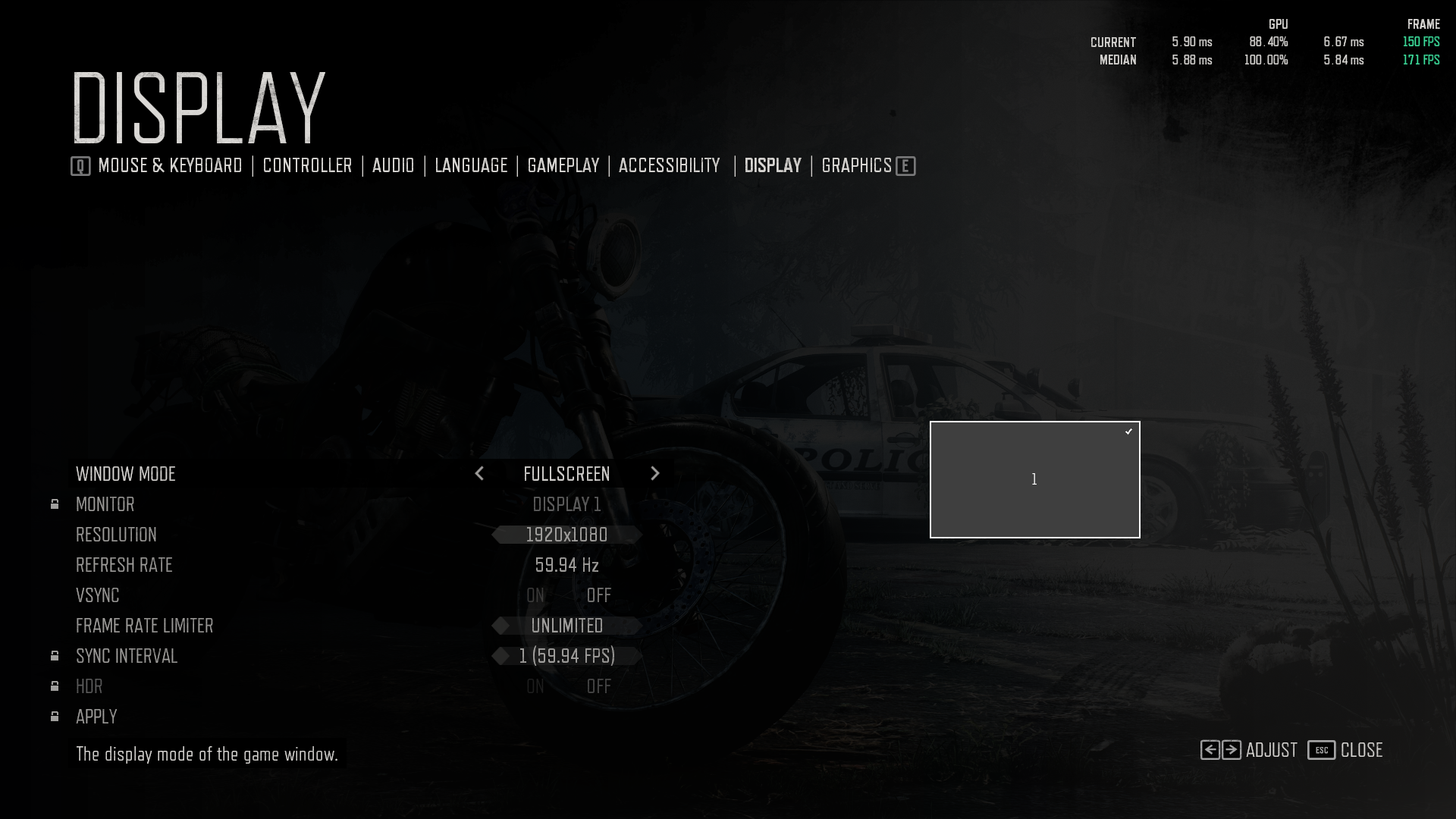
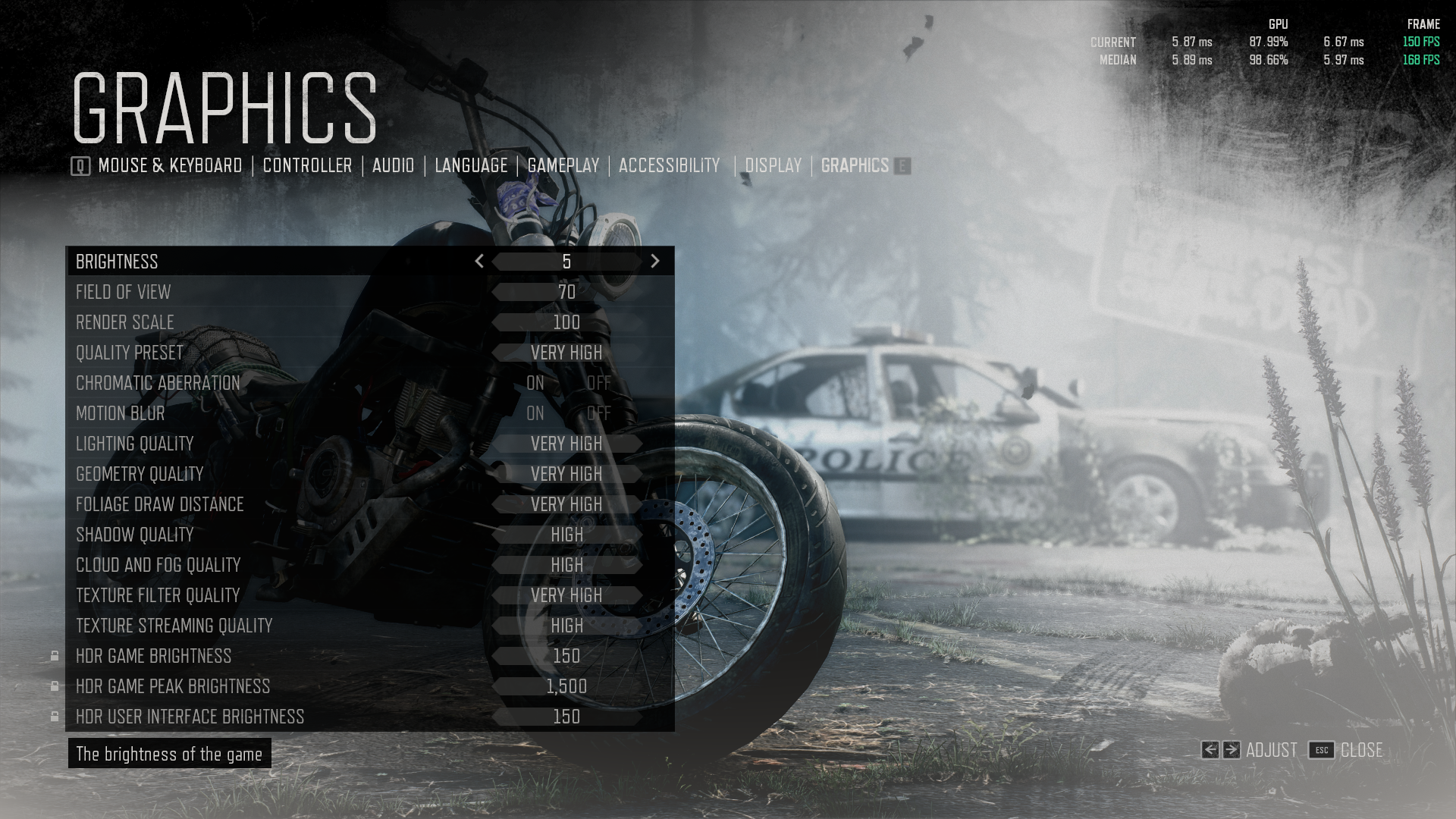
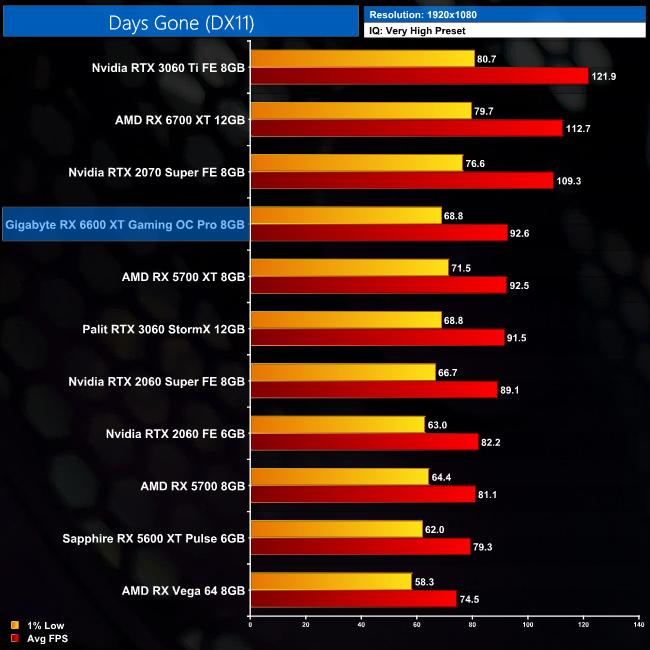
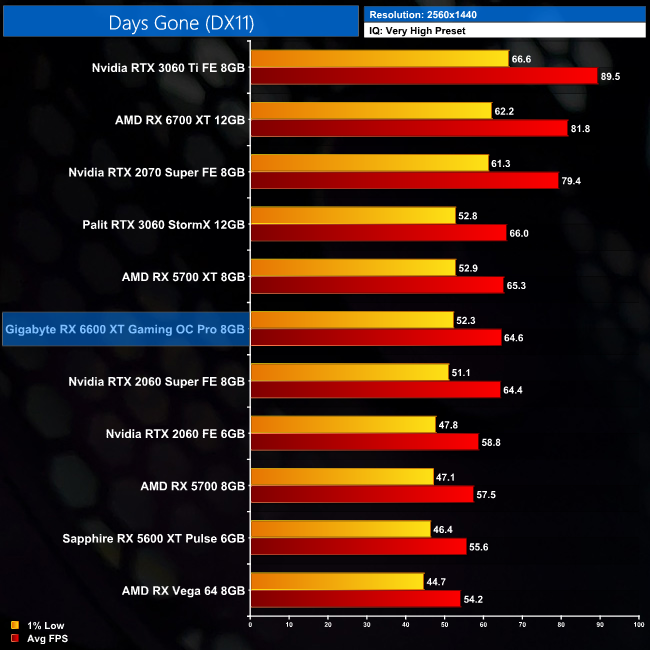
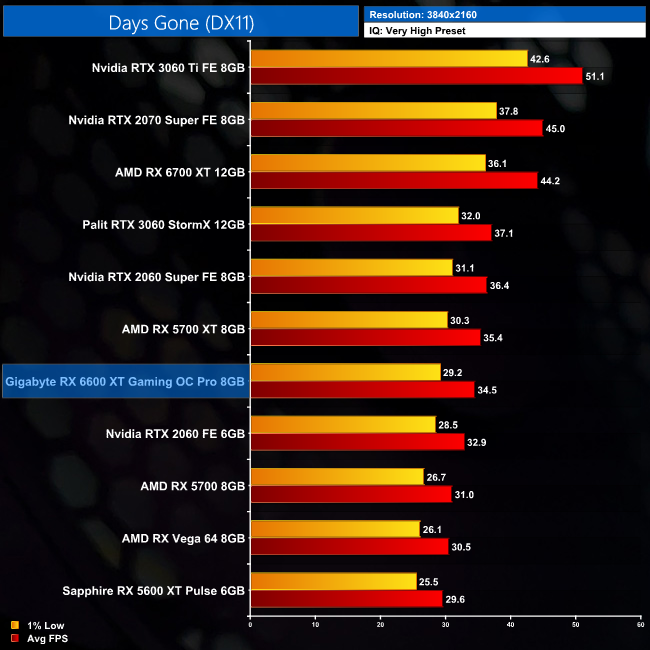
As for Days Gone, while it's not a sponsored title, by using Unreal Engine 4 and the DX11 API this game definitely has a preference for Nvidia GPUs, so the fact the 6600 XT is matching the RTX 3060 at 1080p is a good result. There's a clear gulf between this card and the RTX 3060 Ti however, while it is also on par with the RX 5700 XT.
Not a whole lot changes at 1440p. Like we saw in Control, the RX 6600 XT, RX 5700 XT, RTX 3060 and RTX 2060 Super are all clumped extremely close together, with less than two FPS separating all four GPUs. Averaging over 60FPS at 1440p max settings is an impressive result for those cards, though.
F1 2021 is the official video game of the 2021 Formula One and Formula 2 Championships developed by Codemasters and published by EA Sports. It is the fourteenth title in the F1 series by Codemasters and the first in the series published by Electronic Arts under its EA Sports division since F1 Career Challenge in 2003. The game was released on July 16, 2021, for Microsoft Windows, PlayStation 4, PlayStation 5, Xbox One, and Xbox Series X/S. (Wikipedia)
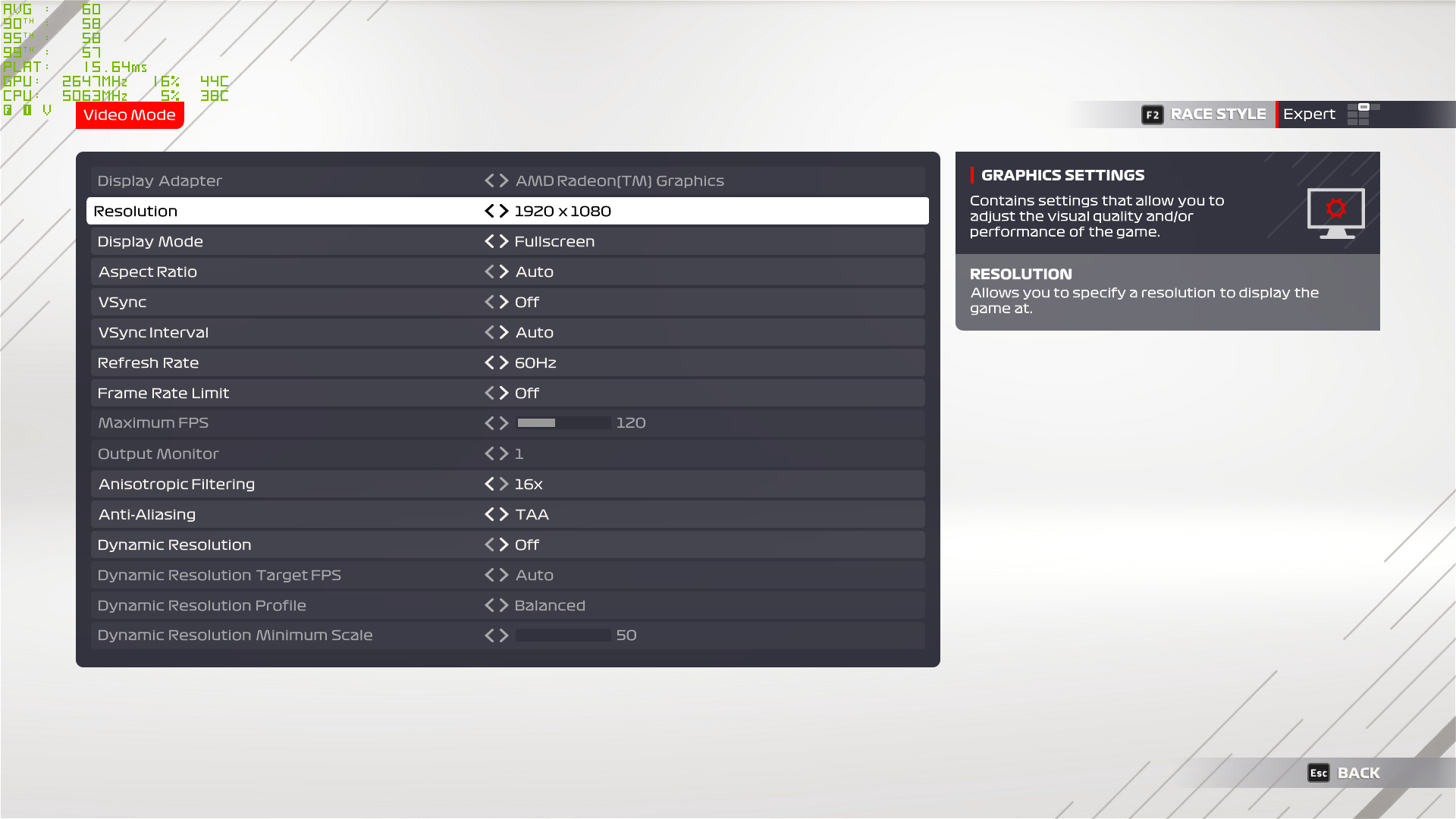
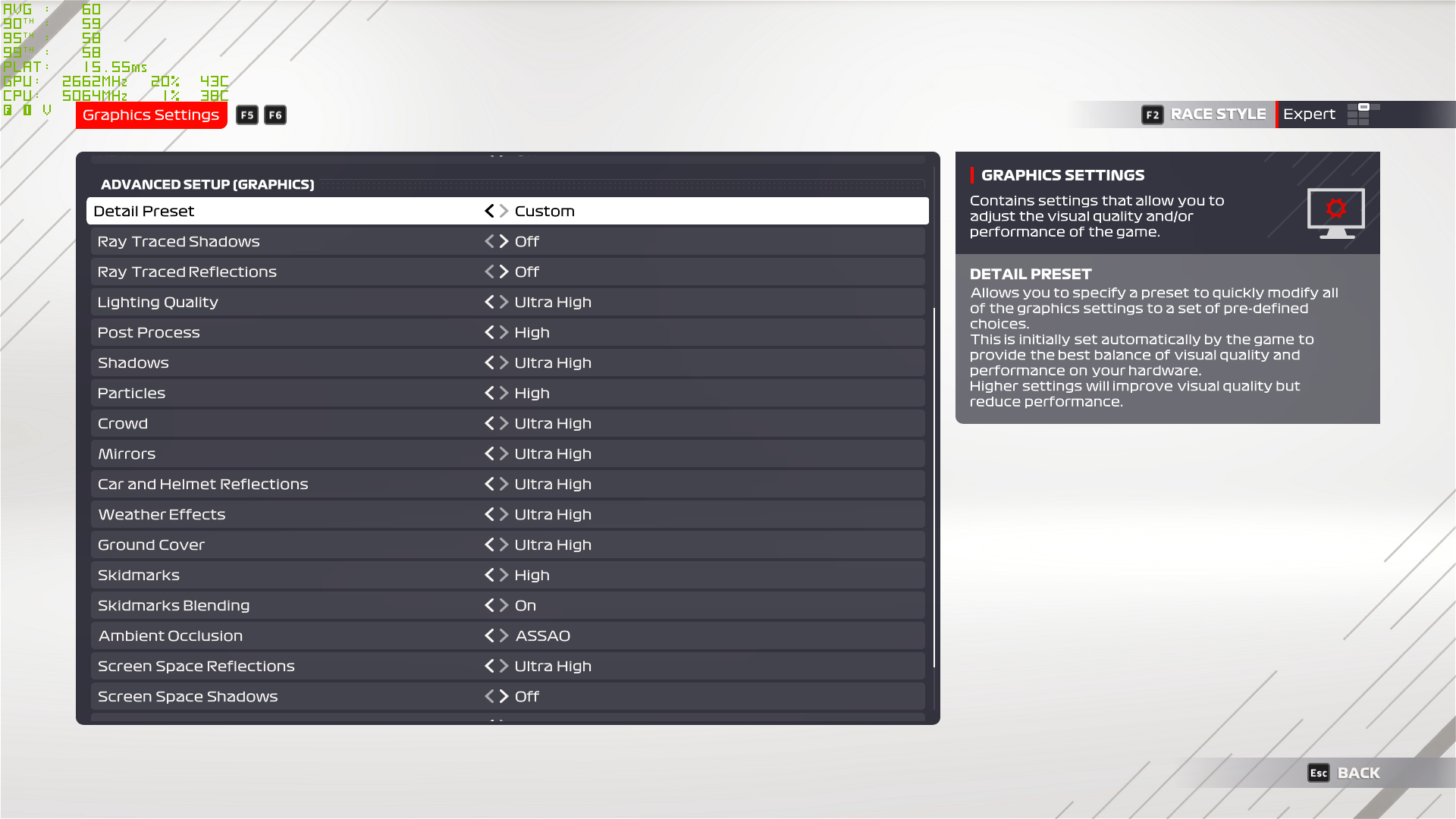
Engine: EGO. We test using the Ultra High preset, with all ray tracing settings turned off, DX12 API.
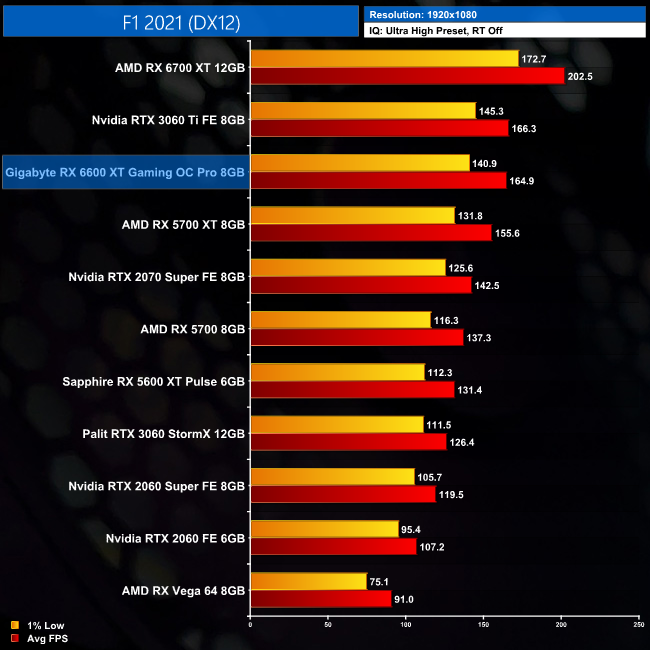
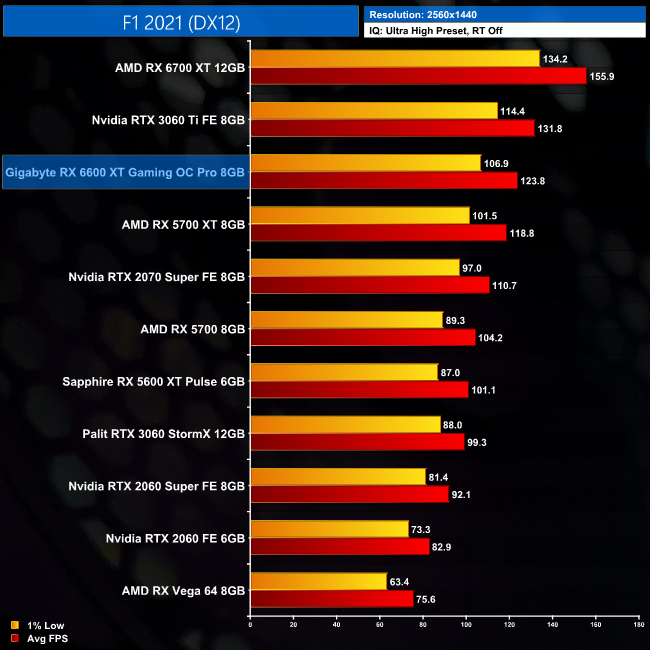
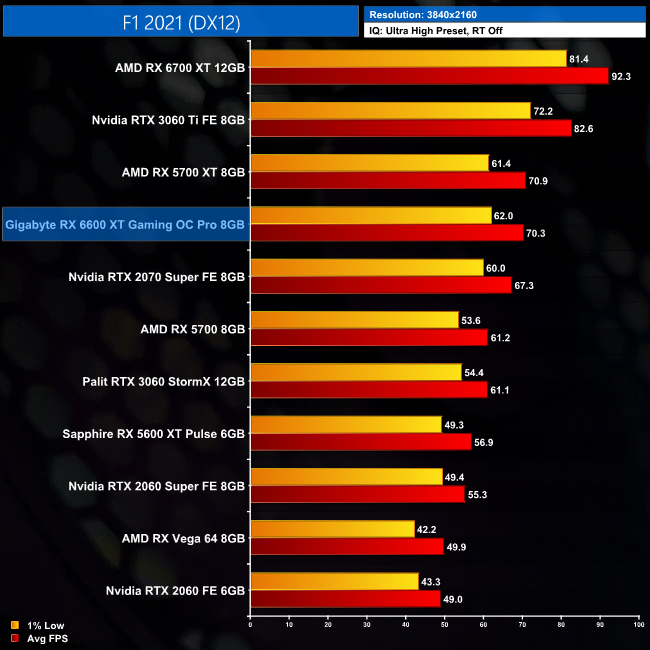
F1 2021, on the other hand, delivers the single most impressive set of benchmark results for the RX 6600 XT. At 1080p it is absolutely miles ahead of the RTX 3060 here, delivering 31% better performance, while it's also bang on level with the RTX 3060 Ti, which isn't something we have seen too much in our testing so far.
Stepping up to 1440p, the 6600 XT is still 25% faster than the RTX 3060, a slightly small gap between those two cards, but still a very clear victory for AMD. Against the RTX 3060 Ti however, the 6600 XT is now 6% slower – but at the end of the day we're still looking at over 120FPS on average, so we can't really complain.
Gears 5 is a third-person shooter video game developed by The Coalition and published by Xbox Game Studios for Xbox One, Microsoft Windows and Xbox Series X. It is the fifth instalment of the Gears of War series and the sequel to Gears of War 4. The ultimate edition was released on September 6, 2019, while the standard edition of the game was released worldwide on September 10, 2019. (Wikipedia).
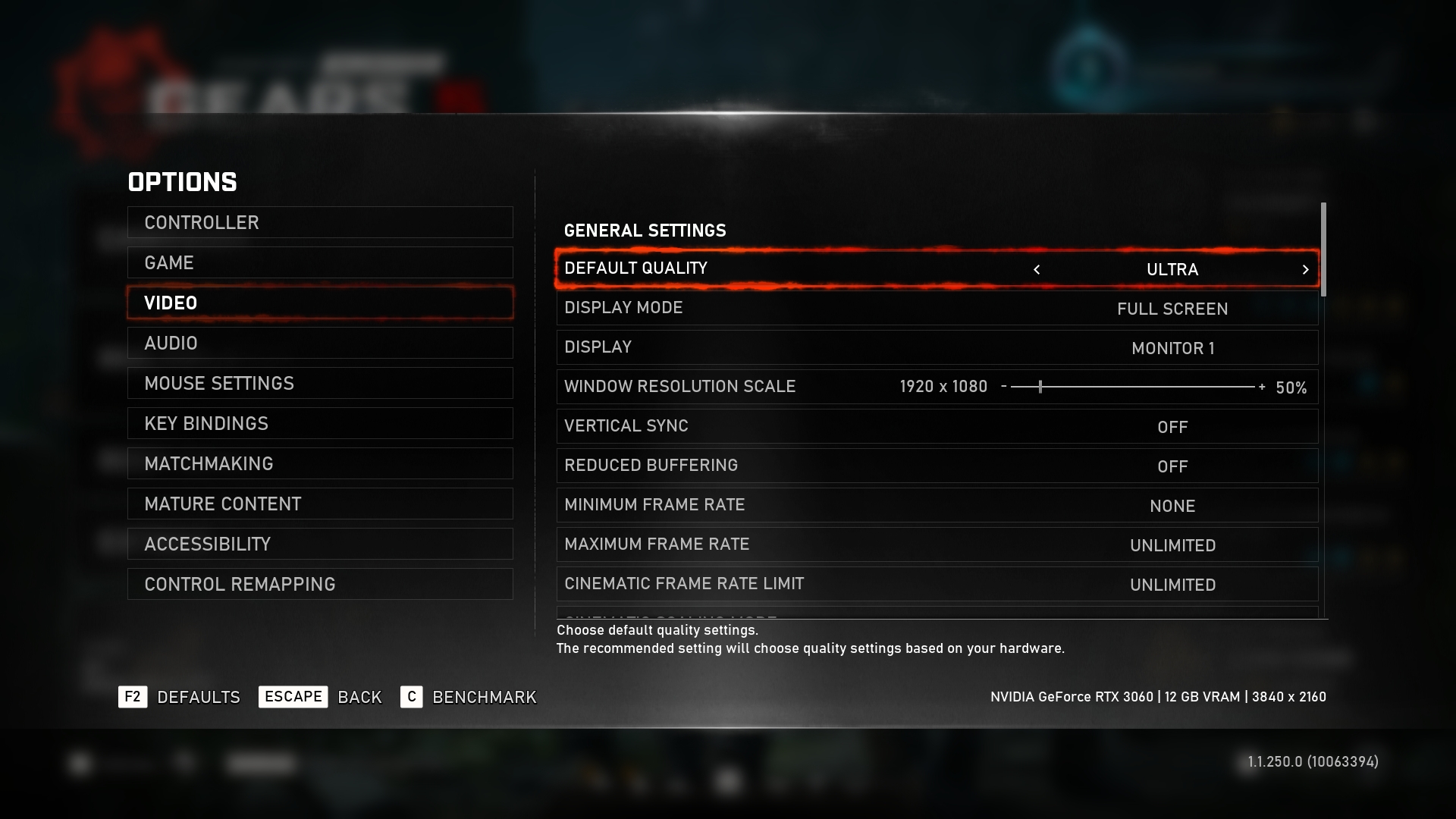
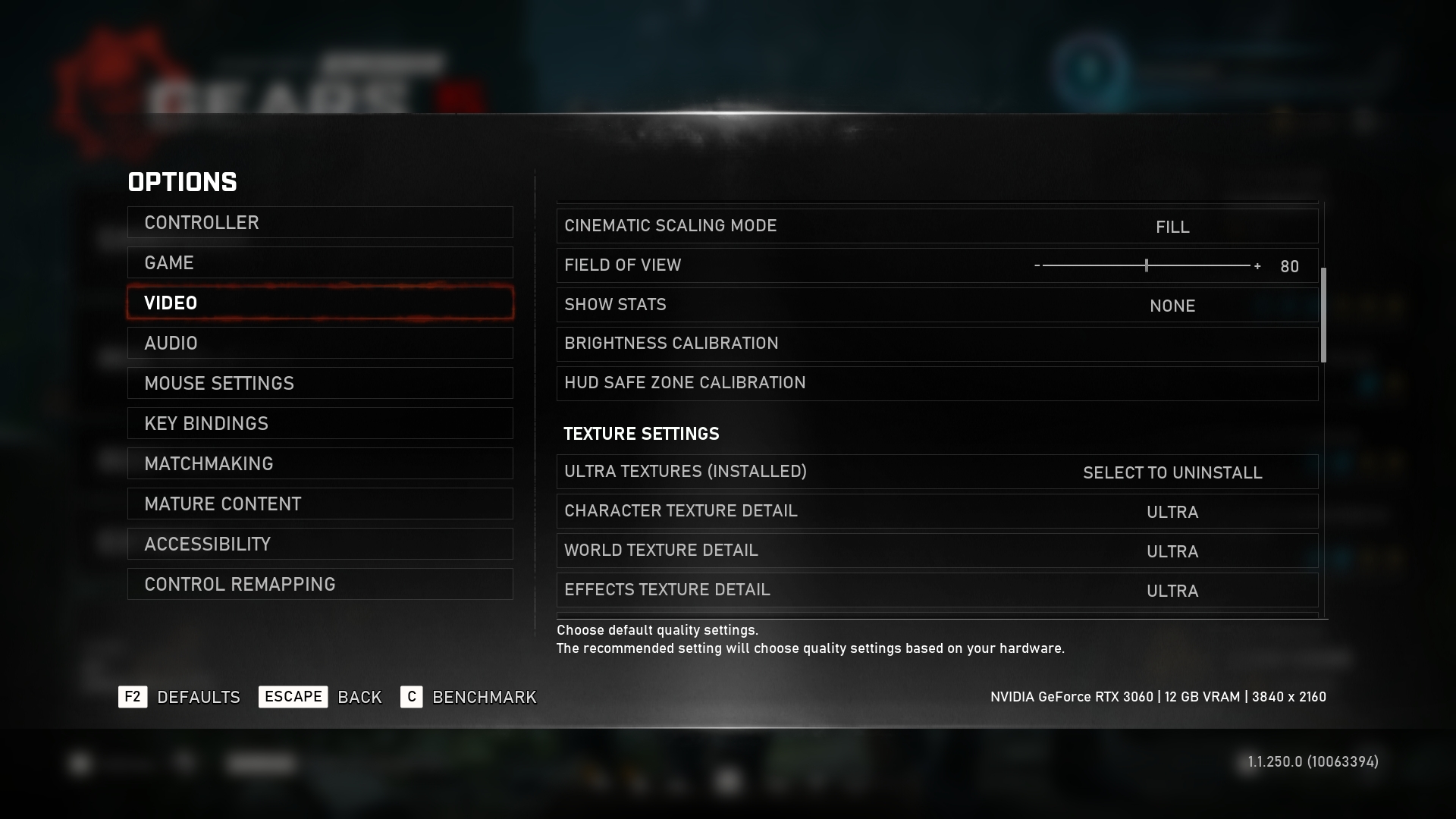
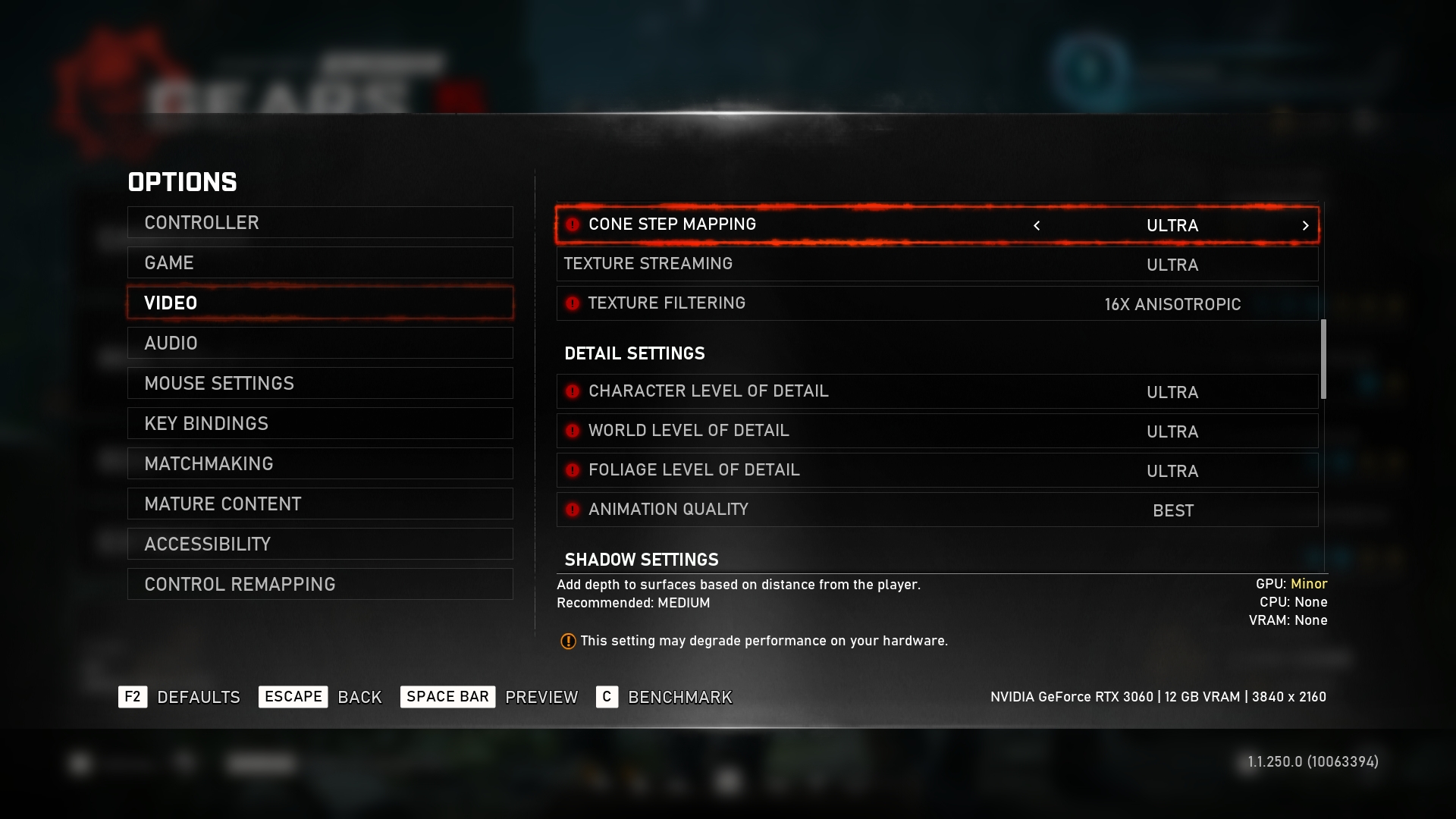
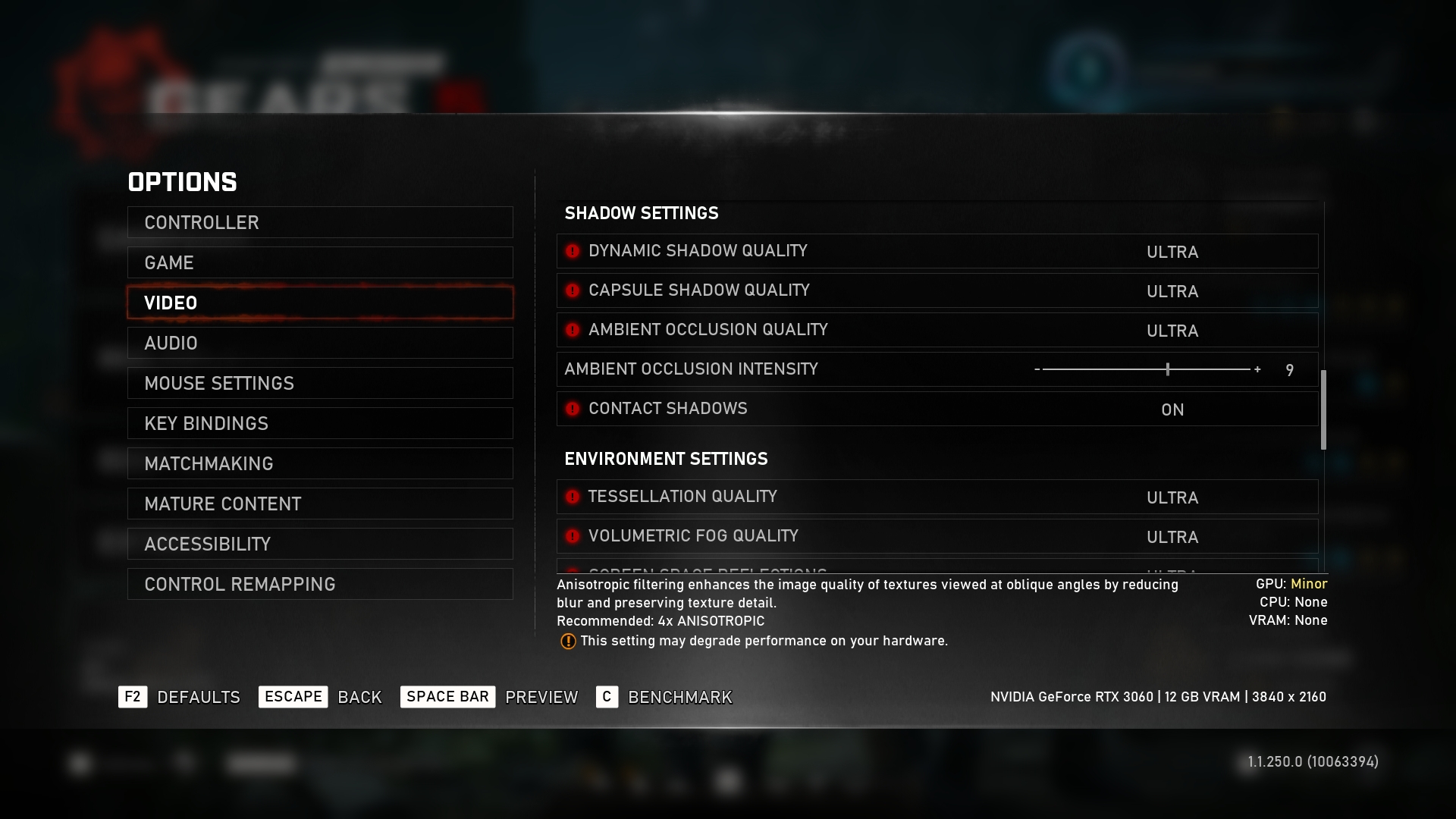
Engine: Unreal Engine 4. We test using the Ultra preset, with Best Animation Quality (instead of Auto), VRS disabled, DX12 API.
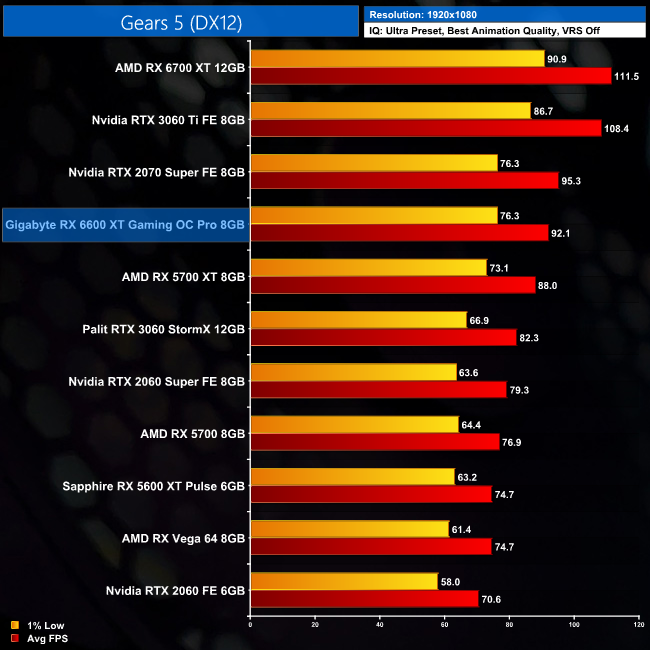
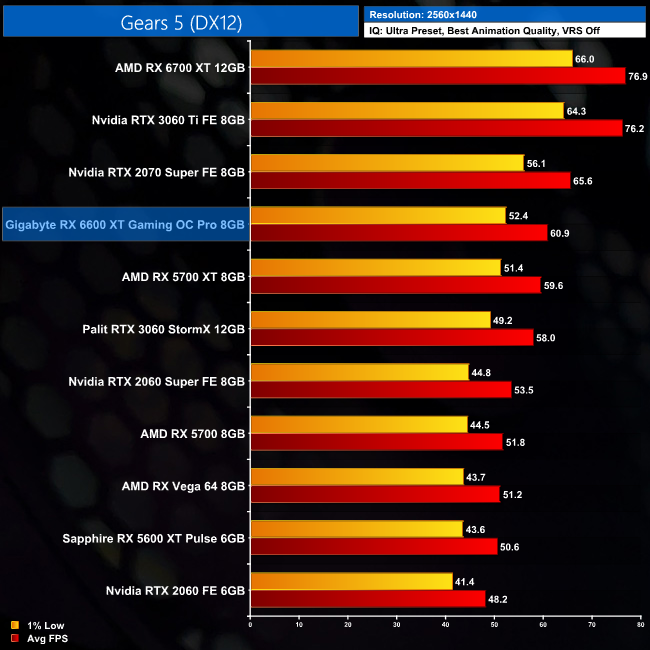
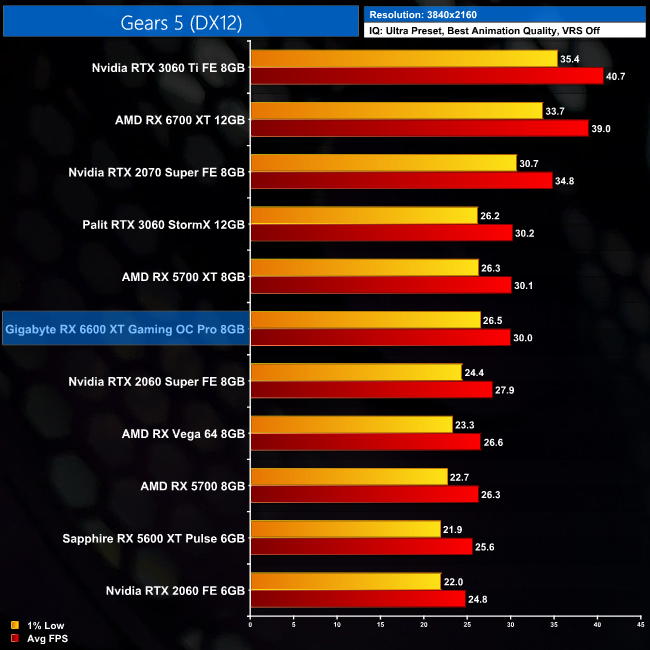
Gears 5 brings things back down to earth for the RX 6600 XT. At 1080p it is able to deliver 92FPS on average, giving it a healthy 12% lead over the RTX 3060, but we're once again looking at a similarly-sized deficit when compared to the RTX 3060 Ti. We can also see a tiny lead over the RX 5700 XT, with a difference of just 4FPS between those cards.
At 1440p meanwhile, the 6600 XT is still delivering a great experience here, averaging just over 60FPS, and that makes it 5% faster than the RTX 3060. Its lead over the RX 5700 XT is even smaller though, while it's also 20% slower than the RTX 3060 Ti, despite being just 5% cheaper in terms of MSRP.
Hitman 3 (stylized as HITMAN III) is a stealth game developed and published by IO Interactive for Microsoft Windows, PlayStation 4, PlayStation 5, Xbox One, Xbox Series X/S, Stadia (under the title Hitman: World of Assassination), and Nintendo Switch on 20 January 2021. It is the eighth main instalment in the Hitman series and the final entry in the World of Assassination trilogy, following Hitman (2016) and Hitman 2 (2018). (Wikipedia).
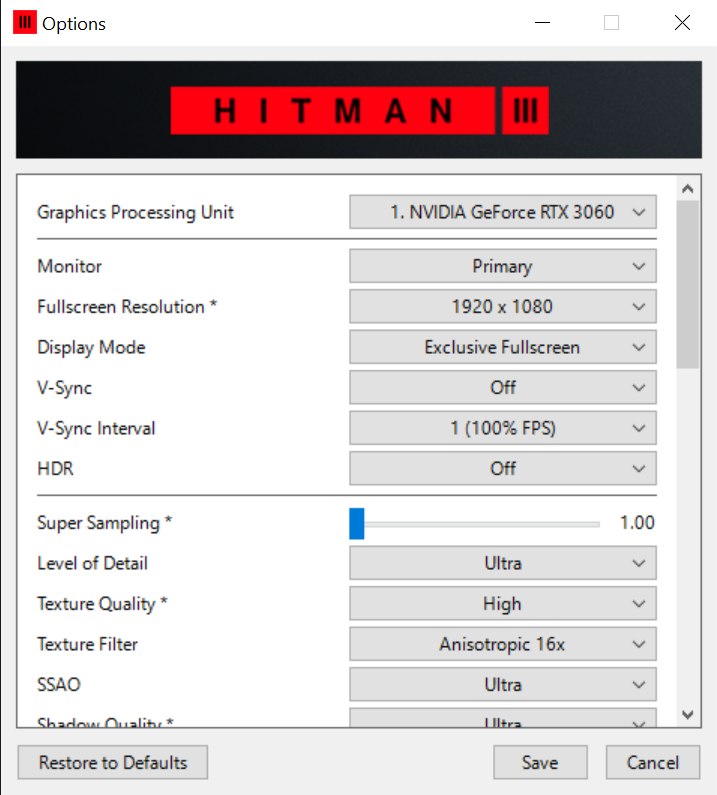
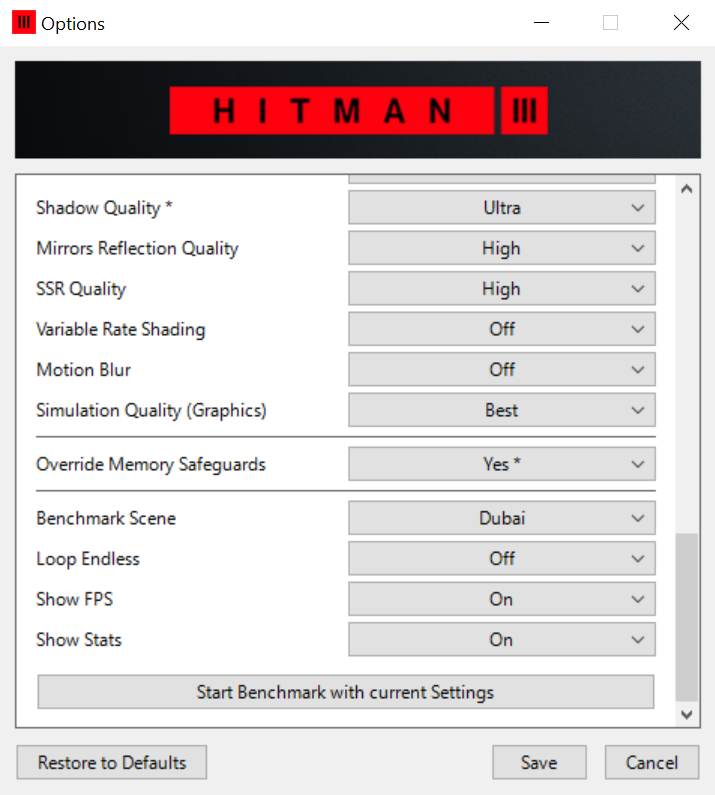
Engine: Glacier. We test using Ultra settings (or High where Ultra is not available), VRS off, DX12 API.
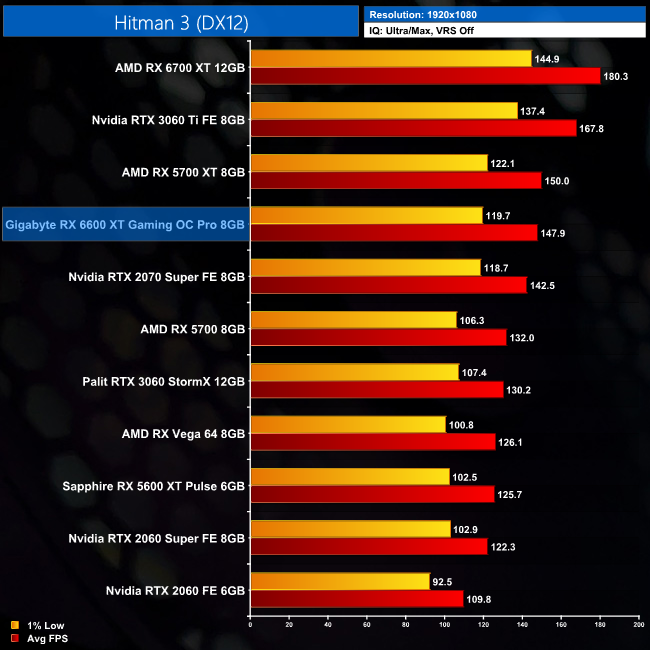
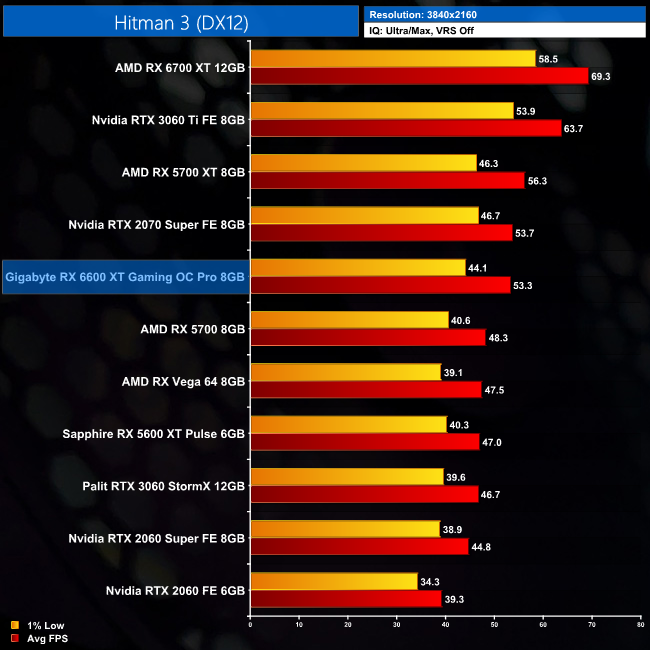
Up next we have Hitman 3, another strong title for AMD GPUs. Here the RX 6600 XT is averaging just shy of 150FPS, which isn't half-bad, and it's 14% faster than the RTX 3060. It is however, actually slower than the RX 5700 XT – admittedly not by a lot, but it's not the direction of travel that you want to be seeing from this new GPU.
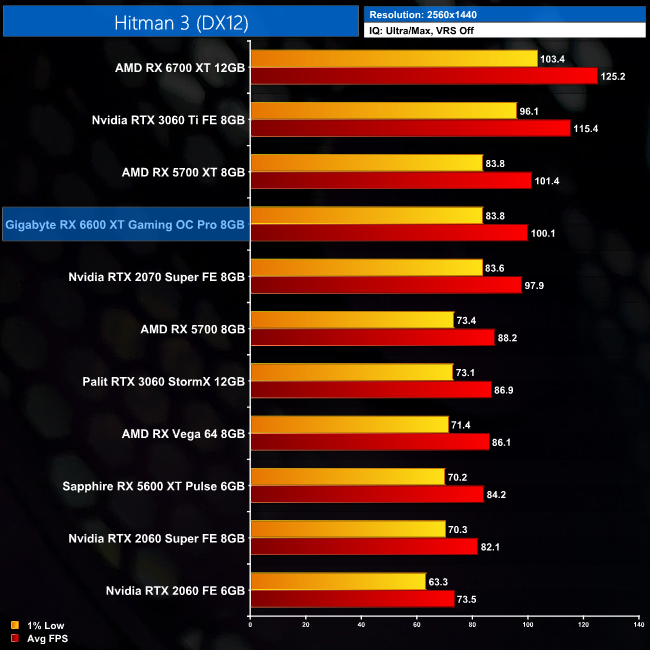
Still, an average of 100FPS at 1440p is another solid result, putting the 6600 XT 13% behind the RTX 3060 Ti – and that's actually one of the closer results between these GPUs. We can also see the 1% lows are identical between the 6600 XT and the 5700 XT.
Horizon Zero Dawn is an action role-playing game developed by Guerrilla Games and published by Sony Interactive Entertainment. The plot follows Aloy, a hunter in a world overrun by machines, who sets out to uncover her past. It was released for the PlayStation 4 in 2017 and Microsoft Windows in 2020. (Wikipedia).
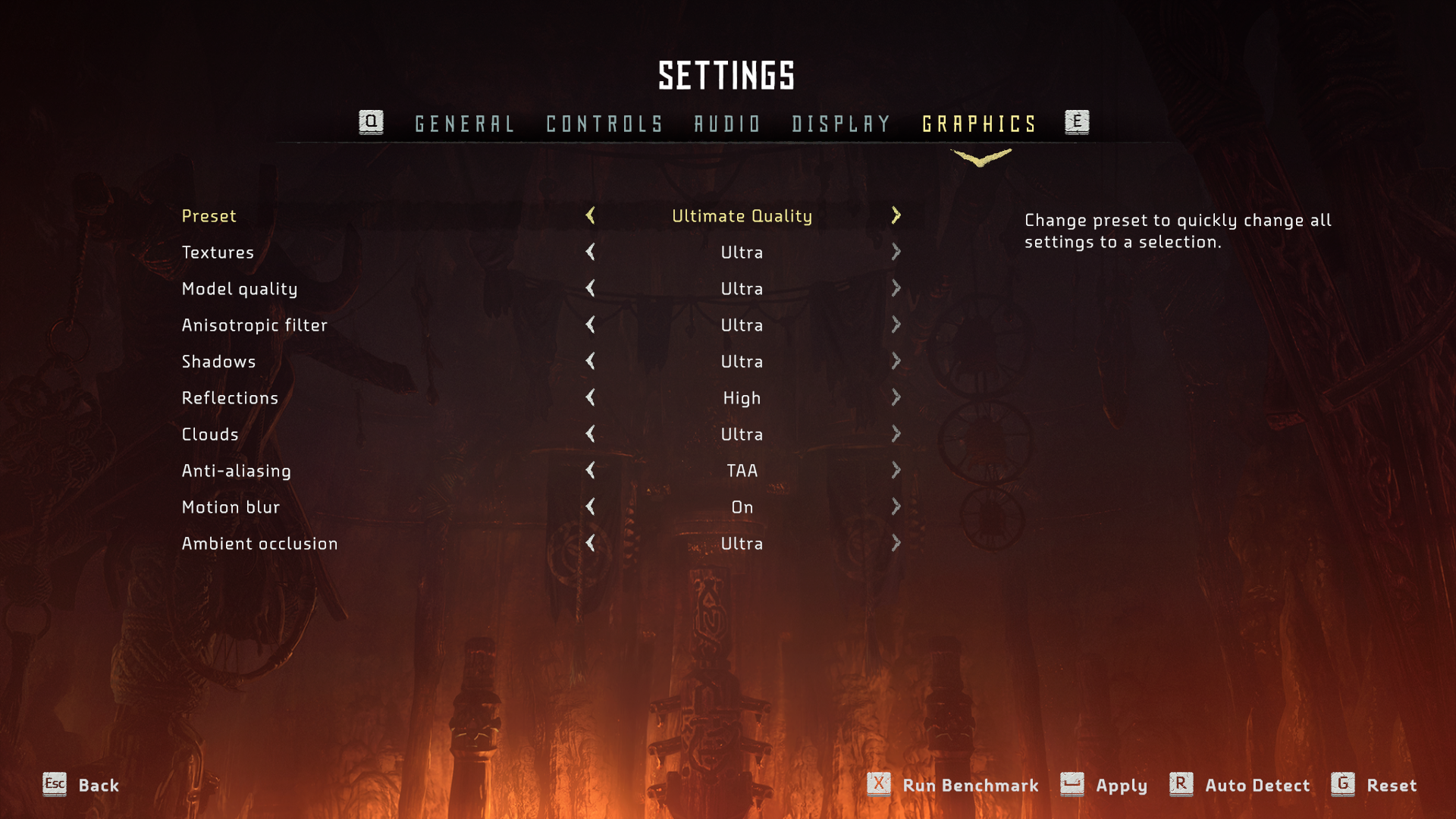
Engine: Decima. We test using the Ultimate Quality preset, DX12 API.
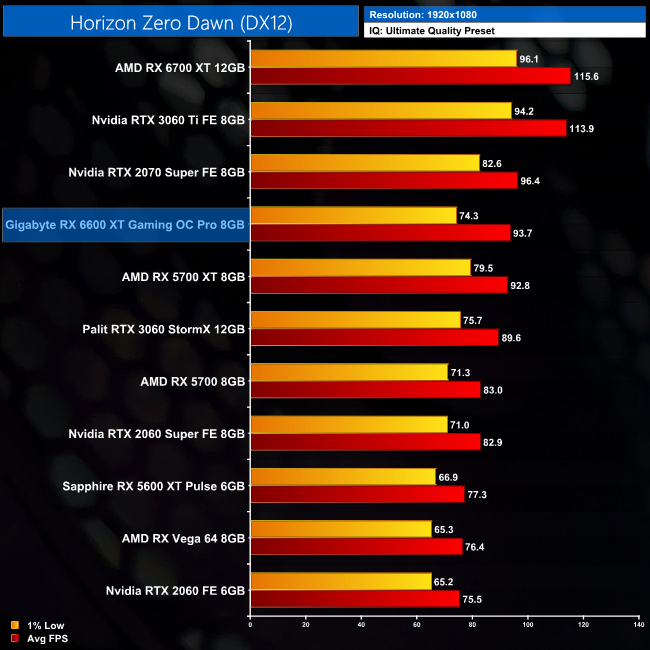
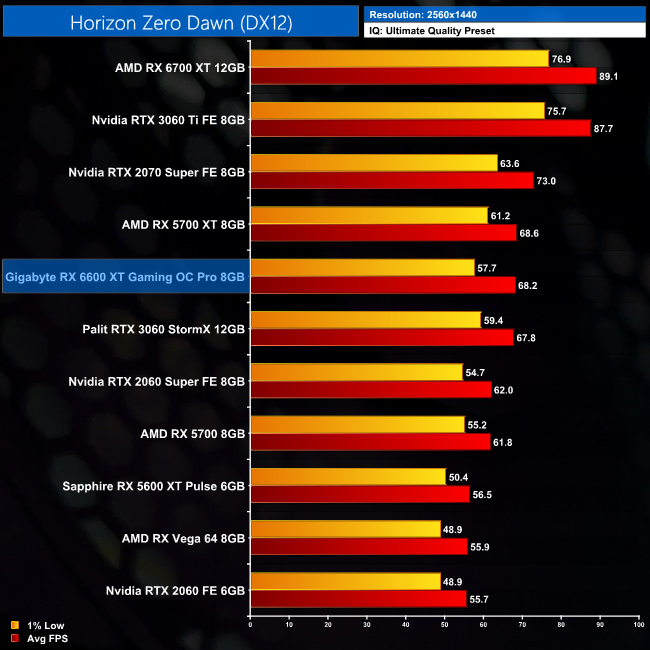
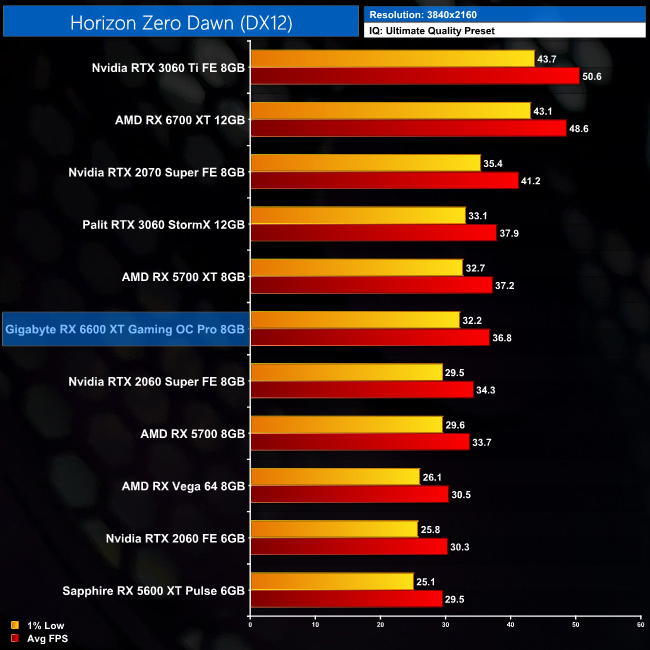
Horizon Zero Dawn is a much closer affair, with only a 5% margin separating the RX 6600 XT and the RTX 3060. The RX 5700 XT is also fractionally slower in terms of the average frame rate, but its 1% low performance is actually better than the 6600 XT by around 7% or so.
That is also true at 1440p, with identical average frame rates between the two GPUs, but the 6600 XT does worse in terms of the 1% lows. The RTX 3060 has also caught up slightly at this resolution, with no real difference between any of those three GPUs. Compared against the RTX 3060 Ti however, the 6600 XT is 22% slower, a pretty significant gap there.
Red Dead Redemption 2 is a 2018 action-adventure game developed and published by Rockstar Games. The game is the third entry in the Red Dead series and is a prequel to the 2010 game Red Dead Redemption. Red Dead Redemption 2 was released for the PlayStation 4 and Xbox One in October 2018, and for Microsoft Windows and Stadia in November 2019. (Wikipedia).
Engine: Rockstar Advance Game Engine (RAGE). We test by manually selecting Ultra settings (or High where Ultra is not available), TAA, Vulkan API.
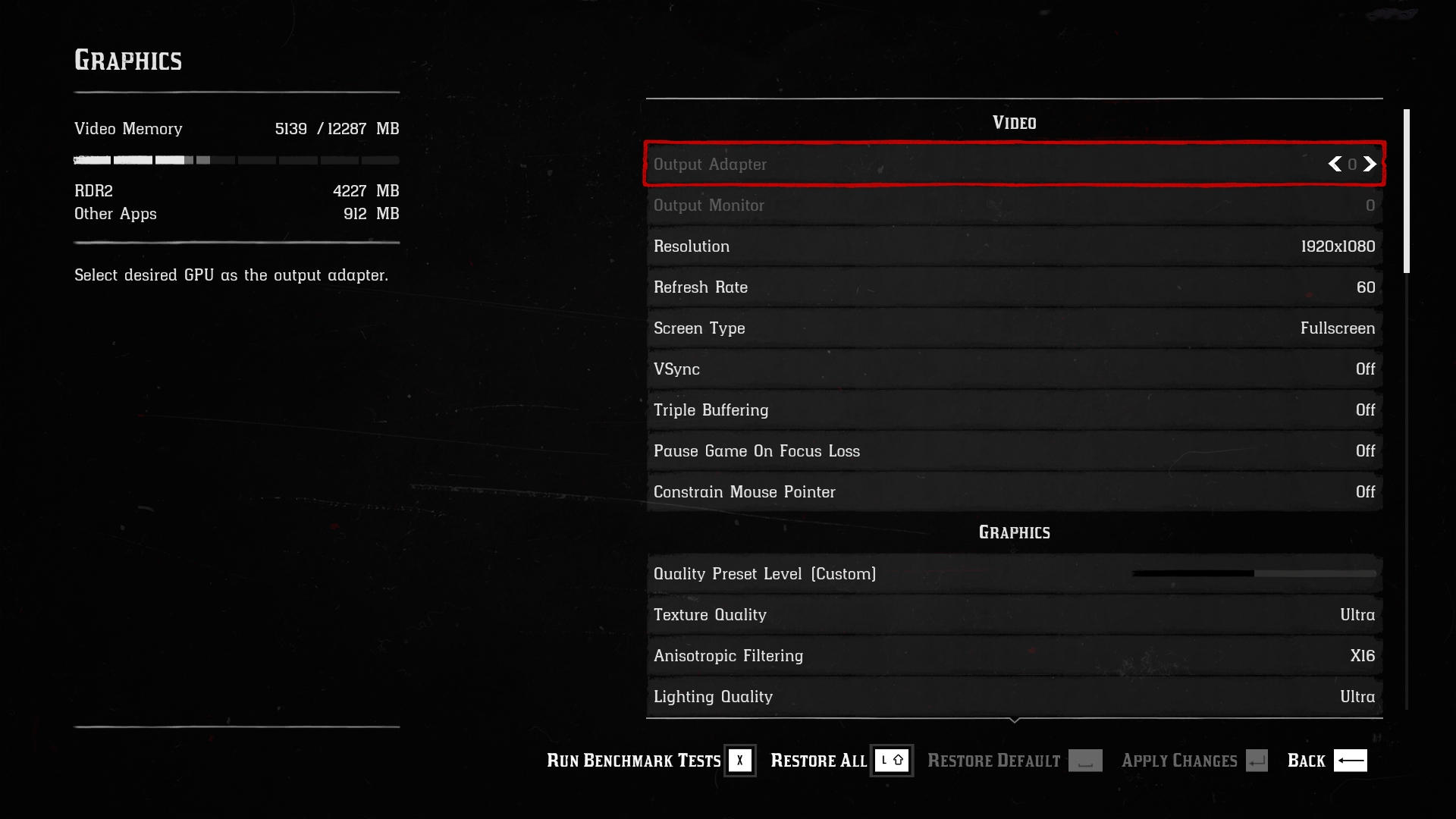
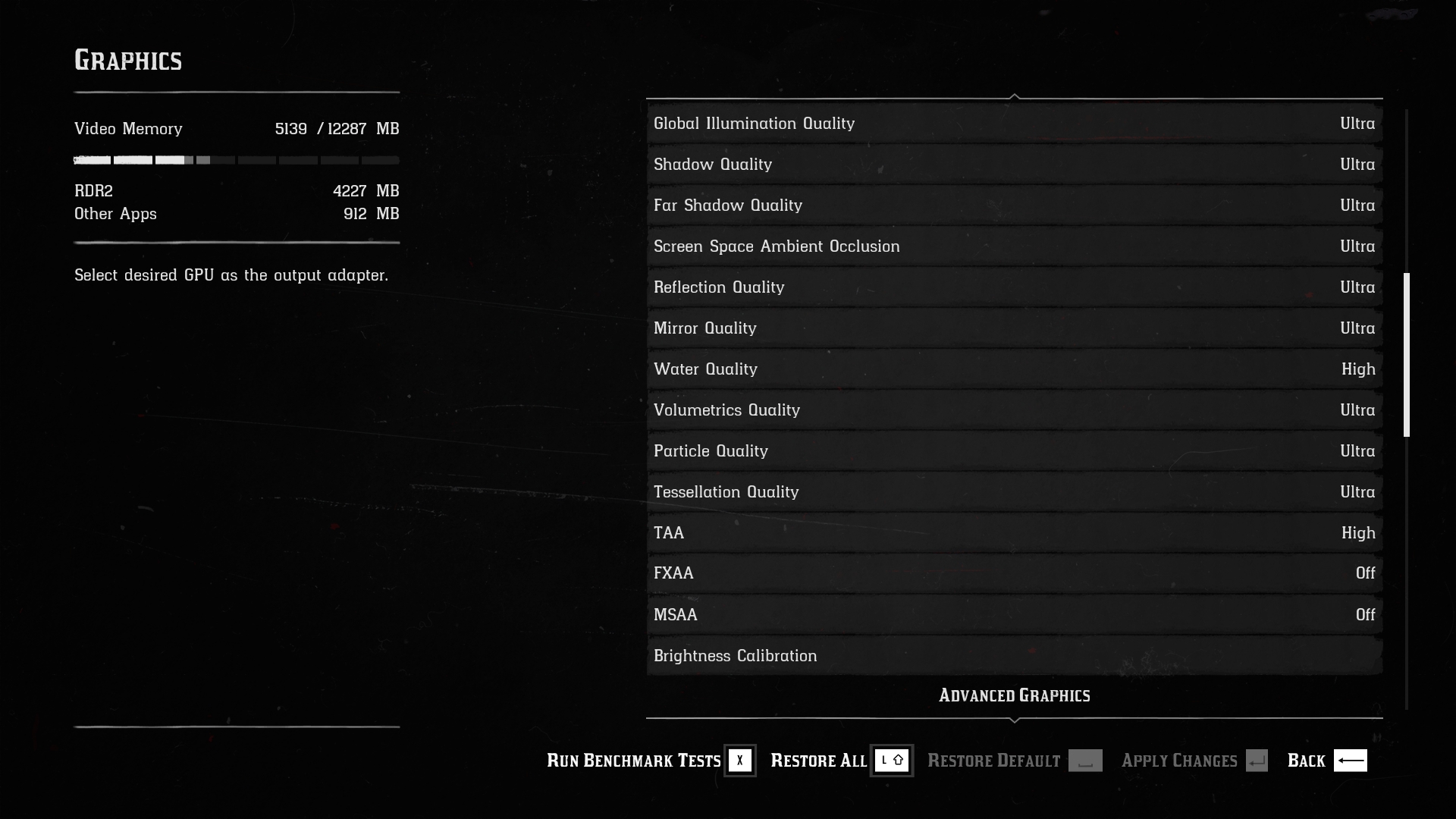
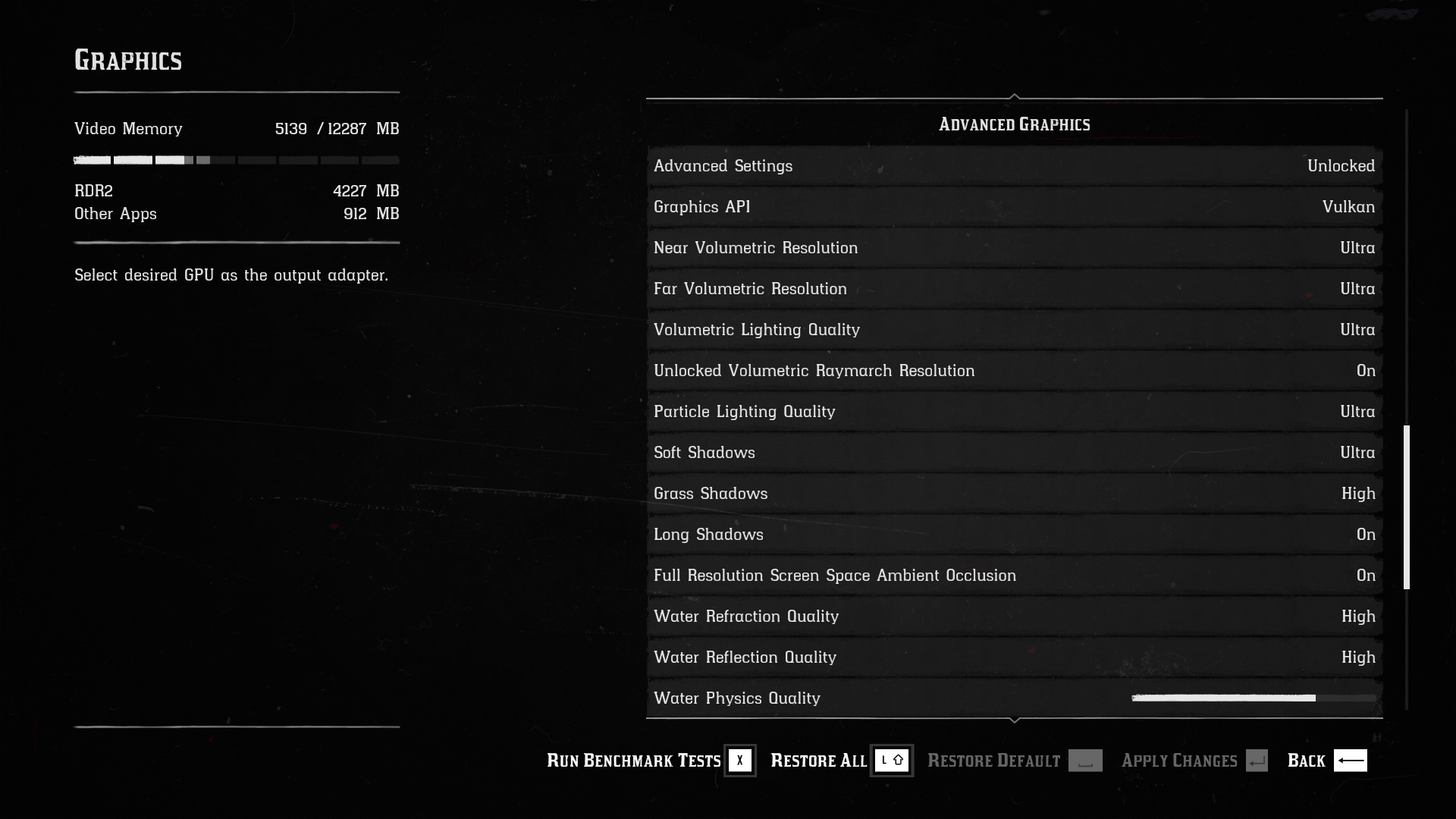
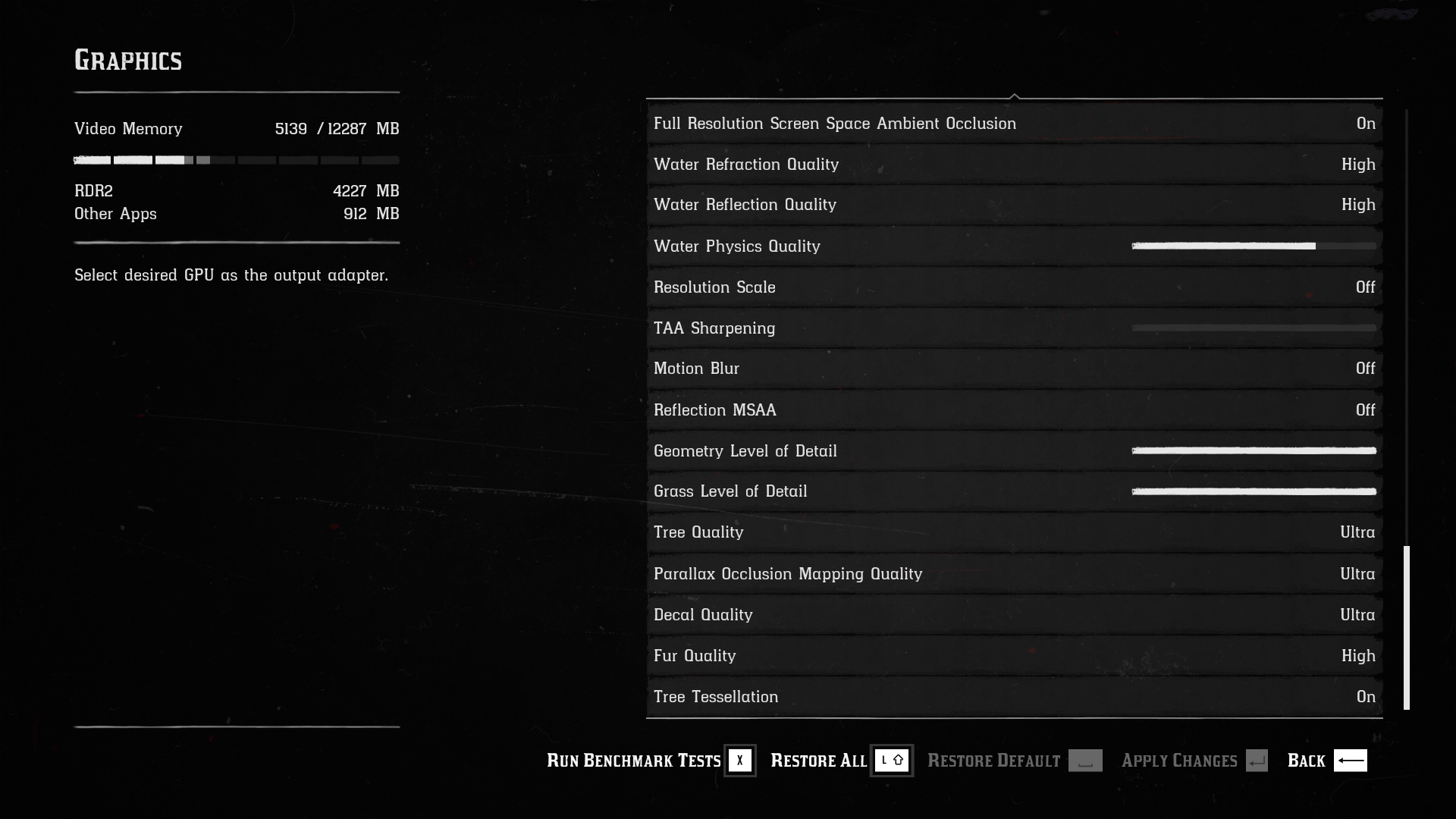
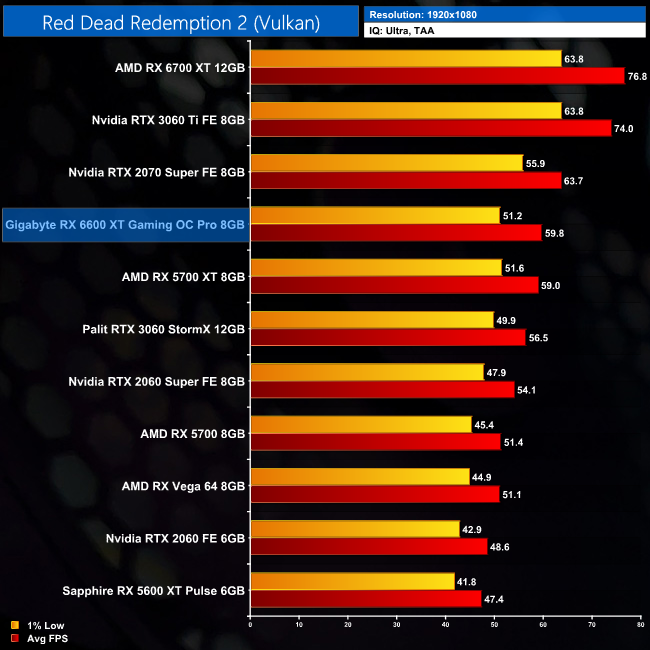

Moving onto Red Dead Redemption 2, at 1080p the RX 6600 XT is averaging just shy of 60FPS, which is not bad all when using Ultra settings in this game. It's once more dead level with the RX 5700 XT, while we're only looking at a 6% lead over the RTX 3060, which isn't that great considering the 15% difference in MSRPs.
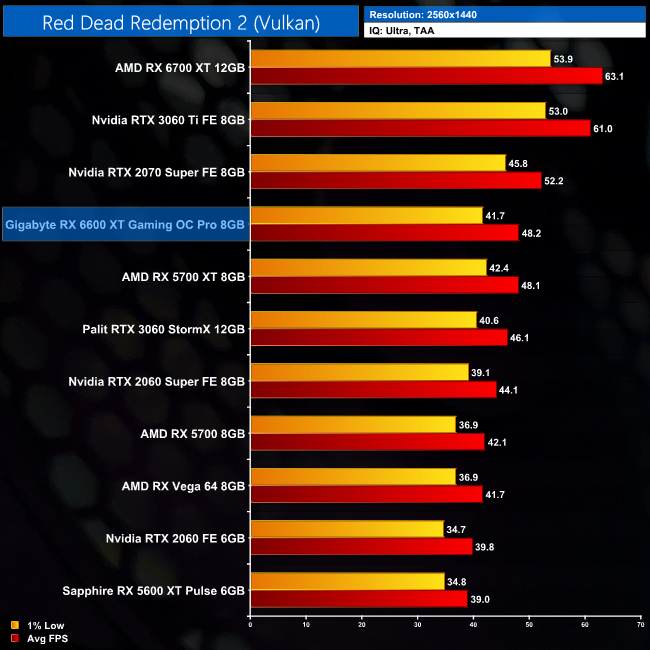
Up at 1440p, not much really changes, and again I have to say I am just impressed this GPU is still capable of averaging 48FPS using Ultra settings. It's still about 5% faster than the RTX 3060, but it is well behind the RTX 3060 Ti which can average over 60FPS at this resolution.
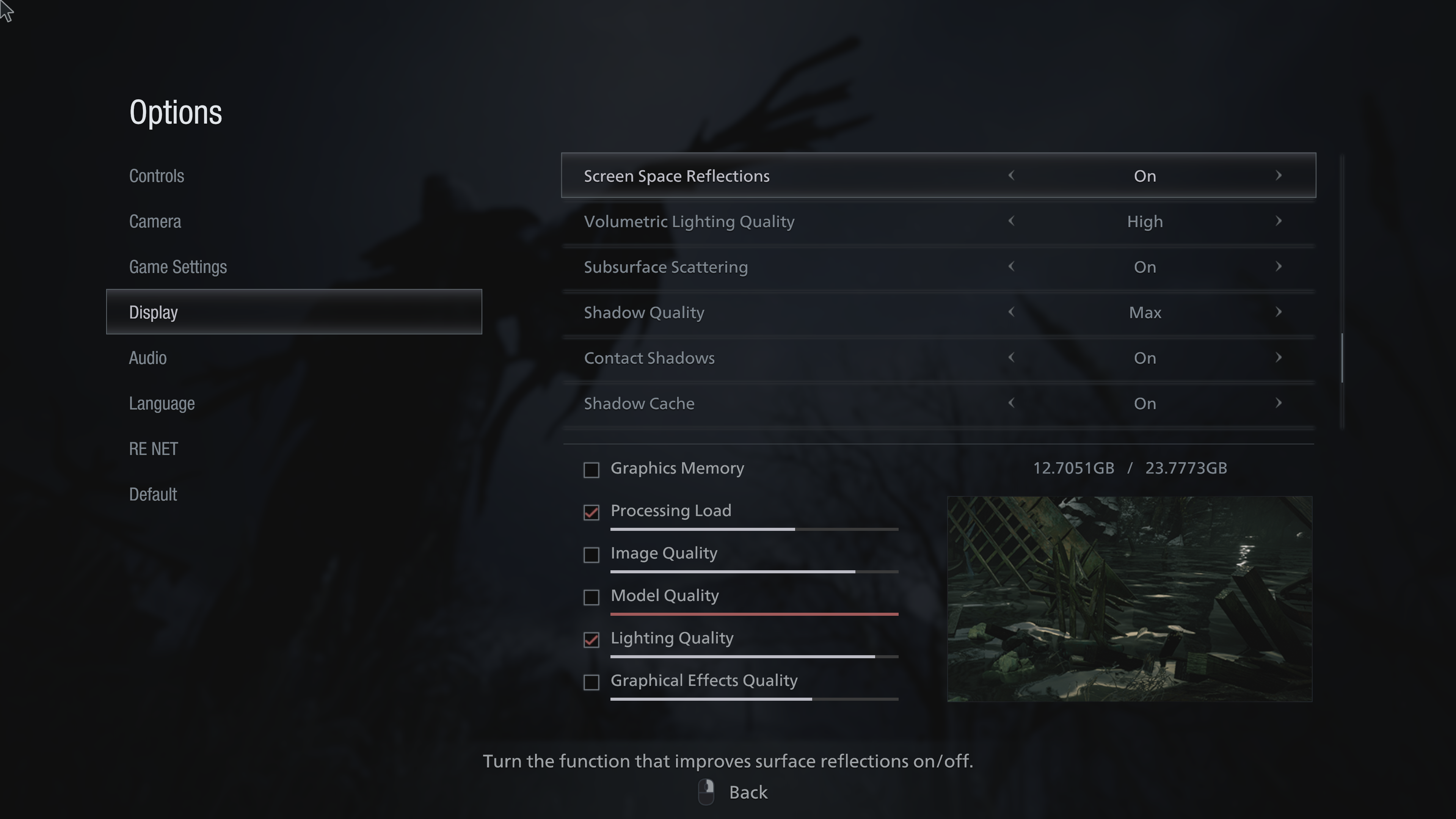
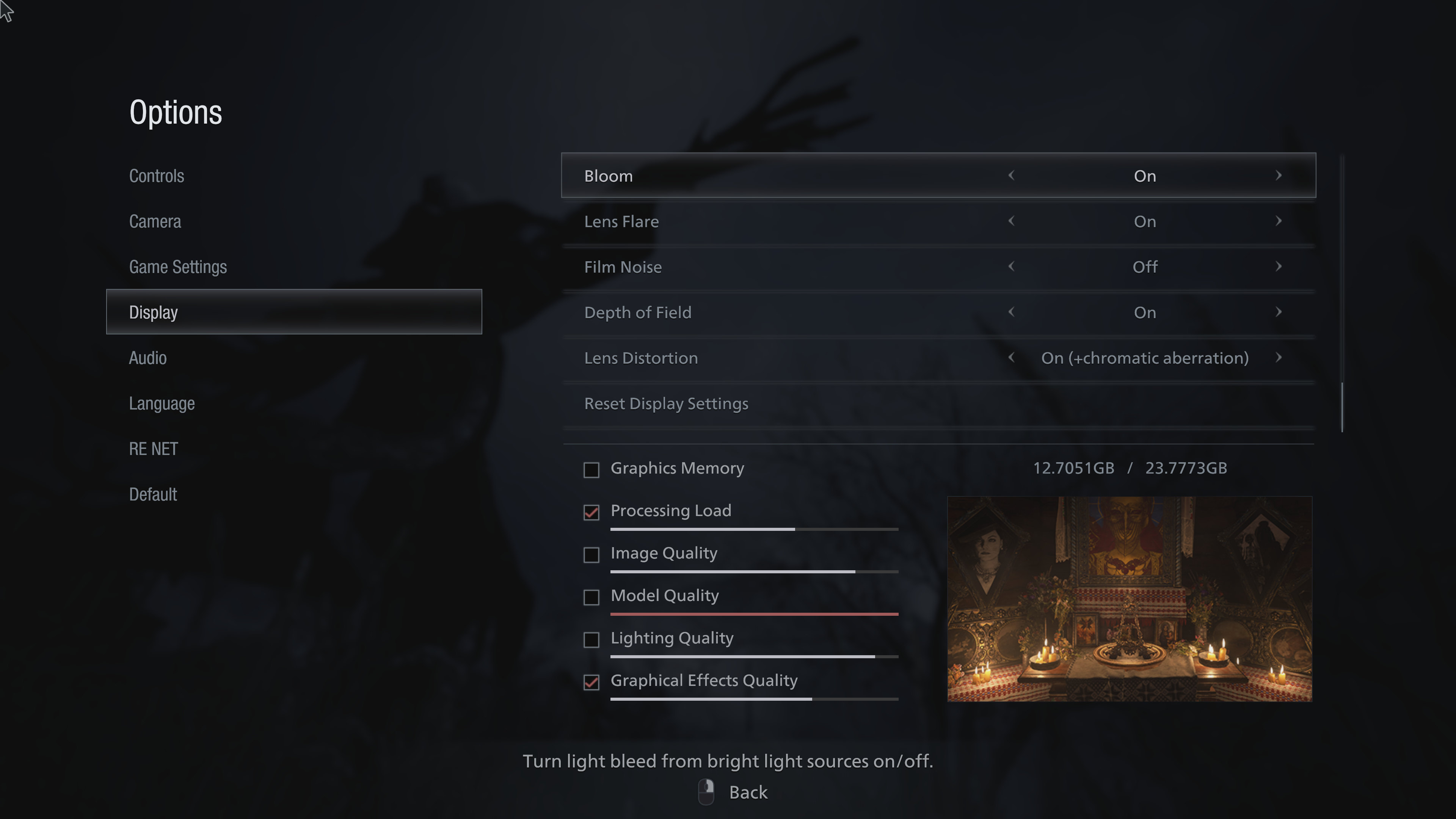
Resident Evil Village is a survival horror game developed and published by Capcom. The sequel to Resident Evil 7: Biohazard (2017), players control Ethan Winters, who is searching for his kidnapped daughter; after a fateful encounter with Chris Redfield, he finds himself in a village filled with mutant creatures. The game was announced at the PlayStation 5 reveal event in June 2020 and was released on May 7, 2021, for Windows, PlayStation 4, PlayStation 5, Xbox One, Xbox Series X/S and Stadia. (Wikipedia.)
Engine: RE Engine. We test using the Max preset, with V-Sync and CAS disabled, DX12 API.

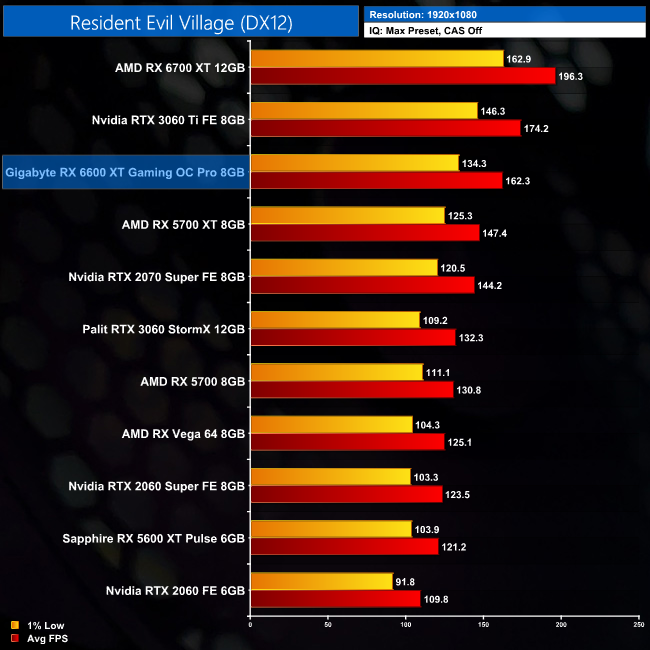
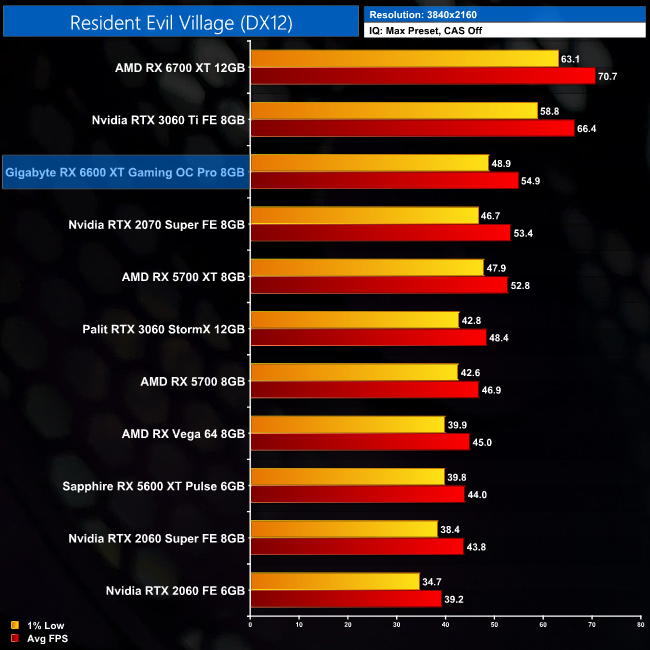
Resident Evil Village is the last AMD-sponsored title that we test, and the RX 6600 XT does produce the goods here. It averages over 160FPS at 1080p, giving it an impressive 23% lead over the RTX 3060. We can even see the 6600 XT's biggest win over the RX 5700 XT here, to the tune of 10%, with this new game best placed to get the most out of RDNA 2 compared to the original RDNA architecture.
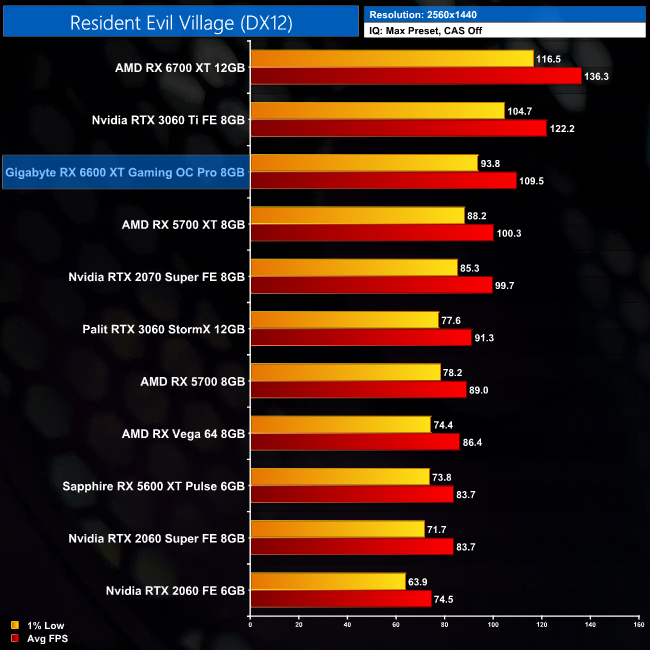
At 1440p, that picture remains pretty consistent. We're still getting frame rates over 100FPS, which isn't bad at all for a card focused on 1080p gaming, while the 6600 XT is still 20% faster than the RTX 3060. It is still 10% slower than the RTX 3060 Ti, but that's one of the better results for the 6600 XT at this resolution.
Total War Saga: Troy is a 2020 turn-based strategy video game developed by Creative Assembly Sofia and published by Sega. The game was released for Windows on 13 August 2020 as the second instalment in the Total War Saga subseries, succeeding Thrones of Britannia (2018). (Wikipedia).
Engine: TW Engine 3 (Warscape). We test using the Ultra preset, with unlimited video memory enabled, DX11 API.
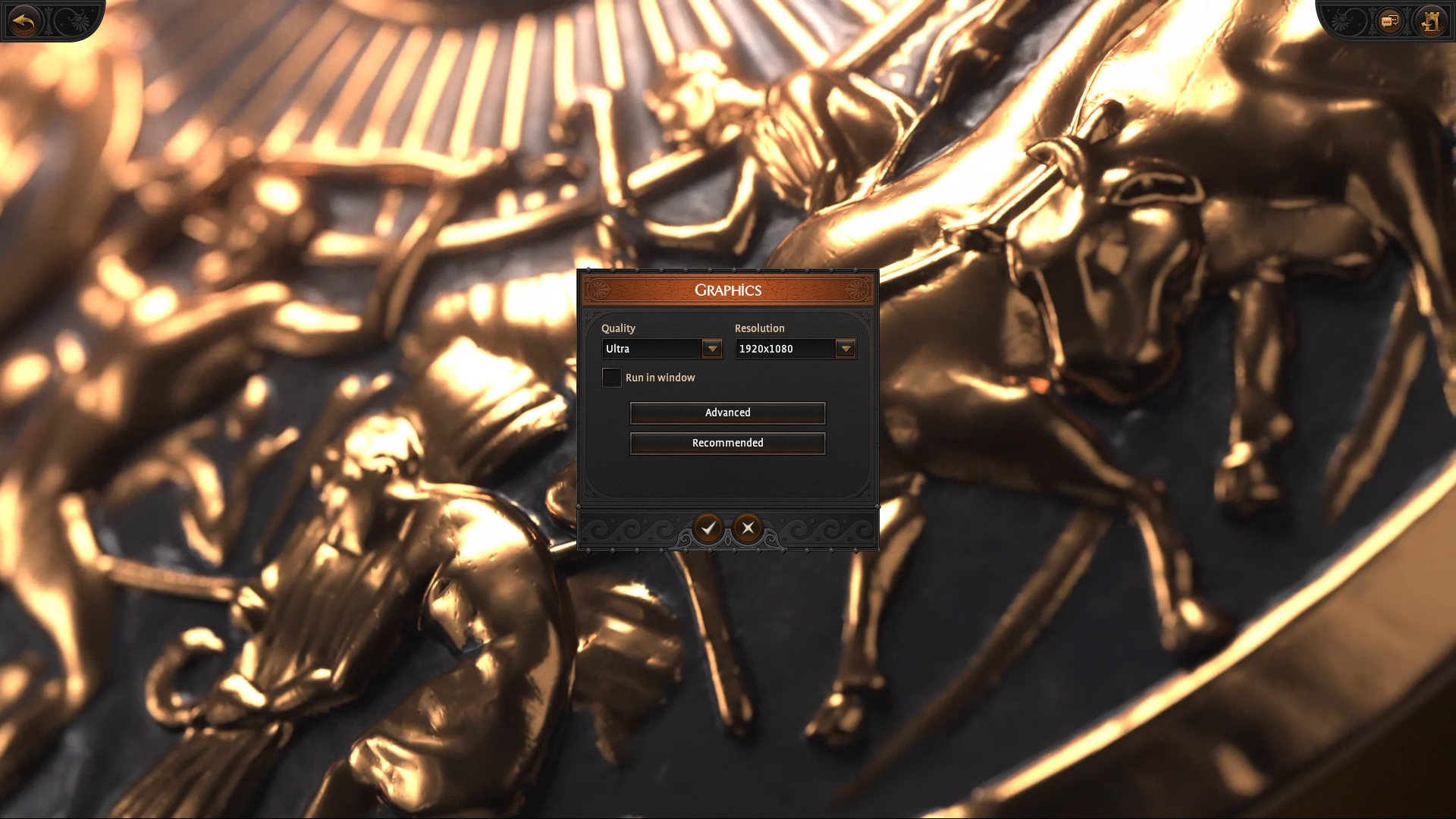
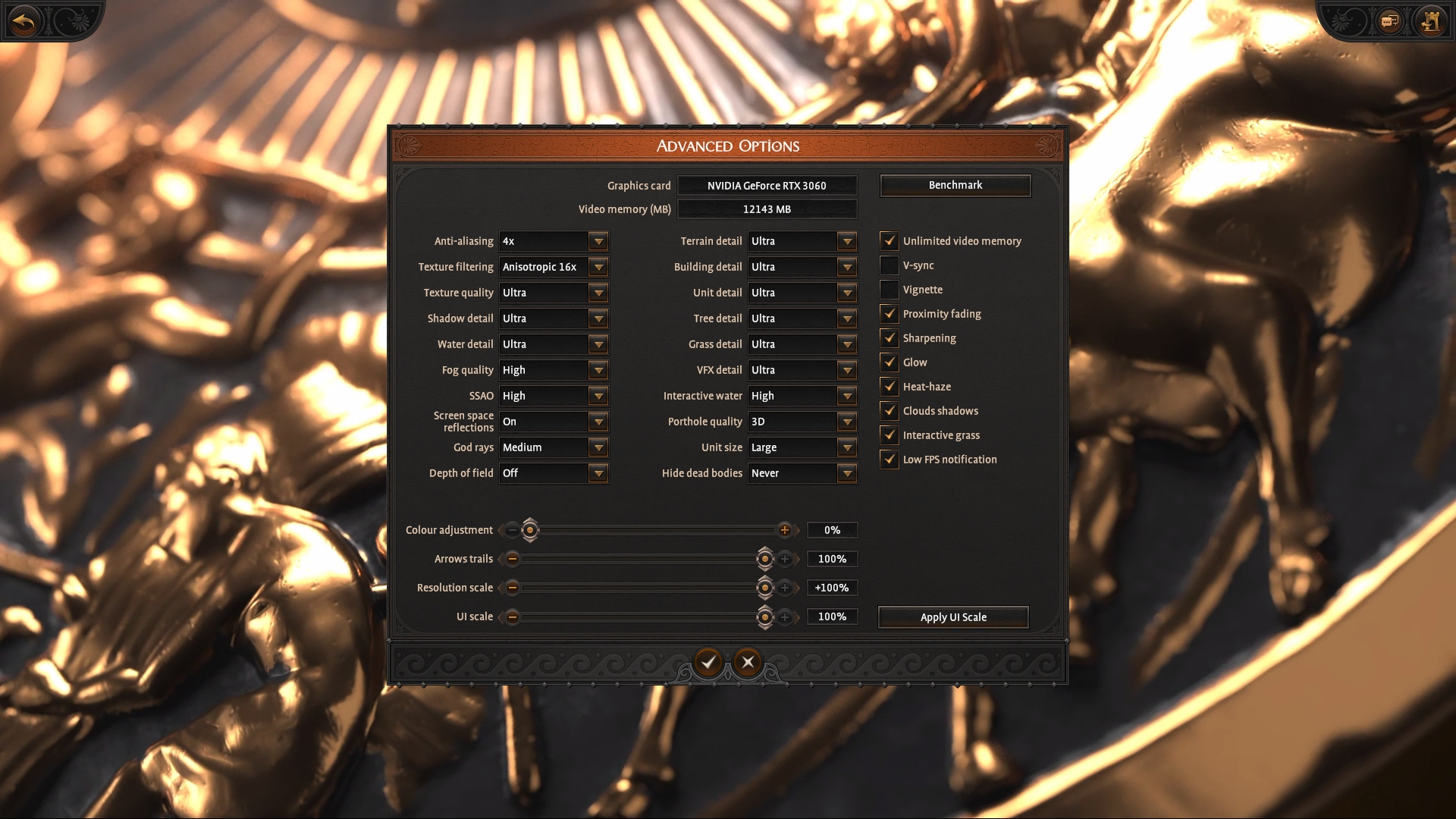
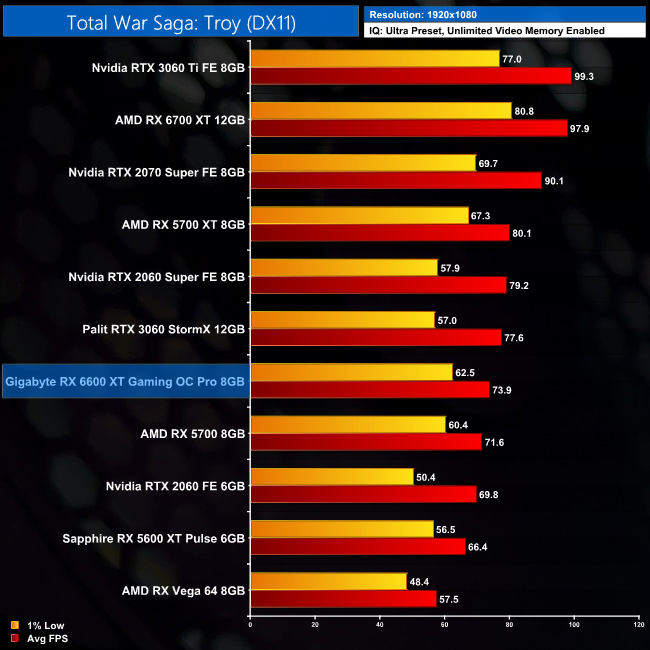
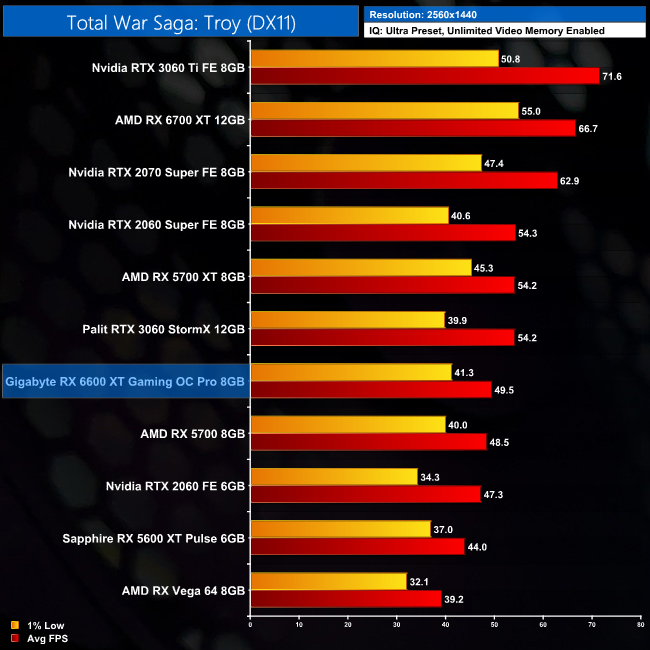
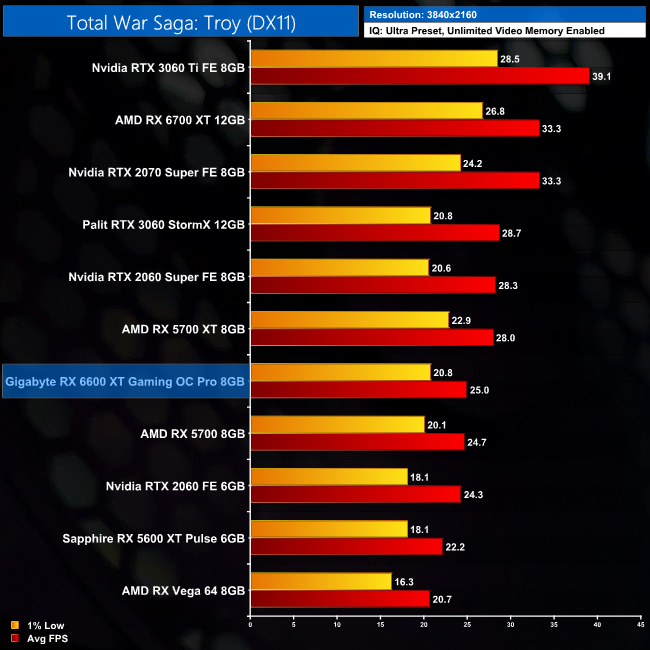
As for Total War Saga: Troy, this is the only other game, aside from Control, where the RX 6600 XT proved slower than the RTX 3060. There's not much in it, and actually the 6600 XT delivered better 1% low performance, so we're counting this one as a draw. The 6600 XT is, however, 8% slower than the RX 5700 XT at 1080p, when we'd really expect it to be faster.
At 1440p the RX 6600 XT does fall behind the RTX 3060 by 9%, but once more that's when looking at average frame rates, and the 1% lows are much closer together. The RX 5700 XT is still clearly faster though, and that's not even mentioning the RTX 3060 Ti which is in a league of its own here.
Watch Dogs: Legion is a 2020 action-adventure game published by Ubisoft and developed by its Toronto studio. It is the third instalment in the Watch Dogs series, and the sequel to 2016's Watch Dogs 2. Legion was released on October 29, 2020 for Microsoft Windows, PlayStation 4, Xbox One, and Stadia. (Wikipedia).
Engine: Disrupt. We test using the Ultra preset, DX12 API.
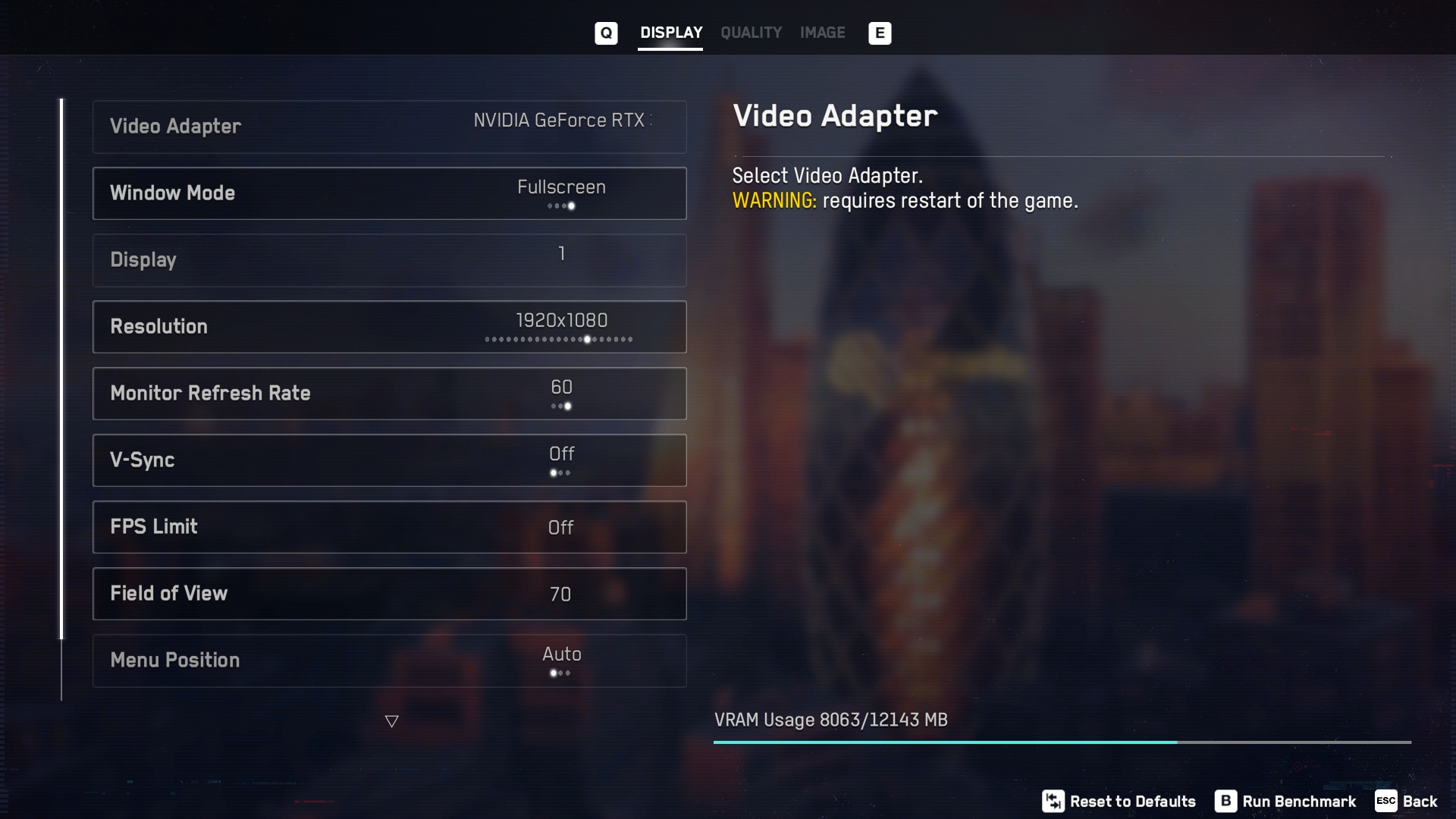
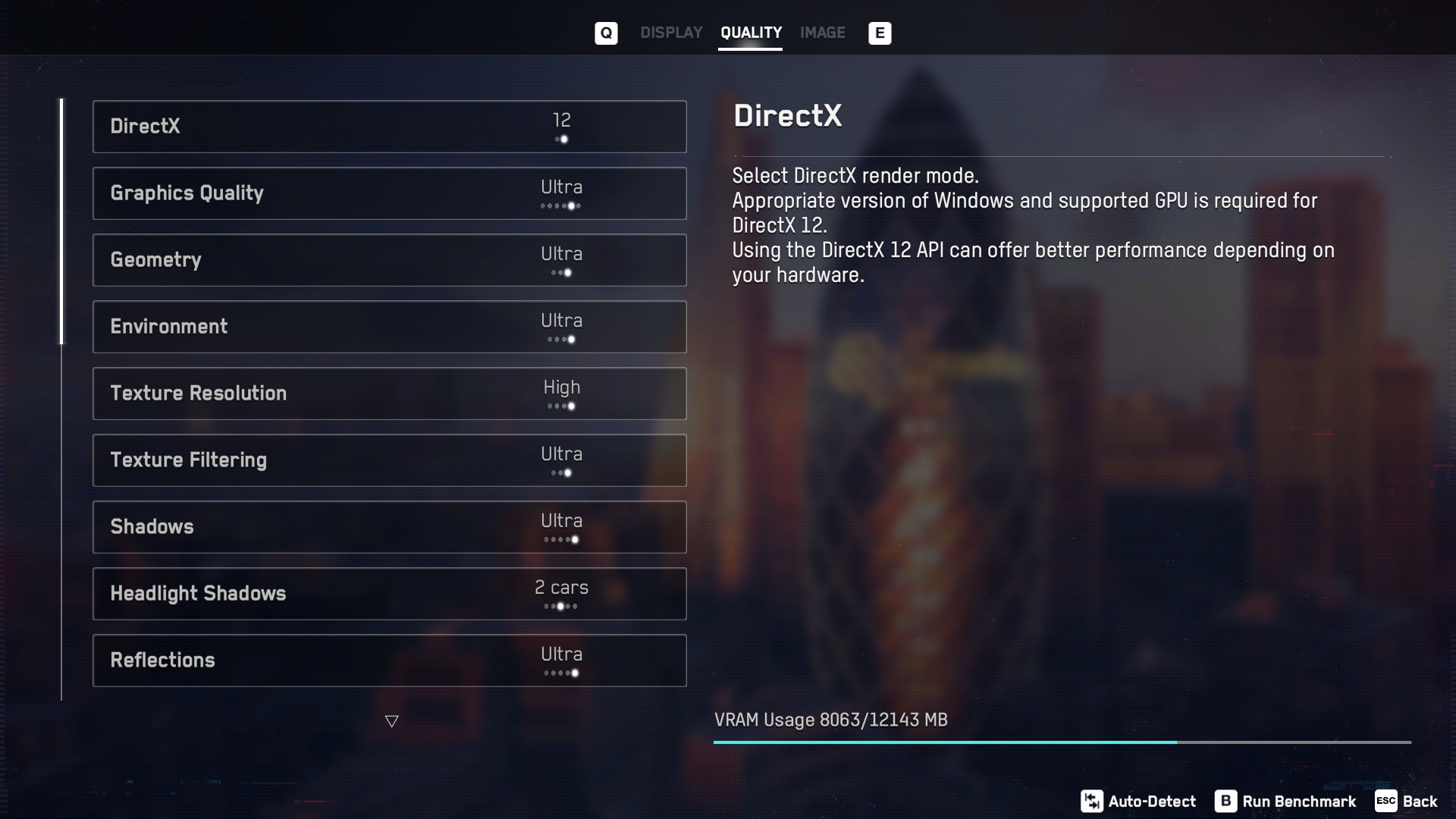
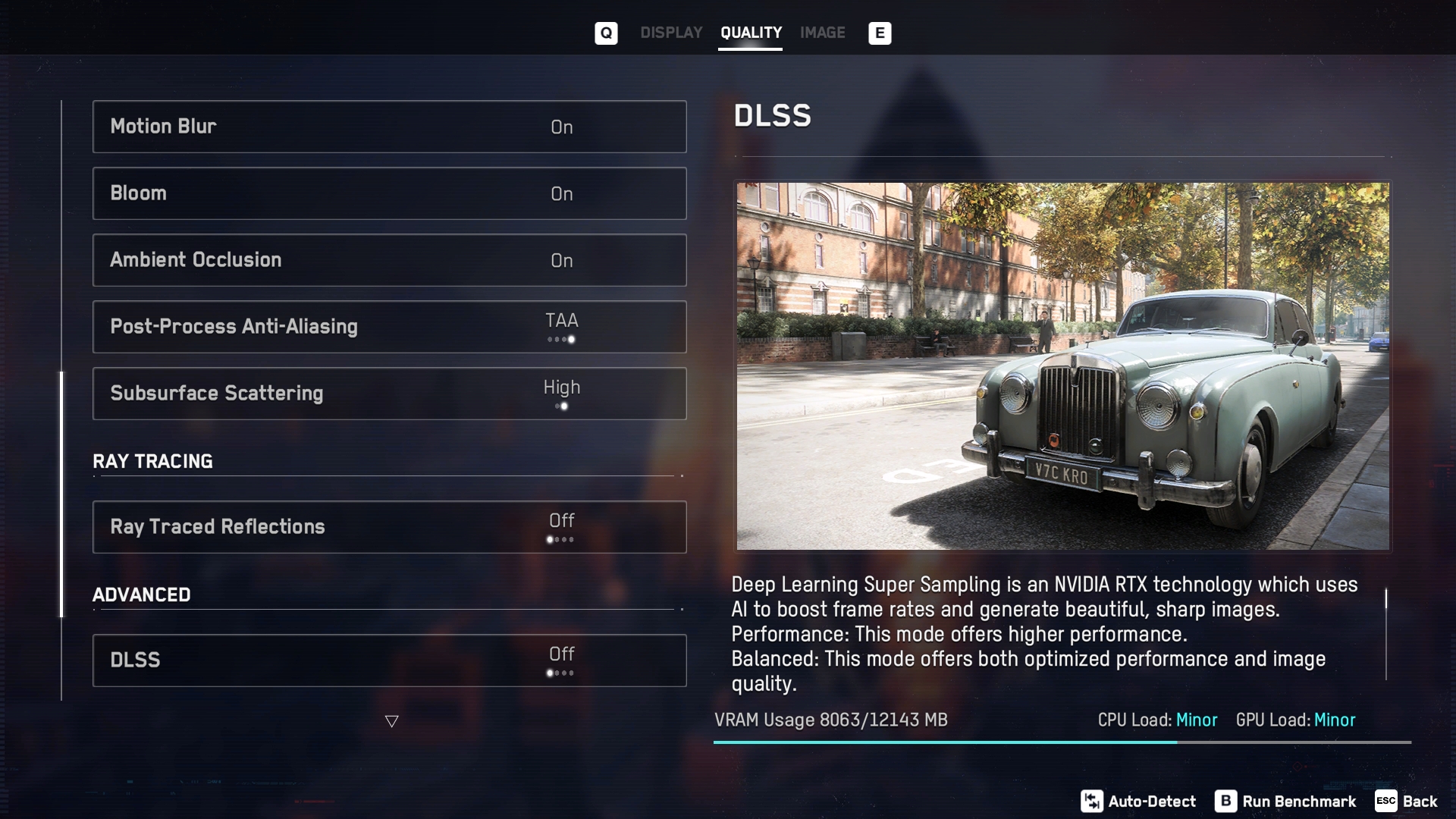
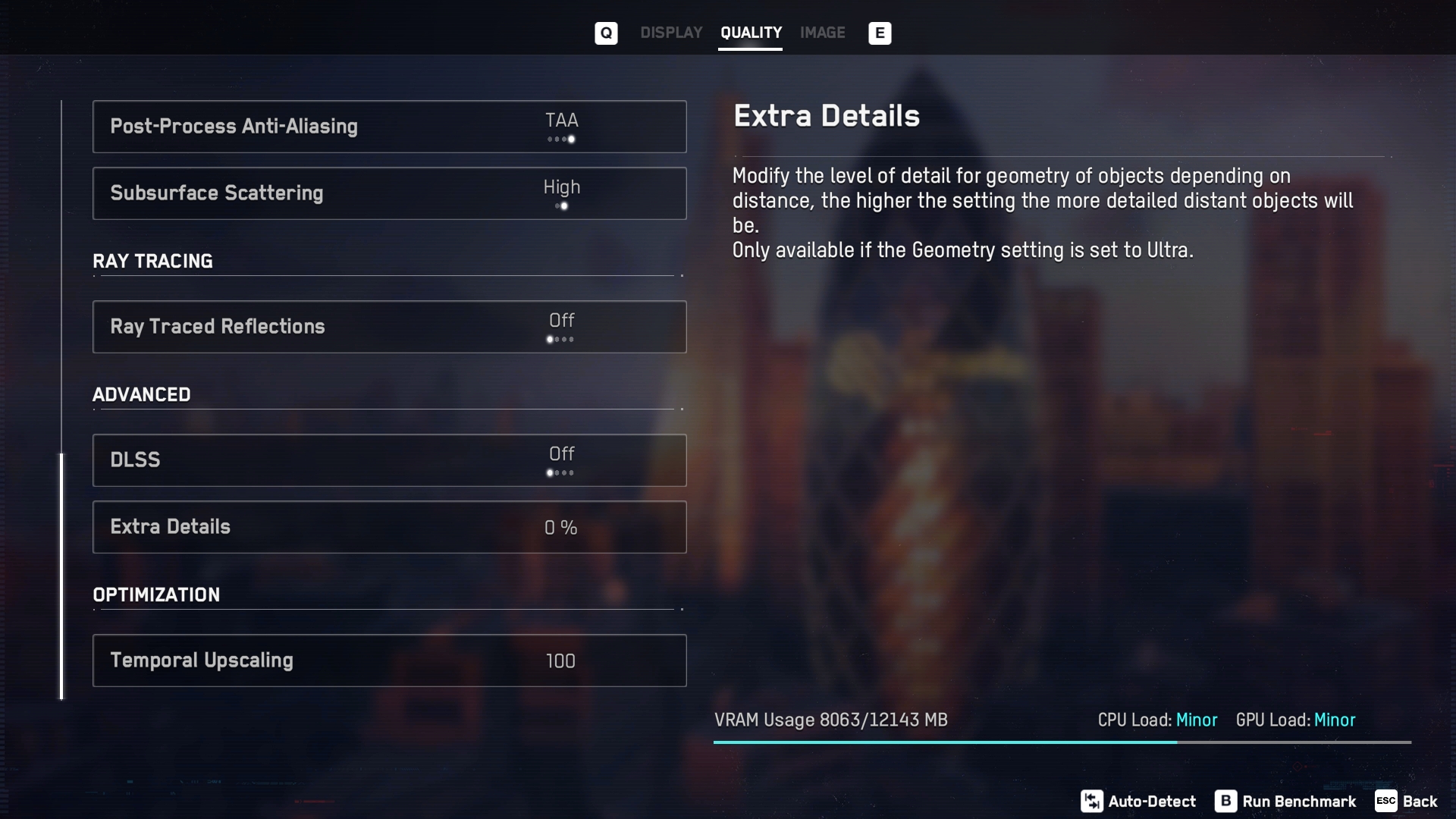
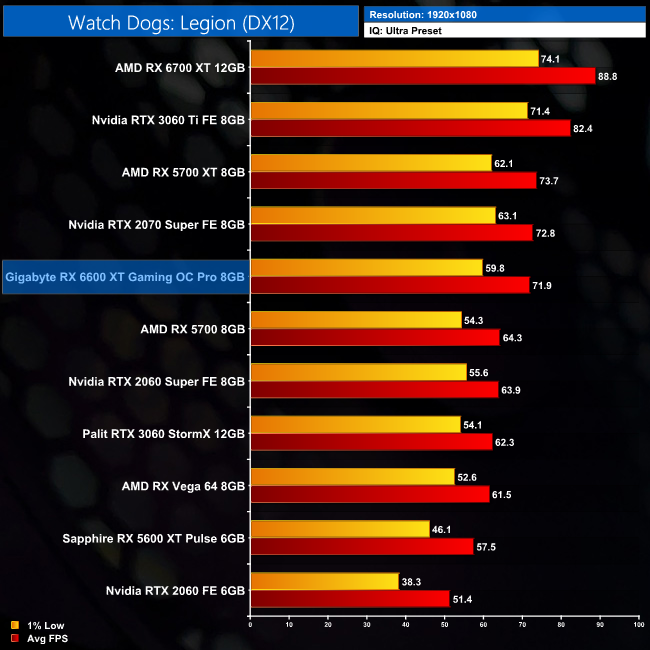
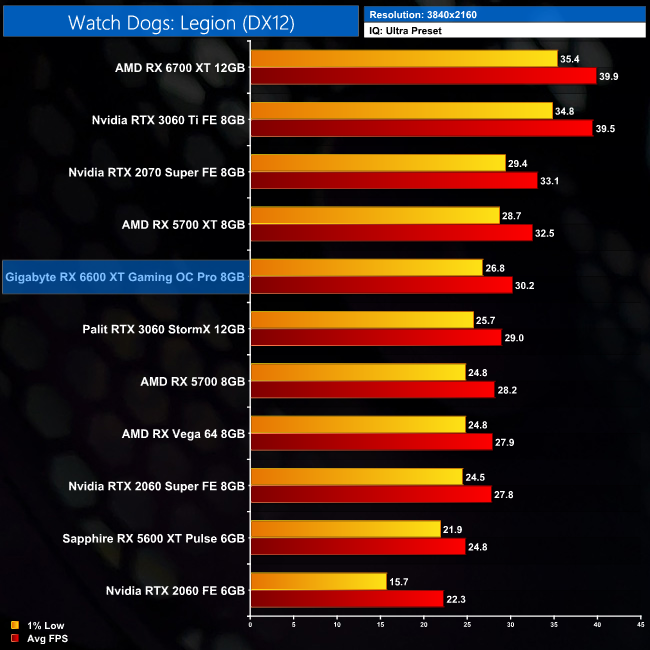
Finally, we finish up with Watch Dogs: Legion. Interestingly, despite being an Nvidia-sponsored title, the RX 6600 XT is a good 15% faster than the RTX 3060 at 1080p. It's still 13% behind the RTX 3060 Ti, but it's definitely better than you might have thought.
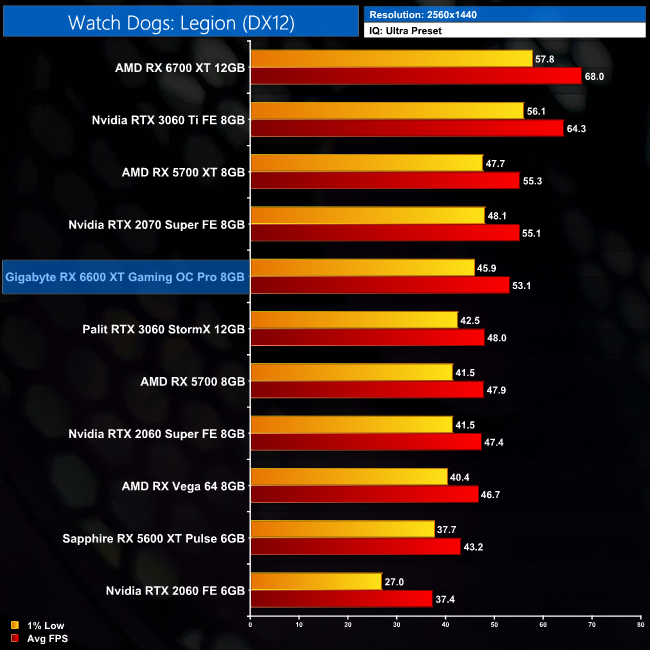
The Nvidia GPUs do catch up at 1440p however, with the 6600 XT now 10% faster than the RTX 3060, when it was 15% faster at 1080p. We can also see the 6600 XT is fractionally behind the RX 5700 XT, only by 2FPS, but that's a difference of 4%.
Here we present frame rate figures for each graphics card, averaged across all 12 games on test today. These figures can disguise significant variations in performance from game to game, but provide a useful overview of the sort of performance you can expect at each resolution tested.
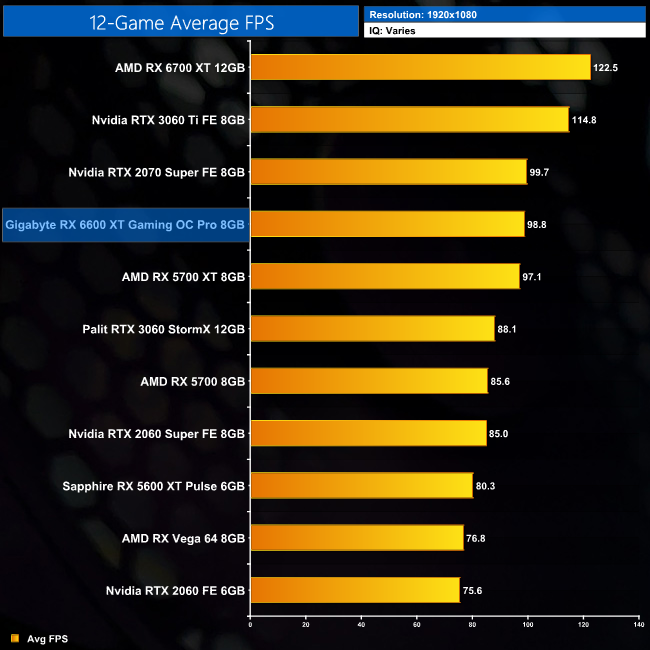
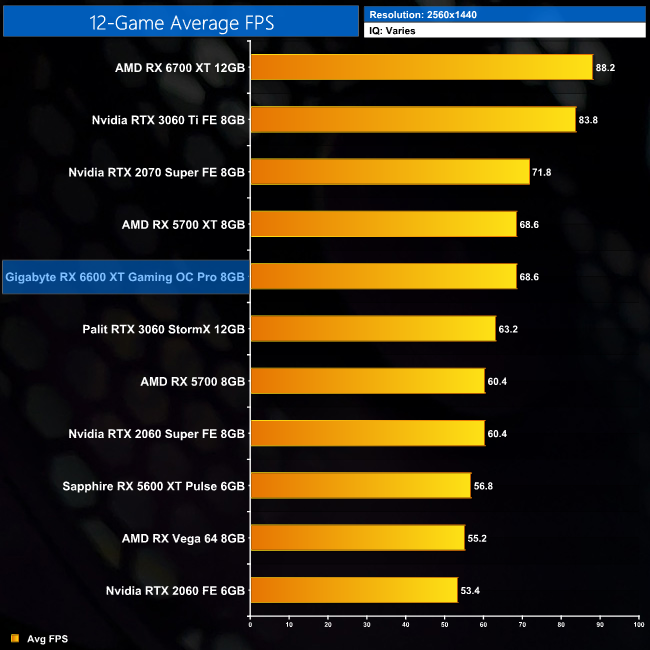
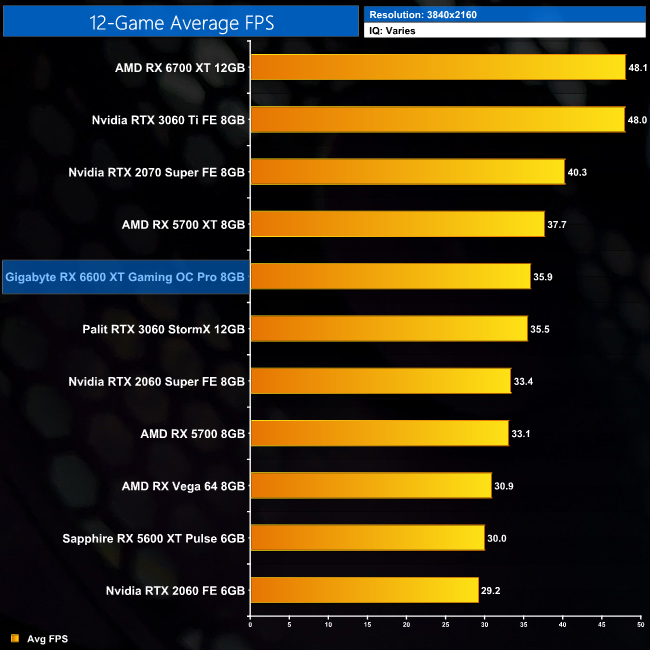
Looking at the big picture, AMD claimed the RX 6600 XT to be faster than the RTX 3060, and that is borne out by our testing – at 1080p, the AMD GPU is 12% faster on average. It's 14% slower on average than the RTX 3060 Ti however, despite being just 5% cheaper in terms of the MSRP. We can also see a very marginal difference between the RX 5700 XT and the 6600 XT, with both cards effectively as fast as each other.
At 1440p, the 6600 XT does fall away slightly, as it's now 9% faster than the RTX 3060, rather than the 12% margin we saw at 1080p. Compared to the RTX 3060 Ti, we're looking at an 18% difference, which really puts these GPUs in different performance categories. Interestingly, the 6600 XT and RX 5700 XT have the exact same average frame rate at this resolution, which shows you just how similar they are.
Using the average frame rate data presented earlier in the review, here we look at the cost per frame using the USD ($) MSRP launch prices for each GPU. Usually we present this data using GBP (£) pricing, but this information was not yet confirmed at the time of writing.
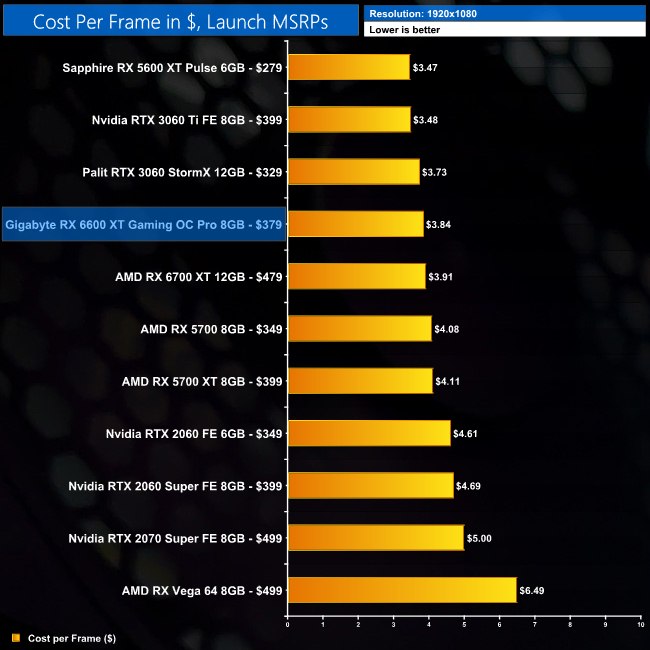
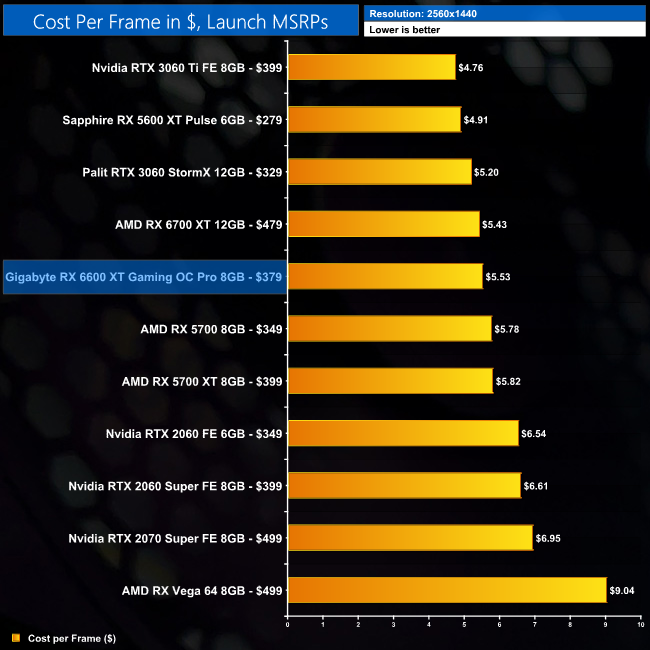
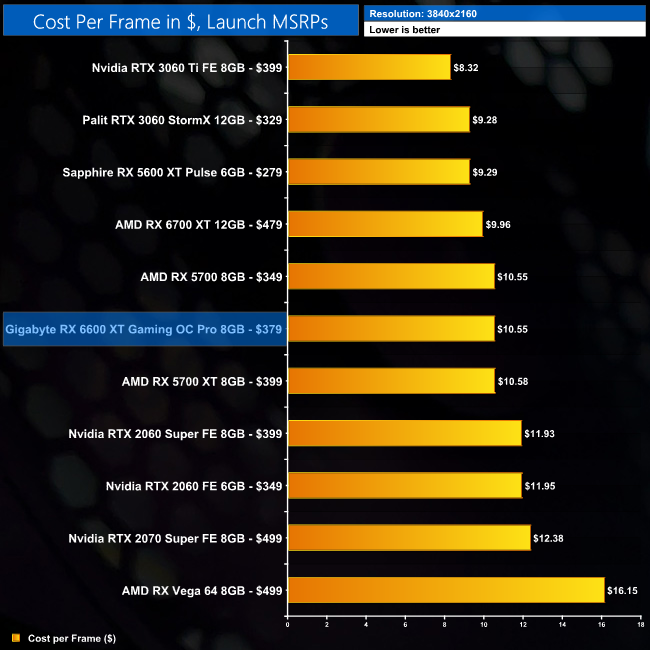
Looking at the cost per frame data, the RX 6600 XT is competitive and sits towards the top of the chart. The interesting thing for me though, is the small improvement it brings over the RX 5700 XT – it is just 7% cheaper per frame at 1080p, despite being released over two years on from the launch of the first Navi GPUs.
That difference shrinks at 1440p, too, where the 6600 XT is just 5% cheaper per frame. It is also 16% more expensive per frame than the RTX 3060 Ti, with Nvidia's GPU just 5% more expensive in terms of MSRP, but offering significant better performance.
Here we test Cyberpunk 2077, this time testing with the in-game ray tracing effects set to their highest values.
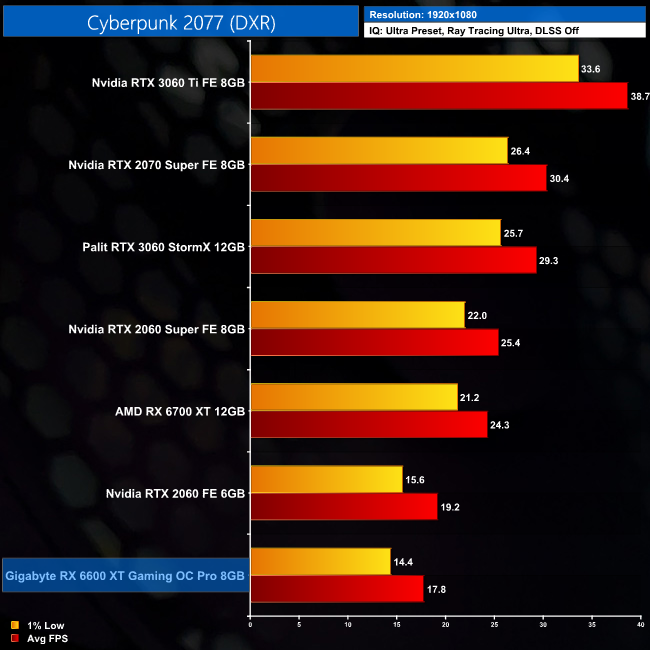
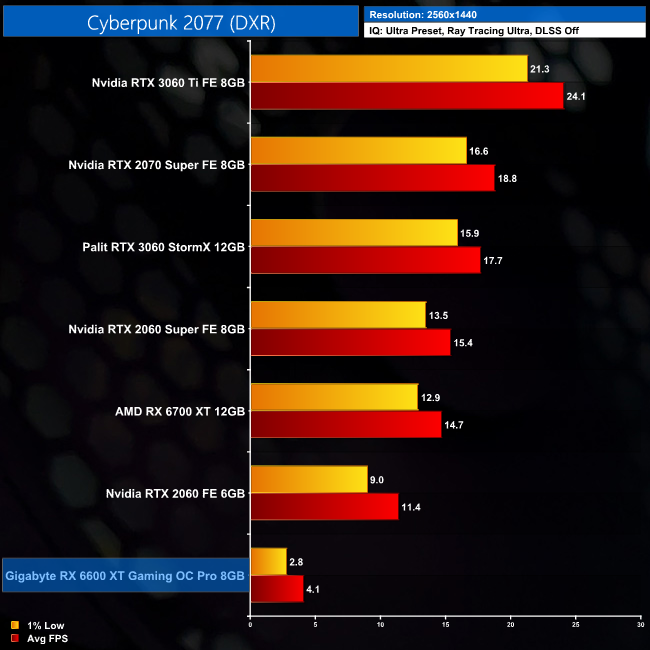
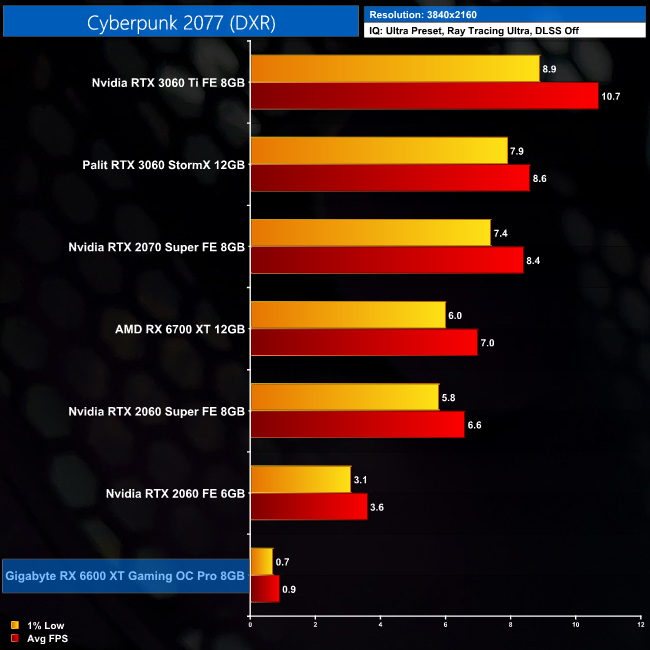
Kicking off our look at ray tracing performance, we know AMD GPUs struggle with the array of ray traced lighting effects found in Cyberpunk, so it's not a surprise to see the RX 6600 XT sitting bottom of the chart at every resolution. Even at 1080p, the two-year old RTX 2060 is outpacing AMD's new GPU.
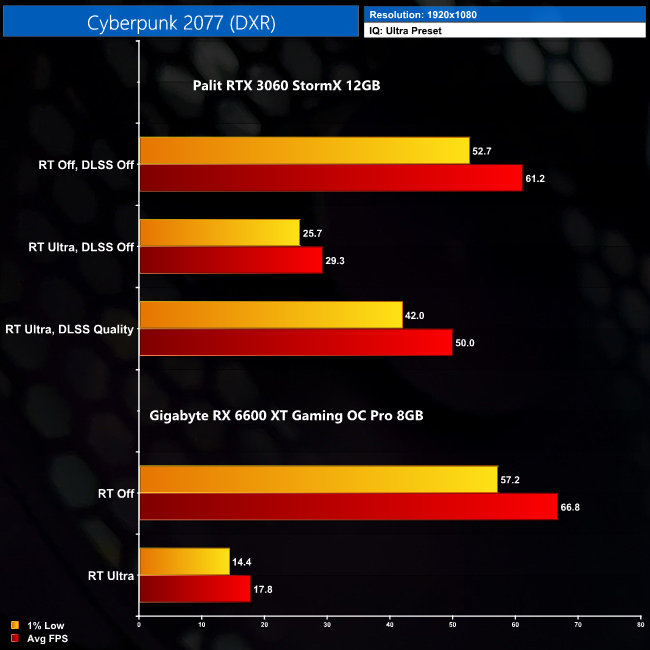
Add in DLSS and we can see the RTX 3060 runs away with it in this head-to-head, delivering almost three times the frame rate of the RX 6600 XT. DLSS may not be perfect at 1080p, but considering the boost to performance it can offer, it's definitely something to factor in.
Here we test Metro Exodus Enhanced Edition, with the in-game ray tracing effects set to their highest values.
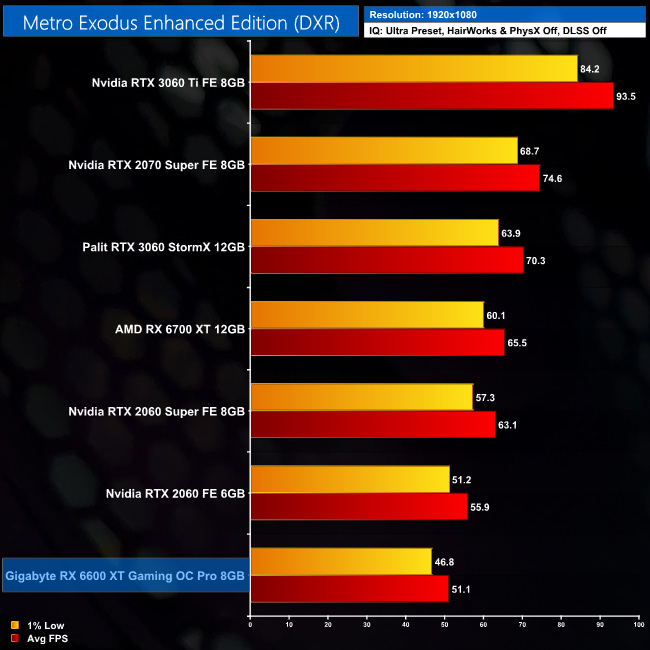
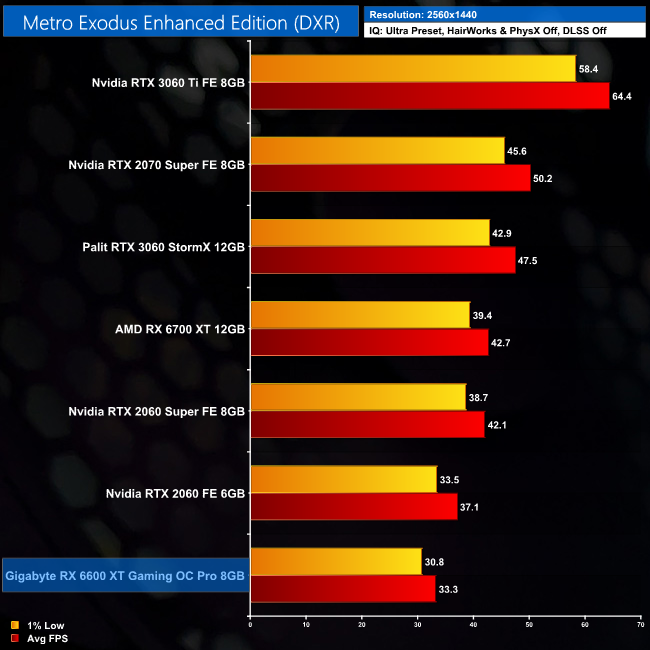
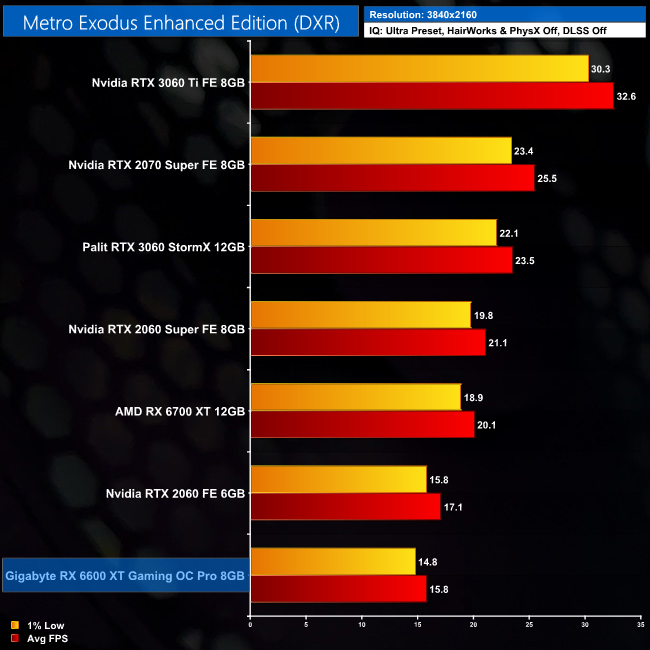
Metro Exodus Enhanced Edition looks a lot better for the RX 6600 XT. I say that, but it is still rooted to the bottom of our charts, but at least we're getting a playable experience at 1080p with ray tracing set to its highest values. All of that data is without DLSS enabled for the Nvidia GPUs however…
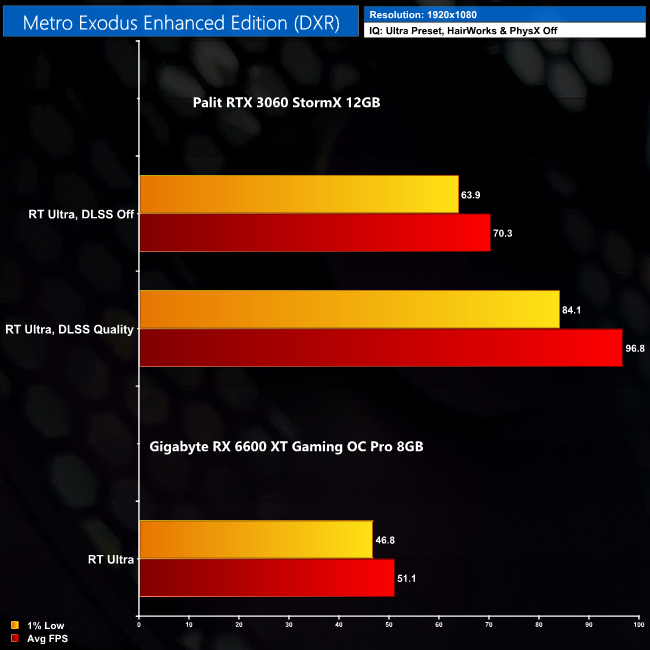
… so when we add it in for the RTX 3060, it is nearly twice as fast as the RX 6600 XT in Metro Exodus Enhanced Edition. Even without DLSS, the 3060 is 37% faster – and remember, this is meant to be the cheaper GPU.
Here we test Resident Evil Village, this time testing with the in-game ray tracing effects set to their highest values.
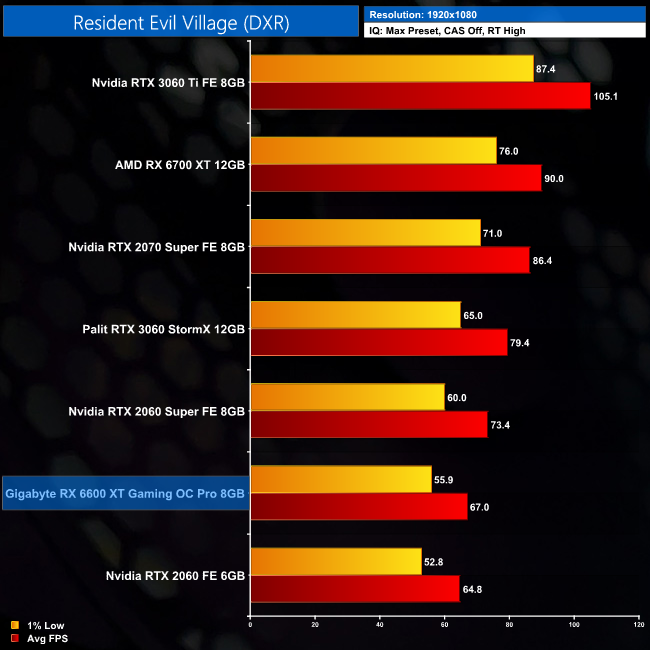
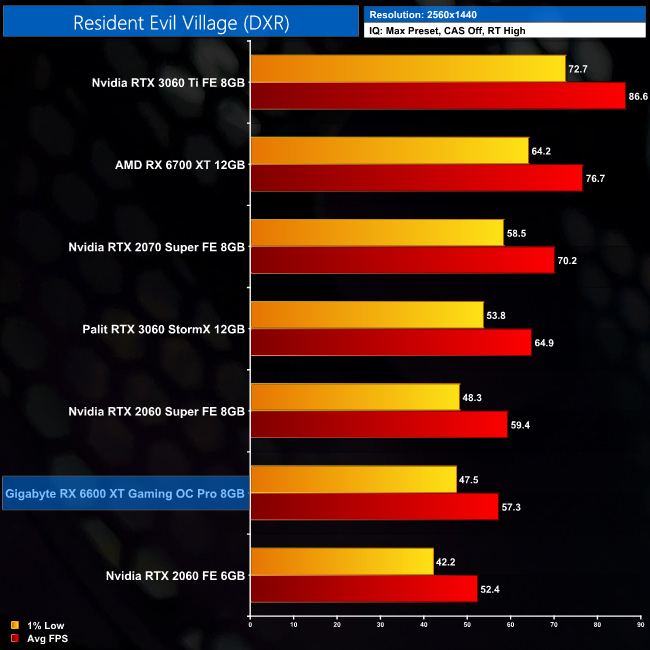
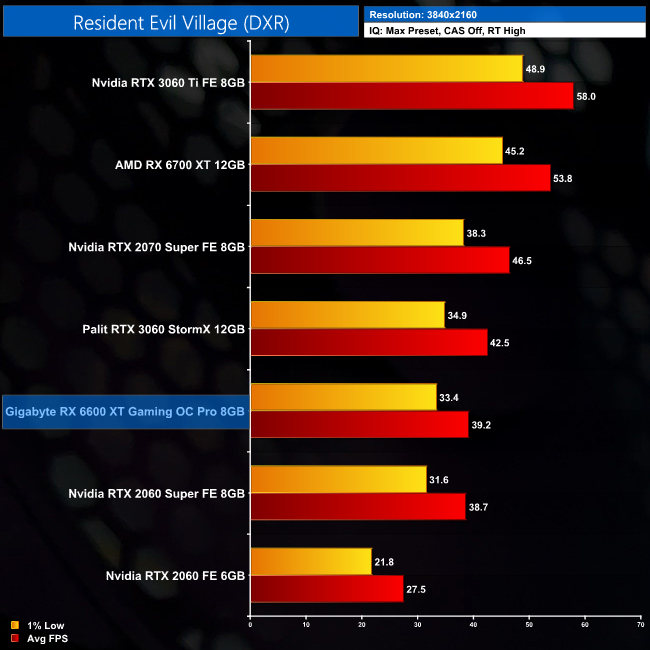
Lastly, Resident Evil Village is one of the best-case scenarios for ray tracing with the RX 6600 XT. That said, it's still only just faster than the RTX 2060 at 1080p, but it is able to hold over 60FPS at 1080p.
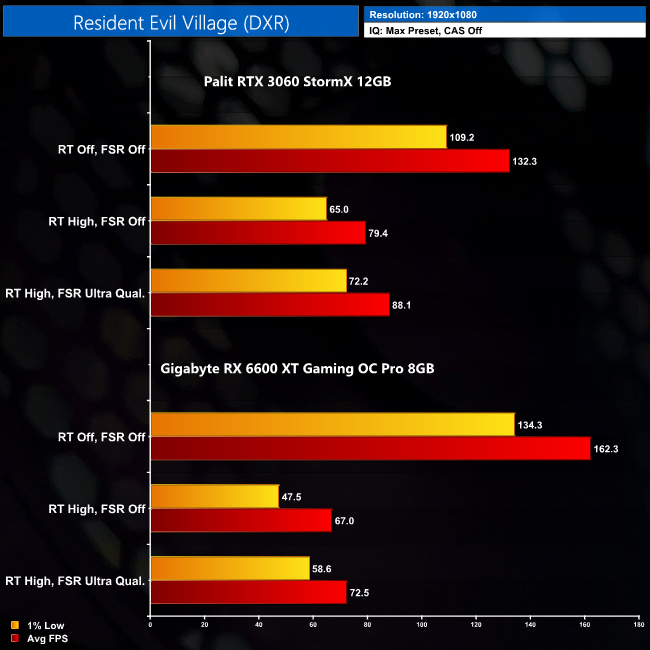
AMD's FidelityFX Super Resolution upscaling feature is also available in Resident Evil Village, and at 1080p the Ultra Quality mode only provides an 8% boost for the RX 6600 XT when also using ray tracing. It's still behind the RTX 3060 by over 15% however.
Here we re-run four benchmarks with the RX 6600 XT, but this time with Resizable BAR enabled. According to AMD, a Ryzen 3000/5000 CPU is required to use Smart Access Memory (SAM), as is a 500-series motherboard. However, my ASUS ROG Maximus XII Hero offers support for Resizable BAR on the Z490 platform, so I put it to the test with the RX 6600 XT. We have tested this previously and the gains aren't as big as we would see if we were using a Ryzen 3000/5000 CPU and compatible motherboard, but we can at least highlight the potential performance that is on offer for those with other systems.
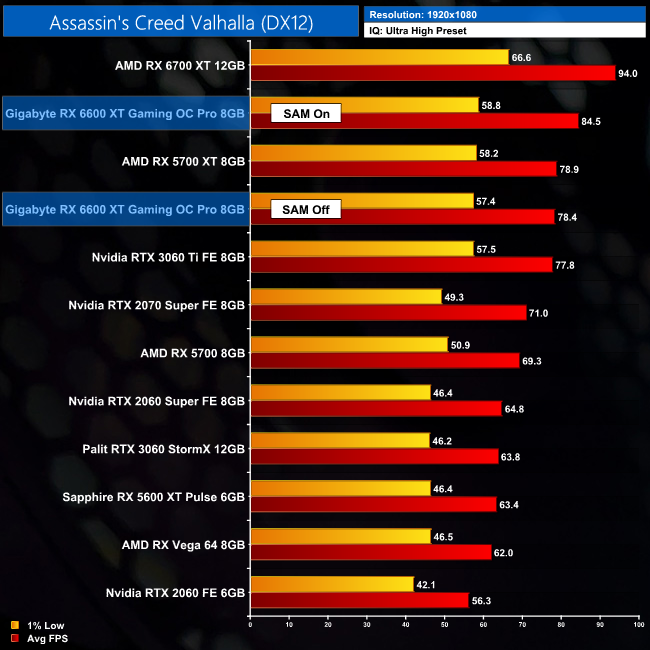
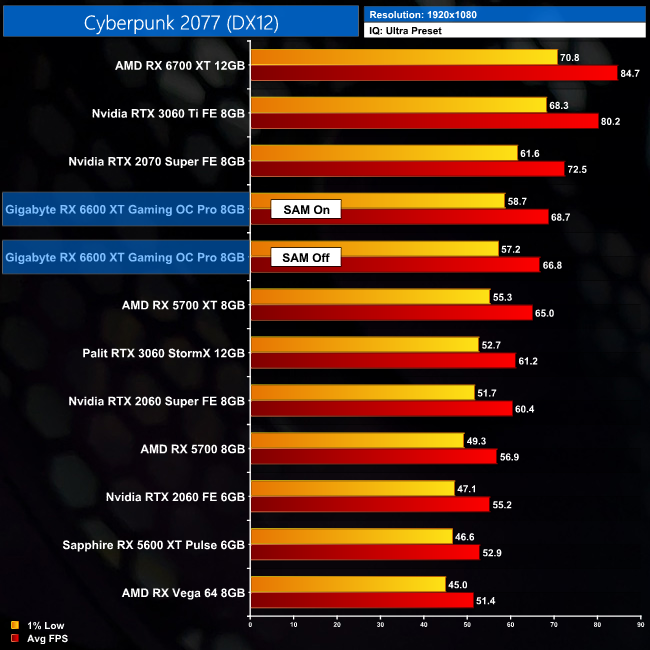
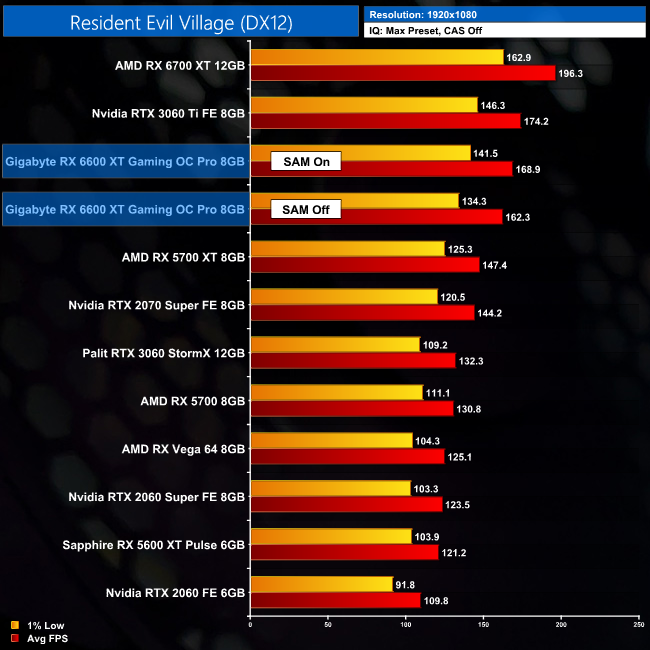
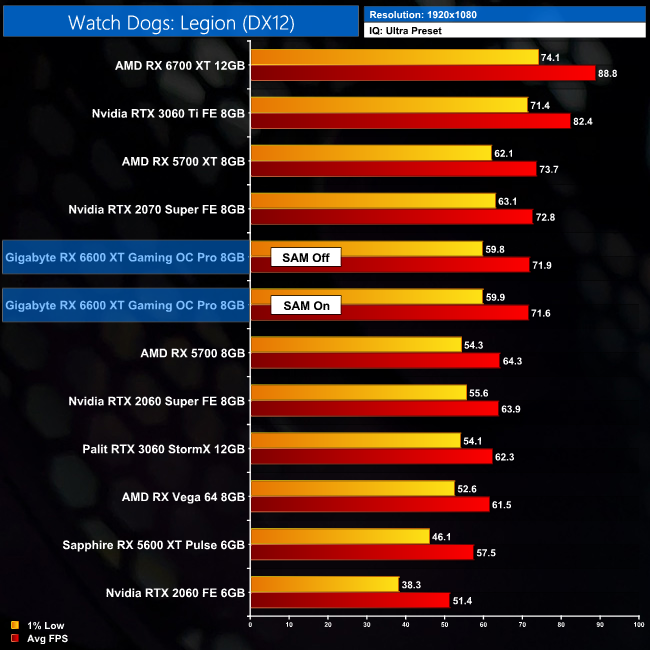
There's no real surprises here, with the RX 6600 XT up to 8% faster with Resizable BAR enabled when looking at Assassin's Creed Valhalla, though the gains are smaller in Cyberpunk and Resident Evil Village. Watch Dogs: Legion even shows a tiny regression, though the difference of just 0.3FPS is clearly within our margin for error.
Here we present the average clock speed for each graphics card while running Cyberpunk 2077 for 30 minutes. We use GPU-Z to record the GPU core frequency during gameplay. We calculate the average core frequency during the 30 minute run to present here.
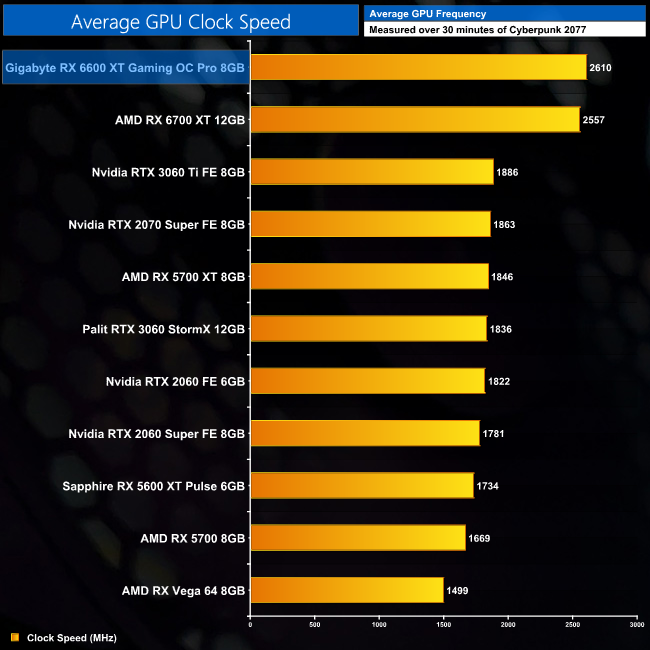
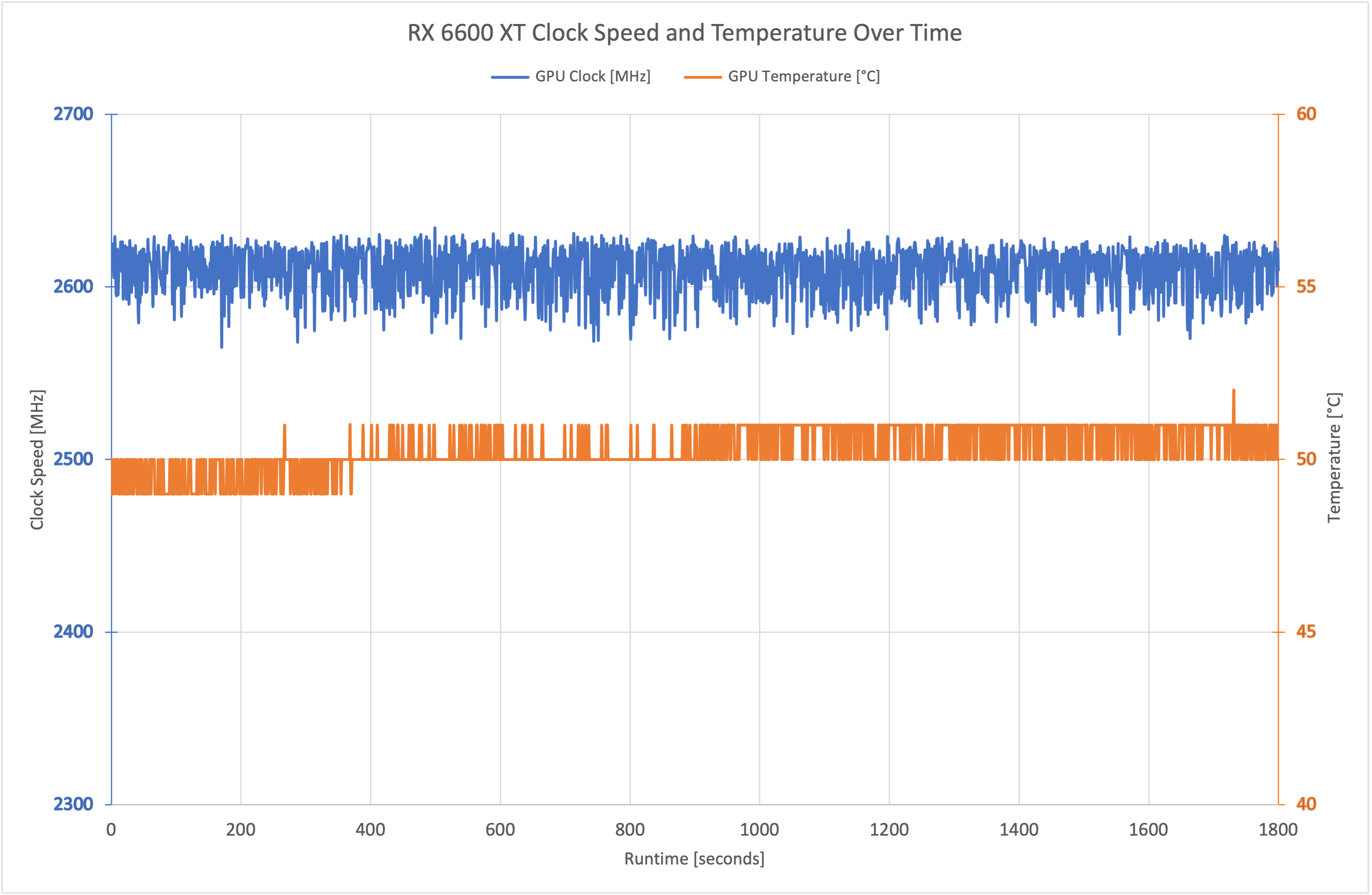
One of the hallmarks of the RDNA 2 architecture is its ability to hit very high clocks speeds, and that is exactly what we have here with the RX 6600 XT. Over our thirty minute run, the Gigabyte 6600 XT Gaming OC Pro averaged 2610MHz, delivering the card's rated boost clock almost exactly.
For our temperature testing, we measure the peak GPU core temperature under load. A reading under load comes from running Cyberpunk 2077 for 30 minutes.
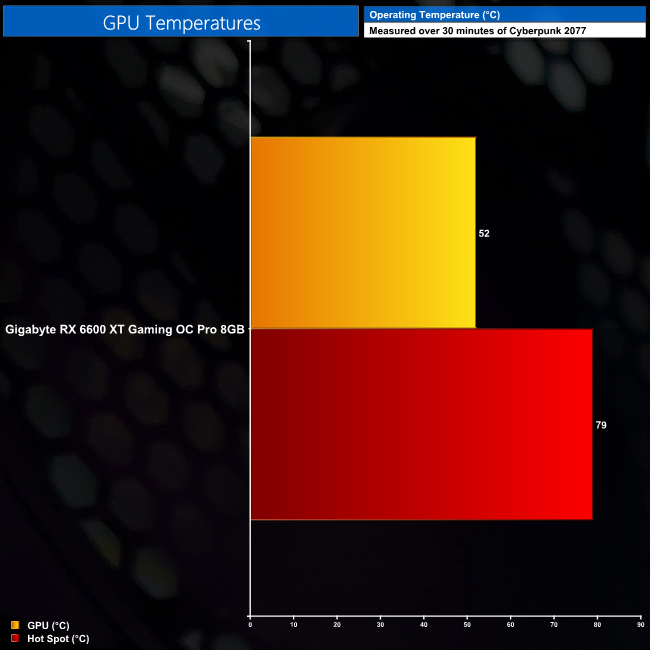
As this is the first and only RX 6600 XT we have tested for launch day, we don't have any comparison data for the Gigabyte Gaming OC Pro model. However, as we expected due to its size and heatsink layout, it is clearly a very proficient cooler, delivering a peak GPU temperature of just 52C, while the hot spot hit 79C.
We take our noise measurements with the sound meter positioned 1 foot from the graphics card. I measured the noise floor to be 32 dBA, thus anything above this level can be attributed to the graphics cards. The power supply is passive for the entire power output range we tested all graphics cards in, while all CPU and system fans were disabled. A reading under load comes from running Cyberpunk 2077 for 30 minutes.
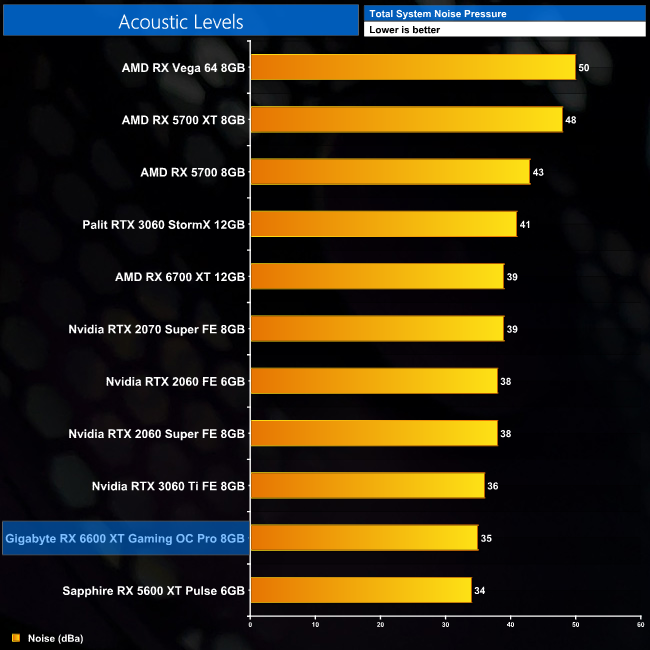
Noise output from the Gaming OC Pro is also very low. Under load we saw the fans spin at 47%, or 1650rpm, producing just 35dBa on our sound meter. As far as graphics cards go, it doesn't get much quieter than that, and you certainly wouldn't be able to hear the card if it were installed in a case with system fans running.
Following on from our stock thermal and acoustic testing, here we re-test the operating temperature of the GPU, but with noise levels normalised to 40dBa. This allows us to measure the efficiency of the overall cooling solution as varying noise levels as a result of more aggressive fan curves are no longer a factor.
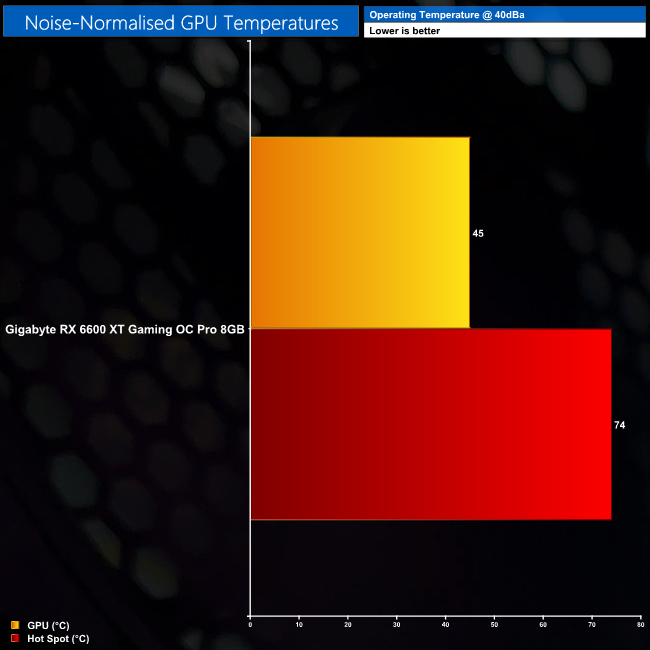
Given how quiet the Gaming OC Pro proved to be, there is plenty of scope to crank the fan speed if you want even lower temperatures – we saw a peak GPU temperature of just 45C when noise-normalised to 40dBa. That's not a realistic use case for this specific card since it already runs so cool to begin with, but it will enable us to do some apples-to-apples cooler testing once we have tested other models.
Here we present power draw figures for the graphics card-only, on a per-game basis for all twelve games we tested at 1080p. This is measured using Nvidia's Power Capture Analysis Tool, also known as PCAT. You can read more about our updated power draw testing methodology HERE.
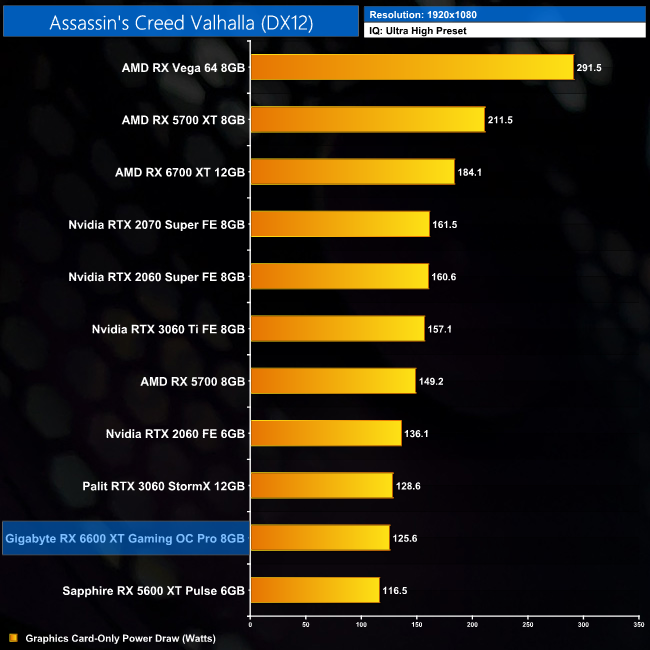
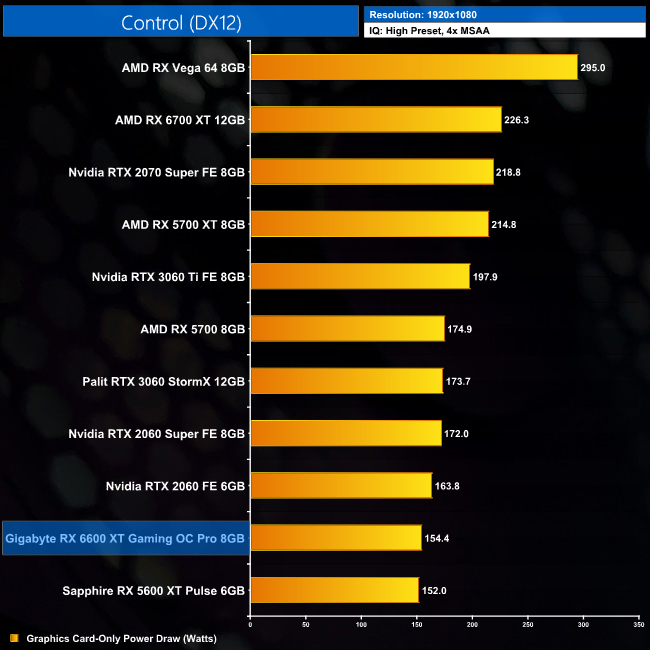
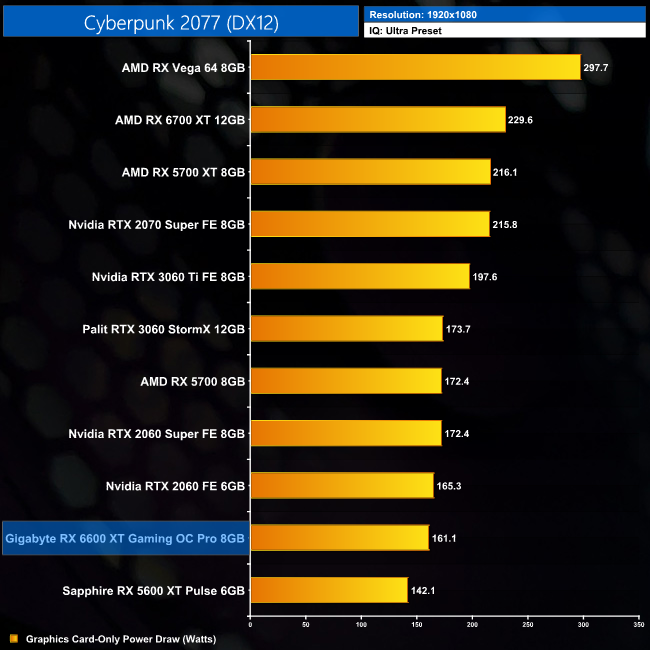
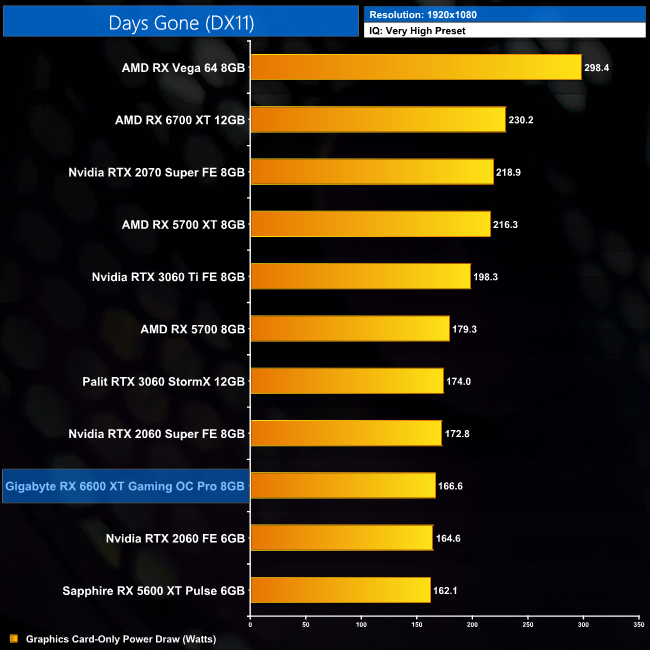
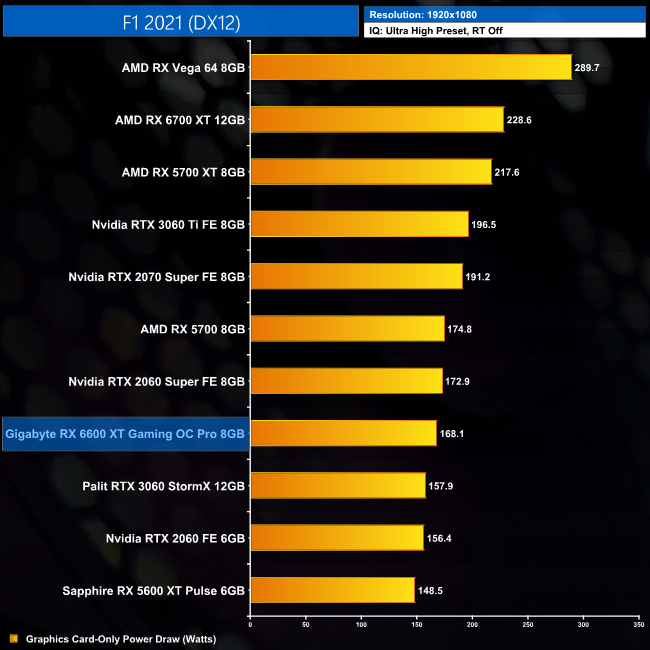
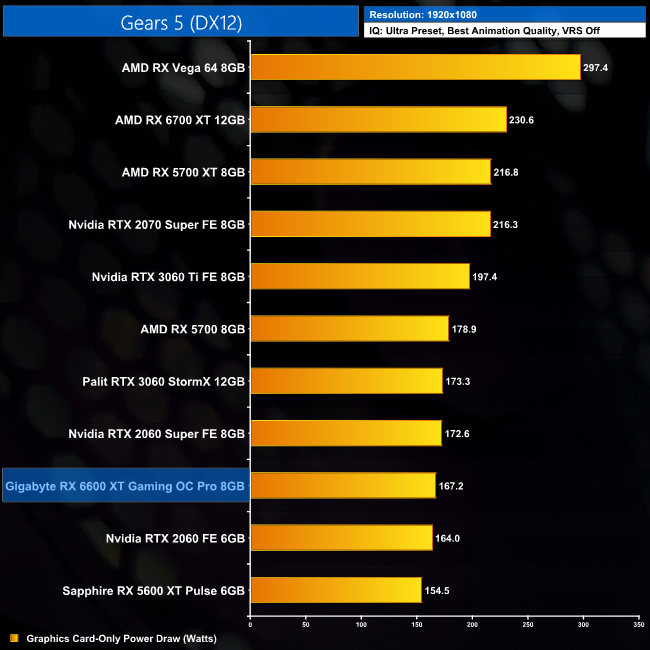
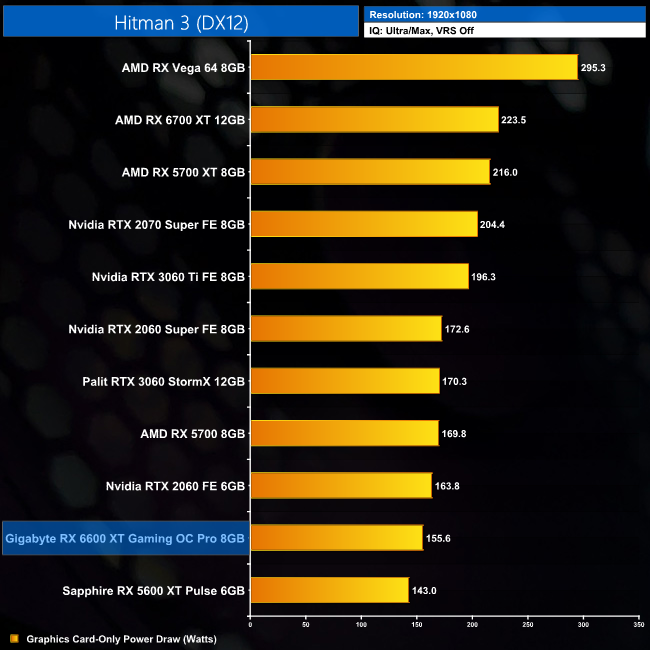
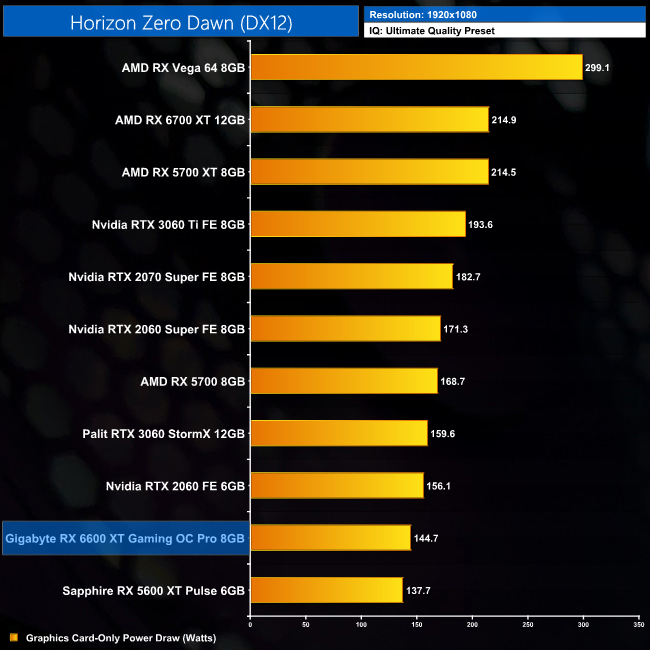
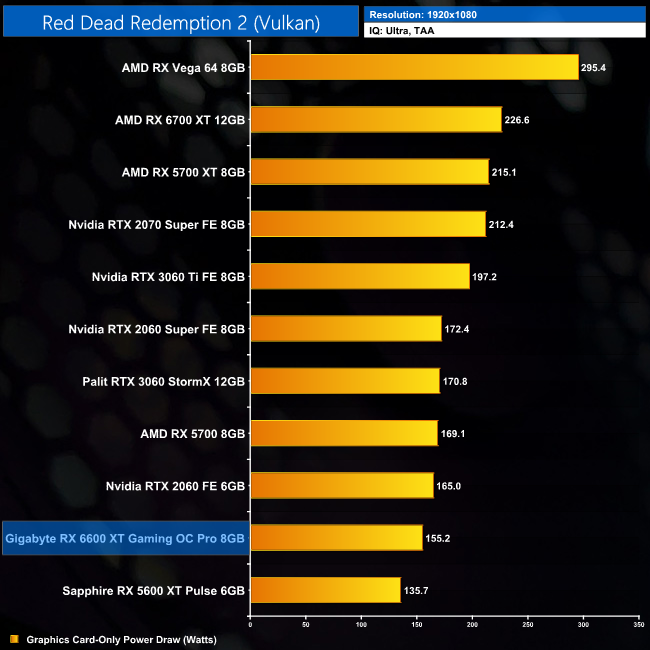
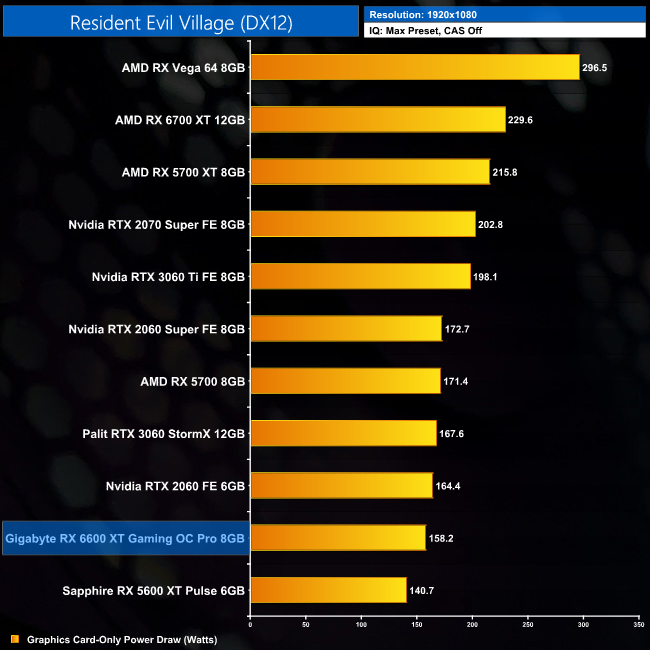
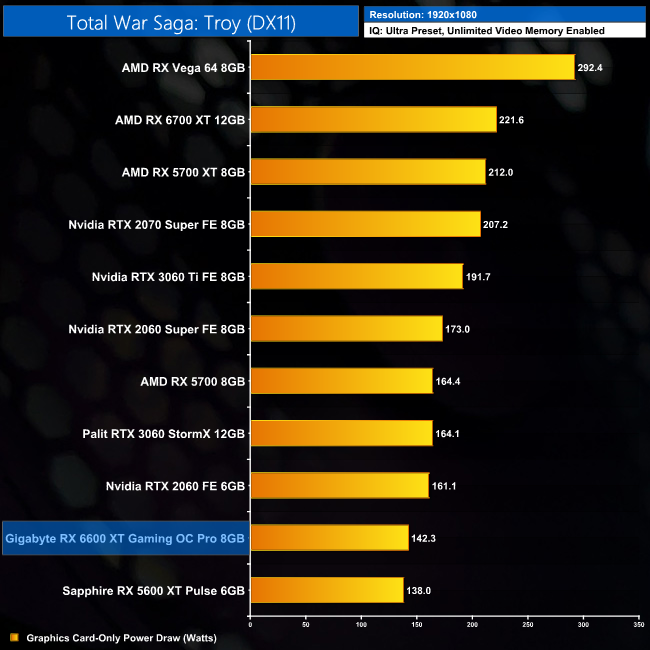
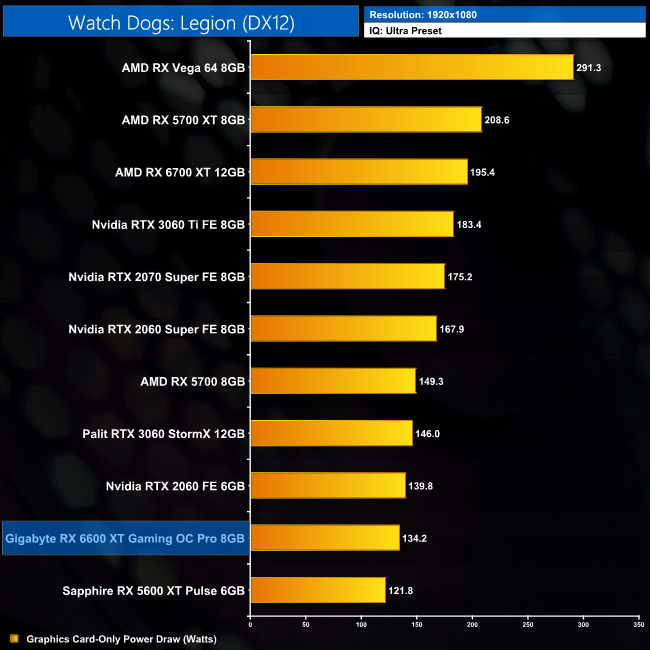
Click to enlarge.
12-Game Average at 1080p:
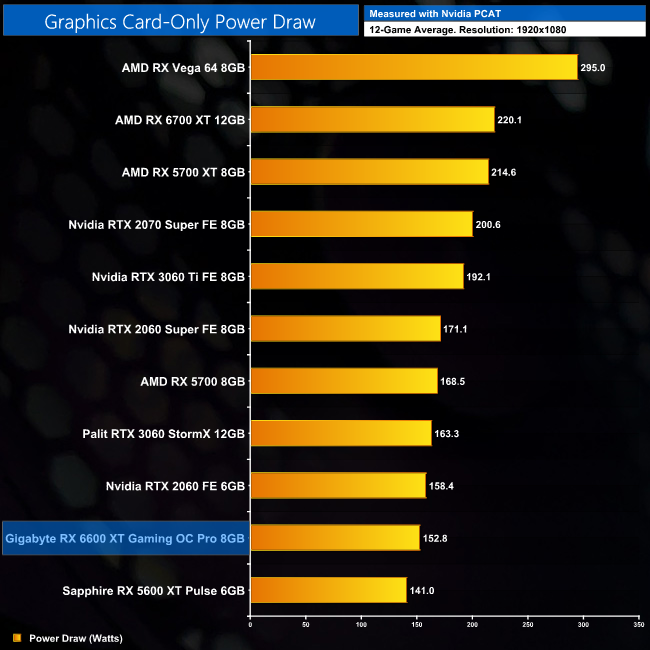
As we can see, average power draw is very low, and that is actually despite Gigabyte increasing GPU Chip power by 15W over reference. Total board power, averaged over our 12 game sample, hit 152.8W, though there are a few examples (F1 2021, Gears 5) of this hitting close to 170W as you can see above.
Here we present power draw figures for the graphics card-only, on a per-game basis for all twelve games we tested at 1440p. This is measured using Nvidia's Power Capture Analysis Tool, also known as PCAT. You can read more about our updated power draw testing methodology HERE.
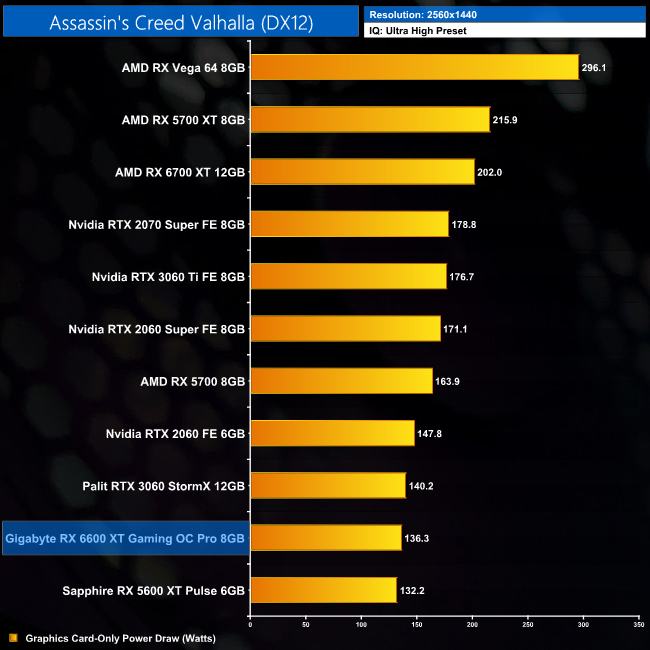
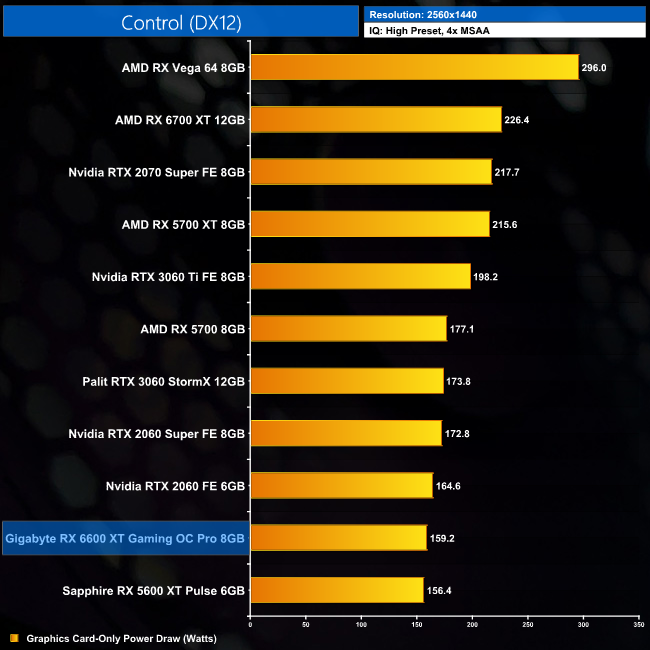
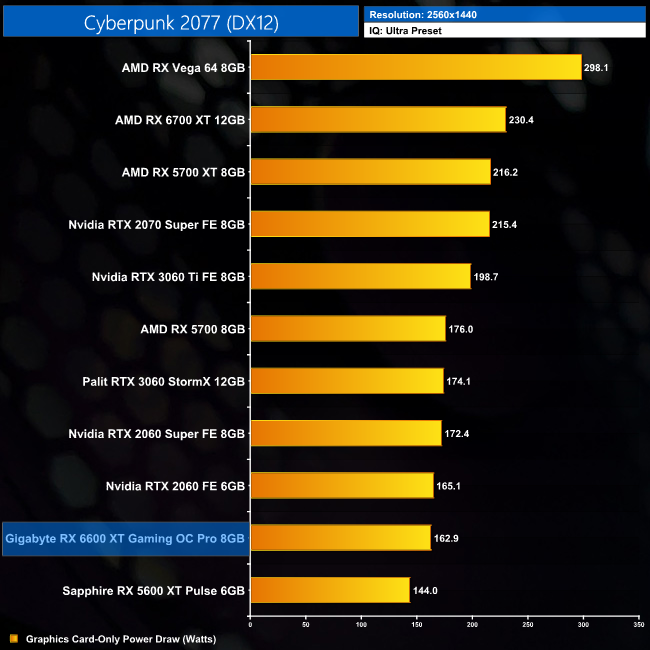
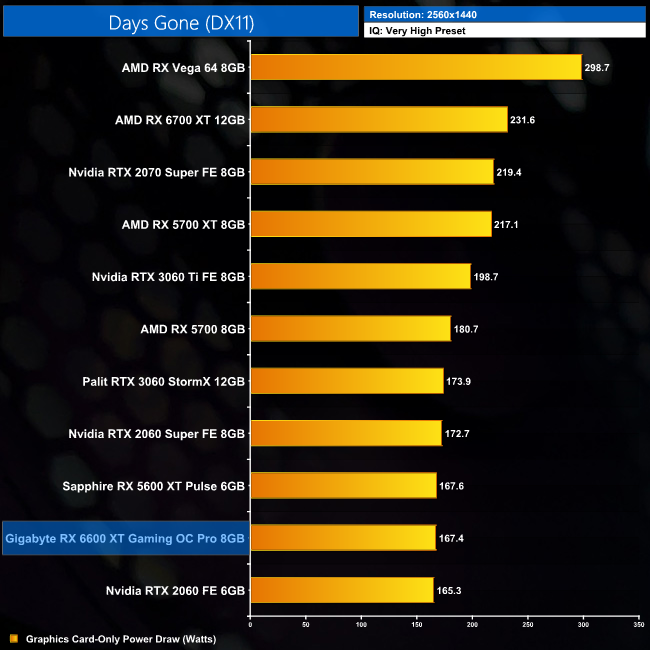
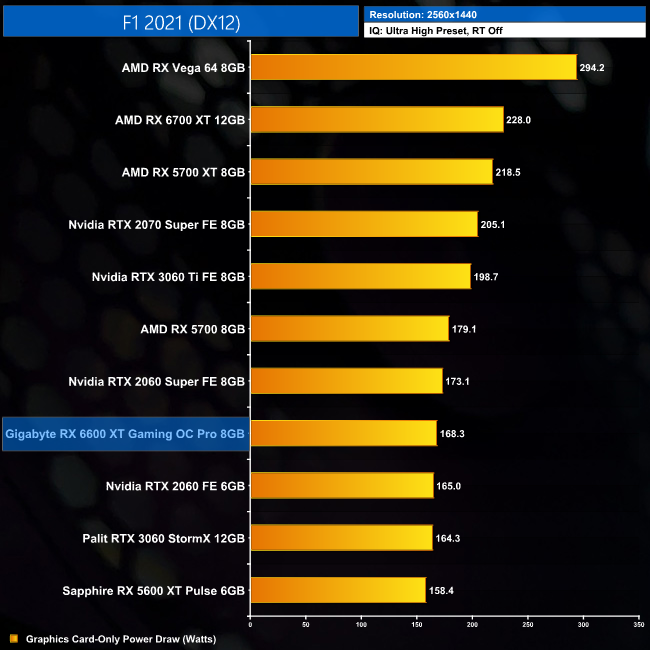
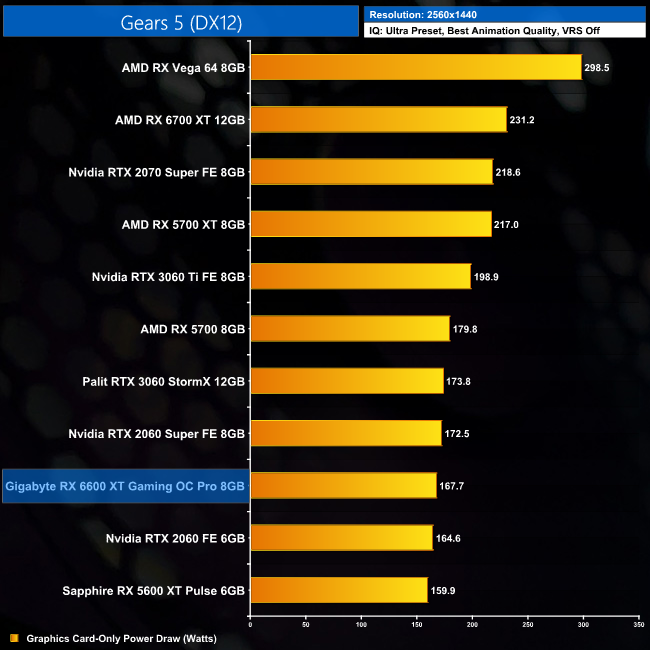
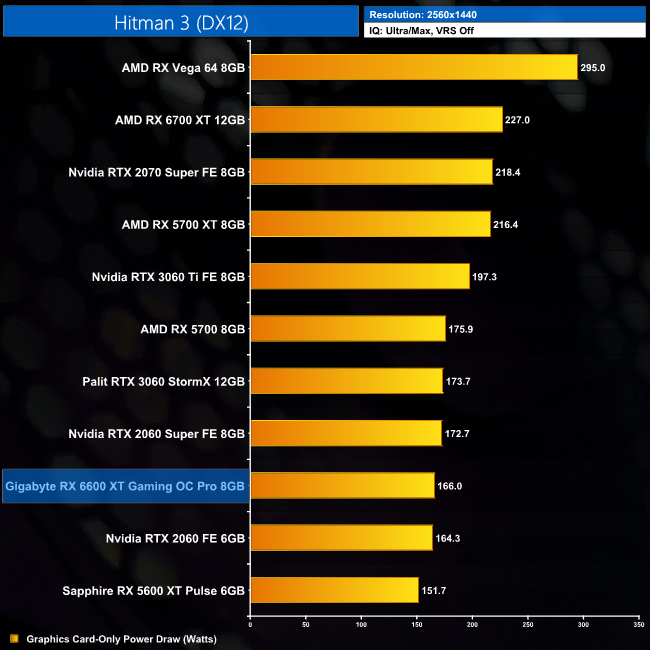
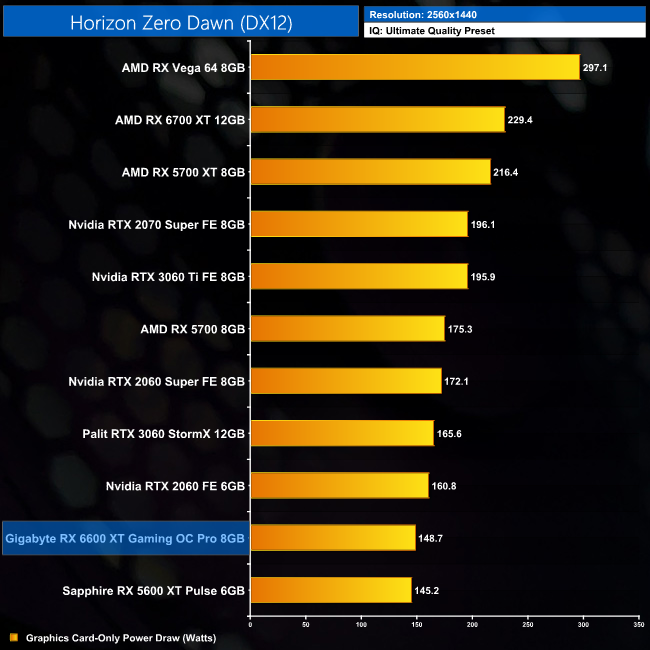
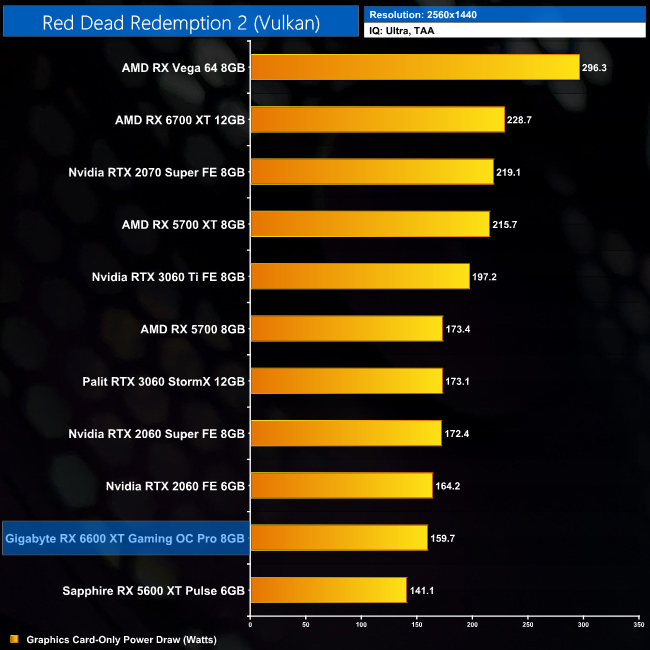
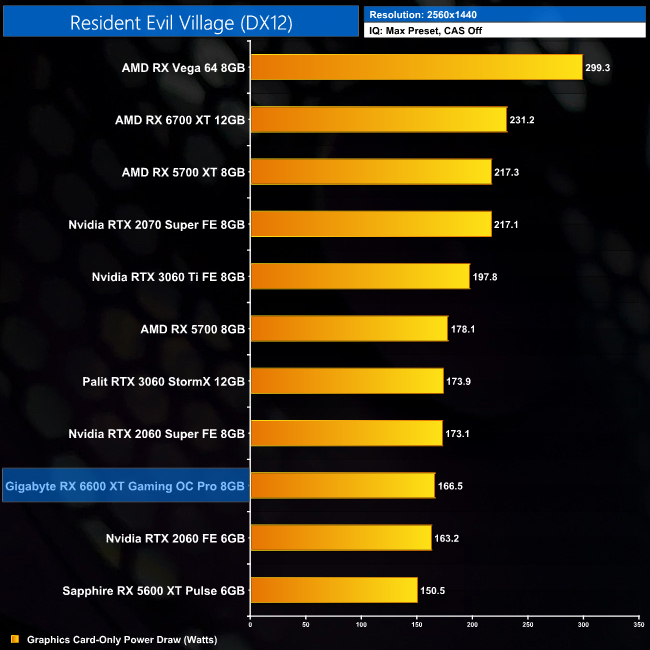
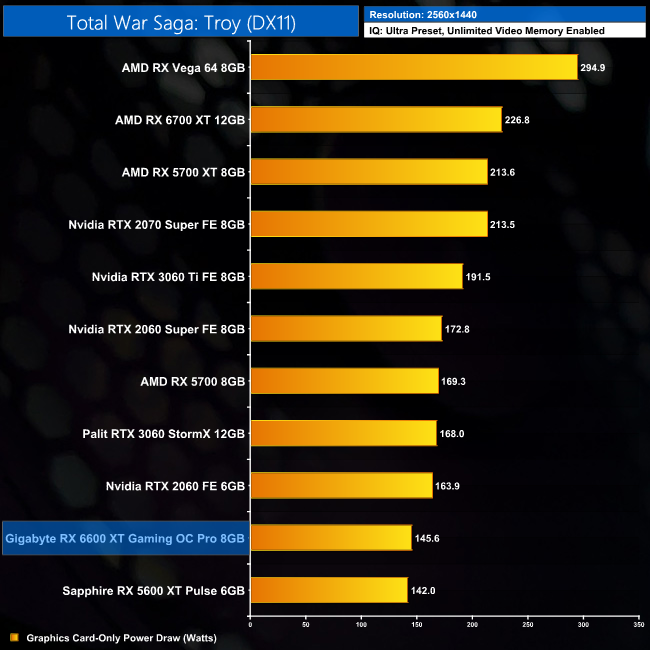
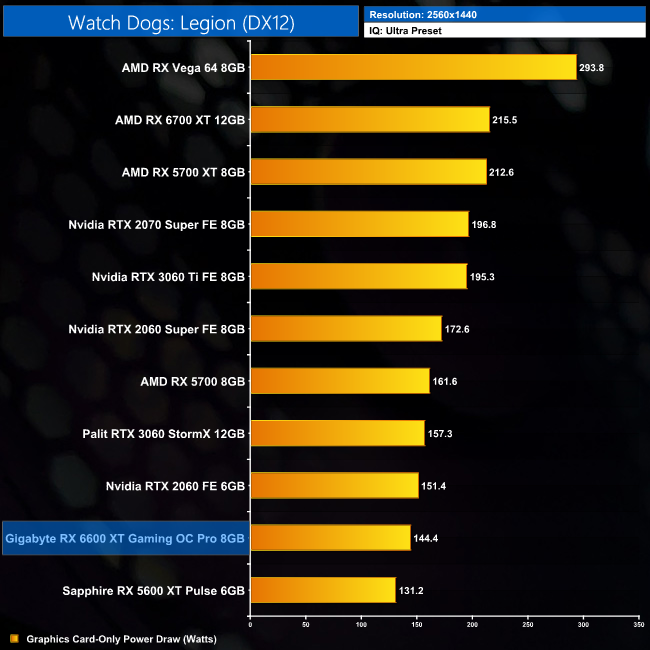
Click to enlarge.
12-Game Average at 1440p:
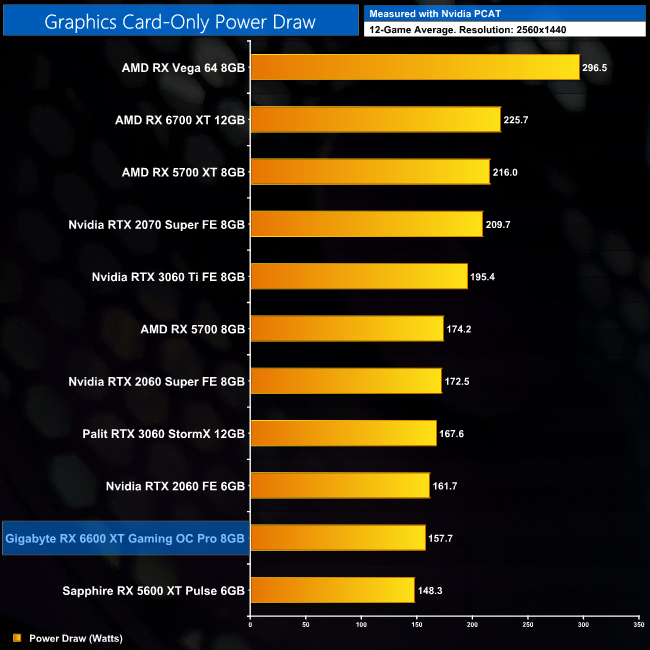
At 1440p, average power draw is still second from bottom, about 4W less than the RTX 2060 but just under 10W higher than the RX 5600 XT Pulse.
Here we present power draw figures for the graphics card-only, on a per-game basis for all twelve games we tested at 2160p (4K). This is measured using Nvidia's Power Capture Analysis Tool, also known as PCAT. You can read more about our updated power draw testing methodology HERE.
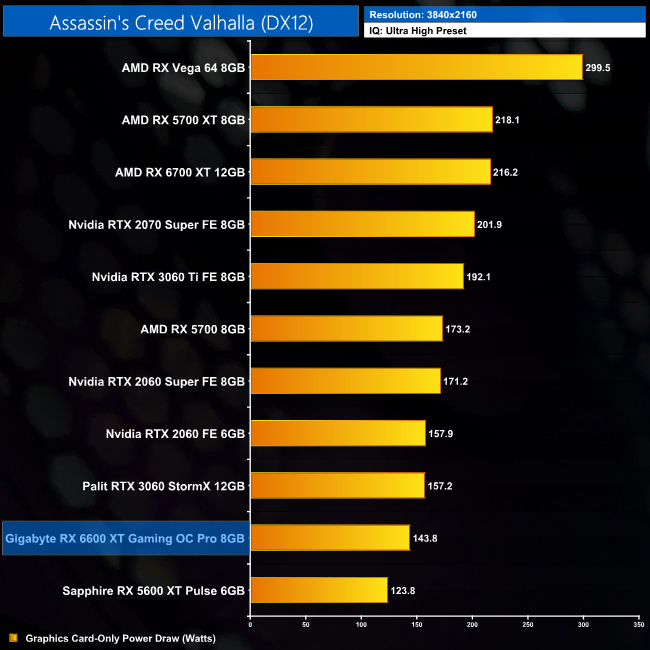
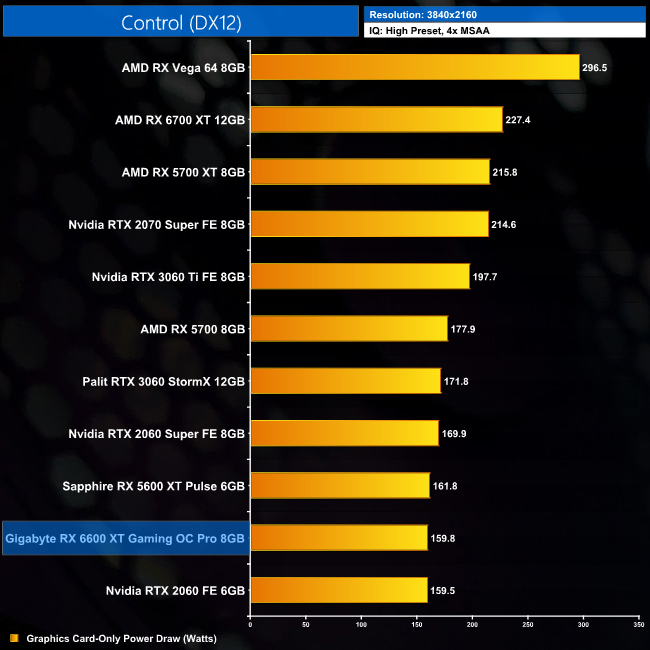
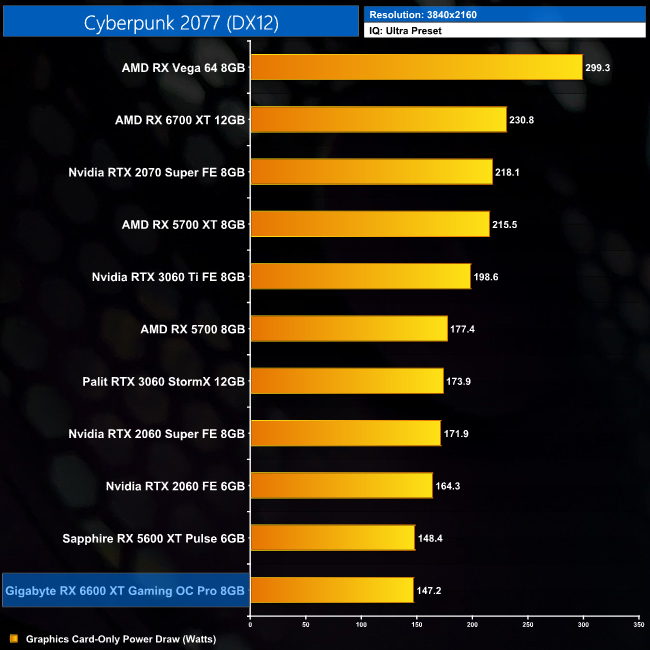
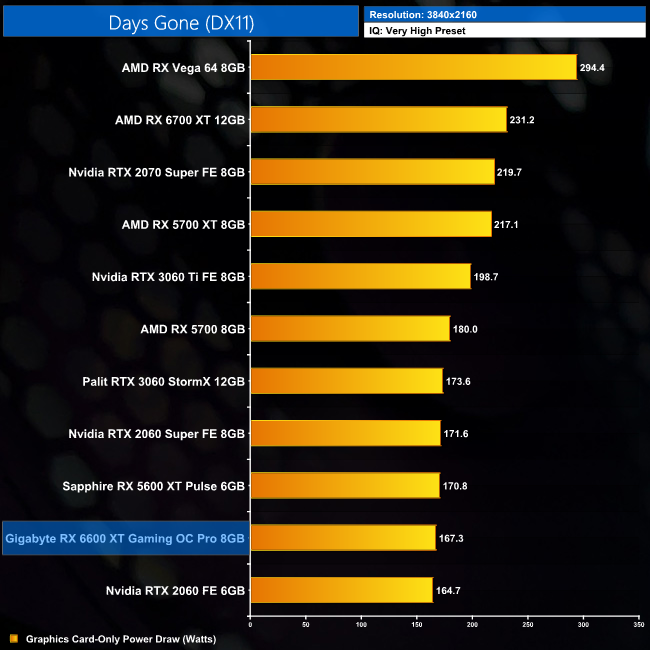
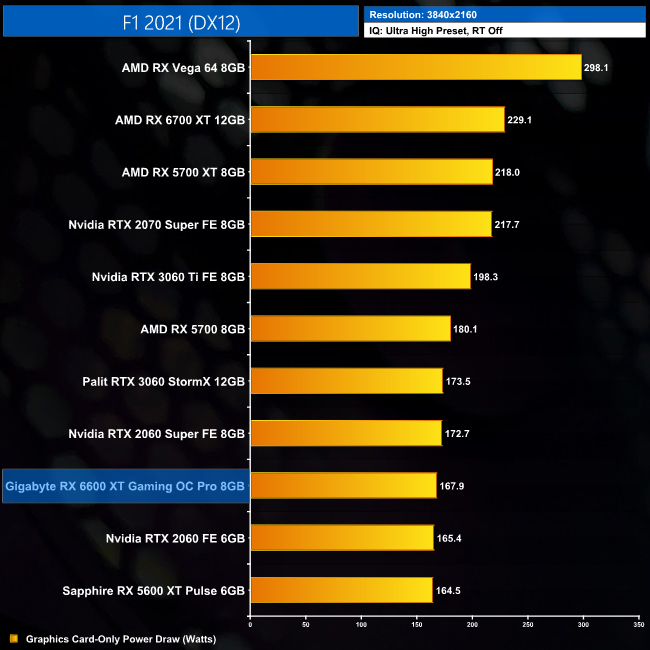
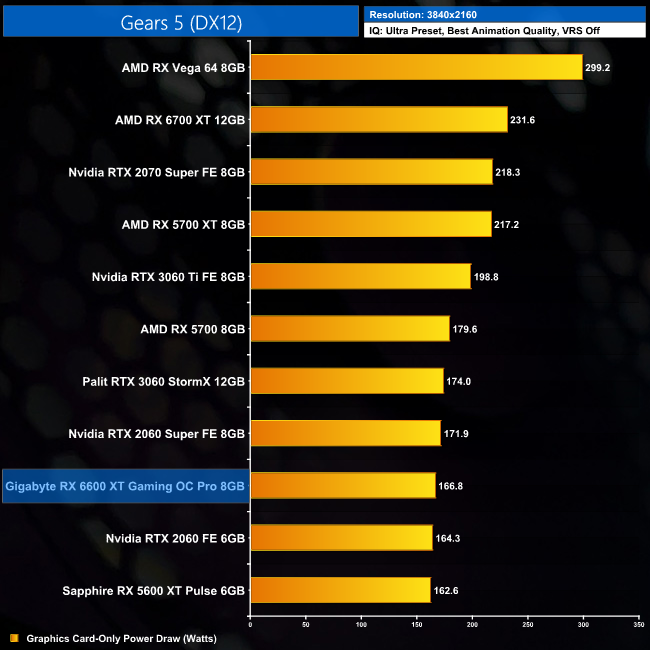
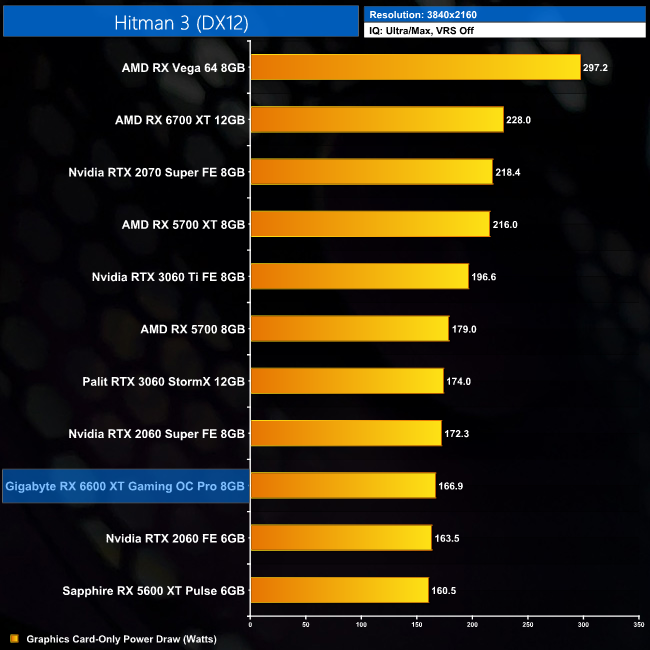
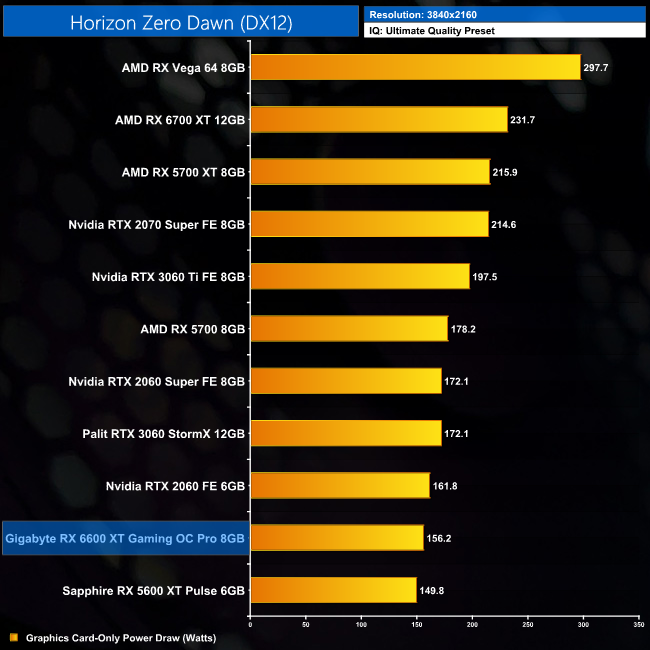
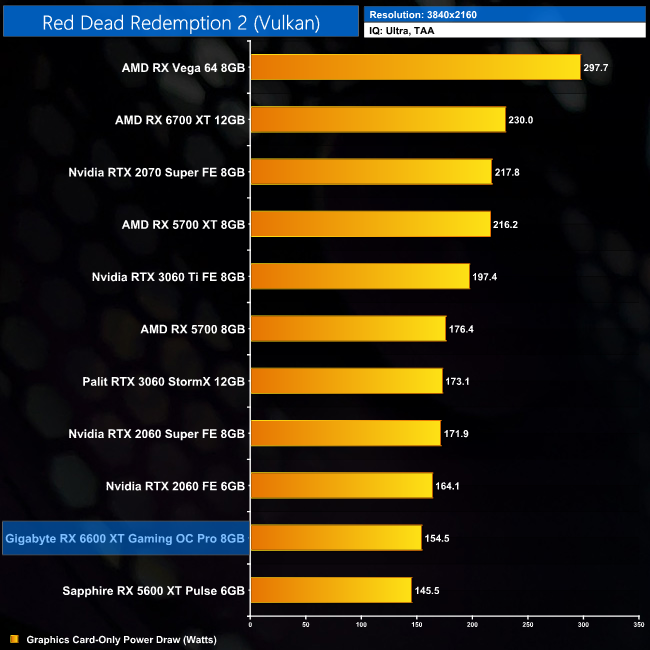
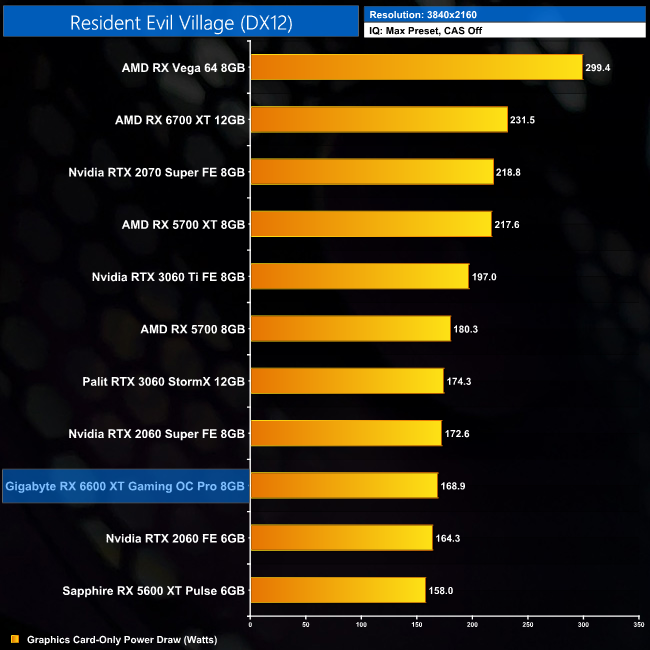
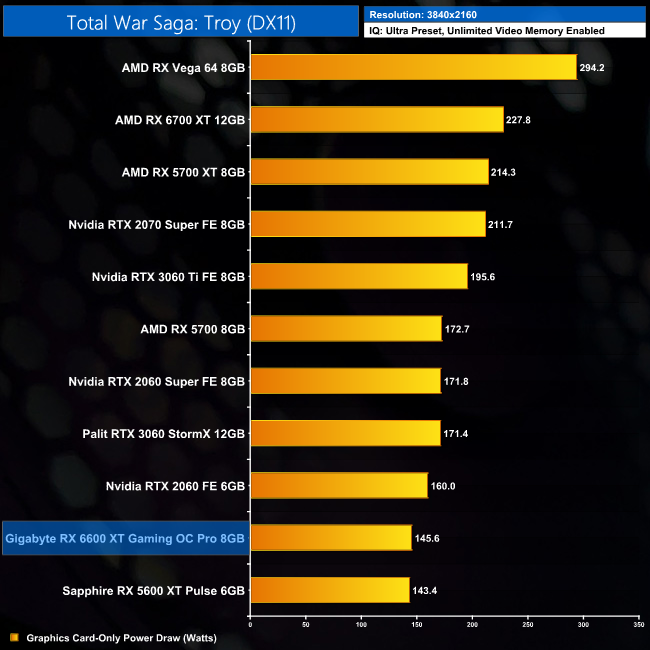
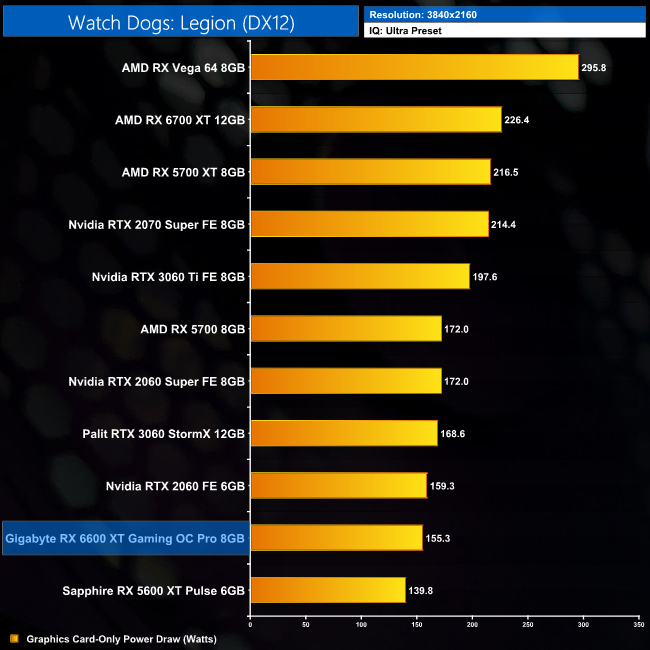
Click to enlarge.
12-Game Average at 2160p (4K):
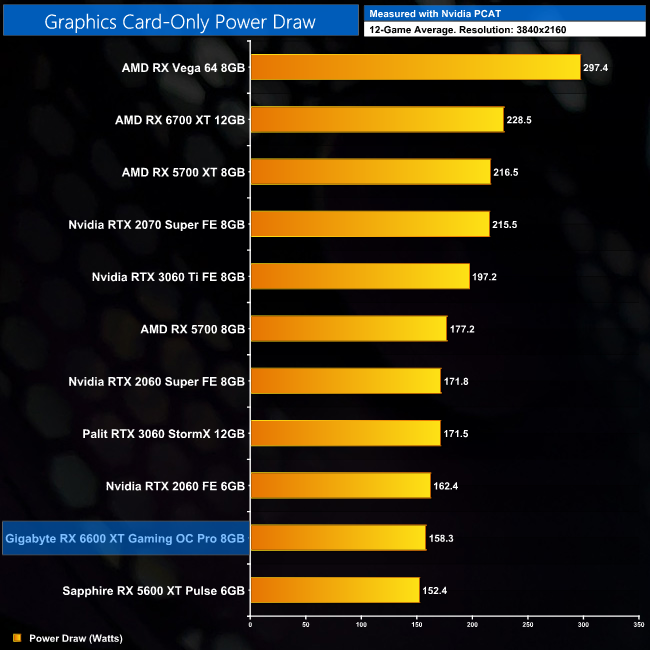
Even at 4K we're still not seeing average power draw exceed 160W. At most we saw 168.9W of power draw in Resident Evil Village (as shown at the top of the page.)
Using the graphics card-only power draw figures presented earlier in the review, here we present performance per Watt on a per-game basis for all twelve games we tested at 1080p.
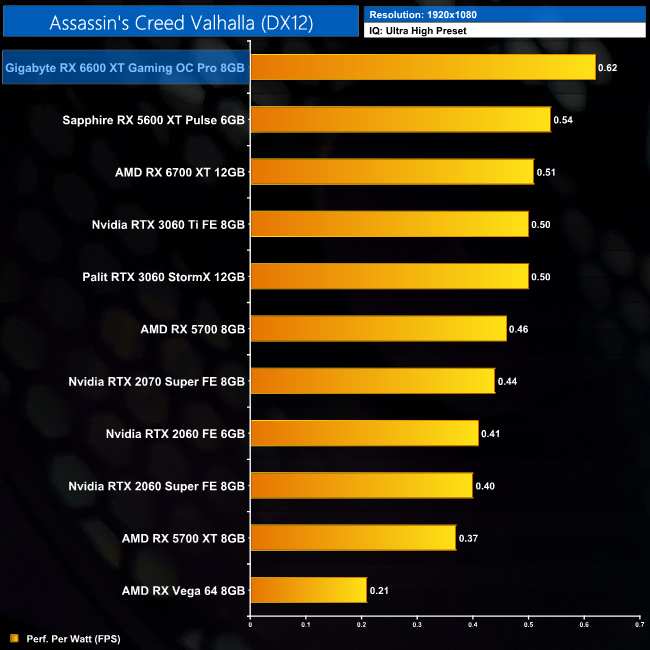
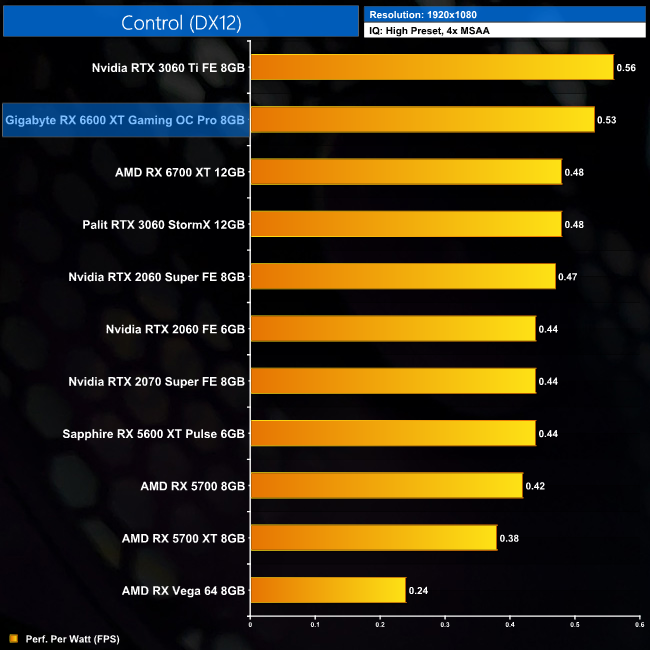
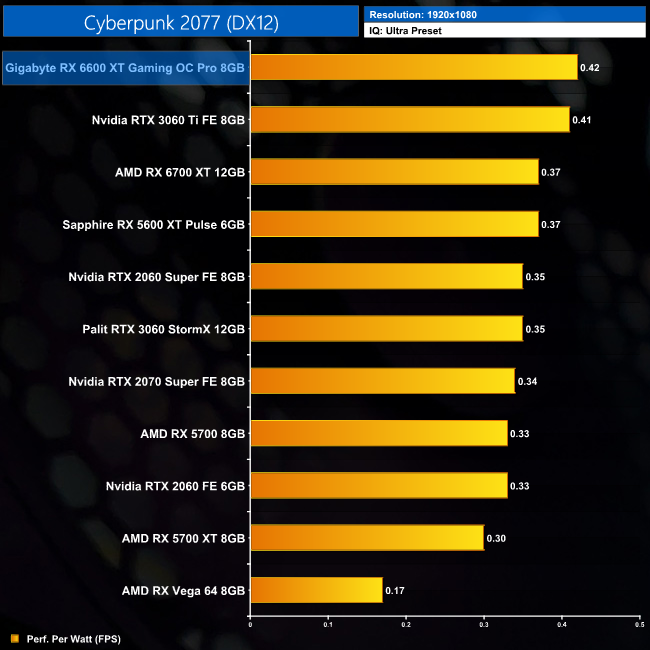
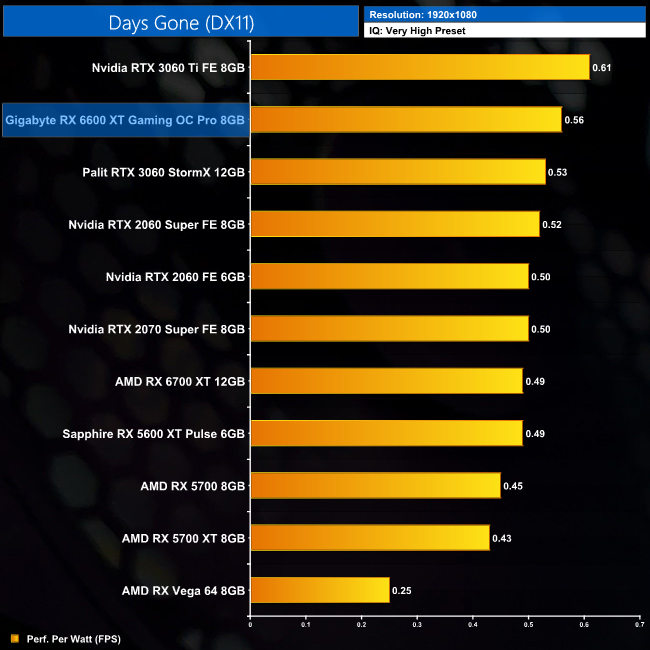
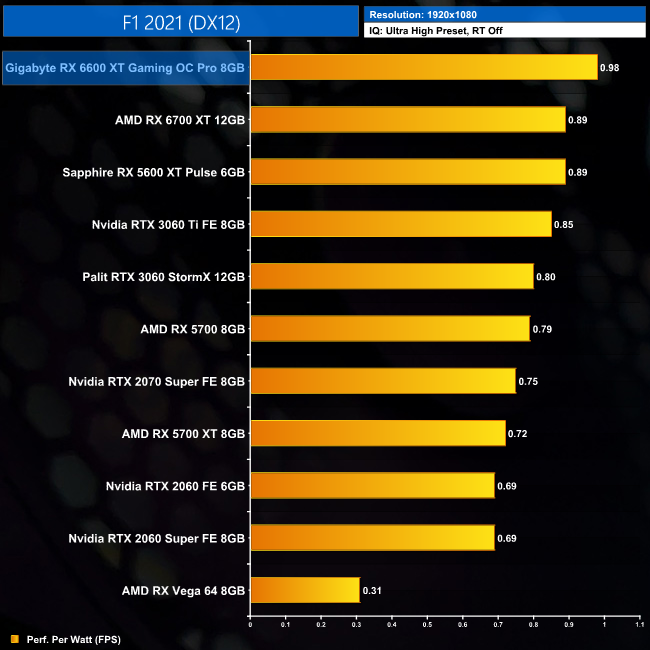
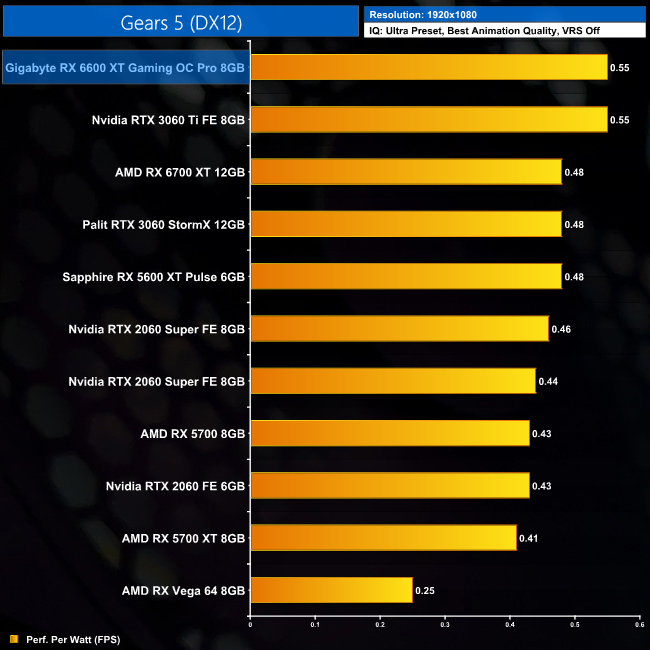
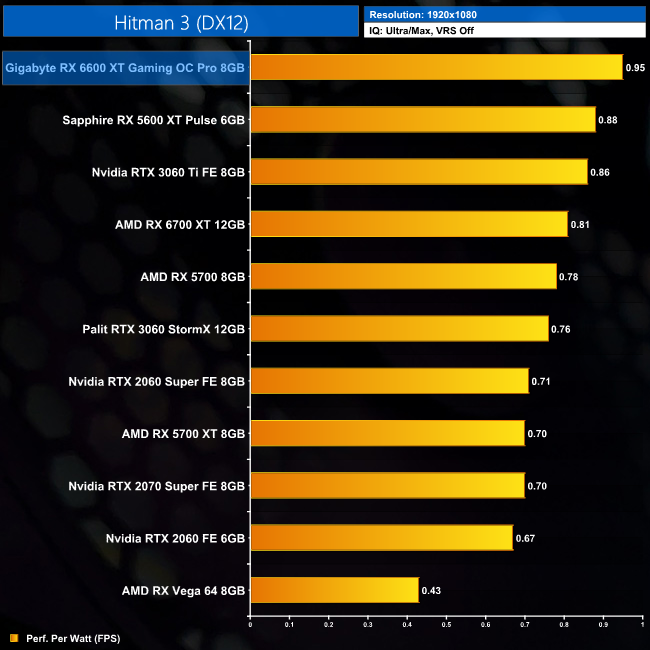
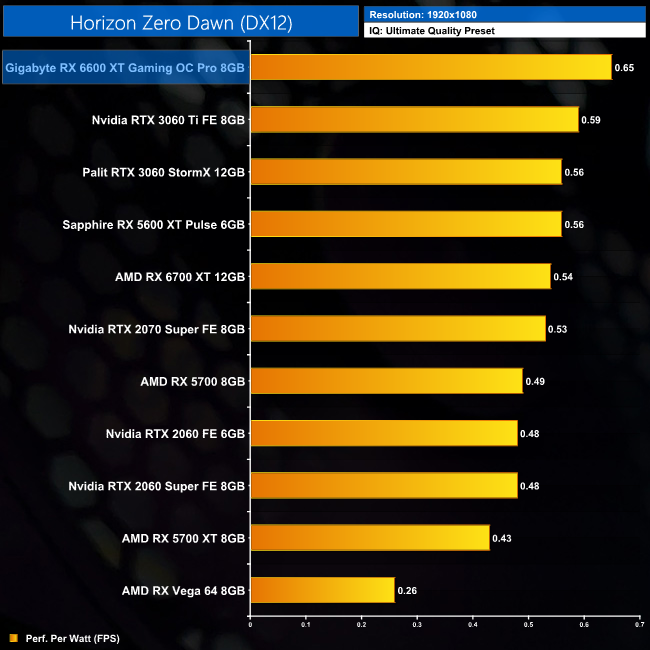
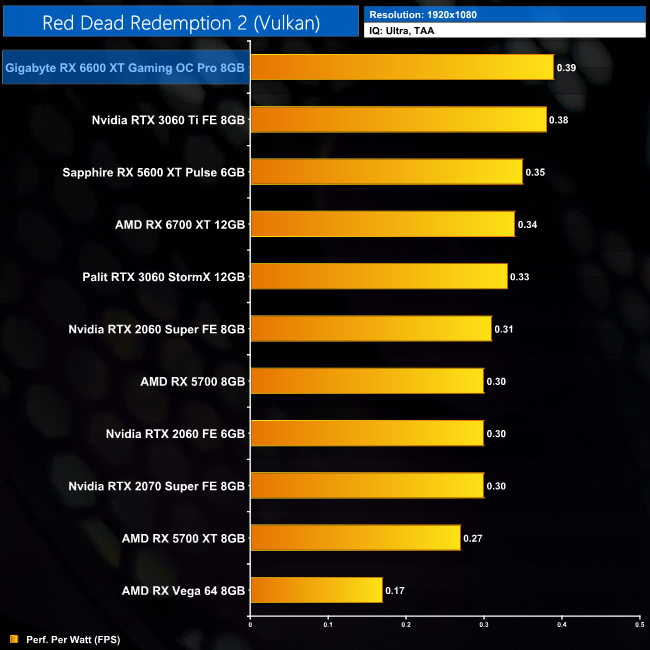
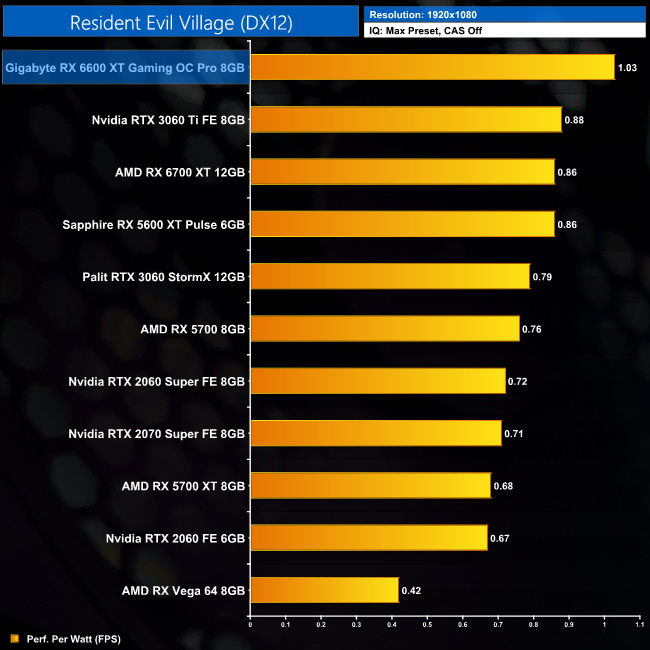
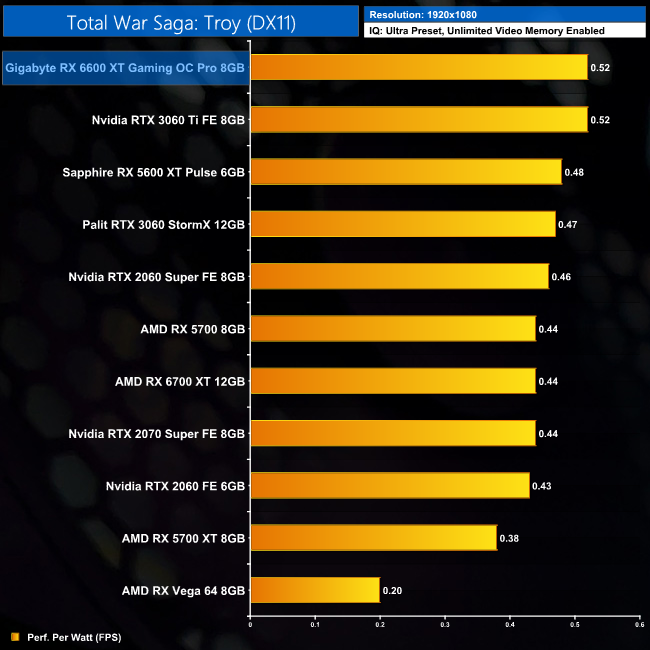
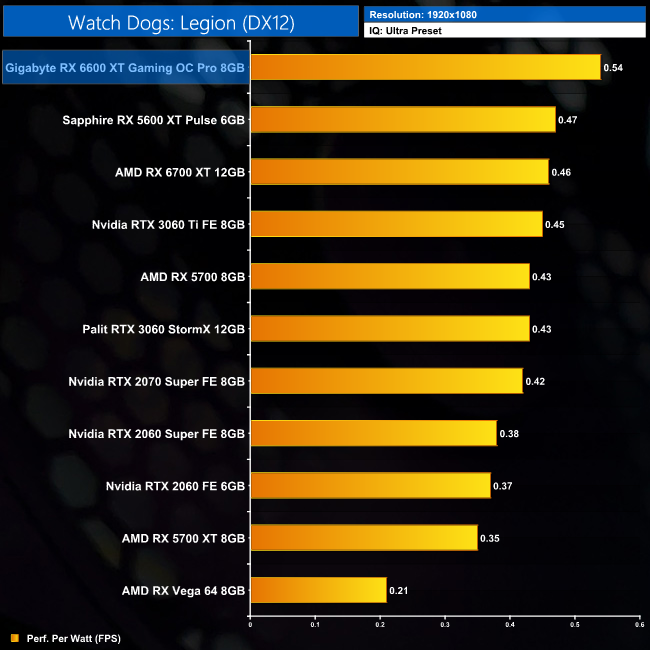
Click to enlarge.
12-Game Average at 1080p:
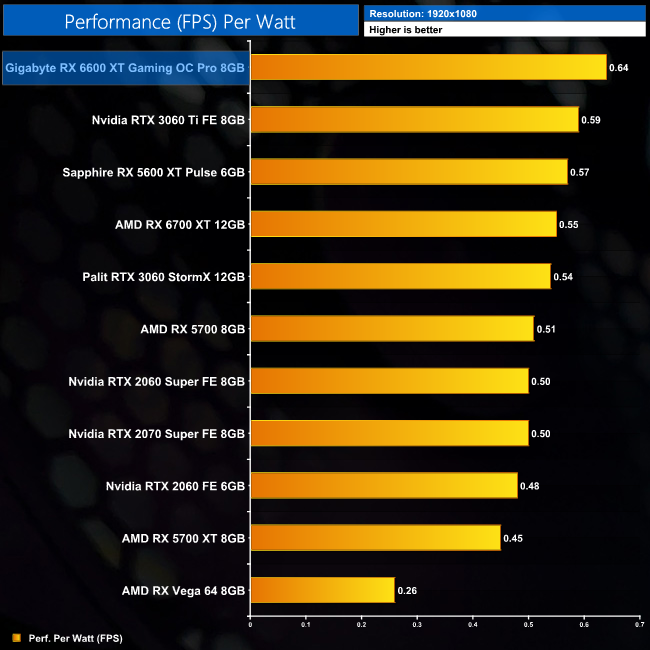
The RX 6600 XT is a highly efficient GPU at its 1080p target resolution. Delivering RX 5700 XT performance, but for around 60W less power is always going to help matters, and we can see it delivers 8% better performance per Watt than its nearest challenger, the RTX 3060 Ti.
Using the graphics card-only power draw figures presented earlier in the review, here we present performance per Watt on a per-game basis for all twelve games we tested at 1440p.
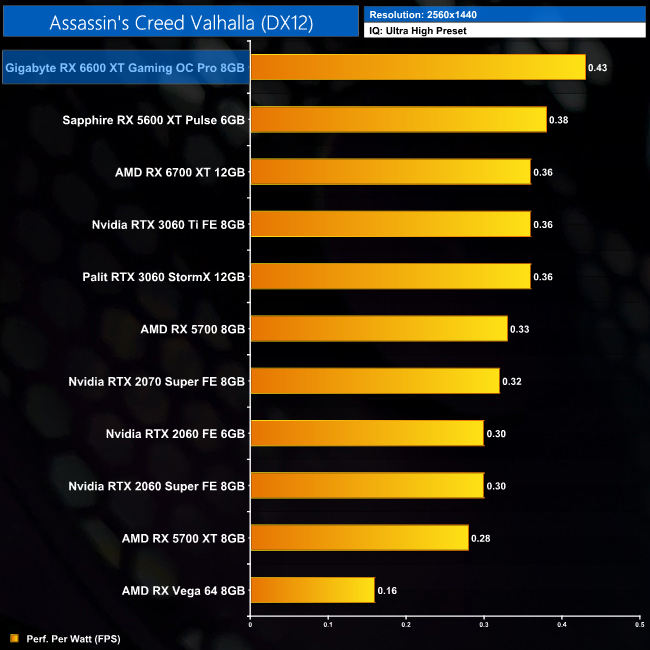
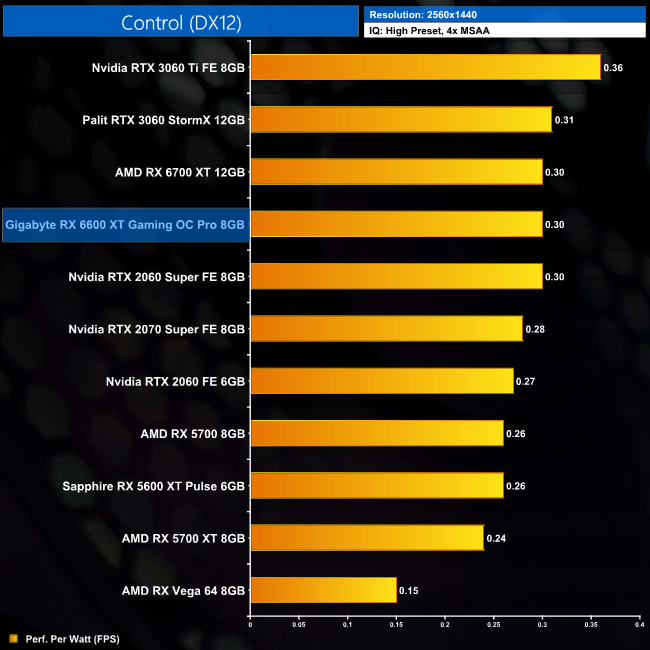
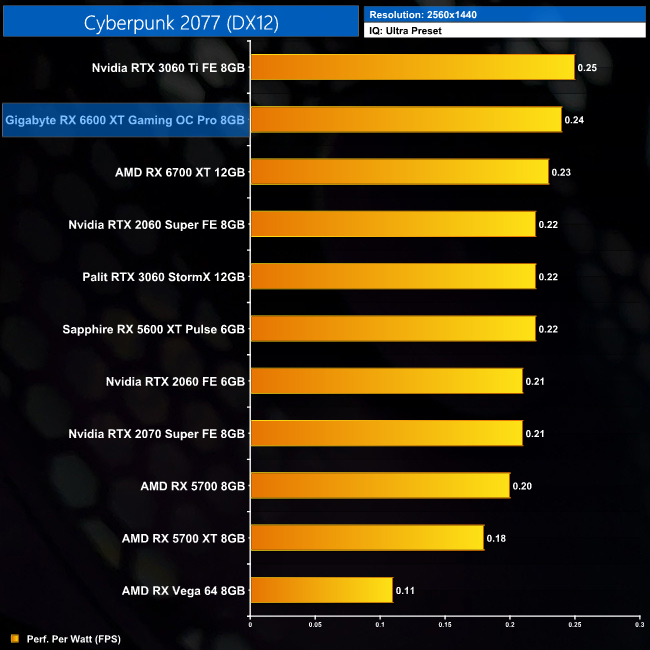
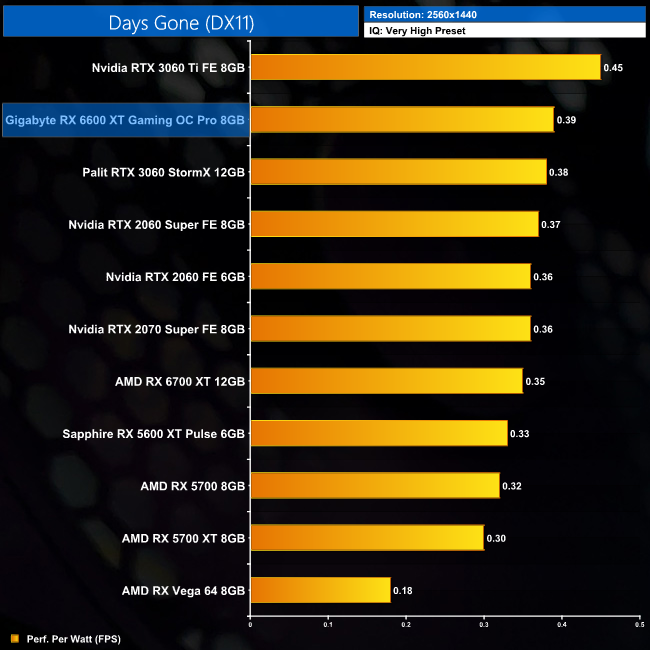
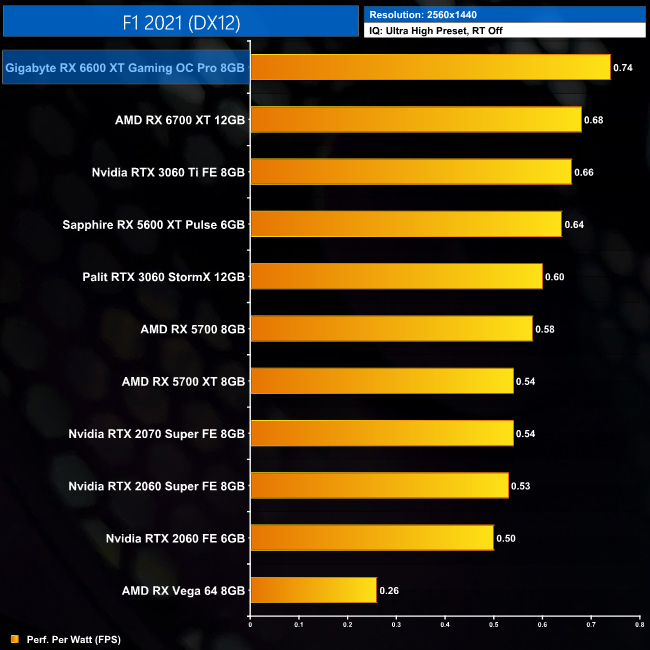
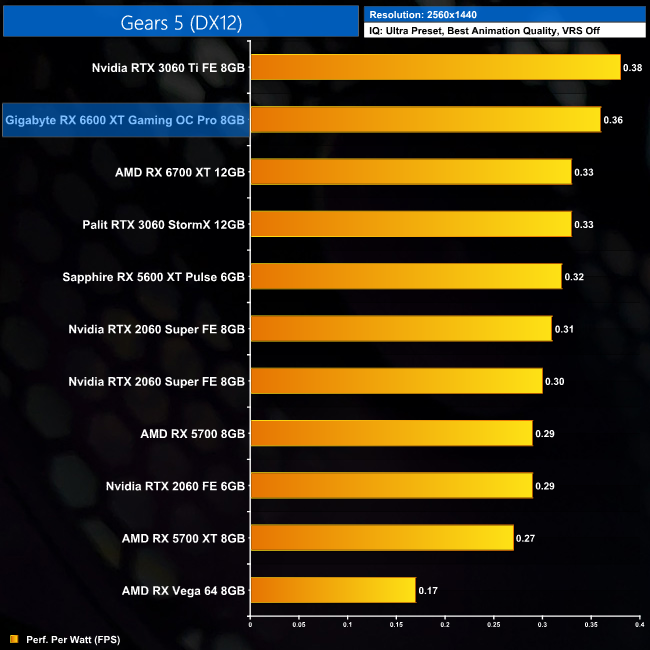
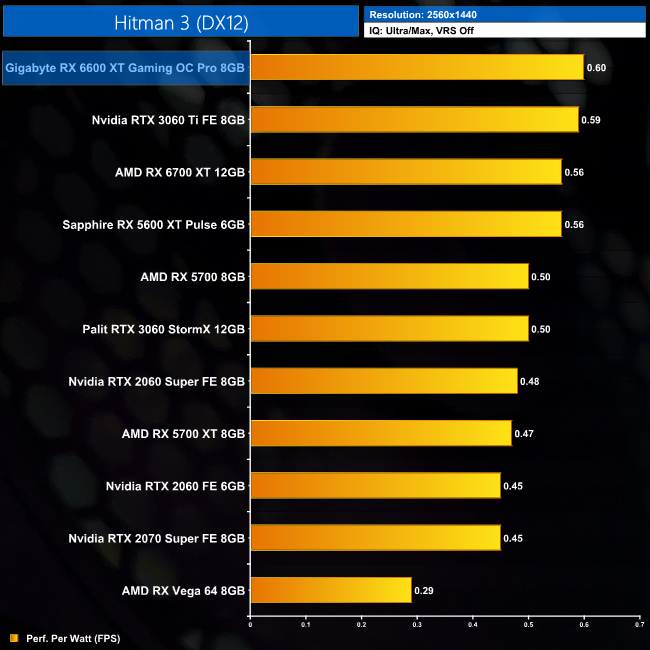
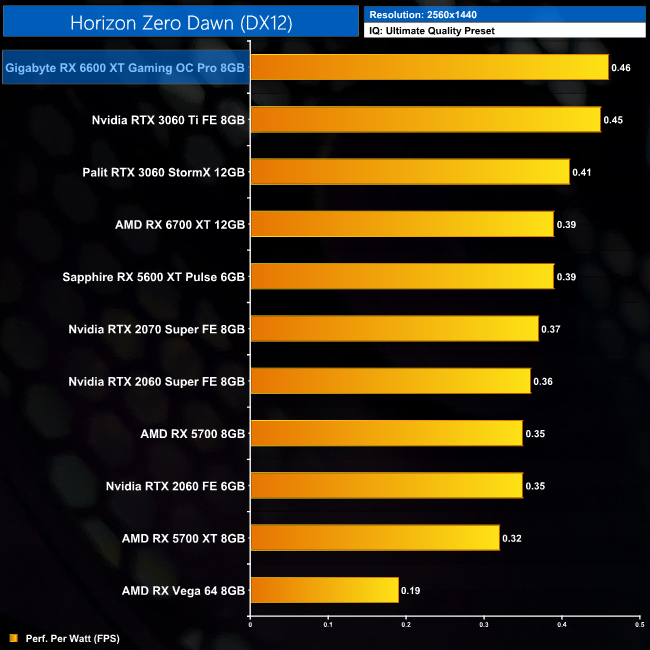
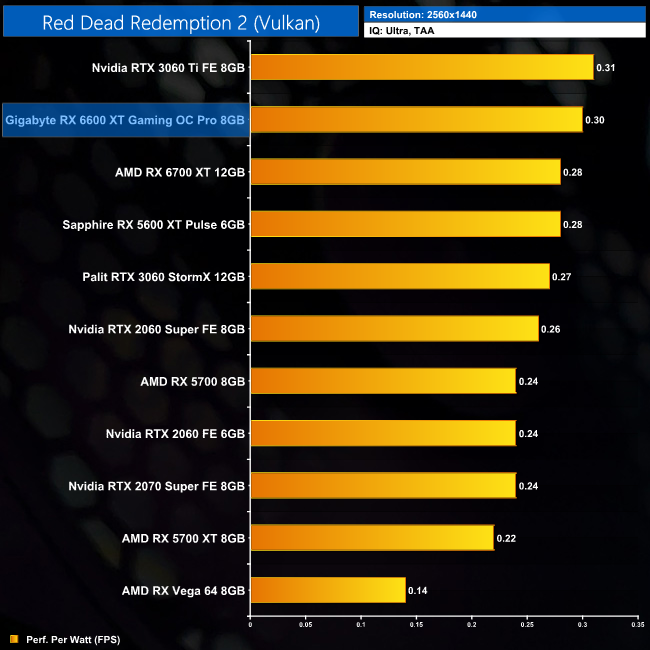
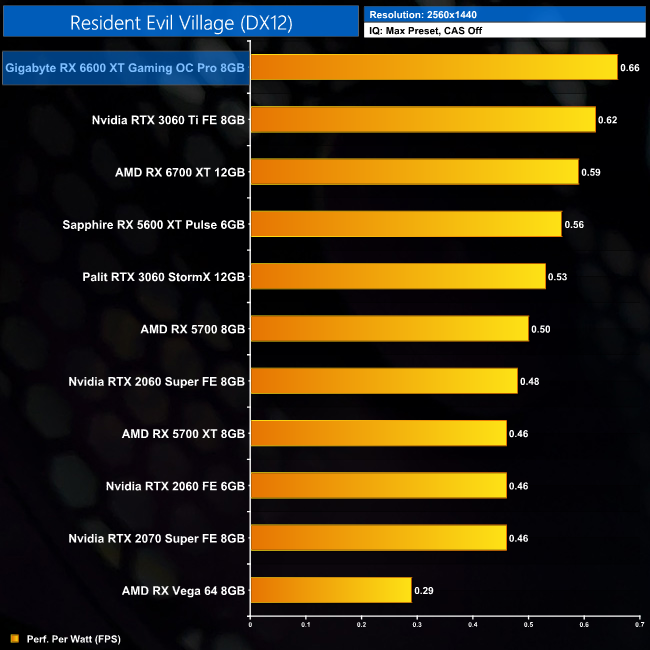
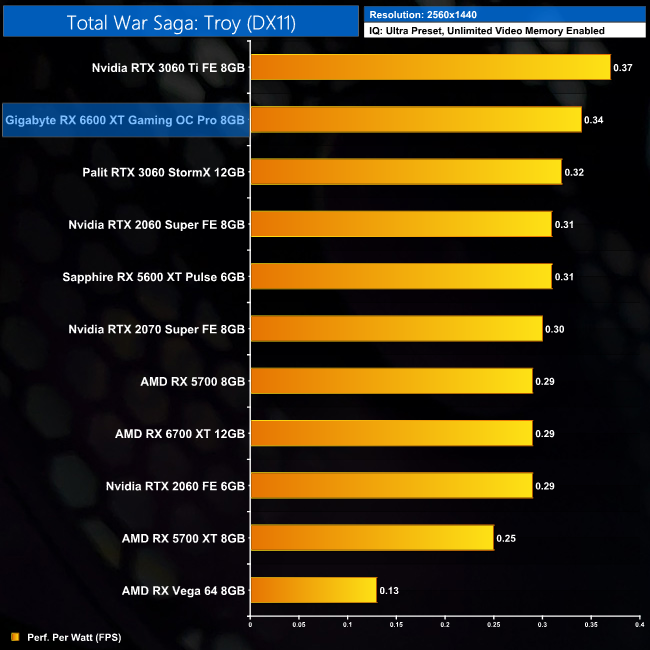
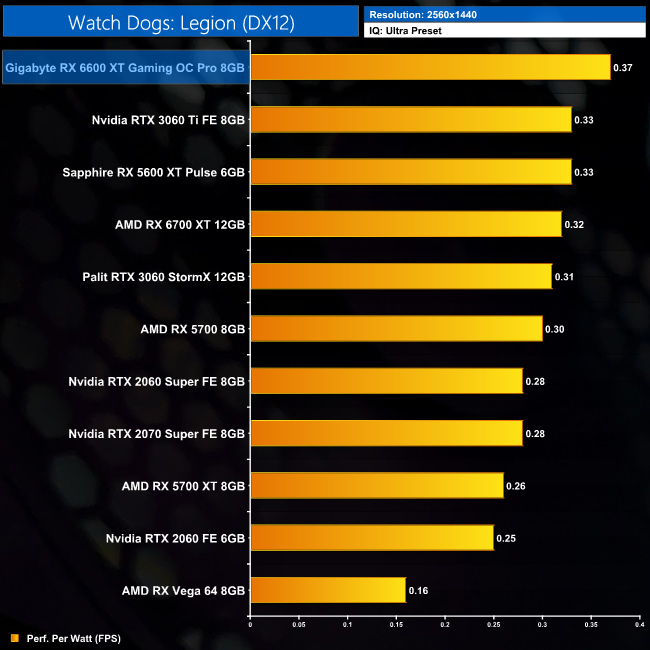
Click to enlarge.
12-Game Average at 1440p:
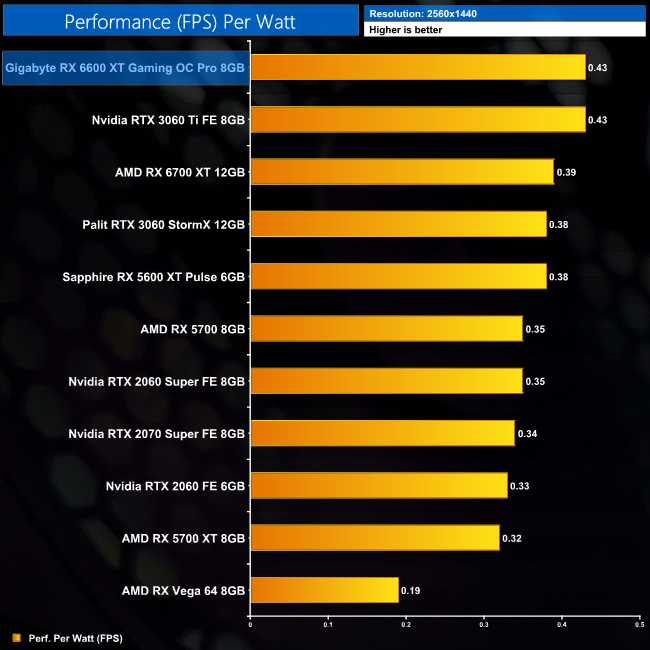
Even at 1440p, where the RX 6600 XT isn't as strong as it is at 1080p, the efficiency data is highly impressive – it's level with the RTX 3060 Ti, but still delivers 34% better performance per Watt than the RX 5700 XT, and we're not even going to mention Vega 64 at the bottom of the chart there…
Using the graphics card-only power draw figures presented earlier in the review, here we present performance per Watt on a per-game basis for all twelve games we tested at 2160p (4K).
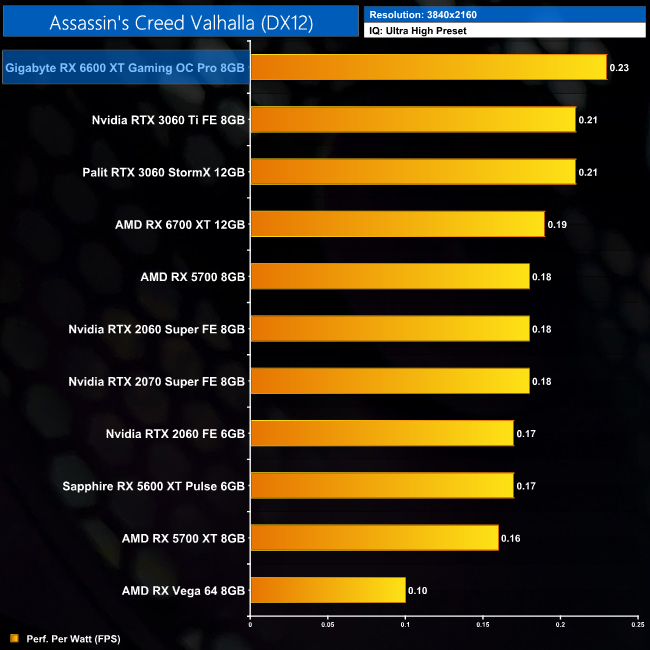
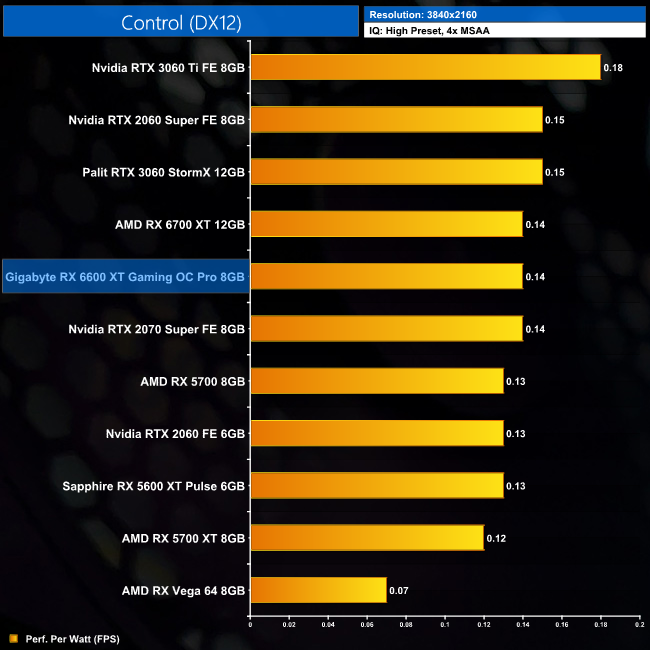
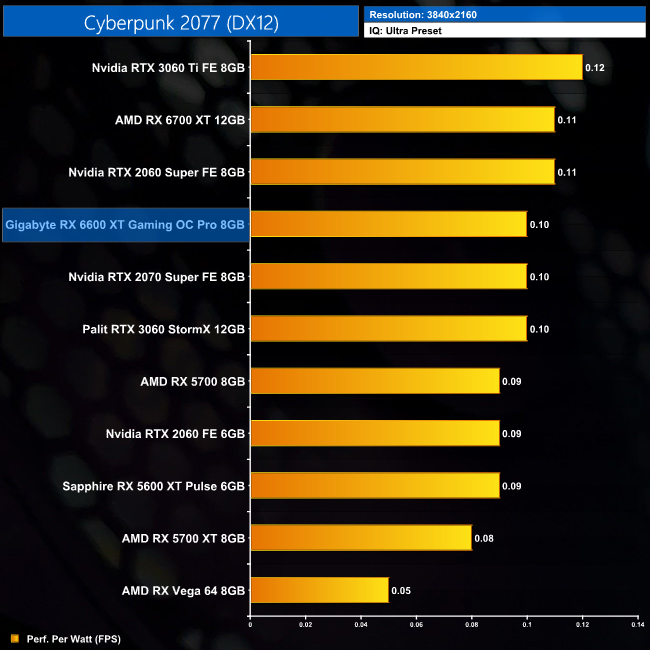
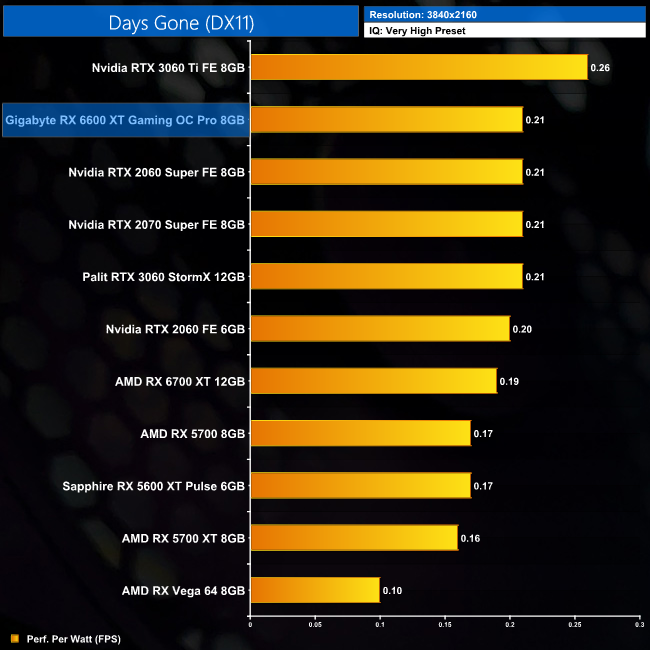
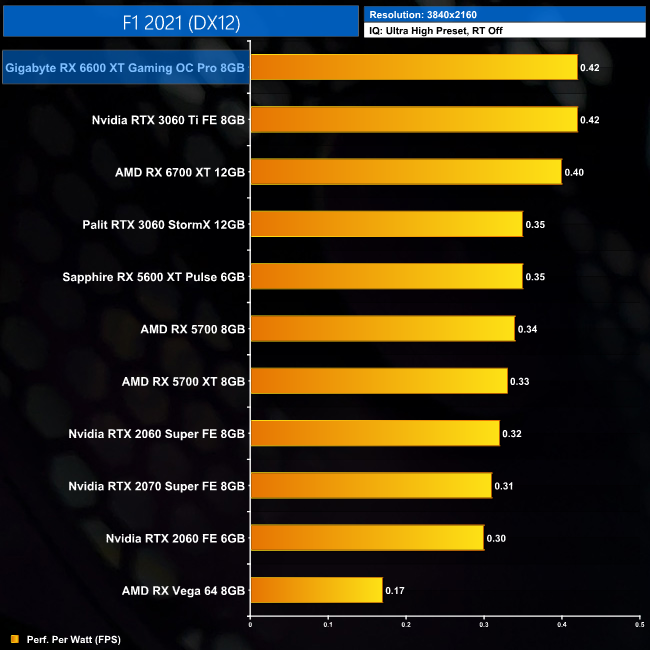
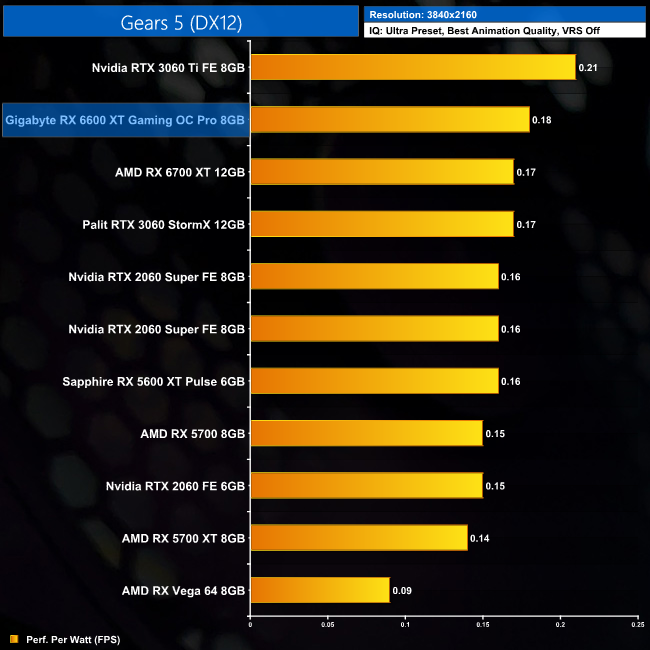
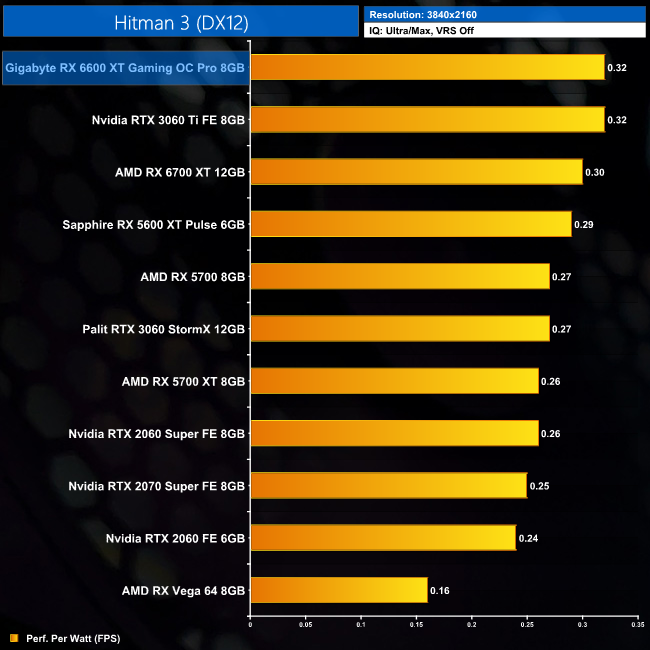
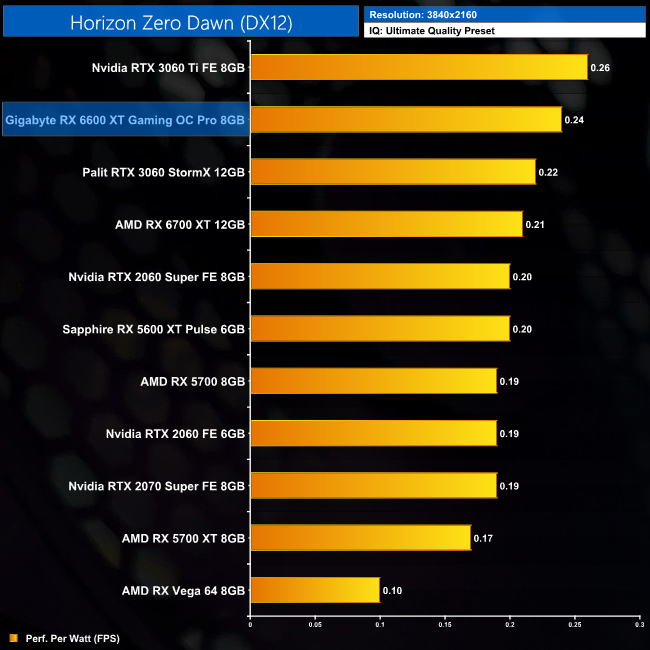
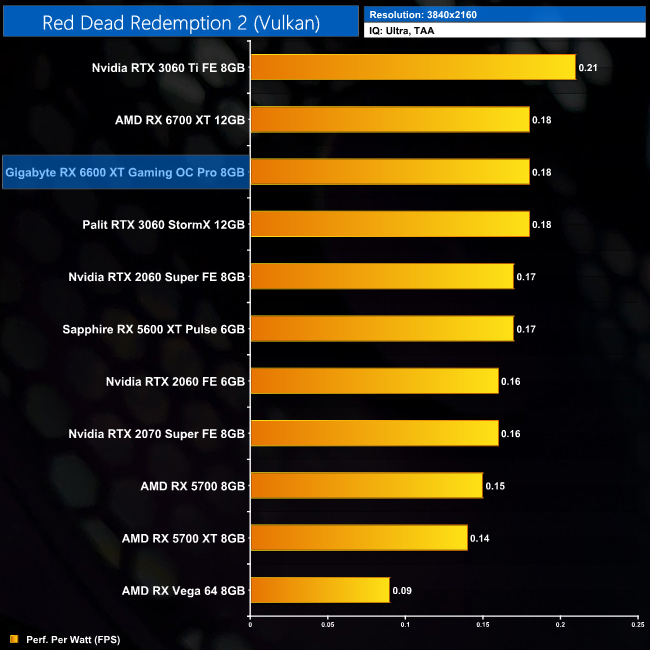
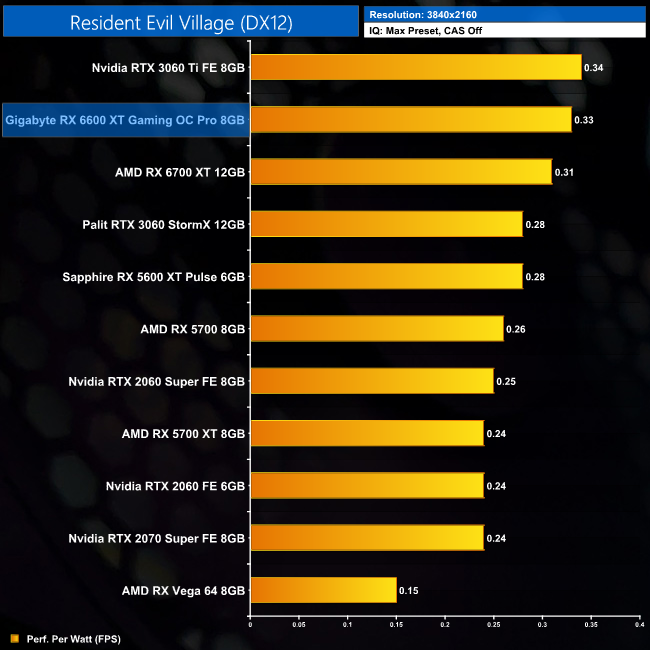
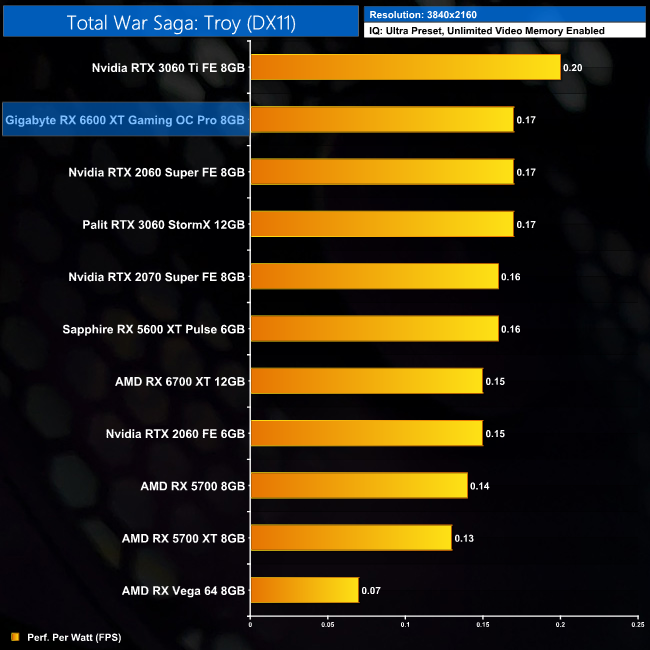
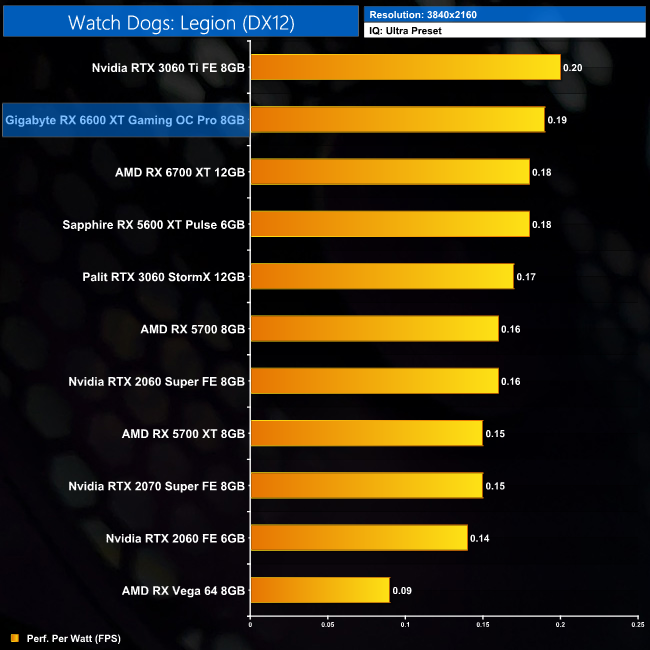
Click to enlarge.
12-Game Average at 2160p (4K):
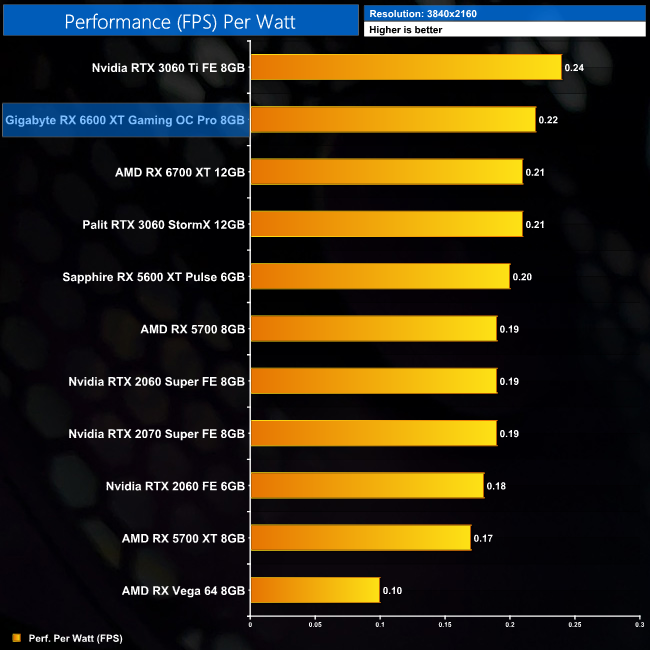
Lastly, despite clearly not being a 4K card in any way, shape or form, the performance per Watt results are not bad at all – second only to the RTX 3060 Ti.
We measure system-wide power draw from the wall while running Cyberpunk 2077 for 30 minutes.
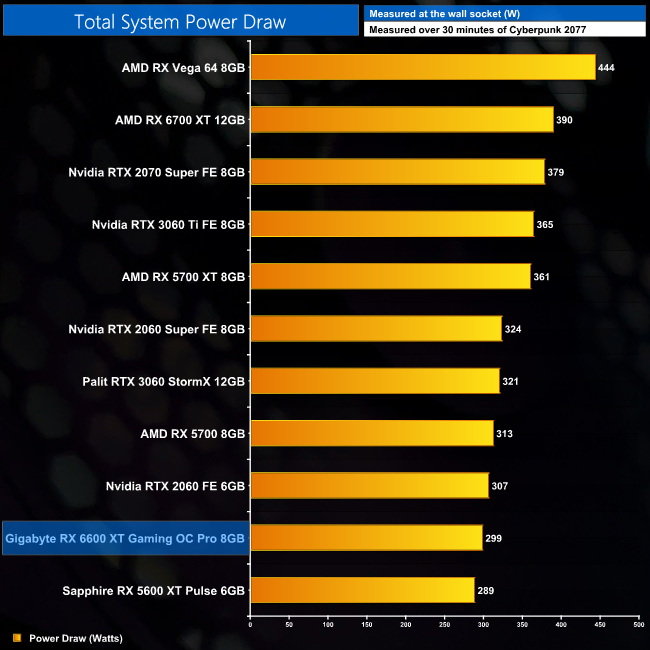
For those interested in total system power draw, we saw peak power consumption of 299W with our i9-10900K system when running Cyberpunk 2077. Gigabyte officially recommends a 500W PSU, which should be plenty.
For our manual overclocking tests, we used AMD built-in tuning tool. Our best results are as below.
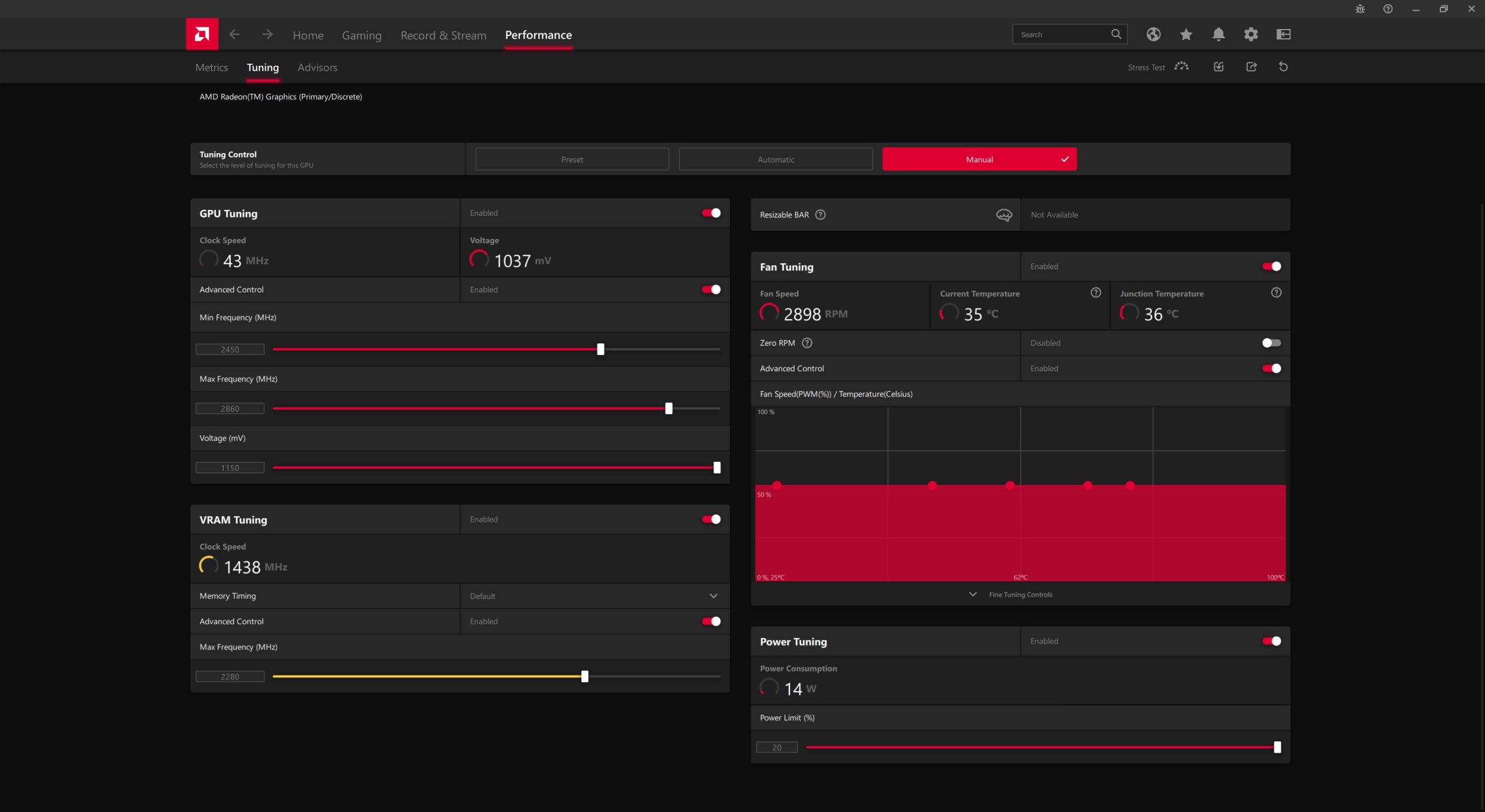
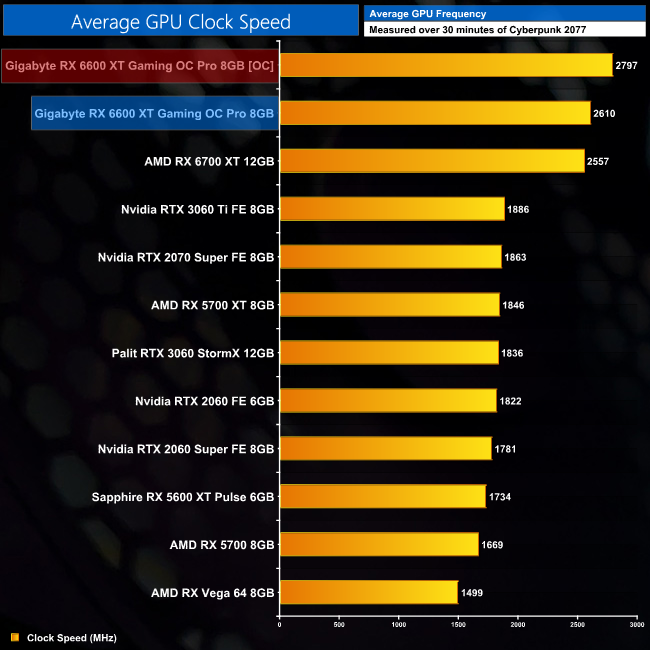
With 2860MHz dialled in, the GPU averaged just shy of 2800MHz in the real world. That's still a tidy boost over stock however, with an extra 187MHz on tap thanks to the overclock.
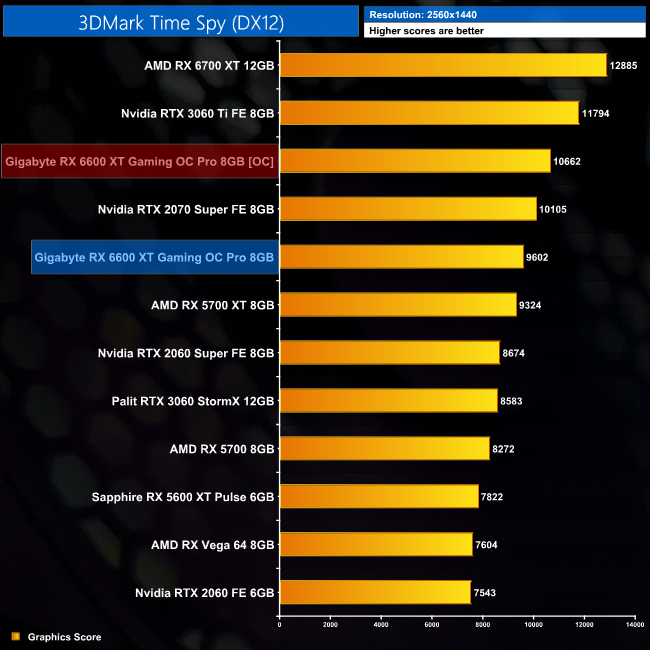
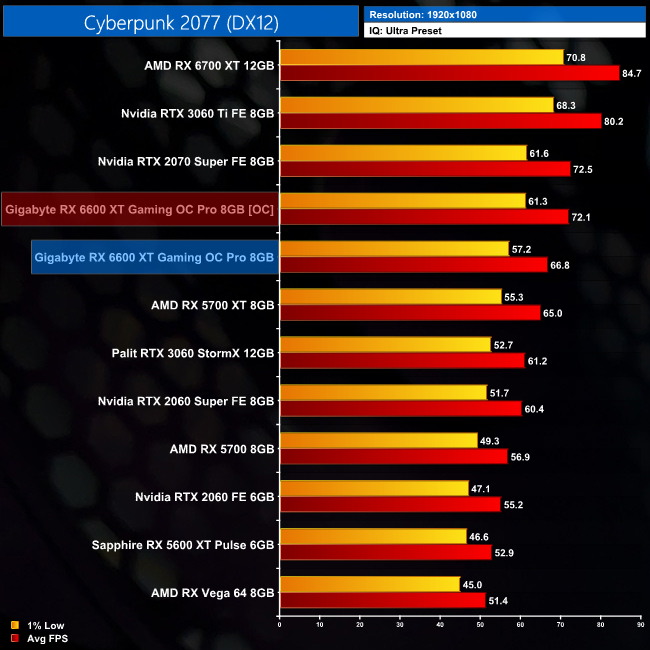
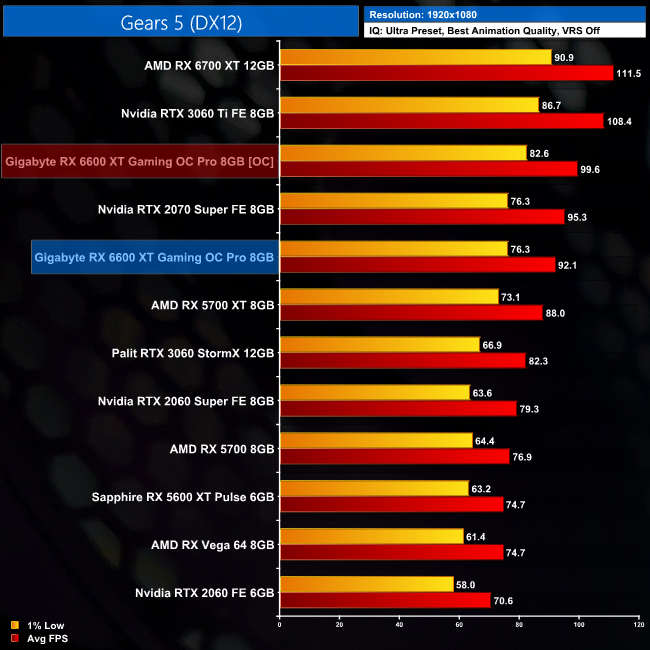
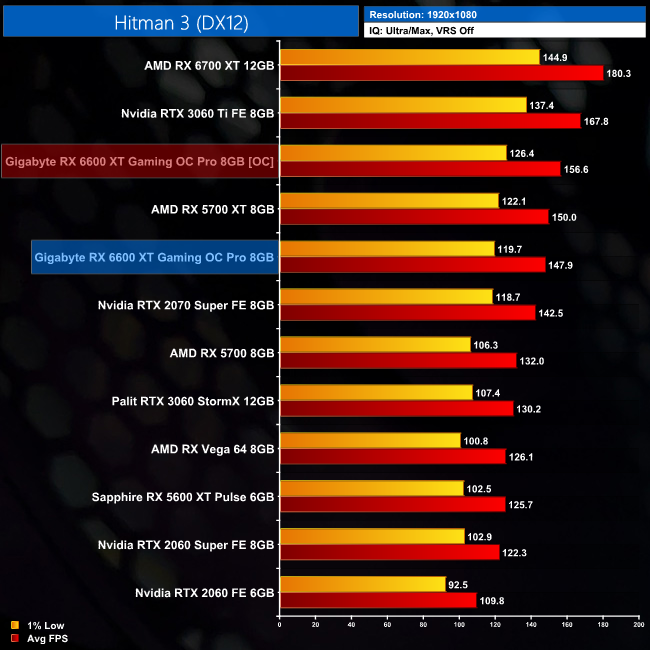
Overall, this overclock saw frame rates improve by between 6-9%, which we have to say is pretty typical of the other RDNA 2-based GPUs we have tested.
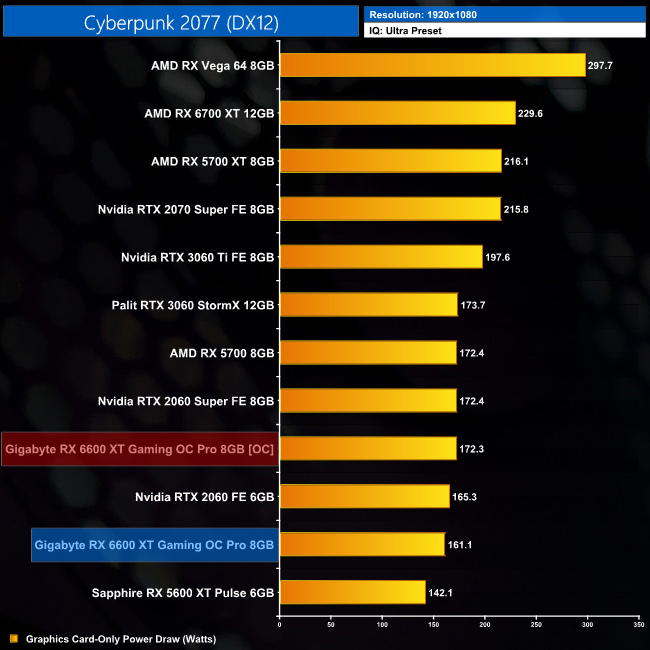
Power draw rose by 11W in Cyberpunk 2077 with the overclock dialled in, which is only an extra 7% versus stock.
Five months on from the launch of the RX 6700 XT, today we have assessed AMD's new RX 6600 XT 8GB GPU. Aimed squarely at 1080p gamers, AMD has priced this card at $379 USD, slotting it between Nvidia's Ampere-based RTX 3060 and RTX 3060 Ti, priced at $329 and $399 respectively.
As always, there is a lot to talk about with this GPU launch, but we'll start with the performance summary. The first thing you need to know is that this GPU more than meets its aim of delivering 1080p Ultra gaming – it was able to deliver 60FPS at max settings in every one of the twelve games we tested. Strictly speaking, Red Dead Redemption 2 averaged 59.8FPS… but we'll call that 60.
In fact, I would say that AMD undersold the 6600 XT with its marketing, as it is very capable of 1440p gaming too. Granted, you won't hit 60FPS in every title, but the lowest average frame rate we saw at 1440p was 38FPS in Cyberpunk 2077 – the likes of Days Gone, Hitman 3 and Resident Evil Village all delivered well over 60FPS at 1440p. Objectively speaking, before getting into anything else, this GPU produces good results for 1080p and 1440p gaming.
Looking at relative performance though, here things get slightly more complicated. The good news is AMD's claim that the RX 6600 XT is faster than the RTX 3060 proved true – at 1080p the RX 6600 XT ran 12% faster on average compared to the RTX 3060. However, the 6600 XT is also 15% slower than the RTX 3060 Ti, despite being just 5% cheaper based on MSRP pricing, while it's also within 2% of the RX 5700 XT – a GPU that launched over two years ago, for just $20 more than the RX 6600 XT's MSRP today. That certainly doesn't seem like much – if any – progress has been made. Even against the RX 5600 XT, a comparison I've not made throughout this review as the two products are really in different price categories, the RX 6600 XT is 23% faster but also 35% more expensive.
We do also have ray tracing to cover, but what there is to say won't come as a surprise. Over the three games we benchmarked, the RX 6600 XT was slower than the RTX 2060 in two of them, and it didn't come close to competing with the RTX 3060 – and that's before factoring in DLSS in the games that support it. It is good that end users can at least enable ray tracing on the RX 6600 XT, but I'm not sure how realistic it is to do all your gaming with it turned on, so I wouldn't look at it as a key selling point for this GPU.
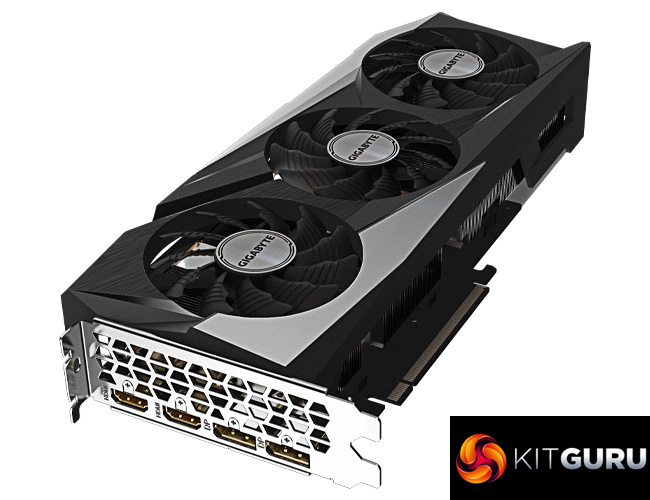
As an AIB-only launch, today we have tested Gigabyte's RX 6600 XT Gaming OC Pro. It is undoubtedly an extremely capable graphics card, to the point where it is overkill for a GPU like the RX 6600 XT. GPU temperatures peaked at just 52C for instance, which is fantastic – but also far cooler than you would ever need your GPU to run. I only say that as being Gigabyte's flagship RX 6600 XT model, it is likely to fetch a significant price premium, when chances are a cheaper card will still provide enough cooling power. We will have to test other AIB models to verify that claim though, so stay tuned for that.
We have also implemented our recently-updated GPU power testing methodology as part of this review, so if you want to see power draw figures on a per-game and per-resolution basis, you can find that starting on page 28 of this review. The results aren't too much of a shock – offering RX 5700 XT-levels of performance, but while drawing over 60W less power, results in a highly efficient GPU, and it is actually the most efficient of any graphics card have tested today when looking at the 1080p data. Even at 1440p, the 6600 XT is an exact match for the RTX 3060 Ti in terms of performance per Watt, so that's a big positive for AMD.
We did also try our hand at overclocking, though the results won't be much of a surprise to anyone who's been keeping an eye on AMD's RDNA 2 GPUs. We were able to squeeze an extra 6-9% performance out of our sample, which is certainly decent and in-line with what we'd expect, but it's nothing to go crazy about.
Overall, we have a bit of a mixed bag with the RX 6600 XT. On the one hand, it is a good card for 1080p and 1440p gaming, so if you're just looking to get your hands on something which you know can play the latest AAA games, this will do that for you. On the other hand, we can't escape the fact that at the $379 MSRP, there are clearly better options out there. Just $20 separates the RX 6600 XT and the RTX 3060 Ti, and that GPU is significantly faster across the board, and also offers substantially better ray tracing performance, as well as support for DLSS.
I completely understand the business sense behind such pricing, as in the current market any new GPU is going to sell out regardless, and AMD's first priority is to its shareholders, not its customers. That doesn't mean I have to recommend the product though, and to me the RTX 3060 Ti is clearly the better purchase.

The good news is we have been speaking with Overclockers UK who are expecting ‘good' supply of RX 6600 XT GPUs, and we are told pricing will start at £379, though at the time of writing we don't have an official UK MSRP as set by AMD. OCUK also told us they are expecting ‘large volumes' of RTX 3060 Ti cards in the coming weeks, so we're hopeful that will provide a good amount of options for those considering a new GPU purchase around the £370-£400 price point.
You can view all the listed RX 6600 XT models on OCUK HERE.
Pros
- Capable GPU for 1080p and even 1440p gaming.
- Highly efficient.
- Gigabyte Gaming OC Pro model is exceptionally cool and quiet.
Cons
- MSRP is just $20 below the RTX 3060 Ti.
- Barely faster than the RX 5700 XT, over two years on at a similar price point.
- Ray tracing performance is significantly slower than the competition.
KitGuru says: If you can get one at a decent price, the RX 6600 XT is capable of playing the latest AAA titles at good frame rates. Relative to the competition however, it is clearly weaker than the RTX 3060 Ti.